

The central challenge in financing cross-border infrastructure is not simply raising capital. It is aligning debt, project cash flows, and risk across national boundaries. These projects connect two or more countries, and financing may combine loans with debt capital markets to fund construction and long-term operations. The structure must also address currency exposure, political risk, and the possibility that no participant will accept the project’s residual risks.
The funding requirement may be the first concern, but a viable financing structure also depends on how risks and obligations are allocated. A loan may suit negotiated terms and contracted cash flows, while debt capital markets offer another route to long-term funding. Neither eliminates uncertainty from regulation, coordination, or changing government priorities.
This article explains what cross-border financing involves, how loans and debt markets can support infrastructure, and why projects may face barriers before financial close. It also examines how currency mismatches, political developments, and residual-risk allocation shape a financing structure, clarifying the relationship between available capital and project exposure.
Key Takeaways
- Identify who bears residual risk and align project obligations with the concession or contract horizon before financing reaches close.
- Understand how loans and debt capital markets can support infrastructure, with financing terms shaped by contracted cash flows and project structure.
- Assess currency exposure alongside political and convertibility risks, since each can affect whether project revenues meet debt obligations.
- Consider how development capital and strategic investment can support projects where design, permitting, and long-term economic development intersect.
Barriers to financing cross-border projects
Cross-border projects connect countries, but financing depends on agreement among distinct institutions. Barriers often arise when project responsibilities, funding sources, and risks are fragmented.
Legal and Regulatory Frameworks
Legal and regulatory frameworks comprise the national rules and agreements that shape a cross-border project. Each participating country’s systems affect approvals, land access, procurement, and enforceability. Regulatory uncertainty can disrupt assumptions shared by lenders and project partners. Before financial close, parties need to map approval responsibilities, governing agreements, and dispute-resolution processes. A neutral forum can provide a common route for resolving cross-border disputes. This coordination matters because no single national framework automatically governs the whole project.
Allocating Costs and Benefits
Cost and benefit allocation determines how participating countries share project contributions and gains. Arrangements can account for construction responsibilities, expected usage, fiscal capacity, and the distribution of economic benefits. For example, a country providing land or connecting infrastructure may benefit through improved access or trade. Clear allocation helps prevent unequal burdens from weakening political support. It also gives lenders a clearer picture of which parties fund, benefit from, and sustain the asset.
Public-private partnerships can divide responsibilities among governments, private investors, and project entities. Governments may define public objectives and coordinate approvals, while private participants contribute capital or manage agreed responsibilities. Financing depends on clearly assigned obligations, revenue arrangements, and risk allocation. If no participant accepts residual risk, the project may not reach financial close. Governance, follow-on funding, and exit arrangements therefore need agreement before commitments become difficult to unwind.
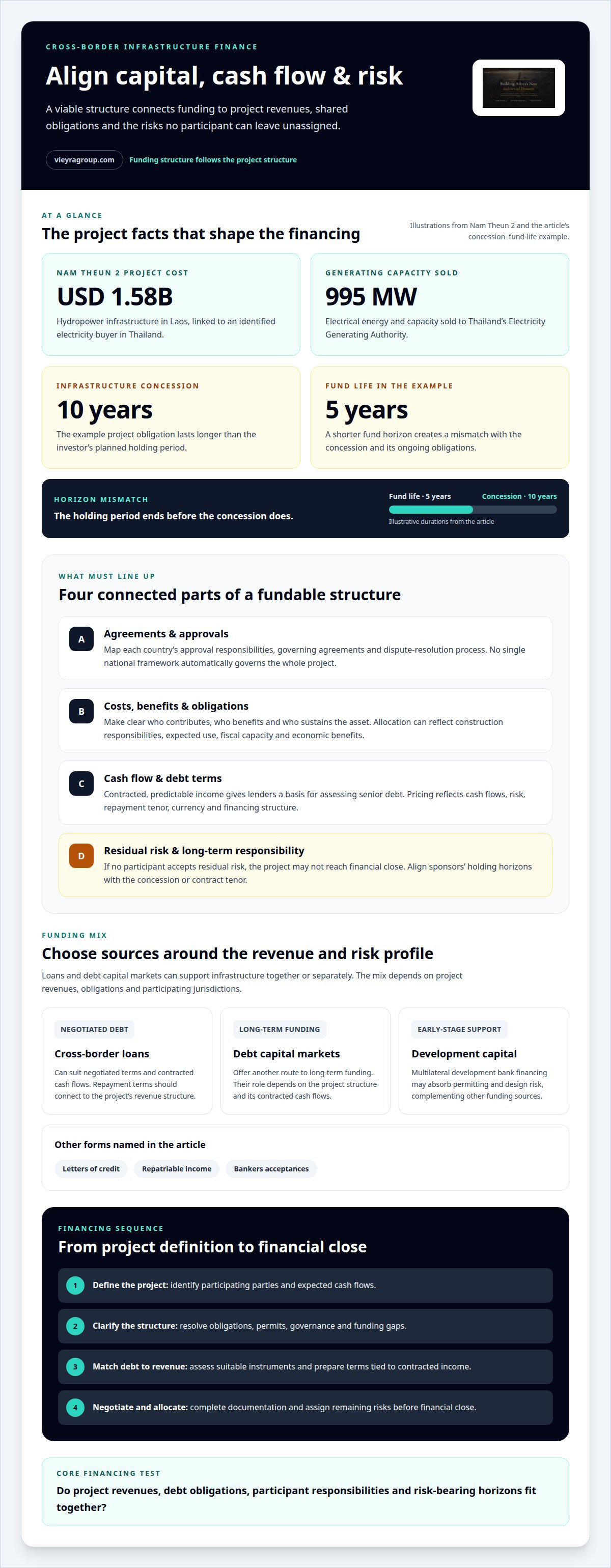
Nam Theun 2 in Laos illustrates cross-border energy financing. The hydropower project cost USD 1.58 billion and involved selling 995 MW of generating capacity and electrical energy to Thailand’s Electricity Generating Authority. Its cross-border arrangement linked infrastructure in Laos with an identified buyer in Thailand. The example shows how project revenues and national coordination are connected, though each project’s structure depends on its own agreements and risks.
Different time horizons can also create a structural barrier. A ten-year infrastructure concession paired with a five-year fund life creates a mismatch between the asset’s obligations and the investor’s planned holding period. Sponsors’ holding horizons should align with the concession or contract tenor. This alignment clarifies who remains responsible throughout the project’s operating life.
Cross-border loans and debt capital markets
Funding structures can combine negotiated lending with capital raised through debt markets. The right mix depends on project revenues, obligations, and participating jurisdictions. Financing cross-border infrastructure means aligning these elements with the project’s operating model.
Financing Costs and Interest Rates
Financing costs include borrowing interest and transaction expenses associated with arranging debt. No single rate applies to every cross-border project. Pricing reflects contracted cash flows, borrower and project risk, repayment tenor, currency, and financing structure. These factors affect debt service and the revenue available for operations. Predictable contracted income gives lenders a different basis for assessing senior debt than uncertain revenue does.
Multilateral Development Bank Financing
Multilateral development bank financing can provide development capital alongside other project funding. It may absorb permitting and design risk, addressing early-stage uncertainties that complicate financing. This role matters when approvals and technical planning determine project readiness. Such participation can complement loans and debt capital markets rather than replace them. Project agreements and risk allocation determine how each source contributes.
Steps to Secure Project Financing
Securing financing involves establishing a fundable structure, then aligning lenders with its risks and revenues. Sponsors define the project, participating parties, and expected cash flows. They clarify obligations, permits, governance, and funding gaps. Next, they assess suitable debt instruments and prepare terms that connect repayment to contracted revenue. Finally, financing parties negotiate documentation and allocate remaining risks. This sequence helps expose unresolved responsibilities before financial close.
For financing cross-border infrastructure in the United States and neighboring countries, participating jurisdictions, revenue arrangements, and risk profiles shape the funding mix. Possible forms include cross-border loans, letters of credit, repatriable income, and bankers acceptances. Debt capital markets offer another route, while senior debt is priced against contracted cash flow. A project may combine sources to suit its obligations and revenue structure.
For projects where long-term development priorities shape capital needs, Strategic Capital Solutions offers a relevant capital perspective.
Currency and political risks
Political, currency, construction, and repayment risks can disrupt project delivery and debt service. Their effects depend on government actions, currency alignment, construction performance, and reliable revenue.
Political Risks
Political risk arises when government decisions or instability affect project rights, revenues, or operations. Elections, social unrest, and coups can delay a transaction or turn a profitable investment unprofitable. Government measures may also restrict currency conversion or transfers, preventing payment collection. Contracted revenue can help manage exposure, while local participation can give the host economy a stake in continuity. Project structures should also account for changes in government administrations.
Currency Risks
Currency risk arises when project income and debt obligations are denominated in different currencies. If revenues weaken against the repayment currency, meeting debt service becomes harder. For large projects earning revenue in multiple currencies, the World Bank recommends matching financing to the dollar and local-currency shares where possible. This aligns repayment capacity with the project’s actual income stream and reduces a mismatch that could put pressure on operations.
Repayment Risks
Repayment risk is the possibility that project cash flows will not meet scheduled debt obligations. Contracted revenue provides a basis for assessing senior debt, but political interruptions or currency restrictions can still impede payments. Lenders therefore consider the reliability and currency of income, alongside the project’s ability to keep operating. Multilateral or export credit participation may absorb political and convertibility risks that private lenders will not underwrite alone.
Construction risk arises when design, permitting, or delivery problems delay completion or weaken expected revenues. In a cross-border project, approvals and coordination across jurisdictions can affect progress on connected infrastructure. Development capital can absorb permitting and design risk, supporting project preparation before long-term debt depends on operating cash flows. Repayment planning should account for the transition from construction to revenue generation rather than assume income begins as scheduled.
These exposures interact. A government decision may delay construction, postpone contracted revenue, and complicate repayment. Aligning debt currencies with revenues, addressing political changes in project structures, and assigning risks to capable participants can make the financing logic more coherent. The essential test is whether the project can sustain debt service under the conditions created by its agreements and cash flows.
How do multilateral development banks finance cross-border infrastructure?
Multilateral development banks can provide development capital for cross-border projects, including support that may absorb permitting and design risk. This addresses early project uncertainties before construction and operation. It does not remove the need to align project responsibilities, funding, and expected revenues. Instead, it can strengthen the development stage on which later financing depends.
Permitting risk arises when approvals required for a project remain unresolved. Design risk concerns whether the planned infrastructure can be developed as intended. For a rail link crossing a border, separate approvals and coordinated design affect the readiness of the connected route. Development capital can help address these risks, making early preparation central to the financing structure.
The sequence matters. First, project sponsors define the infrastructure and participating jurisdictions. They then identify permitting responsibilities and develop the design needed to advance the project. Development capital can absorb risk at this stage, before lenders assess financing against expected cash flows. Clearer preparation helps distinguish early development uncertainty from risks tied to construction or operation.
For cross-border projects, the development stage also requires coordination between participating countries. A connection is useful only when infrastructure on each side can function as part of a coherent project. For example, a border crossing may depend on compatible planning and approvals across both jurisdictions. Development capital can address permitting and design risk, while project agreements clarify responsibilities between countries.
This role differs from simply supplying debt for construction. By addressing early-stage risks, development capital can help move a project toward a structure that other financing sources can assess. The key consideration is how permitting and design uncertainties affect readiness, responsibilities, and anticipated revenues. For sponsors, this distinction clarifies where development financing fits within a broader capital plan.
For a project requiring a considered approach to long-term capital, explore strategic capital alignment.
Vieyra Family Office
Vieyra Family Office brings a long-term investment perspective to infrastructure and economic development. For readers assessing cross-border projects, the central question is how capital strategy can align with enduring growth priorities across participating markets. Its Strategic Capital Solutions and African Industrialization Capital reflect a focus on long-term projects and African industrial development.
This perspective matters when infrastructure funding decisions extend beyond the debt instrument itself to wider investment objectives and regional development. A project’s financing structure still depends on its revenues, risks, agreements, and participating parties. Strategic capital can be considered within that broader context.
For a considered discussion of your project’s capital priorities, contact Vieyra Family Office.
Shape the Next Phase of Infrastructure Investment
The next step is to treat capital structure as part of a project’s long-term strategic design. For financing cross-border infrastructure, consider how investment priorities, project obligations, and economic development objectives can remain aligned as conditions evolve across participating markets.
Vieyra Family Office brings this perspective through Global Investment Management, African Industrialization Capital, and Strategic Capital Solutions. These offerings connect investment oversight and strategic capital with a focus on African industrialisation and long-term growth projects. For sponsors considering how infrastructure fits within broader development priorities, this perspective can help frame the next stage of capital planning.
Contact Vieyra Family Office to discuss your project’s strategic capital priorities. A considered approach today can help establish a stronger foundation for enduring regional progress.
Frequently Asked Questions
What Is Cross-Border Financing?
Cross-border financing is capital arranged across national boundaries to support an activity or asset involving more than one country. For infrastructure, the structure connects financing terms with project obligations and the currencies, jurisdictions, and revenue sources involved. For example, a transport link serving two countries may need agreements that coordinate funding and repayment across both sides. The structure should reflect how the project operates, not merely where capital originates.
What are the main financing sources for cross-border infrastructure projects?
Main sources include cross-border loans, debt capital markets, and development capital from multilateral development banks. Projects may also use letters of credit, bankers acceptances, or repatriable income as part of cross-border financing arrangements. Governments and private investors can both contribute to infrastructure funding, with the mix shaped by project revenues, risk allocation, and coordination needs. These sources can complement one another, supporting different stages or obligations within a single project structure.


