
The decisive question in financing industrial parks in Africa is not simply which incentives are available, but whether demand, infrastructure and governance can sustain a viable project over time. Funding may combine public investment in enabling infrastructure, development finance, private capital and park revenues. The right balance depends on the location and industrial purpose.
Incentives can strengthen a project’s value proposition, but land access, utilities and transport connections also determine whether manufacturers can operate effectively. This article explains how these factors interact and how a project’s structure can align capital with its development and operating needs.
The discussion covers investment incentives and infrastructure, development finance for agro-industrial zones, governance and practical financing models. Together, these considerations help clarify when a project should be structured as a long-term industrial platform rather than treated as a real-estate development alone.
Key Takeaways
- Assess land demand, sector prospects and infrastructure links together; incentives alone do not establish a project’s long-term viability.
- Match development finance and private capital to the park’s purpose, development stages and revenue model, with agro-industrial zones requiring particular attention to processing needs.
- Plan for reliable utilities, transport access, operating costs and accountable governance as core parts of the financing structure.
- Use project structures that clarify public and private roles, allocate risks transparently and connect capital investment to durable industrial outcomes.
Investment incentives and enabling infrastructure
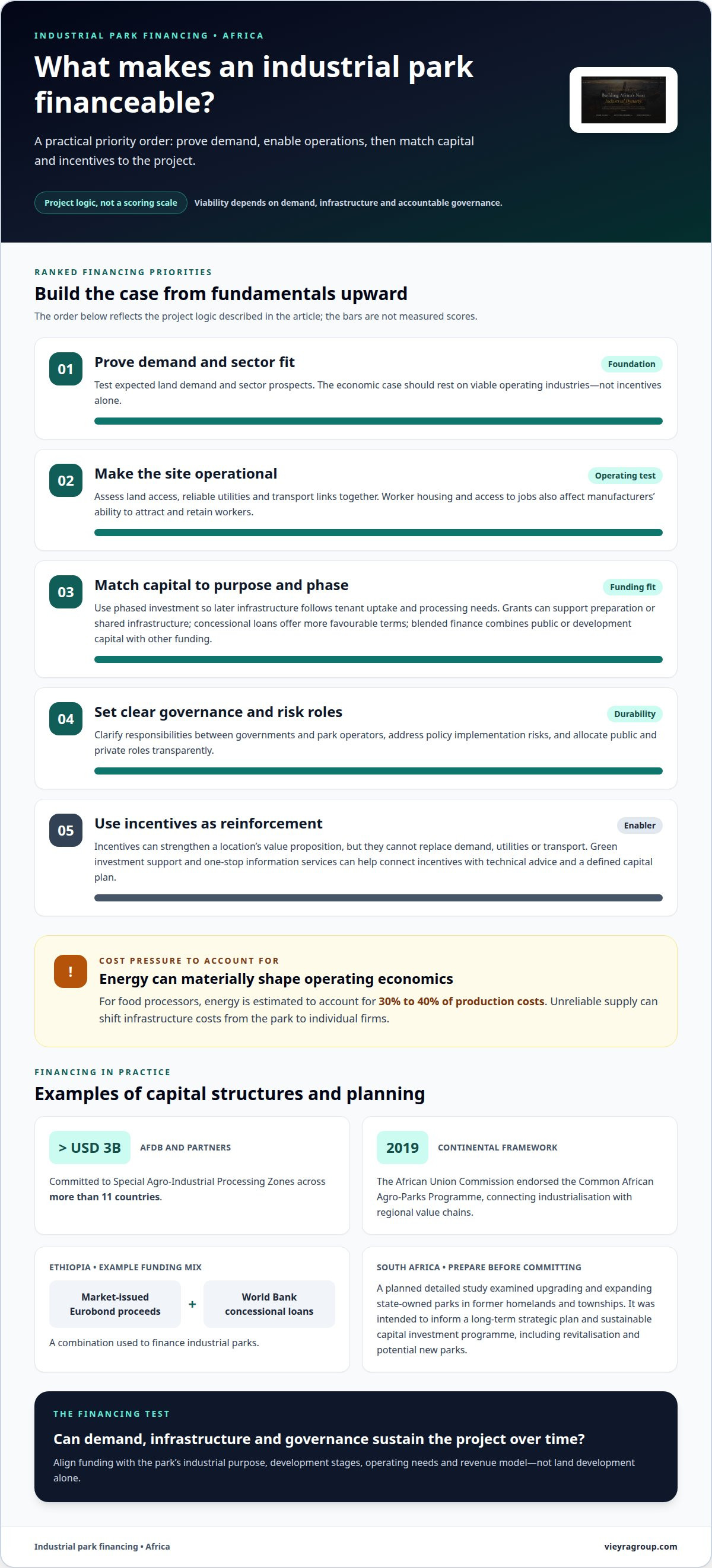
Industrial park incentives can strengthen a location’s value proposition, but they cannot replace demand, utilities or transport links. Governments assessing a proposed site should consider expected land demand, sector prospects and existing or planned infrastructure together. These factors show whether the economic case rests on operating industries or incentives alone. For financing industrial parks in Africa, this assessment helps align capital with a location’s practical advantages and constraints.
Investor costs can vary considerably by location and project design. In some African markets, manufacturing loans can carry interest rates in the high double digits. A project’s value proposition therefore depends on more than land terms: access to utilities, logistics and relevant policies also affects operating costs and investment decisions.
Pre-investment studies help governments test assumptions before committing to major works. In South Africa, a project was designed to fund a detailed study on upgrading and expanding state-owned industrial parks in former homelands and townships. The study was intended to inform a long-term strategic plan, including a sustainable capital investment programme. It also considered options for revitalising existing parks and developing new ones, linking site selection to demand and sector prospects.
That sequence matters. A study can identify infrastructure gaps, assess a park’s potential role and set investment priorities before capital is allocated. In South Africa, the planned strategy connected park revitalisation with a broader investment programme, rather than treating each upgrade as an isolated works package. This approach can strengthen the case for public investment and clarify where private participation may be appropriate.
Green investment adds another dimension. Governments can support industrial parks moving toward eco-industrial models by facilitating access to finance for green investments and to technical experts. One-stop shops can give park operators information and advice on relevant policies, regulations and programmes. Incentives are more useful when investors can connect them with infrastructure, technical support and a defined capital plan.
Development finance for agro-industrial zones
Agro-industrial zones need financing that connects processing facilities with the wider regional economy. Development finance can support infrastructure and manufacturing capacity as projects progress in phases.
Industrial Park Development Costs
Development costs cover the facilities and shared infrastructure needed to make an industrial park operational.
These examples show why budgets must distinguish factory construction from the full development programme. Land preparation, shared services and the sequence of infrastructure works all shape capital requirements. Phased development can match new facilities to demonstrated demand: initial works establish essential capacity, while later investment follows tenant uptake and processing needs. This can reduce the risk of building infrastructure ahead of viable projects.
Grants, Concessional Loans, and Blended Finance
Grants can support project preparation or shared infrastructure, concessional loans offer financing on more favourable terms, and blended finance combines public or development capital with other funding. Together, these instruments can help enable projects whose regional economic benefits extend beyond individual tenants.
The African Development Bank and its partners have committed more than USD 3 billion to Special Agro-Industrial Processing Zones across more than 11 countries. The African Union Commission endorsed the Common African Agro-Parks Programme in 2019, establishing a continental framework for agro-park development. These initiatives connect industrialisation with regional value chains, helping countries build processing capacity closer to agricultural production.
Ethiopia offers one financing example: its industrial parks were financed through proceeds from a market-issued Eurobond and concessional loans from the World Bank. This combination illustrates how market borrowing and development finance can support large-scale projects. The right structure for each zone depends on project readiness, infrastructure needs, expected demand and the public benefits the investment is intended to enable.
For projects requiring a long-term capital perspective, African Industrialization Capital is a relevant avenue to explore.
Infrastructure and governance challenges
Infrastructure weaknesses can increase operating costs, disrupt supply and undermine an industrial park’s investment case. Financial and political risks include unreliable utilities, weak implementation of policy, and unclear responsibilities among governments and park operators.
Infrastructure and Operating Costs
Infrastructure and operating costs include the shared services and recurring expenses needed to keep a park functioning. Gaps in power, transport or worker access can affect manufacturers’ output and costs.
Energy is estimated to account for 30% to 40% of production costs for food processors. These examples show how unreliable supply can shift infrastructure costs from the park to individual firms.
Worker housing also belongs in infrastructure planning. If housing and transport connections do not support access to jobs, manufacturers may struggle to attract and retain workers. Governments and developers should consider these needs alongside utilities and logistics when structuring park investment.
Financial and Political Risks
Financial and political risks are uncertainties that can affect project costs, operating continuity and governance. They matter to investors because infrastructure commitments and park policies need to be implemented, not merely announced.
African industrial parks are a median distance of 60km from the nearest port, more than three times the international average. Hawassa Industrial Park is 965 kilometres from Djibouti port, illustrating how distance can shape logistics planning. Such exposure makes transport links and dependable supply arrangements material to project viability.
Policy implementation can remain challenging even where enabling policies and legislation exist. A sound governance framework therefore requires public-private dialogue among relevant government agencies, industries, civil society organisations and communities. South Africa established a stakeholder forum that meets regularly on eco-industrial park development and implementation. Policy promotion should go hand in hand with enforcement of legislation and park requirements. Development banks and public authorities can account for these governance risks in project oversight.
Financing models and project structuring
Across African countries and regions, financing structures reflect project readiness, infrastructure responsibilities and access to capital markets. Comparing these conditions helps clarify how funding can support implementation, employment and sustainable industrial development.
Financing Options Across African Regions
Regional options include public capital, concessional development finance, market-issued debt and blended structures. The right mix depends on which infrastructure serves public purposes, which assets generate revenue and how project risks are allocated. Countries differ in financing capacity and industrial priorities, so a structure suited to one market may not fit another project’s strategic objectives or implementation conditions.
Secured Financing and Funding Structures
Secured financing links committed capital to a defined park or development project and its requirements. Ethiopia’s industrial parks used proceeds from a market-issued Eurobond alongside concessional loans from the World Bank. This example shows how market borrowing and development finance can be paired while serving distinct roles in the funding structure.
South Africa’s Enterprise Development Pilot Project provides a related example of targeted development funding: MICF provided 1,200,000 UAC in financing. The project supports skills, infrastructure and enterprise development across the country, showing how capital can be directed toward capabilities that complement industrial investment. It is not evidence that the pilot project itself financed an industrial park.
For an industrial park, project structuring should assign each funding source a defined use, such as shared infrastructure, manufacturing facilities or enterprise support. This can improve accountability and clarify which costs public investment supports and which depend on project revenues. A development bank or bank group may participate alongside market finance, with the structure reflecting implementation needs and intended regional benefits.
Employment and market access also inform a strategic financing case. Where a park serves several industries or regional supply chains, its structure can account for shared infrastructure and staged investment rather than relying on one tenant’s requirements. Discuss a strategic capital structure for an industrial development project.
Vieyra Family Office: African Industrialization Capital
Vieyra Family Office provides African Industrialization Capital to support long-term growth projects and economic development. For industrial park sponsors aligning infrastructure, manufacturing priorities and regional development, this offering provides a relevant basis for considering how financing can reflect a project’s strategic purpose.
Global Investment Management and Strategic Capital Solutions connect a broader investment perspective with the capital needs of long-horizon initiatives. The discussion centres on how a proposed park fits its economic context, development objectives and project structure, rather than treating capital as separate from implementation.
For sponsors advancing an industrial park project, contact Vieyra Family Office to discuss its strategic capital needs.
Shape the Next Industrial Investment Mandate
A durable mandate for financing industrial parks in Africa begins with a clear account of the economic purpose the project is intended to serve. The next step is to define how that purpose translates into an investable structure: which outcomes matter, how responsibilities are governed and how capital can support implementation over the long term. This framing can move sponsors beyond a site-level proposition toward an industrial platform with a coherent strategic rationale.
For project sponsors, this is also the point to consider whether a broader capital perspective can strengthen the relationship between industrial development and long-term investment priorities. Vieyra Family Office brings an African industrialisation focus to its investment activity, providing a relevant basis for considering a project’s ambitions and financing structure together.
Discuss your industrial development priorities with Vieyra Family Office, and continue shaping a project with enduring economic purpose.
Frequently Asked Questions
What financing models are used for industrial parks in Africa?
Common structures combine public investment, development finance, market borrowing and private capital. The appropriate model depends on which assets generate revenue, whether infrastructure serves multiple tenants and how construction and operating responsibilities are allocated. A project may use different funding sources for distinct components rather than rely on one instrument for the entire park. This can align financing terms with each asset’s purpose.
Which African development banks and international lenders finance industrial parks?
The African Development Bank and the World Bank are among the institutions associated with industrial and agro-industrial park financing in these examples. Their roles can differ by project: development finance may complement public resources or market borrowing, while programme support can target broader industrial infrastructure. Participation depends on a project’s purpose, structure and financing needs, not simply its location in Africa.
What are the typical capital costs of developing an industrial park in Africa?
There is no single capital cost that applies across African industrial parks. The budget depends on the site, development scale, factory specification, utility capacity and transport connections, as well as whether the project includes shared facilities. A useful estimate separates land preparation, core infrastructure, factory construction and equipment, then distinguishes initial capital works from later expansion. This makes proposed sites easier to compare.
How do public-private partnerships finance industrial parks in Africa?
A public-private partnership can divide project components between public authorities and private investors, with financing tied to each party’s responsibilities. Public participation may support shared infrastructure, while private capital can fund revenue-generating facilities or operations. The structure should define asset ownership, investment obligations, operating duties and revenue arrangements. Clear allocation helps investors understand how project risks and long-term responsibilities are distributed.
What are the requirements for obtaining project finance for an industrial park in Africa?
Project finance depends on a credible development case, a defined capital plan and a clear path to operating revenues or other repayment sources. Lenders and investors assess demand, site readiness, infrastructure dependencies, governance and the allocation of construction and operating risks. A phased plan can connect funding commitments to implementation milestones, while documented roles for sponsors and public bodies clarify accountability.
What land, infrastructure, tax, and environmental regulations affect industrial park financing in Africa?
The applicable rules vary by country and site. Financing assessments should address land rights and lease terms, infrastructure approvals and service arrangements, tax treatment and relevant environmental requirements. These matters affect project costs, timelines and the conditions for developing or operating assets. A country-specific legal and technical review helps incorporate these constraints into the financing structure.


