

A circular-economy project does not have to depend on a single funding route. Financing circular economy projects can involve regional policy funding, guidance through the Circular Economy Finance Support Platform, and access to private investment or capital markets, with the appropriate mix shaped by the project’s needs and risk profile.
Securing capital for reuse, repair, recycling, or resource-efficiency initiatives can be complex. A compelling environmental purpose alone does not explain how a project will be financed. The practical challenge is to connect its objectives and investment case with financing routes suited to its needs and stage of development.
This article explains how regional policy funding may support circular-economy investment, the role of the Circular Economy Finance Support Platform, and how businesses and project sponsors can approach broader financing routes. It also considers how strategic capital can support long-term industrial and development projects, helping you assess which pathways merit consideration.
Key Takeaways
- Assess how regional policy priorities align with your project’s circular-economy goals and investment needs.
- Understand how the Circular Economy Finance Support Platform connects project sponsors with guidance and existing financing instruments.
- Consider how private investment and capital-market routes can complement public support, with environmental, social and governance factors included in the investment case.
- Distinguish the roles of grants and loans, then assess which federal funding route best fits your project’s development stage and financing needs.
Regional policy funding for circular-economy investments
Regional policy funding can align circular-economy investments with public priorities, while private capital may address remaining financing needs. The appropriate mix depends on the project’s activities, risk profile, and development stage.
Investment Advisory and Financing
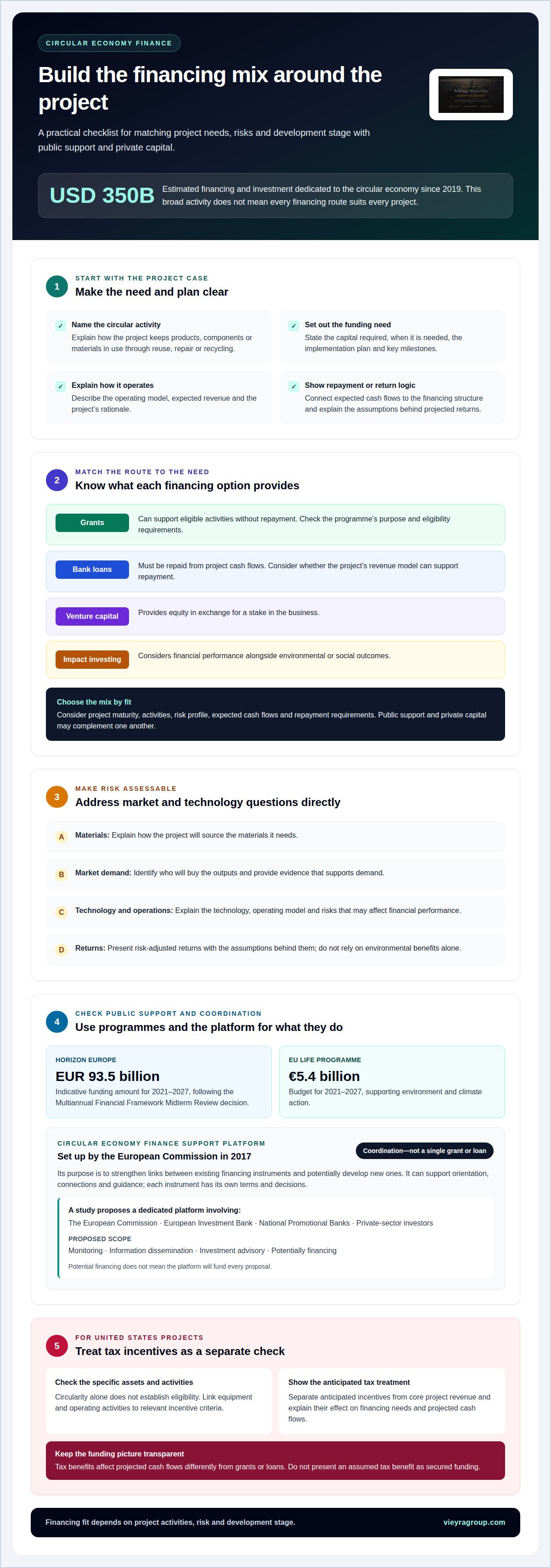
Investment advisory and financing help sponsors assess a project’s capital needs, risks, and potential funding routes. The European Commission reports an indicative Horizon Europe funding amount of EUR 93.5 billion for 2021-2027, following the Multiannual Financial Framework Midterm Review decision. The EU LIFE programme has a €5.4 billion budget for 2021-2027, supporting environment and climate action.
For each route, match the project’s activities to the programme’s purpose, then distinguish grant support from investment capital. A recycling facility, for example, needs a clear case for its technology, market demand, operating model, and expected cash flows.
Preparing a Project Financing Proposal
A financing proposal should explain the project’s rationale, capital requirement, implementation plan, and repayment or return logic. Describe how it keeps products, components, or materials in use through reuse, repair, or recycling. Then set out the operating model, funding needs, expected revenue, and milestones.
Investors may see market or technology risks in circular-economy projects. Address them directly: explain how materials will be sourced, who will buy the outputs, and what evidence supports demand. Present risk-adjusted returns with the assumptions behind them, so reviewers can assess both the expected outcome and its risks.
Tax Credits and Investment Incentives
In the United States, assess federal tax incentives against the project’s specific assets and activities. Do not assume that circularity alone establishes eligibility. Identify the investment components, their intended uses, and their anticipated tax treatment in the financing model. This distinction matters because tax benefits affect projected cash flows differently from grants or loans.
In a proposal, separate anticipated incentives from core project revenue and show how they affect financing needs. A circular materials project should link its equipment and operating activities to relevant incentive criteria. This keeps the investment case transparent and avoids presenting an assumed tax benefit as secured funding.
The Circular Economy Finance Support Platform
The European Commission set up the Circular Economy Finance Support Platform in 2017. Its purpose was to strengthen links between existing financing instruments and potentially develop new ones. The platform is therefore a coordination and development mechanism, not a single grant or loan. For project sponsors, that distinction matters: the platform can support connections and guidance, while each financing instrument has its own terms and decisions.
One study recommends a dedicated platform involving the European Commission, the European Investment Bank, National Promotional Banks, and private-sector investors. Its proposed scope includes monitoring, information dissemination, investment advisory, and potentially financing. Each function addresses a different barrier: monitoring can reveal financing patterns, information dissemination can make relevant routes easier to find, and advisory support can help sponsors explain a project’s investment case. Potential financing is separate; it does not mean the platform will fund every proposal.
For sponsors, the platform’s practical value is orientation and connection. Define the project’s circular activity, such as reuse, repair, or recycling, then identify the capital required and when it is needed. With those points clear, investment advisory can help frame the project for discussion with relevant public or private financing participants. A reuse initiative, for example, may need a different financing structure from a technology investment focused on material recovery.
Investor risk assessment remains central to access. Circular-economy proposals can carry specific market or technology risks, so sponsors should explain the underlying assumptions rather than rely only on environmental benefits. Set out how the project operates, the market it serves, and the risks that may affect its financial performance. This gives advisers and potential investors a clearer basis for evaluating risk-adjusted returns. For a broader view of long-term investment perspectives, connect the project’s financing needs with its wider strategic objectives.
Access to finance for circular economy projects
Financing circular economy projects may involve public programmes, lenders, equity investors, or impact-oriented capital. The right structure depends on the project’s maturity, risks, and expected cash flows.
Comparing Project Financing Options
Grants, bank loans, venture capital, and impact investing meet different financing needs. Grants can support eligible activities without repayment, while loans must be repaid from project cash flows. Venture capital provides equity in exchange for a stake; impact investors consider financial performance alongside environmental or social outcomes.
Since 2019, an estimated USD 350 billion in financing and investment has been dedicated to the circular economy. This broad activity does not mean each route suits every proposal. Match the instrument to the project’s revenue model, risk profile, and repayment requirements.
Funding Requirements and Eligibility Rules
Funding requirements set the conditions for assessing an application, while eligibility rules define which applicants and activities qualify. Requirements vary by programme. Before preparing a proposal, align the project scope, intended outcomes, funding request, and milestones with the specific call or financing terms.
Present market and technology risks alongside the financial case. Public equity funds focused on the circular economy held USD 6.6 billion in assets by the end of December 2023, up 22-fold from USD 0.3 billion. Clear documentation helps investors assess both impact and financial exposure. Explain how the project’s operating model supports its forecasts.
Federal Grants and Loans
Federal grants and loans are distinct public financing routes. Grants support eligible activities, while loans provide repayable capital. The programme sets eligible applicants, activities, costs, and application requirements. Separate grant-supported work from expenses financed through borrowing.
There is no single typical cost for starting or operating a circular-economy project. Requirements depend on the technology, infrastructure, materials, staffing, and operating model. A materials-reuse venture and a recycling facility, for example, need different assets and ongoing inputs. Separate capital expenditure from operating expenditure to show the amount and timing of financing required. This makes a proposal for financing circular economy projects more concrete by tying each request to a defined project need.
What federal grants and loans fund circular economy projects?
For a U.S. circular-economy project, federal funding depends on the purpose and terms of the specific program. Grants generally support eligible activities without repayment, while loans provide capital that borrowers repay. Since no federal program name or award amount is established here, the useful distinction is how each route fits a project’s financing plan, rather than assuming a circular-economy label secures funding.
Start by defining the project activity and the expenditure that needs support. A materials-reuse facility, for example, may need funding for equipment, site preparation, or operating activities. Separate these needs in the proposal, then match each to a federal programme whose published scope covers the applicant, activity, and cost. Programme requirements determine eligibility, application evidence, and award conditions.
Use this comparison when assessing a potential route:
- Grant: Examine whether the program supports the proposed work and whether the application explains measurable project outcomes.
- Loan: Assess repayment capacity against projected cash flows, operating costs, and the timing of revenue.
- Combined financing: Separate grant-supported activities from expenses funded through borrowing, and show how both fit the project schedule.
A recycling project shows why this distinction matters. A grant may suit a defined pilot or eligible public-purpose activity, while a loan may better fit a facility expected to generate operating revenue. These are financing examples, not claims about a specific federal award. The proposal should state the amount sought, intended use, milestones, and financial assumptions, then explain how market or technology risks could affect delivery and repayment.
Federal capital is one part of a wider investment structure. For projects requiring long-term industrial development capital, explore strategic capital pathways alongside public funding options.
Grants can support eligible activities, such as a defined pilot or public-purpose work. Loans can provide repayable capital for projects with operating revenue and repayment capacity. The right route depends on whether the programme covers the applicant, activities, and costs.
Vieyra Family Office
Vieyra Family Office offers a strategic perspective for sponsors considering how circular-economy initiatives fit broader investment and development priorities. Its Global Investment Management and Strategic Capital Solutions offerings are relevant when a project’s capital needs must be considered alongside long-term objectives. African Industrialization Capital is relevant to projects connected with industrial development in Africa.
For sponsors assessing how reuse, repair, recycling, or resource efficiency could contribute to a broader development strategy, these perspectives can help frame the project’s role. Vieyra Family Office also includes the Vieyra Foundation. Consider institutional engagement when the financing question reaches beyond a single funding instrument and involves broader strategic capital considerations. Institutional inquiries are Access by Invitation.
Contact Vieyra Family Office to discuss your project’s strategic capital considerations.
Shape the next stage of your project
A disciplined approach to financing circular economy projects treats the capital plan as part of the project’s architecture, not a final administrative step. The next decision is how each funding source can support a distinct phase while maintaining a coherent commercial and development rationale. This helps sponsors move from identifying possible routes to explaining a durable investment proposition.
Explain how capital will support implementation, operations, and future growth. A well-structured plan connects financing decisions with project governance, stakeholder responsibilities, and intended development outcomes. This alignment can strengthen the project’s strategic foundation as it moves from concept toward execution.
For initiatives with wider industrial or economic-development implications, strategic alignment can matter as much as the financing instrument itself. Vieyra Family Office’s investment and capital capabilities provide a relevant point of consideration when a project’s ambitions extend beyond a standalone facility or transaction. Discuss your project’s strategic direction with Vieyra Family Office, and take the next step toward a capital plan grounded in enduring purpose.
Frequently Asked Questions
What financing options are available for circular economy projects in the United States?
U.S. projects can consider federal or regional grants and loans, commercial debt, venture capital, impact investment, and bond financing. The appropriate mix depends on revenue prospects, repayment capacity, project maturity, and the funder’s objectives. Circular-economy-focused corporate and sovereign bond issuance totalled USD 93 billion cumulatively across the four years described in the market data. That demonstrates a capital-market route, not automatic eligibility for every project.
What financial risks and barriers affect circular economy projects?
Investors may find projects difficult to assess when revenue depends on new markets, reliable material flows, or technologies without established commercial performance. Developers can clarify these risks by separating construction, supply, customer-demand, and operating assumptions in the financial model. A reuse business, for example, can show how forecasts change if recovered-product volumes or sales differ from the base case, helping investors assess downside exposure alongside expected returns.
How can project developers measure financial returns and environmental impact for investors?
Present financial performance and environmental outcomes as related but distinct measures. For returns, show projected cash flows, capital requirements, operating expenditure, and the assumptions behind any internal rate of return or payback calculation. For impact, define a baseline and track project-specific outputs, such as materials reused, repaired, or recycled. Explain the measurement boundary and reporting period so investors can interpret results consistently, without treating environmental outcomes as a substitute for financial evidence.


