
With sovereign wealth fund assets under management surpassing $15.1 trillion in 2026, the global financial architecture is witnessing a profound shift toward direct, long-term capital deployment. For institutions seeking to anchor large-scale industrialization projects, particularly within the African continent, the challenge of attracting sovereign co-investors remains centered on overcoming profound information asymmetry and structural misalignments. One often recognizes that matching the multi-generational horizons of a state-owned investor with the rigid requirements of commercial finance is a task of immense complexity.
This discourse serves as a definitive guide to mastering the sophisticated frameworks and institutional benchmarks necessary to secure these prestigious partnerships. We shall examine the mandatory governance standards defined by the International Forum of Sovereign Wealth Funds and the regulatory nuances of the 2026 EU FDI Screening Regulation. By adopting the principles of the Vieyra Paradigm, organizations can establish the rigorous transparency and strategic depth required to transform perceived regional risks into stable, sovereign-scale legacies.
Key Takeaways
- Master the application of the Santiago Principles as the fundamental benchmark for establishing the institutional trust essential for attracting sovereign co-investors in high-stakes industrial sectors.
- Analyze the dual-mandate underwriting process where global funds evaluate commercial viability in tandem with systemic impacts such as energy security and supply chain resilience.
- Navigate the evolving 2026 regulatory landscape, including the implications of the EU FDI Screening Overhaul and U.S. Section 892 safe harbor classifications for co-investment syndicates.
- Utilize the Vieyra Paradigm to bridge the gap between multi-generational family stewardship and the long-duration capital requirements of sovereign-scale industrial projects.
- Determine the most effective institutional structures, from specialized joint ventures to dedicated co-investment platforms, to ensure seamless operational and governance alignment.
The Strategic Imperative of Sovereign Co-Investment in 2026
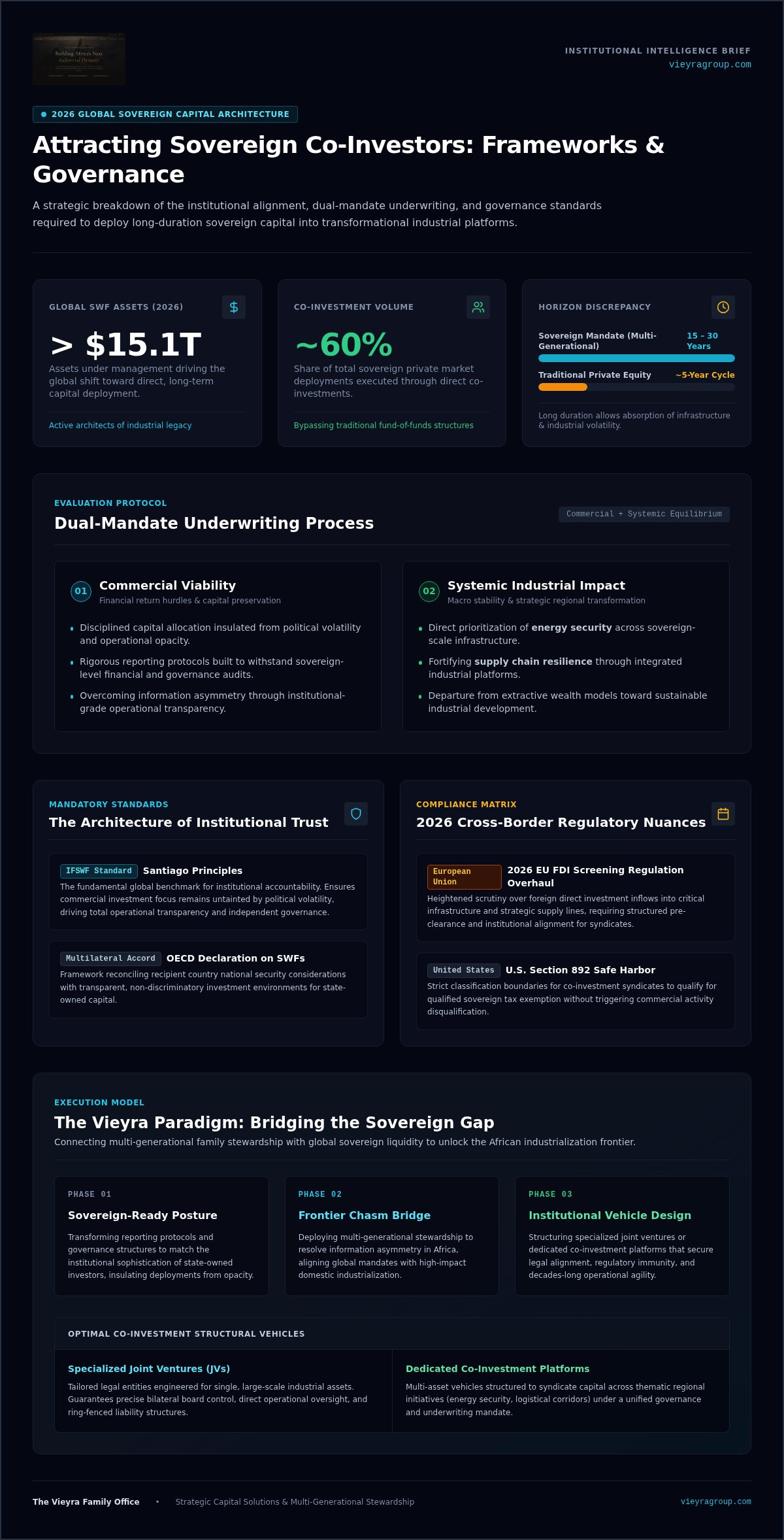
The global financial architecture of 2026 is defined by a fundamental realignment of state-owned capital. Sovereign wealth funds have transcended their historical roles as passive providers of liquidity, evolving into active architects of industrial legacy. This transition toward direct participation is evidenced by the fact that co-investments now comprise nearly 60% of total sovereign private market deployments, with aggregate assets under management crossing the $15.1 trillion threshold. For entities focused on attracting sovereign co-investors, success is no longer a matter of mere commercial attractiveness. It's a matter of institutional synchronicity. The deliberate pace of these funds reflects a commitment to stability that traditional markets often lack.
Unlike the compressed horizons of traditional private equity, which often prioritize five-year exit cycles, sovereign mandates operate on 15 to 30-year intergenerational timelines. This structural "long-termism" allows for the absorption of the volatility inherent in large-scale infrastructure and industrial platforms. By partnering with institutional peers who share this vision, sovereign funds can effectively mitigate the geopolitical and operational risks that often deter shorter-term capital. Such partnerships are essential for projects where the timeline for realization spans decades rather than quarters.
Evolving Mandates of Global Sovereign Funds
The rise of Strategic Investment Funds (SIFs) signifies a departure from traditional extractive wealth models toward sustainable industrial development. These specialized sovereign vehicles prioritize direct investment to bypass the fee structures of fund-of-funds models and to exercise greater governance over their assets. Central to this approach is a rigorous adherence to the Santiago Principles. These principles serve as the foundational benchmark for institutional accountability, ensuring that commercial investment focus remains untainted by political volatility and operational opacity.
Africa as the New Frontier for Sovereign-Scale Capital
Africa has emerged as the definitive frontier for sovereign-scale capital, yet a persistent gap remains between global liquidity and domestic industrial demand. Bridging this chasm requires local partners who possess a level of sophistication that mirrors the sovereign entities they seek to attract. The Vieyra Family Office serves as this critical bridge, offering the strategic capital solutions and multi-generational stewardship necessary to align global mandates with regional economic transformation. This alignment ensures that industrial projects aren't merely profitable but are also systemically resilient, providing a secure harbor for sovereign wealth in a transforming global economy.
The Architecture of Institutional Trust: Governance as a Prerequisite
Institutional Trust is the convergence of regulatory compliance and multi-generational reliability. For any entity engaged in the pursuit of attracting sovereign co-investors, governance is not merely a procedural requirement; it's the fundamental language of the partnership. Sovereign wealth funds operate under intense global scrutiny, necessitating partners who mirror their own commitment to institutional rigor. This alignment ensures that every deployment of capital remains insulated from the short-termism and opacity that frequently destabilize standard commercial ventures. Within this context, the OECD Declaration on Sovereign Wealth Funds and Recipient Country Policies provides a critical framework for reconciling national security considerations with the need for transparent, non-discriminatory investment environments.
Implementing the Santiago Principles for Partners
Adopting a "Sovereign-Ready" posture requires a comprehensive overhaul of traditional family office or institutional reporting structures to ensure jurisdictional compatibility. This transformation begins with the adoption of reporting protocols that can withstand the rigors of sovereign-level audits, moving beyond basic accounting toward total operational transparency. By establishing independent boards and ethical investment committees, partners demonstrate a level of institutional maturity that mitigates the risks associated with unilateral decision-making. Such structures signal a commitment to permanence that is highly valued by state-backed capital, as it mirrors the governance benchmarks required by the world's most sophisticated funds.
Risk Management and Fiduciary Excellence
Fiduciary excellence in the sovereign space relies on the total institutionalization of risk assessment protocols. One must move beyond the "key man" dependencies that characterize many private firms, replacing individual intuition with systematic, repeatable processes that ensure continuity across decades. This institutionalization ensures that the partnership remains resilient across generations, regardless of leadership transitions. Permanent capital structures are essential here, as they align the partner’s liquidity needs with the multi-generational horizons of sovereign wealth. Establishing these robust systems is a core component of the strategic capital solutions provided by the Vieyra Family Office, ensuring that every project is anchored in institutional-grade stability. This level of preparation doesn't just manage risk; it actively creates the conditions for long-term strategic success.
Synthesising Commercial Viability with Systemic Industrialisation
The successful synthesis of commercial viability with systemic industrialisation represents the pinnacle of institutional alignment. Sovereign wealth funds increasingly operate under a dual-mandate framework, where the pursuit of market-rate returns is inextricably linked to the broader objective of driving systemic change. For entities focused on attracting sovereign co-investors, this requires a fundamental shift in perspective. Projects must be structured to meet the stringent bankability requirements of conservative investment committees while simultaneously demonstrating a capacity for long-term wealth preservation through industrial development. In this context, industrialisation acts as a defensive moat, anchoring capital in physical assets that provide utility and stability across generations. One does not simply seek profit; one seeks the creation of a resilient economic ecosystem.
The Framework for Systemic Value Creation
The transition from extractive economic models to value-added industrial projects is a primary driver for sovereign-scale capital in 2026. By integrating local supply chain development, partners can effectively utilize industrial depth as a risk mitigation strategy, ensuring that projects are woven into the regional economic fabric. Utility-scale energy generation and strategic infrastructure serve as ideal sovereign-aligned assets, offering the predictable cash flows and long-duration utility that state-owned investors prioritize. This approach transforms a standalone project into a systemic pillar, providing the institutional gravity that sovereign funds demand before committing multi-generational capital.
Commercial vs. Sovereign Alignment
A fundamental tension exists between the exit-oriented velocity of traditional private equity and the legacy-driven deliberation of sovereign wealth. While commercial sponsors often prioritize a five-to-seven-year liquidity event, sovereign capital seeks stability over decades. This misalignment necessitates a partner capable of providing strategic capital solutions to bridge the period of capital intensity often referred to as the valley of death in large-scale industrial platforms. As noted in the Harvard Law School Forum on Corporate Governance analysis, the way sovereign funds engage in corporate oversight is distinct, focusing on long-term institutional governance and fiduciary alignment rather than short-term shareholder activism. Balancing the inherent illiquidity of industrial assets with the stability of permanent capital structures is essential for maintaining this alignment. Through the deployment of African industrialisation capital, the Vieyra Family Office facilitates this convergence, ensuring that commercial success and systemic progress are treated as a singular, unified objective.
Operationalising the Partnership: Structural and Regulatory Frameworks
The transition from strategic alignment to operational reality requires a meticulous calibration of legal and fiscal architectures. For those committed to attracting sovereign co-investors, the choice of an investment vehicle is a decision of profound consequence, as it dictates the long-term governance and tax efficiency of the partnership. Whether utilizing Special Purpose Vehicles (SPVs), joint ventures, or dedicated co-investment platforms, the structure must ensure that the sovereign fund's institutional status is protected. In particular, the U.S. Section 892 Final Regulations issued on December 15, 2025, require careful navigation to maintain tax-exempt status by ensuring co-investors hold passive interests without effective control. It's essential that the chosen framework reflects a commitment to permanence while allowing for the operational flexibility needed to execute complex industrial projects.
Structuring the Co-Investment Vehicle
Special Purpose Vehicles remain the preferred instrument for asset-specific deployments, offering a clean ring-fencing of liabilities and a clear path for governance rights. The challenge lies in balancing the sovereign fund's need for oversight with the operational agility required to manage large-scale industrial projects. Fee structures must be designed to eliminate the traditional friction between General Partners and Limited Partners, moving toward a model of total alignment where interests are tethered to the long-term performance of the asset. This structural transparency is a prerequisite for funds adhering to the Santiago Principles, ensuring that the partnership operates with the deliberation and foresight of a sovereign-scale entity. Such alignment doesn't just satisfy compliance; it builds the foundation for a multi-generational legacy.
Regulatory and Geopolitical Navigation
Operationalizing a cross-border partnership necessitates a sophisticated approach to regulatory compliance, particularly concerning global Anti-Money Laundering (AML) and Know Your Customer (KYC) standards. The complexity increases when managing the implications of sovereign immunity within commercial contracts, requiring precise legal drafting to ensure that dispute resolution mechanisms are both enforceable and respectful of sovereign status. The 2026 EU FDI Screening Regulation (Regulation 2026/1386) demands that co-investment syndicates build regulatory-clean structures to avoid national security review triggers. Strategic communication with local governments is equally vital, as it ensures that the project remains aligned with domestic industrial policies, thereby securing the political stability necessary for multi-generational wealth preservation. To navigate these complexities, institutions must deploy strategic capital solutions that bridge the gap between private operational excellence and sovereign-level institutional requirements.
The Vieyra Paradigm: Aligning Multi-Generational Vision with Sovereign Mandates
The Vieyra Paradigm represents a unique intersection of private agility and sovereign-scale stability. It's a framework designed to facilitate the complex process of attracting sovereign co-investors by providing a peer-level institutional environment that mirrors the gravity of state-owned actors. While traditional investment firms may struggle to reconcile their quarterly obligations with the thirty-year horizons of a state fund, the Vieyra Family Office operates with a multi-generational mandate. This synergy ensures that capital isn't just deployed; it's stewarded through the entire lifecycle of industrial development with the deliberation of a visionary architect. Such alignment is the cornerstone of institutional trust.
The Vieyra Foundation serves as an essential alignment tool for sovereign wealth funds that increasingly prioritize social development alongside financial returns. By integrating the Foundation’s initiatives into large-scale projects, the institution ensures that ESG mandates are met with the same level of professional rigor as commercial objectives. This holistic approach transforms capital deployment into a catalyst for systemic progress, addressing the dual-mandate challenges that define modern sovereign investment. It's this commitment to legacy that distinguishes the Vieyra approach within the global investment landscape, providing a secure harbor for capital that seeks to build, rather than merely extract.
A Legacy of Stewardship and Industrialisation
The Vieyra approach to African economic transformation is rooted in the belief that industrialisation is the most effective tool for long-term wealth preservation. By focusing on African industrialisation capital, the institution addresses the continent’s most pressing infrastructure needs while providing sovereign partners with stable, utility-scale assets. The family office model offers a level of institutional gravity and permanence that is often absent in the private equity sector, as it's unburdened by the pressure of fund-raising cycles or short-term investor exits. This stability is vital. Strategic capital solutions are deployed with the intent of creating regional supply chain resilience and energy security, ensuring every initiative contributes to a broader narrative of progress that sovereign wealth funds find inherently attractive.
Engagement and Next Steps
Initiating a strategic dialogue with the Vieyra group is a process defined by mutual due diligence and a shared commitment to excellence. We invite state-owned investors and institutional peers to explore how our governance benchmarks and operational frameworks can serve as a foundation for long-term partnership. The path to institutional alignment begins with a thorough understanding of shared objectives and the implementation of formal governance structures. To begin this dialogue and discover our institutional framework for strategic capital, we encourage a formal inquiry through our institutional relations department. This is the first step toward building a sovereign-scale legacy that will endure for generations.
Architecting a Sovereign-Scale Legacy
The pursuit of attracting sovereign co-investors represents a transition from transactional capital to profound institutional synthesis. We have established that success in this arena requires a commitment to the Santiago Principles and a structural capacity to balance commercial viability with systemic industrial impact. As global sovereign assets continue to expand, the requirement for partners who possess the requisite governance benchmarks and long-duration vision has never been more critical.
The Vieyra Family Office stands as a stately guardian of this vision, offering a multi-generational institutional heritage that mirrors the permanence of the sovereign wealth funds it serves. Through our sovereign-scale capital deployment expertise and a deep-rooted commitment to African industrialisation, we facilitate the creation of legacies that transcend traditional market cycles. We invite you to Engage with Vieyra Family Office on Sovereign-Scale Initiatives to begin architecting the strategic capital solutions of the future. The path toward systemic progress is paved with the deliberation of established institutions and the foresight of a shared, multi-generational trajectory.
Frequently Asked Questions
What are the Santiago Principles and why do they matter for co-investors?
The Santiago Principles consist of 24 Generally Accepted Principles and Practices that define the institutional governance and transparency standards for sovereign wealth funds. For co-investors, these principles serve as a fundamental benchmark for establishing professional rapport and operational independence. Adherence to these standards ensures that commercial objectives remain insulated from political volatility. It's a prerequisite for any entity seeking to facilitate the deployment of sovereign-scale capital within complex global jurisdictions.
How do sovereign wealth funds differ from traditional private equity in their investment approach?
Sovereign wealth funds prioritize intergenerational wealth preservation through investment horizons that typically span 15 to 30 years, contrasting sharply with the five-year exit cycles of traditional private equity. This long-termism allows sovereign actors to absorb the construction and ramp-up risks inherent in utility-scale infrastructure. While private equity focuses on rapid capital appreciation, sovereign funds often pursue a dual-mandate that integrates commercial returns with systemic industrial policy and national security objectives.
What is the role of a family office in attracting sovereign capital to Africa?
A family office operating at sovereign scale, such as the Vieyra Family Office, serves as a sophisticated bridge between global liquidity and regional industrial demand. These institutions provide the local gatekeeping expertise and multi-generational stewardship that sovereign funds require to mitigate operational risks in emerging markets. By functioning as an institutional peer, the family office aligns its own permanent capital with the long-duration mandates of state-owned investors to ensure project stability.
Can sovereign funds invest in greenfield industrial projects?
Sovereign funds frequently deploy capital into greenfield industrial projects, provided the ventures are structured with institutional-grade bankability and robust governance frameworks. These funds increasingly favor specialized platforms targeting semiconductors, data centers, and utility-scale energy to drive domestic technology transfer. Partnering with a local steward who understands the nuances of African industrialisation capital ensures that greenfield risks are managed through a lens of systemic resilience rather than speculative gain.
What level of transparency is required to partner with a sovereign fund?
Partnering with a sovereign fund necessitates a level of transparency that moves beyond standard accounting toward total institutional-grade reporting. Partners must implement governance structures that include independent boards and ethical investment committees to meet the rigors of sovereign audits. This commitment to disclosure ensures jurisdictional compatibility with global regulatory frameworks, including the 2026 EU FDI Screening Regulation. It's a fundamental requirement for building the institutional trust needed for attracting sovereign co-investors.
How does multi-generational wealth preservation align with sovereign mandates?
Multi-generational wealth preservation aligns with sovereign mandates by mirroring the deliberate, century-minded pace of state-owned capital. Both entities prioritize the stability and permanence of assets over the velocity of short-term market exits. This synchronization of investment horizons allows for the steady accumulation of value through industrial platforms that provide essential services to regional economies. It creates a unified trajectory where family legacy and sovereign development goals converge for mutual long-term success.
What are the common pitfalls when structuring co-investments with sovereign entities?
Common pitfalls in structuring these partnerships include the failure to address the implications of sovereign immunity and the complexities of cross-border regulatory compliance. Information asymmetry regarding fund mandates often leads to structural misalignments that cause friction during the governance phase. Additionally, entities often overlook the necessity of regulatory-clean syndication vehicles, which can trigger mandatory national security reviews under CFIUS or FIRRMA rules. Precise legal drafting is essential to resolve these institutional tensions.
Why is African industrialisation a priority for sovereign-scale investors in 2026?
African industrialisation has become a priority for sovereign-scale investors in 2026 because it addresses the global necessity for supply chain resilience and energy security. The continent offers a unique landscape where strategic capital can catalyze systemic economic transformation while delivering market-rate returns. For those engaged in attracting sovereign co-investors, the focus on industrial platforms provides a defensive moat against global volatility. It ensures that capital is anchored in physical assets that drive long-term regional progress.


