
To perceive the African continent merely through the lens of emerging market volatility is to overlook the most significant structural transition of the twenty-first century. We understand that the prevailing reliance on oversimplified risk assessments often obscures the true potential of the region, leaving many institutions without the clarity required for substantial commitment. The reality of African industrialization investment has, however, evolved into an indispensable pillar for the preservation of multi-generational legacy and institutional stability.
This article offers an authoritative exploration of sovereign-scale capital allocation strategies designed to bridge existing gaps and catalyze systemic economic transformation. By establishing a robust framework for industrial investment, we provide the necessary guidance to align capital with the continent's long-term trajectory. Readers will gain a comprehensive understanding of the mechanisms required to identify sovereign-scale opportunities and secure a permanent position within the architecture of Africa's industrial future.
Key Takeaways
- Understand the transition of African industrialization from a development-centric model to a sophisticated, sovereign-scale asset class focused on value-added manufacturing.
- Identify the strategic hierarchy of African industrialization investment by prioritizing infrastructure, manufacturing, and technology to secure multi-generational liquidity.
- Learn to deconstruct the perceived risk premium of the continent by adopting a lens of strategic permanence and long-term asset allocation.
- Discover the essential frameworks for implementation, including deep-sector due diligence and the structuring of multi-jurisdictional investment vehicles.
- Explore how the alignment of global capital with continental heritage serves as a catalyst for a systemic and enduring industrial renaissance.
The Paradigm Shift: Reconceptualizing African Industrialization as a Global Investment Asset
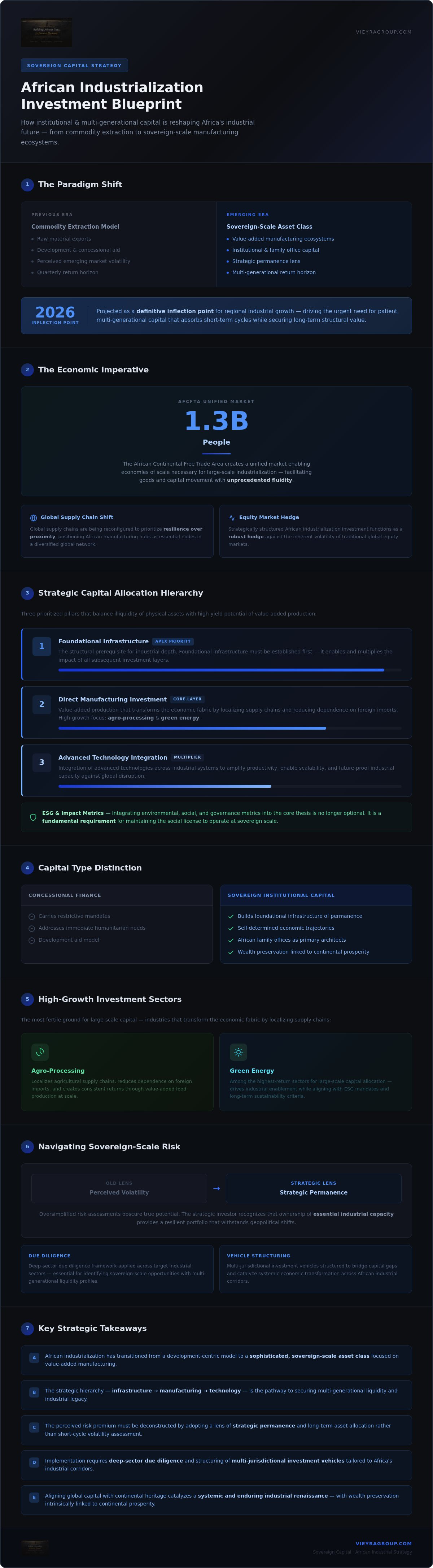
The conceptualization of Africa within the global financial architecture is undergoing a fundamental metamorphosis. For decades, the continent was viewed through the narrow aperture of commodity extraction and developmental assistance. This era is concluding. We now observe the rise of African industrialization investment as a sophisticated, sovereign-scale asset class. This shift represents a transition from a reliance on raw material exports toward the establishment of complex, value-added manufacturing ecosystems. As we approach 2026, a year projected to serve as a definitive inflection point for regional industrial growth, the requirement for "patient capital" has never been more acute. Multi-generational capital provides the requisite horizon to absorb short-term cycles while securing long-term structural value. This institutional approach prioritizes the creation of permanent industrial assets that generate consistent returns across decades rather than quarters.
The Economic Imperative for Continental Transformation
Global supply chains are currently being reconfigured to emphasize resilience over mere proximity. This reorganization positions African manufacturing hubs as essential nodes in a diversified global network. The implementation of the African Continental Free Trade Area (AfCFTA) further accelerates this process by creating a unified market of 1.3 billion people, allowing for the economies of scale necessary for large-scale industrialization in Africa. This integration facilitates the movement of goods and capital with unprecedented fluidity, reducing the fragmentation that previously deterred institutional entry. Strategically structured African industrialization investment functions as a robust hedge against the inherent volatility of traditional global equity markets.
From Development Aid to Strategic Institutional Capital
There is a critical distinction between concessional finance, which often carries restrictive mandates, and sovereign-scale institutional investment. While aid addresses immediate humanitarian needs, strategic capital builds the foundational infrastructure of permanence. African family offices have emerged as the primary architects of this industrial legacy, utilizing their deep-rooted understanding of the continent to deploy capital where it yields the highest systemic impact. This evolution signifies a move toward self-determined economic trajectories where local and global expertise converge. By aligning investment objectives with long-term regional economic stability, these institutions ensure that wealth preservation is intrinsically linked to the prosperity of the continent itself. The result is a more resilient portfolio that withstands geopolitical shifts through the ownership of essential industrial capacity.
Mechanisms of Strategic Capital Allocation in Large-Scale Industrial Projects
The deployment of capital within the African context requires a methodical approach that transcends traditional venture or private equity frameworks. At the apex of this hierarchy lies foundational infrastructure, which serves as the structural prerequisite for industrial depth. This is followed by direct manufacturing investment and the integration of advanced technologies. By prioritizing these three pillars, institutional investors can construct portfolios that balance the illiquidity of physical assets with the high-yield potential of value-added production. This strategic layering ensures that African industrialization investment acts as a stabilizer for multi-generational wealth while contributing to the systemic resilience of the regional economy. Integrating ESG and impact metrics into this core thesis is no longer an elective choice; it's a fundamental requirement for maintaining the social license to operate at a sovereign scale.
Portfolio Diversification Across Industrial Sectors
High-growth sectors such as agro-processing and green energy provide the most fertile ground for large-scale capital. These industries don't merely offer returns; they transform the economic fabric by localizing supply chains and reducing dependence on foreign imports. According to the World Bank Africa economic overview, the continent's growth trajectory is increasingly tied to its ability to leverage these industrial sectors. Incorporating technology into these ventures accelerates productivity and allows for "leapfrogging" traditional industrial stages through automation and data-driven logistics. For those seeking to navigate these complexities with institutional precision, exploring Strategic Capital Solutions provides a framework for aligning global institutional goals with continental opportunity.
The Architecture of Sovereign-Scale Partnerships
The viability of large-scale projects often hinges on the successful orchestration of sovereign-scale partnerships. This involves a delicate navigation of the intersection between private capital objectives and public policy mandates. Building deep-seated relationships with regional development banks and national governments is not a secondary task but a core component of risk mitigation. Ensuring that investment activities mirror national development goals creates a protective layer of political and social alignment. This synergy transforms a standard investment into a permanent pillar of the regional industrial architecture, fostering an environment where African industrialization investment can thrive across multiple political cycles. It's through this deliberate alignment that family office values are translated into enduring national legacies.
Navigating Sovereign-Scale Risk: From Perceived Volatility to Strategic Permanence
The prevailing discourse regarding the "African Risk Premium" often suffers from an acute lack of historical perspective, focusing disproportionately on transient political events rather than underlying structural evolution. For the institutional architect, risk isn't a barrier but a variable to be managed through meticulous asset allocation and a commitment to longevity. Unlike liquid markets where sentiment shifts with the speed of a digital transaction, the permanence of industrial assets provides a tangible anchor against the tides of geopolitical uncertainty. The reality of African industrialization investment is that it requires a shift from viewing the continent as a frontier to seeing it as a foundation. Strategic Permanence in the context of African infrastructure is the deliberate anchoring of capital in foundational physical assets that remain essential to regional economic function regardless of transient political or market fluctuations. By focusing on projects that underpin the very functioning of a nation, capital achieves a level of durability that speculative instruments can't replicate.
A Comparative Framework for Institutional Risk
The distinction between traditional private equity and sovereign-scale industrial capital is found in the intended exit strategy. While private equity often seeks a defined liquidity event within a five-to-seven-year window, sovereign-scale capital prioritizes the compounding value of the asset across generations. This extended timeframe allows for the navigation of currency fluctuations, particularly when investments are directed toward export-oriented industrialization that generates hard currency revenue. Utilizing established World Bank industrialization frameworks allows institutions to align their risk assessment models with globally recognized standards of structural development. Robust legal and regulatory protections, often negotiated at the sovereign level, provide the necessary safeguards for multi-generational planning, ensuring that the rights of capital are respected across successive administrations.
Long-Term Stewardship vs. Short-Term Volatility
Adopting a century-long horizon for industrial project evaluation fundamentally alters the psychological approach to emerging market cycles. Family offices, rooted in a heritage of stability, possess a distinct advantage over institutional funds that are beholden to quarterly performance metrics. This perspective allows for the deployment of African industrialization investment during periods of perceived volatility when others might retreat, securing essential assets at valuations that reflect temporary sentiment rather than long-term utility. Building resilience requires the integration of African-centric industrial assets within a broader, diversified global portfolio. This approach doesn't merely mitigate risk; it creates a structural synergy where the growth of continental industry serves as a primary engine for global portfolio expansion. Stewardship, in this sense, is the active management of legacy through the deliberate selection of projects that will remain relevant for the next hundred years.
Frameworks for Implementation: Structuring Industrial Growth for Long-Term Value
The transition from strategic intent to the physical realization of industrial capacity requires a disciplined framework that prioritizes structural integrity over immediate velocity. This implementation methodology is built upon a four-phased approach designed to ensure that each deployment of African industrialization investment is anchored in technical rigor and sovereign alignment. By adhering to this methodical sequence, institutional actors can navigate the complexities of large-scale project execution while securing the foundations of a multi-generational legacy.
- Phase 1: Deep-Sector Due Diligence and Sovereign Alignment. This initial stage involves an exhaustive analysis of the industrial landscape, ensuring that the project mirrors the host nation's long-term economic trajectory and industrial policy.
- Phase 2: Structuring Multi-Jurisdictional Investment Vehicles. Technical experts design the legal and financial architecture required to manage cross-border capital flows and regulatory requirements.
- Phase 3: Deploying Strategic Capital with Operational Oversight. Capital is committed alongside a robust management framework that ensures world-class standards are maintained throughout the construction and operational phases.
- Phase 4: Monitoring Systemic Impact and Multi-Generational Returns. Long-term tracking of both financial performance and the project's contribution to regional industrial depth ensures the asset remains a pillar of continental growth.
Structuring Multi-Jurisdictional Investment Vehicles
Large-scale industrial projects often necessitate the use of Special Purpose Vehicles (SPVs) to ring-fence assets and manage cross-border liabilities with institutional precision. These sophisticated structures facilitate tax optimization and wealth preservation, protecting the capital from the fragmentation that can occur in complex international finance. Governance frameworks are established to provide oversight that transcends individual leadership cycles, ensuring that the original vision for the asset remains intact across decades. It's this level of structural sophistication that transforms a standard project into a permanent component of a global portfolio, providing the stability required for African industrialization investment to flourish.
Operational Excellence and Strategic Oversight
Capital alone is insufficient to catalyze an industrial renaissance; it must be coupled with institutional expertise and a commitment to operational excellence. Leveraging global networks allows for the infusion of international best practices into local manufacturing hubs, enhancing the productivity and resilience of the entire ecosystem. The integration of philanthropic initiatives through the Vieyra Foundation further supports these industrial centers by fostering the human capital and social stability necessary for sustained operations. For institutions seeking a partner to navigate these implementation frameworks, engaging with Strategic Capital Solutions provides the requisite expertise to turn sovereign-scale vision into industrial reality.
The Vieyra Mandate: Orchestrating a Continental Industrial Renaissance
The Vieyra Family Office operates with the deliberation of a sovereign-level entity, recognizing that the current era demands more than mere capital allocation. It requires a visionary orchestration of resources where the preservation of legacy is intrinsically bound to the successful execution of African industrialization investment. By deploying strategic capital as a primary catalyst for sovereign-level transformation, the institution bridges the gap between global financial sophistication and the specific requirements of continental industrial expansion. This mandate isn't merely a business strategy; it's a multi-generational commitment to the structural progress of the African continent. We believe that true institutional success is measured by the permanence of the assets we build and the stability they provide to the global economic architecture.
A Legacy of Institutional Stewardship
Preserving wealth across generations requires a transition from liquid volatility to the stability of industrial depth. The Vieyra Family Office achieves this by identifying and nurturing assets that serve as the bedrock of regional economies. Through the Vieyra Foundation, this stewardship extends beyond financial returns to encompass the fostering of sustainable economic development and the cultivation of local technical capacity. The foundation serves as a critical instrument in this regard, focusing on the long-term sustainability of the ecosystems that surround our industrial projects. By investing in education and specialized technical training, the foundation ensures that the local workforce is prepared to lead and maintain the sophisticated manufacturing facilities of the future. Maintaining a global perspective allows the institution to bring world-class investment management standards to every continental mission, ensuring that African growth is positioned at the center of the global economic order.
The Path Forward: 2026 and Beyond
As we look toward 2026 and the decades that follow, the impact of current industrial capital allocation will become increasingly evident in the rising complexity of African manufacturing. The continent is no longer a peripheral actor but a central architect of its own industrial destiny. The synergy between global investment expertise and local industrial focus creates a uniquely resilient model for wealth preservation and systemic progress. We invite institutional partners who share this vision of long-term stability and continental renaissance to engage with the Vieyra Family Office on strategic capital initiatives. Together, we can secure a position within the most significant economic transition of our time, ensuring that African industrialization investment remains a cornerstone of institutional portfolios for generations to come. This journey requires the poise of an entity that is certain of its trajectory and dedicated to the architecture of a lasting legacy.
Securing the Foundations of a Continental Legacy
The transition toward a fully industrialized Africa represents the preeminent structural opportunity for global capital in the current century. We've explored how the reconceptualization of the continent as a sophisticated asset class requires a departure from short-term volatility in favor of strategic permanence. By aligning sovereign-scale institutional capacity with a multi-generational African heritage, investors secure a position within an economic renaissance that's both resilient and transformative. The successful execution of African industrialization investment depends upon the integration of global strategic capital allocation with deep-rooted regional expertise. This methodical approach ensures that wealth preservation is inextricably linked to the systemic progress of the continent. We invite you to explore our institutional approach to African industrialization and participate in the architecture of a multi-generational legacy. The trajectory of the continent is certain, and it's through this deliberate stewardship that a permanent legacy is forged.
Frequently Asked Questions
What defines African industrialization as a sovereign-scale investment?
Sovereign-scale investment involves capital allocation into foundational infrastructure and manufacturing ecosystems that underpin national economic stability. These projects require the scale and duration typically associated with sovereign wealth funds rather than traditional private equity. African industrialization investment at this level focuses on systemic transformation rather than isolated ventures. It ensures that capital is anchored in essential physical assets that remain productive and relevant across multiple political and economic cycles.
How does a family office mitigate geopolitical risk in African industrial projects?
Mitigation is achieved through strategic asset allocation and the cultivation of deep-rooted sovereign-level partnerships. By aligning private capital with national development goals, the institution creates a social and political license to operate that transcends transient volatility. Utilizing multi-jurisdictional investment vehicles and ring-fencing assets through sophisticated legal structures further protects the portfolio. This approach prioritizes long-term stewardship over the short-term sentiment shifts often found in public capital markets.
What is the role of the AfCFTA in industrial capital allocation?
The African Continental Free Trade Area (AfCFTA) serves as a primary catalyst for scaling industrial projects by creating a unified market of 1.3 billion people. This integration allows for economies of scale that were previously unattainable within fragmented national borders. Capital allocation strategies now prioritize regional manufacturing hubs that can distribute value-added goods across the continent without the friction of traditional trade barriers. It fundamentally reconfigures the risk-return profile of large-scale industrial ventures.
Why is multi-generational capital uniquely suited for African industrialization?
Multi-generational capital possesses the requisite patient horizon to absorb the initial complexity of large-scale industrialization. Unlike institutional funds beholden to quarterly performance, family offices can commit to a century-long vision that aligns with the structural development of the continent. This longitudinal perspective allows for the compounding of value through industrial depth. It ensures that capital remains a stabilizing force, fostering resilience and permanence within the emerging manufacturing landscape across decades.
How do sovereign partnerships influence the success of industrial investments?
Sovereign partnerships provide the structural framework for large-scale project viability by aligning private investment with public policy mandates. These institutional relationships with regional development banks and governments ensure that projects receive the necessary regulatory support and infrastructure integration. Such alignment reduces the perceived risk premium by embedding the investment within the national economic fabric. It transforms a standard capital deployment into a permanent pillar of the region's industrial architecture and national legacy.
What sectors within African industrialization offer the highest strategic depth?
Strategic depth is most prevalent in sectors that localize global supply chains, such as agro-processing, green energy, and advanced manufacturing. These industries don't merely generate financial returns; they create systemic resilience by reducing dependence on foreign imports. By focusing on sectors with high value-added potential, institutional investors can build portfolios that are essential to regional functioning. This concentration ensures that the assets remain relevant and productive for the next several generations of growth.
How does the Vieyra Family Office balance global investments with African industrial focus?
The institution utilizes a global portfolio diversification strategy that integrates high-finance expertise with a dedicated continental mission. While managing a range of global asset classes for multi-generational wealth preservation, the office prioritizes African industrialization investment as a primary engine for long-term growth. This dual approach ensures that global best practices in strategic capital allocation are applied to regional projects. The result is a resilient institutional framework that bridges international capital and African industrial potential.
What are the primary structures used for large-scale industrial finance in Africa?
Primary structures include sophisticated Special Purpose Vehicles (SPVs) designed for multi-jurisdictional oversight and tax optimization. These vehicles facilitate the movement of sovereign-scale capital while providing the legal protections necessary for wealth preservation. Additionally, governance frameworks are established to ensure multi-generational continuity, preventing the fragmentation of assets during leadership transitions. Such structures are essential for managing the complexities of cross-border industrial finance and securing the long-term integrity of the foundational investment.


