
The conventional perception of the African industrial landscape as a fragmented collection of volatile markets fails to recognize the emergence of sovereign-scale enclaves that are fundamentally redefining the parameters of global capital preservation. For the institutional architect of legacy, the challenges of geopolitical instability and the systemic infrastructure deficits found outside controlled perimeters represent significant barriers to the deployment of enduring industrial capital. It is understood that the pursuit of stability in such environments requires more than transient fiscal incentives; it demands a permanent, structured environment where regulatory consistency and physical security are guaranteed through institutional rigor.
This article provides a comprehensive analytical framework for evaluating the maturity of African special economic zone investment, positioning these territories as the foundational infrastructure for continental industrialisation. We will explore how the strategic alignment of industrial investment with the African Continental Free Trade Area (AfCFTA) creates a nexus of opportunity for the preservation of multi-generational wealth. By examining the transition from mere fiscal enclaves to sophisticated sovereign-scale architectures, this analysis offers a roadmap for aligning capital with the long-term trajectory of African progress and institutional excellence.
Key Takeaways
- Discern the transition of industrial hubs from isolated export enclaves into integrated, multi-sectoral ecosystems that underpin continental industrialisation.
- Apply a rigorous institutional framework to evaluate African special economic zone investment, focusing on the permanence of legal structures and the resilience of physical infrastructure.
- Learn to compartmentalize sovereign and operational risks through the strategic synergy of private capital and long-term public infrastructure commitments.
- Align large-scale industrial projects with the broader objectives of the African Continental Free Trade Area to ensure the preservation of multi-generational capital.
- Understand how the deployment of African Industrialization Capital through a sovereign-scale family office facilitates the creation of a permanent industrial legacy.
The Evolution of African Special Economic Zones: From Enclaves to Ecosystems
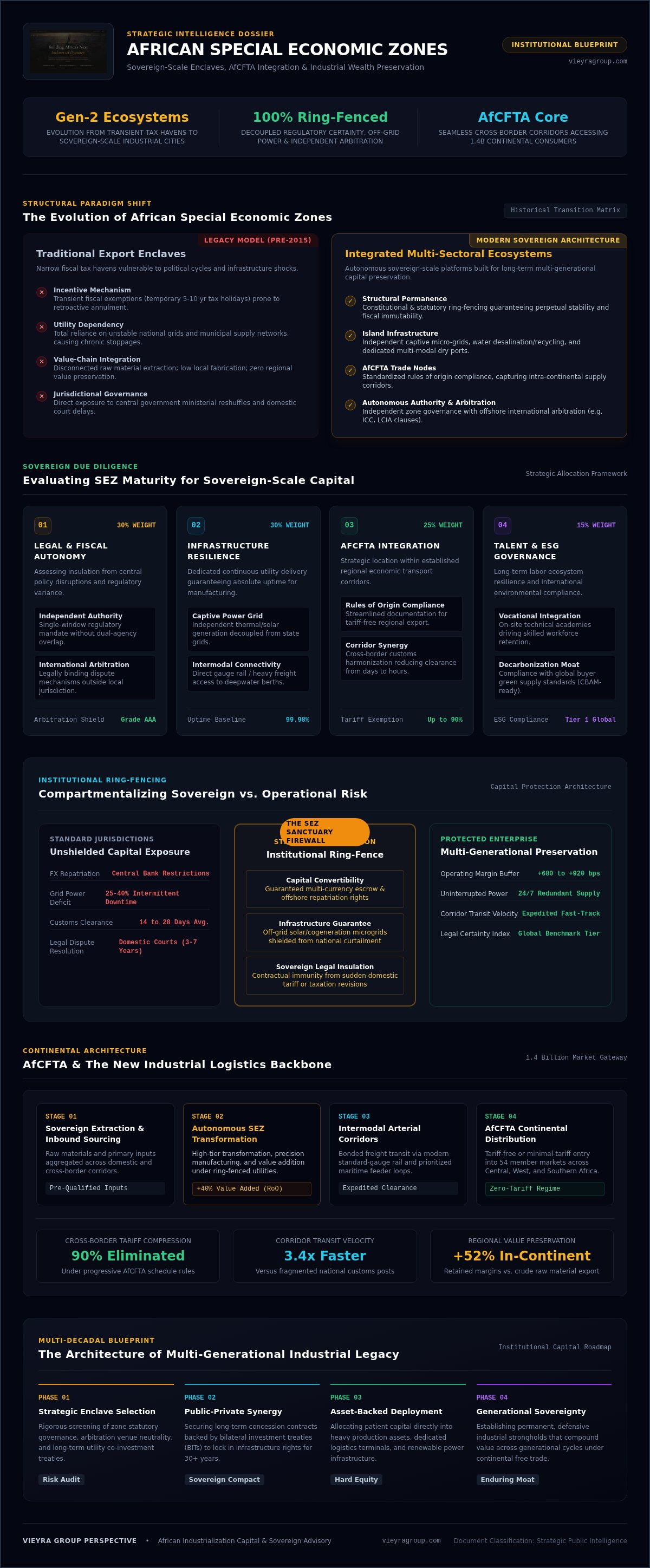
The historical trajectory of industrial development across the continent has undergone a profound metamorphosis, shifting from primitive export processing enclaves toward sophisticated, multi-sectoral ecosystems. This progression marks a departure from the transient, tax-driven incentives of the past. Modern special economic zones now function as comprehensive urban-industrial nodes where manufacturing, logistics, and residential services converge. This evolution is central to the viability of African special economic zone investment, as it provides the stability required for sovereign-scale capital to anchor itself in long-term projects. These zones effectively mitigate the regulatory inconsistencies and infrastructure deficits that frequently impede progress beyond their borders.
The Structural Necessity of Controlled Industrial Environments
Institutional capital seeks environments characterized by permanence and predictability. Within these ring-fenced jurisdictions, the provision of dedicated energy grids and integrated logistics platforms ensures that industrial margins remain shielded from external volatility. The concentration of high-tier utilities allows for a level of operational continuity that is often unattainable in the broader national context. Special Economic Zones represent the primary institutional vehicle for the systematic de-risking of large-scale African industrial initiatives. By consolidating regulatory authority, these zones create a sanctuary of legal certainty that facilitates the deployment of African Industrialization Capital.
AfCFTA and the New Continental Logistics Backbone
The implementation of the African Continental Free Trade Area has fundamentally altered the strategic utility of these industrial hubs. As we observe the 2026 landscape, the integration of simplified rules of origin within these zones has catalyzed the emergence of robust regional value chains. SEZs are no longer isolated islands; they've become the essential nodes of a continental logistics backbone. This connectivity allows for the seamless movement of intermediate goods across borders, fostering industrial sovereignty. The development of cross-border economic corridors ensures that investment isn't merely localized but contributes to a systemic, continent-wide industrial architecture. This interconnectedness is vital for the preservation of multi-generational capital in an increasingly integrated marketplace.
Evaluating SEZ Maturity for Sovereign-Scale Capital Allocation
The transition from fiscal arbitrage to structural permanence requires a rigorous framework for assessing the viability of African special economic zone investment. Sovereign-scale capital isn't attracted to transient tax holidays; it seeks the institutional maturity of the zone authority and the resilience of the underlying infrastructure. This evaluation goes beyond basic utility requirements like power and water. It demands an analysis of how specialized technical talent is integrated into the local labor market and whether the zone adheres to ESG standards that ensure sustainable industrialisation. A Brookings analysis on African manufacturing and industrialization underscores that long-term capital allocation depends on these structural drivers to unlock high-scale production. For the visionary architect of legacy, these factors are the prerequisites for multi-generational capital preservation.
Legal and Fiscal Stability Indicators
The strength of an independent zone authority serves as the primary indicator of institutional health. It's essential to determine if the authority possesses the autonomy to shield industrial operations from central government shifts. The inclusion of international arbitration clauses within investment agreements provides a necessary layer of protection, offering a mechanism for dispute resolution that exists outside local jurisdictions. In the shifting global tax environment of 2026, frameworks that guarantee multi-generational fiscal certainty are paramount. These structures ensure that the industrial footprint remains viable across decades, making the deployment of Strategic Capital Solutions a matter of institutional foresight rather than speculative risk.
Operational Synergy and Cluster Dynamics
Industrial clustering is a critical component of ecosystem stability, as it significantly reduces supply chain friction through the proximity of related enterprises. The presence of established anchor tenants often signals a zone's maturity, providing a gravitational pull for secondary manufacturers and service providers. Successful zones in the 2026 landscape share common principles: they prioritize high-tier digital connectivity, integrated logistics platforms, and a clear commitment to renewable energy sources. These elements create a dense, informative texture of operational synergy that supports complex industrial initiatives. By evaluating these cluster dynamics, institutional investors can identify zones that aren't merely physical locations but are thriving, interconnected industrial hubs capable of supporting large-scale, permanent progress.
The deployment of high-scale industrial projects within the continent necessitates a sophisticated approach to risk management that transcends traditional insurance or hedging mechanisms. African special economic zone investment serves as a primary structural instrument for compartmentalizing sovereign and operational risks. By operating within a specialized legal framework, institutional investors can isolate their industrial assets from broader national-level volatility. This separation is complemented by the synergy between private capital and public infrastructure commitments, where the permanence of the physical environment is guaranteed by mutual interest. Within these specialized offshore economic regimes, currency risk management becomes more manageable; the ability to conduct transactions in stable denominations provides a necessary buffer against local fiscal fluctuations. Long-term stewardship of these assets ensures that the industrial footprint remains a durable component of the continental economy, preserving value across generations.
Sovereign-Scale Capital Solutions for Infrastructure
The mechanics of strategic capital deployment into zone-specific utilities involve complex arrangements that align long-term incentives between the developer and the state. Public-Private Partnerships (PPP) within the SEZ framework allow for the creation of high-tier energy and logistics networks that would otherwise remain unfeasible. Institutional capital acts as the essential bridge for closing the African infrastructure gap through the targeted application of African Industrialization Capital. This approach transforms utility provision from a public burden into a sustainable, revenue-generating asset class. It ensures that the operational requirements of heavy industry are met with unwavering reliability, fostering an environment where multi-generational industrial legacy can flourish.
Navigating Geopolitical and Regulatory Shifts
Maintaining institutional gravity during periods of regional political transition requires a deliberate, multi-jurisdictional approach. The utilization of sophisticated family office structures for SEZ participation allows for the diversification of legal and fiscal exposure across multiple territories. This strategic arrangement ensures that the core industrial mission remains unaffected by localized regulatory shifts. Adherence to global institutional wealth management standards is not merely a compliance requirement; it's a foundational principle that reinforces the prestige and stability of the investment. By blending traditional values of heritage with modern Strategic Capital Solutions, visionary architects can ensure their projects remain resilient in the face of geopolitical change.
The Architecture of Multi-Generational Industrial Legacy
The pursuit of African special economic zone investment is fundamentally an exercise in the creation of systemic value that transcends the immediate fiscal cycle. While the initial phases of industrial deployment focus on risk mitigation and operational synergy, the ultimate objective remains the establishment of a permanent industrial footprint that serves as a foundation for multi-generational growth. This long-term commitment fosters a new generation of technical and managerial leaders, ensuring that the intellectual capital of the continent grows in tandem with its physical infrastructure. By anchoring wealth in tangible, productive assets, institutional actors move beyond the ephemeral nature of liquid markets toward a state of industrial sovereignty that is both resilient and self-sustaining.
Industrialisation as a Vehicle for Wealth Preservation
Physical industrial assets situated within a matured SEZ offer a superior hedge against the volatility inherent in global financial systems. These assets represent a stake in the real economy, where value is derived from production and regional transformation rather than speculative sentiment. As regional economic corridors mature, the appreciation of these industrial nodes reflects the broader growth of the continent, creating a compounding effect that benefits the long-term holder. Integrating such holdings into a diversified global family office portfolio provides a unique balance of growth and stability, shielding capital from the erosion of inflation and geopolitical instability. It's a strategic move that aligns the preservation of capital with the advancement of the African industrial narrative.
Philanthropy and Social Impact in Industrial Hubs
The Vieyra Foundation approaches social transformation with the same deliberation applied to large-scale capital deployment. Within these industrial hubs, workforce development and education are viewed as essential components of the ecosystem's long-term viability rather than secondary considerations. By investing in specialized technical training and community infrastructure, the foundation ensures that the benefits of industrialisation are deeply rooted in the local social fabric, creating a stable environment for ongoing operations. Measuring the results of institutional philanthropy in a sovereign-scale context requires a focus on systemic outcomes, such as the creation of sustainable communities and the elevation of regional living standards. This alignment of social progress with industrial growth reinforces the permanence of the legacy being built, ensuring that industrial capital serves a higher purpose. To align your vision with these transformative objectives, explore the possibilities of African Industrialization Capital through our strategic partnerships.
Partnering for African Industrial Sovereignty: The Vieyra Perspective
The realization of a permanent industrial presence requires a partner who operates with the deliberation of an established institution. Vieyra Family Office occupies this unique position, serving as a stately guardian for those seeking to participate in the continent's structural transformation. By providing access to institutional expertise in industrial finance and capital allocation, we facilitate the alignment of global resources with local opportunities. Our commitment isn't merely to the transaction but to the multi-generational stewardship of African economic growth. This approach ensures that every deployment of African Industrialization Capital contributes to a systemic architecture of sovereignty and progress.
A Legacy of Institutional Excellence
Bridging the gap between global capital markets and African industrial sectors requires a profound understanding of both global standards and local execution. The significance of a multi-generational vision cannot be overstated. It's the difference between transient profit and the creation of a lasting heritage. We integrate institutional wealth management principles with a deep-rooted commitment to the continent's progress. This synergy allows for the natural preservation of legacy while driving large-scale industrial progress within matured economic zones. It ensures that capital isn't just deployed; it's anchored in the future of the continent through rigorous strategic oversight.
Engagement and Strategic Partnerships
The process for establishing sovereign-level investment partnerships is methodical and deeply considered. It begins with a shared commitment to long-term stability and excellence. We collaborate on large-scale projects within premier SEZs, ensuring each initiative is backed by Strategic Capital Solutions that address the specific complexities of the African landscape. Through our Global Investment Management platform, we provide the rigorous oversight required for high-scale industrial participation. This ensures that African special economic zone investment remains a cornerstone of institutional portfolios for decades to come. To begin this journey of institutional progress, Engage with the Vieyra Family Office on strategic capital deployment.
The Future of Continental Industrial Sovereignty
The transition of industrial hubs from isolated enclaves into sophisticated ecosystems marks a definitive shift in the continental economic landscape. By prioritizing structural maturity and institutional rigor, visionary architects can ensure that their capital serves as a foundation for enduring progress. We've analyzed how African special economic zone investment functions as the essential architecture for de-risking large-scale projects while fostering robust regional value chains. This strategic alignment between private capital and public commitment creates a permanent industrial footprint that preserves value across generations. It's a path that demands both technical precision and a commitment to systemic transformation.
As the continent moves toward greater integration, the requirement for sovereign-scale institutional capacity and deep expertise in African industrial finance becomes paramount. We invite you to Explore our institutional approach to African industrialisation, where our multi-generational investment perspective aligns global resources with the trajectory of African industrial sovereignty. The opportunity to shape a tangible legacy through systemic industrial value is present for those who operate with the foresight and deliberation of an established institution. Together, we're building the infrastructure of a new industrial era.
Institutional Perspectives on African Special Economic Zones
What are the primary benefits of investing in an African Special Economic Zone?
Primary benefits include ring-fenced regulatory certainty, high-tier infrastructure, and fiscal incentives that shield capital from national-level volatility. These zones provide a sanctuary of legal stability where industrial margins are protected from external infrastructure deficits. By consolidating administrative authority, they streamline operational logistics and facilitate the deployment of large-scale capital. This environment is essential for the preservation of wealth across several generations within a structured and secure industrial enclave.
How do SEZs integrate with the African Continental Free Trade Area (AfCFTA)?
SEZs function as the primary logistics backbone for the AfCFTA by utilizing simplified rules of origin to catalyze intra-African trade. They provide the physical infrastructure necessary for regional value chains to thrive across national borders. As economic corridors mature, these zones allow for the seamless movement of intermediate goods, fostering industrial sovereignty. This integration ensures that African special economic zone investment is aligned with the continent's long-term trajectory toward a unified and prosperous marketplace.
What criteria should a family office use to evaluate an SEZ for long-term investment?
Evaluation should focus on the institutional maturity of the zone authority and the permanence of its legal framework. It's vital to assess the resilience of dedicated utilities and the depth of the local technical labor market. A matured zone will demonstrate a clear commitment to ESG standards and possess a diverse cluster of anchor tenants. These indicators suggest an ecosystem capable of supporting permanent industrial progress and multi-generational capital allocation rather than transient fiscal arbitrage.
How do Special Economic Zones mitigate sovereign risk for institutional investors?
SEZs mitigate sovereign risk by compartmentalizing industrial operations within specialized legal and fiscal regimes that operate independently of central government shifts. The inclusion of international arbitration clauses provides a necessary layer of protection for large-scale assets. By utilizing these ring-fenced jurisdictions, investors can isolate their projects from broader political transitions. This structural separation ensures that operational continuity and asset security are maintained even amidst regional geopolitical fluctuations, reinforcing the stability of the investment.
What is the role of infrastructure in the success of an African industrial zone?
Reliable infrastructure is the foundational requirement for the success of any industrial node. It encompasses more than basic utilities; it includes dedicated energy grids, high-tier digital connectivity, and integrated logistics platforms. These elements reduce supply chain friction and ensure that manufacturing processes remain uninterrupted. The presence of resilient infrastructure within a zone acts as a gravitational pull for anchor tenants, creating a stable environment where complex industrial initiatives can flourish over several decades.
Can SEZ investments be aligned with institutional philanthropic goals?
Industrial investments within matured zones are naturally aligned with philanthropic objectives through systemic social transformation. The Vieyra Foundation exemplifies this by focusing on workforce development and specialized technical education within industrial hubs. By creating sustainable communities and elevating regional living standards, these initiatives ensure the long-term viability of the ecosystem. This approach transforms philanthropy from a secondary consideration into a core component of the institutional strategy for building a lasting continental legacy.
What are the typical tax and regulatory incentives found in modern African SEZs?
Modern zones offer a sophisticated blend of fiscal and administrative incentives, including corporate tax holidays, duty-free imports of capital goods, and simplified customs procedures. Beyond tax relief, they provide a one-stop-shop regulatory environment that drastically reduces the time required for permits and licenses. These frameworks are designed to provide multi-generational certainty in a shifting global tax landscape. They ensure that African special economic zone investment remains competitive while attracting the sovereign-scale capital needed for high-impact projects.
How does the Vieyra Family Office support African industrialisation projects?
The Vieyra Family Office serves as a strategic partner by providing African Industrialization Capital and institutional expertise in capital allocation. We bridge the gap between global resources and local industrial opportunities through the deployment of Strategic Capital Solutions. Our role involves the multi-generational stewardship of large-scale projects within premier economic zones. By blending traditional values of heritage with a forward-looking commitment to progress, we ensure that every initiative contributes to the systemic industrial sovereignty of the continent.


