
What if the perceived volatility of the African continent is merely a failure of institutional architecture rather than an inherent quality of the market itself? For too long, global capital has retreated from the continent due to a profound misalignment between short-term market expectations and the long-wave requirements of industrial production. You likely recognize that the traditional frameworks for African industrialisation finance often prioritize immediate liquidity over the enduring stability of sovereign-scale assets. This article offers an authoritative analysis of the institutional structures and multi-generational capital strategies necessary to bridge this gap. We will explore how sovereign-scale institutions act as the architects of regional development, providing the strategic capital solutions required to mitigate systemic risk. By examining the integration of global asset management with local industrial capacity, this perspective establishes a blueprint for aligning international wealth with the permanent trajectory of African progress, ensuring that the structural transformation of the continent is supported by the weight of permanent, institutional commitment.
Key Takeaways
- Examine the paradigm shift from short-term market liquidity to the deployment of patient, strategic capital within robust national development frameworks.
- Master the institutional mechanics of African industrialisation finance to facilitate the deployment of sovereign-scale capital into productive sectors and large-scale infrastructure.
- Learn to align global investment management with local industrial production to mobilize domestic and international assets for long-term economic resilience.
- Implement a multi-generational risk-mitigation framework that leverages strategic partnerships and institutional gravity to navigate geopolitical and systemic complexities.
- Understand the principles of global stewardship as practiced by the Vieyra Family Office to ensure the permanence and stability of continental industrial progress.
The Imperative of Structural Transformation through African Industrialisation Finance
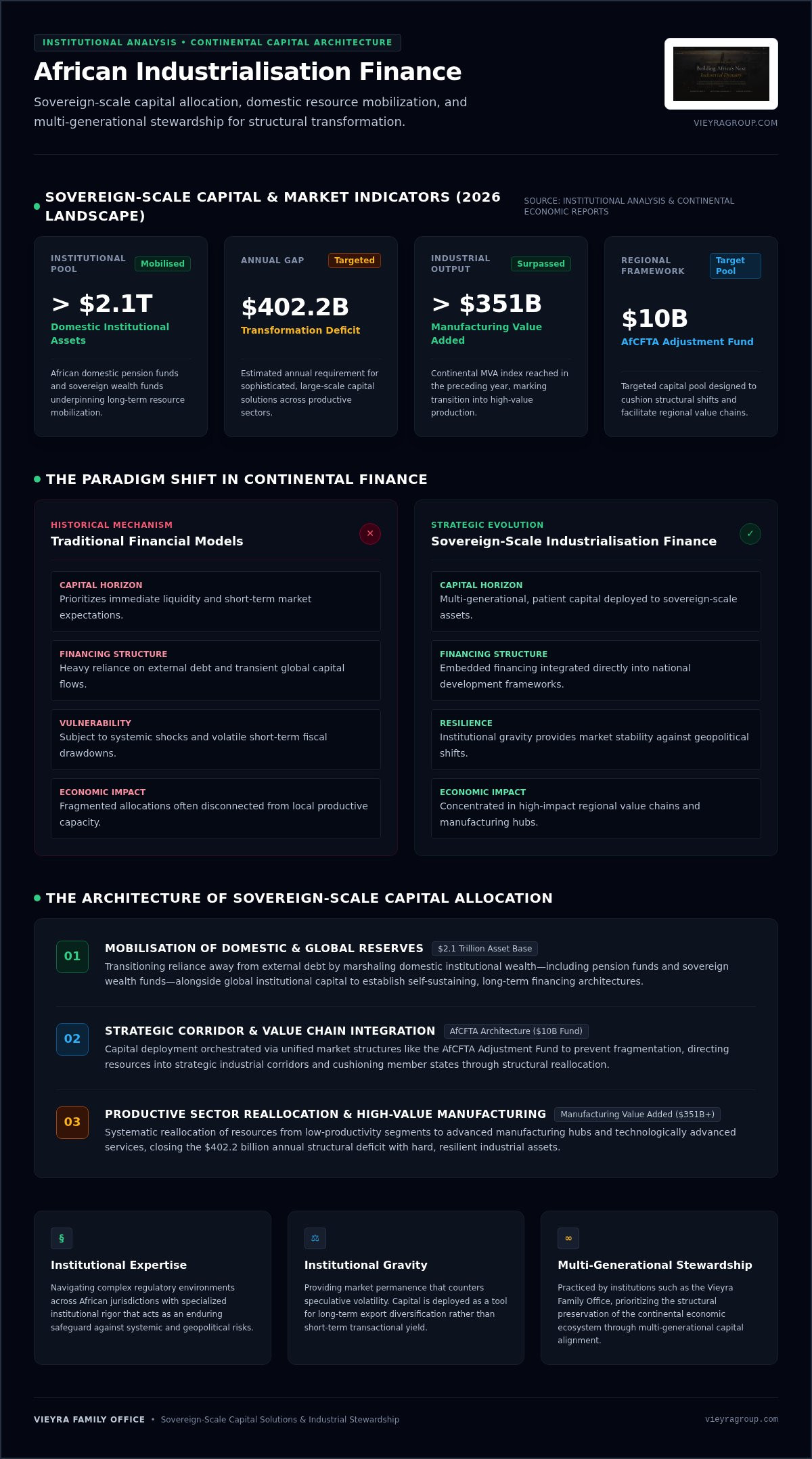
The deployment of African industrialisation finance is more than a mere fiscal exercise; it's the strategic allocation of patient capital into the productive sectors that form the bedrock of continental sovereignty. As we move through 2026, the global financial community has shifted its focus from the theoretical "billions to trillions" narrative toward a model of embedded financing that integrates directly into national development frameworks. This evolution reflects a growing realization that industrialisation remains the most credible pathway for economic resilience. The historical challenges of industrialisation in Africa have often stemmed from a lack of alignment between global liquidity and local production, but sovereign-scale institutions now bridge this gap by acting as visionary architects of long-term progress. With an annual structural transformation deficit estimated at $402.2 billion, the requirement for sophisticated, large-scale capital solutions has never been more acute.
The 2026 Landscape of Continental Finance
The current era is defined by a significant geopolitical realignment that has redirected capital flows toward emerging industrial corridors. The operationalization of the AfCFTA Adjustment Fund, which targets a total capital pool of $10 billion, provides a unified market architecture that cushions structural shifts for member states. Structural transformation in 2026 is defined as the systematic reallocation of economic resources from low-productivity sectors to high-value manufacturing and technologically advanced services, supported by a Manufacturing Value Added index that surpassed $351 billion in the preceding year. This unified market approach ensures that African industrialisation finance isn't fragmented but rather concentrated into high-impact regional value chains that benefit from collective scale.
Institutional Gravity and Market Stability
Sovereign-scale actors provide an essential stabilizing force within volatile global markets, offering a sense of permanence that traditional capital markets often lack. The transition from a reliance on external debt to the mobilization of domestic resources is well underway; African domestic institutional assets, including pension funds and sovereign wealth funds, now exceed $2.1 trillion. By utilizing strategic capital as a tool for long-term export diversification, institutions like the Vieyra Family Office ensure that industrial growth isn't subject to the whims of short-term fiscal drawdowns. This institutional gravity allows for the development of hard infrastructure and manufacturing hubs that can withstand systemic shocks. It's a methodical approach to wealth preservation that prioritizes the health of the entire economic ecosystem over immediate, transitory gains.
The Architecture of Sovereign-Scale Capital Allocation
The orchestration of sovereign-scale capital necessitates the implementation of a deliberate architectural framework that transcends the transactional nature of traditional financial markets. Within the context of African industrialisation finance, the deployment of large-scale capital into manufacturing and infrastructure requires a synthesis of global asset management principles and a profound understanding of local industrial requirements. The mechanics of capital allocation fees in these sovereign-level initiatives are meticulously designed to reflect the profound complexity of long-term stewardship and the high-level professional rigor required for multi-generational wealth preservation. Navigating the intricate regulatory environments of various African jurisdictions demands a level of institutional expertise that serves as a safeguard against systemic risk, ensuring the permanence of strategic initiatives.
According to the African Economic Outlook, the successful transformation of the continent's economic landscape is predicated upon the mobilization of domestic resources in conjunction with sophisticated international capital structures. This alignment ensures that global liquidity is not merely a transient visitor but an embedded component of the continent's industrial fabric. By prioritizing institutional gravity over market hype, sovereign-scale actors establish a foundation of stability that allows for the deliberate unfolding of large-scale industrial projects. This methodical approach to allocation ensures that capital is directed toward sectors with the highest potential for systemic impact and long-term value creation.
Strategic Capital Solutions for Industrial Projects
Structuring finance for expansive industrial projects in Africa involves the sophisticated utilization of mezzanine and equity financing to create a resilient capital base. This hybrid approach allows for the absorption of initial project volatility while securing the long-term viability of the asset. The integration of African industrialisation finance into these structures ensures that projects are insulated from the short-termism of traditional credit markets. For institutions seeking to refine their approach to these complex environments, the adoption of Strategic Capital Solutions offers a methodical pathway toward sustainable industrial transformation and the development of bankable productive infrastructure.
Allocating for Multi-Generational Impact
The methodology employed by the Vieyra Family Office diverges fundamentally from the five-to-seven-year cycles characteristic of traditional private equity. This approach prioritizes the science of preserving wealth through the lens of continental industrial growth, where the focus is on the creation of a lasting legacy rather than immediate exit strategies. Investment contracts are characterized by sophisticated syntactical arrangements and noun-heavy phrasing to codify the permanence of the commitment and safeguard the interests of future generations. This deliberate pace of communication and action reflects a commitment to quality and depth, ensuring that every allocation serves the overarching objective of multi-generational progress and institutional stability.
Mobilising Domestic and Global Assets for Industrial Resilience
The strategic orchestration of sovereign-scale capital demands a profound synthesis of global liquidity and domestic resource mobilization. Forging a resilient industrial base requires that African industrialisation finance transcends traditional silos, creating a unified architecture where global investment management is directly aligned with local production capabilities. Recent global supply chain disruptions exposed the structural vulnerabilities of over-reliance on external manufacturing, prompting a decisive shift toward the fortification of continental value chains. By leveraging public resources as a primary catalyst, sovereign-level actors can attract high-scale private institutional investment, ensuring that the capital remains anchored in productive, long-life assets. This methodical alignment provides the stability necessary to withstand systemic shocks while fostering an environment where industrial growth is both sustainable and permanent.
The evolution of African capital markets serves as the indispensable foundation for this industrial expansion. With domestic institutional assets now exceeding $2.1 trillion, the priority has shifted toward unlocking these pools of capital, which have historically remained concentrated in short-term sovereign debt. Redirecting even a fraction of these resources into bankable productive infrastructure requires a sophisticated understanding of risk and a commitment to institutional gravity. By establishing frameworks that prioritize long-term value creation, the continent can ensure that its industrial trajectory is supported by the weight of its own economic potential, supplemented by strategic international partnerships that share a vision of multi-generational progress.
The Synergy of Global and African-Centric Assets
Achieving industrial stability necessitates a prerequisite of diversified asset management, where global portfolios are utilized to de-risk continental investments. This synergy allows for the absorption of localized volatility through the strength of a broader, globalized capital base. By integrating African industrial assets into a wider strategic framework, institutions can provide the patient capital required for large-scale manufacturing without compromising the security of the overall portfolio. For those seeking to navigate these complex capital arrangements, the implementation of Diversified Asset Management in Global Markets offers a structured methodology for balancing international growth with targeted industrial deployment.
Strengthening Africa's Financial Architecture
The financial architecture of 2026 is bolstered by the emergence of the African Financing Stability Mechanism, a pivotal institution designed to provide a collective safeguard against external economic pressures. This mechanism works in tandem with coordinated capital deployment strategies to accelerate the development of regional value chains, ensuring that industrial projects aren't isolated but part of an integrated continental network. Central to this effort is the investment in sustainable energy systems, which provide the reliable power necessary to drive high-capacity industrial production. These initiatives reflect a deliberate and methodical approach to economic sovereignty, where every institutional pillar is designed to support the overarching objective of continental resilience and industrial excellence.
Navigating Institutional Risk in Large-Scale Industrial Infrastructure
Navigating the intricate layers of sovereign-scale risk requires a departure from the reactive posture typical of traditional capital markets. Instead, a multi-generational approach ensures that African industrialisation finance remains insulated from the ephemeral nature of political cycles. By fostering strategic institutional partnerships, global actors can neutralize geopolitical tensions that might otherwise destabilize long-term infrastructure projects. The Vieyra Foundation plays a critical role here, addressing social risk through targeted initiatives that ensure local communities are integrated into the industrial value chain. This alignment creates a level of fiscal coherence that is often missing across fragmented policy areas, providing a unified front for continental progress. It's a methodical process that prioritizes the stability of the entire economic ecosystem over transitory market gains.
Sovereign-Level Risk Mitigation Strategies
Institutional gravity serves as a formidable shield against the volatility of short-term political shifts. It's not enough to merely observe market trends; one must possess the intellectual sophistication to analyze risk through a lens of permanence and strategic depth. Empirical data from the 2026 sovereign debt monitoring reports suggests that nations prioritizing high-value industrial output experience a more stable credit trajectory, as diversified export bases mitigate the impact of the debt service obligations that currently consume upwards of 15% of regional revenues. For entities managing global wealth, the adoption of Strategic Capital Solutions provides the necessary architecture to navigate these institutional headwinds with composure and foresight.
The Role of Strategic Philanthropy
Strategic philanthropy acts as a catalyst for industrial development by addressing the systemic barriers that capital alone cannot resolve. By aligning foundation initiatives with large-scale economic objectives, the Vieyra Foundation ensures that the human element of industrialisation is not overlooked. This involves investing in technical education and regional health infrastructure to create a stable, productive workforce capable of supporting high-capacity manufacturing. Understanding The Role of Institutional Philanthropy in this context allows for a holistic approach to risk, where social stability and industrial output are viewed as interconnected pillars of a single, grand architecture. This synergy ensures that industrial progress is not merely a financial achievement but a permanent social legacy.
To secure the future of continental infrastructure through sophisticated risk management and multi-generational stewardship, explore our Global Investment Management services.
Multi-Generational Stewardship as a Catalyst for Continental Progress
The culmination of a sophisticated financial architecture lies not in the immediate realization of profits but in the enduring stability of the institutions it creates. Within the framework of African industrialisation finance, the Vieyra Family Office functions as a visionary architect of legacy, shifting the focus from transient transactions to the permanent structural transformation of the continent. This multi-generational vision ensures that industrial progress isn't subject to the cyclical nature of global markets but is instead anchored by the principles of global stewardship. By treating capital as a tool for long-term growth, sovereign-scale actors establish a foundation that transcends individual investment cycles. Quality outweighs speed. This methodical approach ensures that the industrialisation of Africa is a permanent fixture of the global economic landscape rather than a fleeting market trend.
The Architecture of Legacy
Building institutions that outlast their founders requires a profound commitment to the interconnectedness of wealth preservation and continental prosperity. It's a realization that the health of a private portfolio is inextricably linked to the resilience of the industrial ecosystem in which it operates. This approach demands that institutional actors embrace their role as global stewards, moving beyond the short-termism of traditional asset management. By adhering to the Santiago Principles of governance and the long-wave targets of the African Union Agenda 2063, these stately guardians insulate industrial capital from the pressures of fiscal drawdown. The process is deliberate. It requires a steady, methodical pace that mirrors the long-term nature of its objectives, ensuring that every initiative contributes to a substantial and deeply considered trajectory of progress.
The Vieyra Approach to Strategic Capital
The deployment of sovereign-scale capital into the continent's productive sectors is characterized by a composed and authoritative stance that suggests multi-generational stability. This methodology involves the meticulous alignment of global investment management with the specific requirements of African industrial growth, ensuring that every allocation contributes to a broader, systemic impact. By focusing on long-term growth projects and the development of bankable productive infrastructure, the Vieyra model mitigates the risks associated with the continental infrastructure financing gap. This commitment to permanent progress positions institutional capital as the primary driver of what is increasingly recognized as the African century. It's a legacy defined by foresight and professional rigor.
To explore how these multi-generational strategies can be applied to your institutional objectives, Engage with the Vieyra Family Office on Strategic Capital Solutions.
Architecting the Permanent Continental Transformation
The structural evolution of the continent is no longer a matter of speculative interest but a realization of institutional foresight. Successful African industrialisation finance requires a departure from the transience of traditional capital markets in favor of the stability offered by sovereign-scale frameworks. By aligning global strategic capital deployment with a multi-generational African heritage, we've outlined a blueprint for enduring industrial resilience. This perspective prioritizes the mitigation of systemic risk through the deliberate mobilization of both domestic and international assets. It's a commitment to building hard infrastructure and productive sectors that will serve as the backbone of the African century. As we move forward, the role of institutional stewards becomes paramount in ensuring that this progress is both permanent and profound. We invite you to Explore our Institutional Frameworks for African Industrialisation and witness how sovereign-scale investment management can catalyze a legacy of continental prosperity. The trajectory of growth is certain for those who build with the deliberation of generations.
Frequently Asked Questions
What is the primary challenge in African industrialisation finance in 2026?
The primary challenge remains the annual structural transformation deficit, which is estimated at $402.2 billion. This is compounded by a continental infrastructure funding gap of up to $108 billion per year. While domestic institutional assets exceed $2.1 trillion, between 60% and 80% of these resources are currently locked in short-term government debt. Overcoming this requires a shift toward cross-border industrial corridors that can attract patient, sovereign-scale capital.
How do sovereign-scale institutions mitigate risk in African industrial projects?
Sovereign-scale institutions utilize sophisticated balance-sheet mechanisms, including synthetic credit risk mitigation and the deployment of first-loss tranches. By leveraging credit insurance and private non-payment insurance from A-rated underwriters, these entities protect capital from localized volatility. This institutional gravity ensures that large-scale projects remain insulated from short-term political cycles. It provides a foundation of stability that traditional capital markets often fail to deliver in high-growth environments.
What role does the AfCFTA play in financing regional industrial value chains?
The AfCFTA provides a robust institutional backbone through its Adjustment Fund, which targets a total capital pool of $10 billion. This fund is structured into three tranches, including a Credit Fund specifically designed to provide commercial capital for private-sector manufacturing and transport retooling. By cushioning structural shifts, it allows African industrialisation finance to flow effectively into cross-border logistics and renewable industrial power, creating a unified market for large-scale investment.
How can multi-generational family offices contribute to African structural transformation?
Multi-generational family offices act as visionary architects of legacy by deploying patient capital into bankable productive infrastructure. Their investment horizon extends far beyond traditional market cycles, allowing for the development of assets that require decades of deliberate stewardship. By aligning philanthropic initiatives through foundations with strategic industrial growth, they address systemic social barriers. This ensures that continental progress is not merely a financial achievement but a permanent social and economic legacy.
What is the difference between traditional private equity and sovereign-scale industrial finance?
Traditional private equity typically operates on restricted five-to-seven-year cycles focused on immediate liquidity and exit strategies. In contrast, sovereign-scale industrial finance prioritizes multi-generational wealth preservation and the long-term health of the economic ecosystem. This approach utilizes sophisticated syntactical arrangements in contracts to ensure the permanence of capital. It focuses on large-scale infrastructure and manufacturing hubs that require a methodical, decade-long commitment to achieve full operational maturity and systemic impact.
Why is domestic resource mobilization critical for African industrial growth?
Domestic resource mobilization is vital because African institutional assets, including pension funds and sovereign wealth funds, now total more than $2.1 trillion. Utilizing these internal resources reduces exposure to foreign exchange volatility and the liquidity crunches associated with external dollar-denominated debt. By leveraging local currency clearing platforms like the Pan-African Payment and Settlement System, the continent can eliminate dollar intermediation in trade. This fosters a more resilient and self-sustaining industrial base.
How does the Vieyra Family Office align global investments with African industrialisation?
The Vieyra Family Office aligns its global portfolio with African industrialisation finance by utilizing international asset management to de-risk continental projects. This methodology ensures that global liquidity is embedded into the continent's industrial fabric through strategic capital solutions. Operating at a sovereign scale, the institution provides the gravity necessary to bridge the gap between global wealth and local productive sectors. It ensures that every allocation contributes to multi-generational stability and progress.
What are the key priorities for strengthening Africa's financial architecture?
Key priorities include the expansion of the African Sovereign Investors Forum and the operational launch of the African Financing Stability Mechanism. Focus is directed toward integrating local currency card payment rails and eliminating dollar intermediation in raw material trade. These initiatives, combined with asset-recycling mechanisms and hybrid bond issuances, create a robust framework. This architecture supports the permanent structural transformation of the continental landscape, ensuring long-term stability for all institutional actors involved.


