
The traditional paradigm of African economic development has long prioritized the extraction of subterranean wealth; however, the true engine of multi-generational stability resides not in the earth, but in the sophisticated cultivation of the continent's citizenry. Within this strategic context, human capital investment Africa emerges as the foundational infrastructure required to transition from volatile, commodity-dependent economies toward resilient, industrialized nations. Institutional investors frequently encounter the limitations of extractive-heavy portfolios, where the absence of skilled technical leadership and a misalignment between philanthropic initiatives and economic objectives creates a persistent barrier to large-scale industrial progress.
This article provides an authoritative exploration of human capital as a sovereign-scale imperative, establishing a framework for integrating intellectual development into the core of industrial strategy. Readers will gain a comprehensive understanding of the nexus between the Vieyra Foundation and systemic growth, illustrating how strategic capital deployment ensures the preservation of wealth through the lens of long-term economic stability. By reframing the development of the workforce as a permanent industrial asset, we illuminate the path toward enduring prosperity and institutional legacy across the African continent.
Key Takeaways
- Understand the fundamental transition from commodity-led growth to a knowledge-based industrial framework that prioritizes intellectual assets over subterranean extraction.
- Examine how human capital investment Africa serves as the essential infrastructure required to support large-scale industrial projects and sophisticated technical leadership.
- Learn to distinguish traditional philanthropic expenditure from strategic institutional alignment by utilizing the Vieyra Foundation model to drive systemic economic progress.
- Identify high-impact sectors, such as energy and manufacturing, where the integration of workforce development and strategic capital secures multi-generational prosperity.
- Establish a strategic framework for long-term wealth preservation by positioning human potential as the definitive hedge against global economic volatility.
Beyond Extraction: The Evolution of Human Capital Investment in Africa
The historical reliance on extractive industries has often overshadowed the most potent driver of sovereign stability: the collective intellectual capacity of the populace. As global markets transition toward high-value manufacturing and digital ecosystems, the traditional model of commodity-led growth faces diminishing returns. The evolution of human capital investment Africa marks a decisive shift toward knowledge-based industrialisation, where the primary objective is the cultivation of a sophisticated, technically proficient workforce capable of managing complex industrial systems.
Institutional capital plays a vital role in this transition. It acts as the bridge between existing educational outputs and the specific technical requirements of large-scale infrastructure projects. By viewing the citizenry as a strategic asset rather than a social liability, sovereign entities can foster an environment where industrial growth is self-sustaining and resilient to external price shocks. This shift requires a departure from traditional models and a move toward the precise integration of talent into the industrial value chain.
Defining Human Capital as Strategic Infrastructure
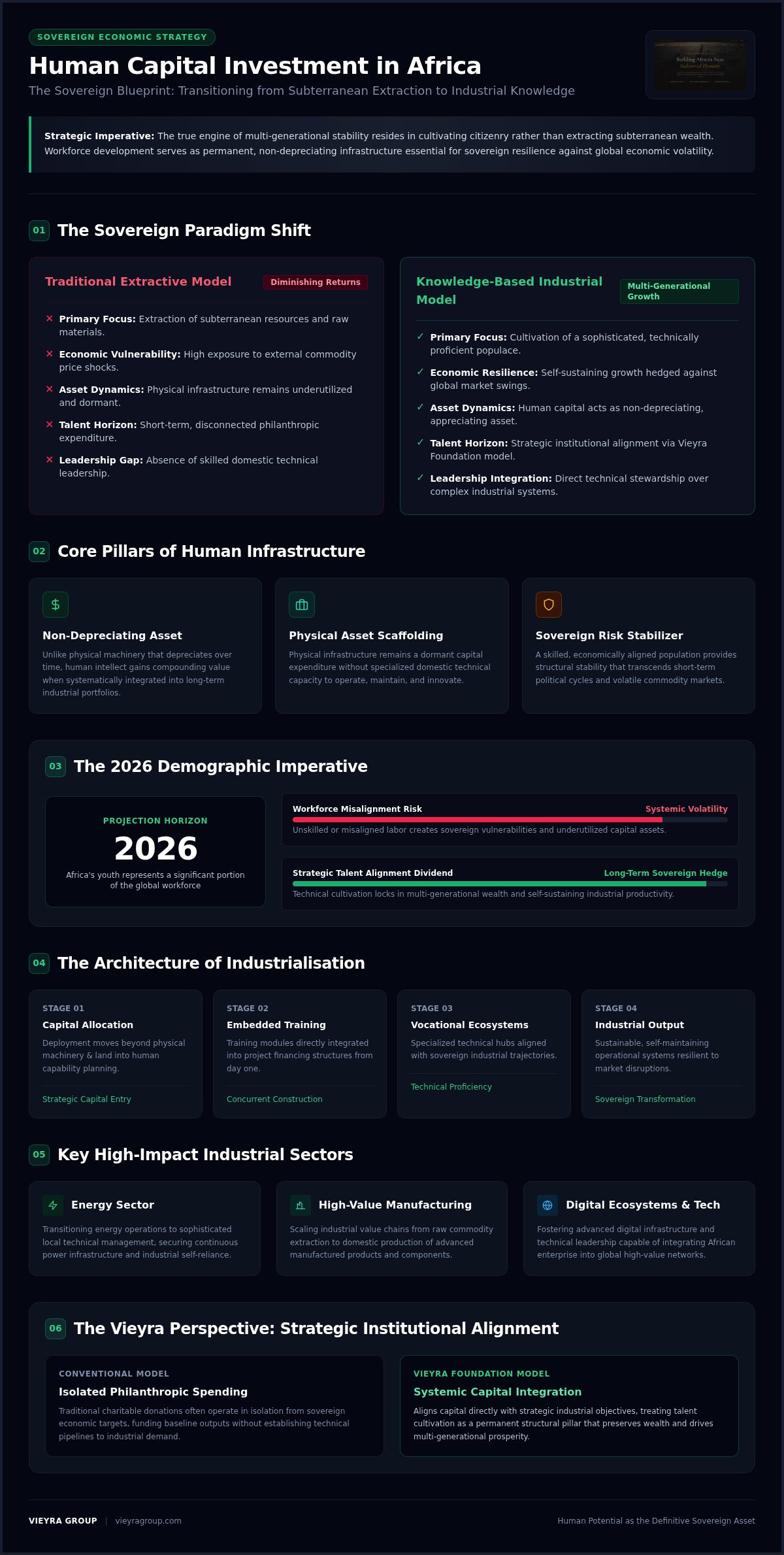
Human capital investment is the strategic allocation of resources to enhance cognitive and technical productivity. In a professional investment context, this represents a non-depreciating asset that gains value as it is integrated into industrial portfolios. While primary education provides a foundational baseline, sovereign-scale transformation requires a focus on industrial-scale technical training and specialized vocational ecosystems. This human capital investment ensures that the workforce possesses the specialized skills necessary to lead energy, manufacturing, and technology sectors. It's the essential scaffolding upon which all physical infrastructure depends; without it, physical assets remain underutilized and difficult to maintain.
The Demographic Shift and Sovereign Risk
Projections for 2026 indicate that Africa's youth population will represent a significant portion of the global workforce, creating a unique demographic dividend for discerning investors. This shift necessitates a move away from short-term philanthropic spending toward multi-generational talent cultivation. When the workforce is misaligned with economic needs, it creates systemic volatility; conversely, a skilled population serves as a stabilizer against long-term sovereign and political risk. The Vieyra Family Office recognizes that securing multi-generational prosperity requires the foresight to treat talent development as a permanent pillar of economic architecture. It's a commitment to stability that transcends political cycles and quarterly reports, ensuring that the continent's most valuable resource is prepared for the challenges of the next century.
The Architecture of Industrialisation: Integrating Workforce Development with Strategic Capital
The realization of large-scale industrial objectives requires a profound synergy between physical assets and the technical proficiency of the individuals who manage them. Physical infrastructure, regardless of its sophistication, remains a dormant expenditure unless it's paired with a workforce capable of navigating complex industrial operations. Within this context, human capital investment Africa acts as the vital connective tissue that transforms raw capital into sustainable industrial output. Strategic capital deployment must therefore move beyond the mere acquisition of machinery and land, focusing instead on the creation of specialized vocational ecosystems that align with long-term industrial trajectories.
Integrating "embedded training" modules directly into the financing structures of large-scale projects ensures that the necessary skill sets are developed in tandem with the project's construction. This approach mitigates the operational risks associated with a shortage of skilled technical leadership. By adopting sovereign-scale human capital development frameworks, institutional investors can standardize competency requirements across regional borders, fostering a more cohesive industrial landscape. It's a method that treats talent development as a capital expenditure rather than a recurring cost, securing the operational integrity of the investment from its inception.
Financing Technical Ecosystems for Industrial Growth
The transition toward advanced manufacturing and energy sectors demands a departure from generalist educational models in favor of industry-specific competency frameworks. Private-sector led research and development hubs represent a critical investment opportunity, serving as the crucible for regional innovation. The Vieyra Family Office views the synergy between capital and capability as the primary driver of industrial resilience. It's through these specialized ecosystems that strategic capital solutions can catalyze profound economic shifts, ensuring that local industries remain competitive on a global scale. This alignment ensures that every unit of capital deployed contributes to a self-sustaining cycle of technical advancement and economic expansion.
Mitigating the Brain Drain Through Institutional Stewardship
Global competition for high-tier technical talent often leads to the depletion of local intellectual reserves, a phenomenon that threatens the stability of industrial projects. Sovereign-scale institutions play a pivotal role in reversing this trend by creating high-value roles that offer the same prestige and complexity found in international markets. Retaining local talent isn't merely a social objective; it's a strategic necessity for maintaining industrial leadership. By establishing regional innovation hubs, capital acts as a magnet, repatriating the global African diaspora and concentrating intellectual wealth within the continent. This institutional stewardship ensures that the intellectual dividends of development remain localized, fueling a self-sustaining cycle of industrial progress and multi-generational prosperity.
Evaluating the Nexus Between Institutional Philanthropy and Sovereign Investment
The distinction between traditional charitable relief and strategic institutional philanthropy is a fundamental requirement for understanding the path to African industrialisation. While transactional aid addresses immediate vulnerabilities, it often fails to build the permanent structures necessary for economic autonomy. Strategic philanthropy, conversely, operates as patient capital for long-lead industrial skills, focusing on the systemic transformation of the labor market. Within this framework, human capital investment Africa represents a deliberate alignment of philanthropic resources with the long-term requirements of sovereign-scale industrial projects.
This approach views social impact not as an isolated moral obligation but as a prerequisite for economic stability. By prioritizing the development of high-tier technical talent, institutional actors can secure a more predictable environment for capital deployment. Data from the World Bank Human Capital Project suggests that countries prioritizing these intellectual foundations achieve more resilient growth trajectories. It's about moving from a model of dependency to one of institutional partnership, where the foundation's activities directly support the industrial objectives of the family office.
Institutional Philanthropy vs. Traditional Aid
Endowment-led models offer a level of permanence and foresight that grant-based aid cannot replicate. Traditional aid is frequently characterized by short-term cycles and transactional outcomes, whereas institutional philanthropy focuses on the architecture of the entire economic system. The Vieyra Foundation functions as a strategic catalyst for industrial readiness, ensuring that the intellectual infrastructure of a region is prepared to absorb and utilize large-scale capital deployment. This focus on systemic transformation ensures that the benefits of investment are not transient but are instead woven into the fabric of the nation's economic identity.
The Strategic Role of the Vieyra Foundation
The Vieyra Foundation's initiatives are designed to de-risk future industrial investments by cultivating the specialized technical leadership required for complex projects. When a workforce is prepared through targeted philanthropic programs, the operational risks associated with staffing and technical proficiency are significantly reduced. This alignment is central to multi-generational wealth preservation, as it fosters a stable economic environment where industrial assets can thrive across several decades. By leveraging global networks, the foundation amplifies the impact of local talent, connecting regional innovation with international expertise. It's a visionary approach that treats social development as a foundational component of a sovereign-scale investment strategy, ensuring that the legacy of progress is both profound and permanent.
Strategic Frameworks for Deploying Large-Scale Capital into African Talent
The deployment of large-scale capital into the African workforce requires a rigorous, sector-specific methodology that prioritizes industries with the highest multiplier effects for industrial growth. Energy, manufacturing, and technology represent the primary pillars of this strategy, as these sectors demand the highest levels of technical proficiency and offer the most significant returns on human capital investment Africa. Establishing multi-stakeholder partnerships that include private sovereign-scale actors and family offices provides a more stable foundation than traditional public-private arrangements alone. This institutional collaboration ensures that capital is not merely distributed but is strategically concentrated to overcome regional bottlenecks. Digital transformation serves as the essential catalyst for scaling these initiatives, allowing for the rapid dissemination of high-tier technical knowledge across disparate geographic regions. It's the mechanism that democratizes access to elite vocational training, ensuring that the industrial centers of the future are supported by a vast, interconnected network of talent.
Sector-Specific Human Capital Allocation
Sovereign portfolios must prioritize STEM and industrial management to ensure that the leadership required for complex infrastructure is developed domestically. Agri-industrialisation talent is equally vital, as it secures food security while expanding export capabilities through sophisticated processing and supply chain management. By allocating capital to "train-the-trainer" models, institutions can achieve exponential scaling, creating a self-perpetuating cycle of expertise that extends far beyond initial investment cohorts. This focused approach ensures that intellectual capital is concentrated where it can most effectively drive the transition toward a diversified, knowledge-based economy. It's a deliberate orchestration of talent that mirrors the complexity of the industrial systems it's designed to manage.
Measuring Impact and Institutional Returns
Rigorous impact measurement is the hallmark of a sophisticated investment framework, moving beyond qualitative anecdotes toward quantifiable KPIs such as labor productivity, talent retention, and innovation rates. There is a direct correlation between consistent human capital investment Africa and the reduction of portfolio volatility, as a skilled workforce provides the operational resilience needed to navigate global economic shifts. Reporting on sovereign-scale social and economic impact allows institutions to demonstrate the long-term efficacy of their strategies. To explore how these frameworks are applied to large-scale projects, institutions may engage with African Industrialization Capital to align their objectives with the continent's industrial trajectory. This disciplined approach to measurement ensures that every unit of capital contributes to the overarching goal of multi-generational prosperity and systemic stability.
The Vieyra Perspective: Securing Multi-Generational Prosperity Through Human Potential
The transition toward a fully industrialized African continent requires a commitment that transcends traditional investment cycles. Within this sovereign-scale vision, human capital investment Africa serves as the definitive hedge against global economic shifts and the inherent volatility of commodity markets. While physical infrastructure and technology are subject to depreciation and obsolescence, the collective intellectual capacity of a nation is a self-reinforcing asset. It's the only resource capable of adapting to the unforeseen challenges of the next century, providing a foundation for institutional permanence that endures beyond the lifespan of any single project or political administration.
Strategic capital allocation today determines the sovereign landscape of 2050. By prioritizing the cultivation of specialized technical leadership and industrial management, the Vieyra Family Office ensures that the continent is not merely a participant in the global economy but a leading architect of its own future. This approach recognizes that the preservation of multi-generational wealth is inextricably linked to the systemic stability of the broader economic environment. When capital is deployed with the foresight of a stately guardian, it fosters a resilient ecosystem where industrial progress and social prosperity are mutually inclusive and perpetually sustained.
A Legacy of Industrial Stewardship
The multi-generational vision required for systemic human capital growth demands a departure from short-termism in favor of long-term industrial stewardship. Integrating African industrialisation into global asset management strategies allows for a more sophisticated approach to risk and return, where the development of talent is viewed as a prerequisite for asset performance. The Vieyra Family Office operates as a guardian of African economic potential, ensuring that the intellectual dividends of development are reinvested into the continent's industrial architecture. This commitment to legacy ensures that the foundations laid today will support the weight of industrial expansion for decades to come, creating a permanent footprint of progress across the region.
Engaging with Sovereign-Scale Capital
The path forward for strategic capital deployment in African talent involves a collaborative effort among institutional partners who share a commitment to long-term stability. Aligning with the Vieyra investment philosophy provides a framework for integrating intellectual development into the core of industrial strategy, moving beyond transactional aid toward deep-rooted economic transformation. This partnership model ensures that large-scale capital is directed toward the high-impact sectors most capable of driving systemic change. To understand how these principles are applied to secure enduring value, institutions are invited to explore the Vieyra Family Office approach to strategic capital. By joining this visionary trajectory, global actors can contribute to a legacy of prosperity that is as profound as it is permanent.
Architecting the Future of African Industry
The transition from subterranean resource extraction to a knowledge-based industrial economy is not merely an economic shift but a sovereign-scale strategic imperative. By treating human capital investment Africa as foundational infrastructure, institutional actors can mitigate the volatility of traditional portfolios and ensure the long-term viability of large-scale projects. This evolution requires a multi-generational investment horizon that aligns technical proficiency with strategic capital deployment, fostering a resilient landscape for global industrial growth.
The Vieyra Family Office maintains a sovereign-scale institutional presence, ensuring that the strategic alignment between the Vieyra Foundation and global industrial goals remains a permanent pillar of its legacy. This stewardship provides the stability necessary for systemic progress and wealth preservation across decades. We invite you to discover our institutional approach to African industrialisation and strategic capital. The path toward enduring prosperity is built upon the limitless potential of a continent and the visionary architecture of its people.
Frequently Asked Questions
What is the definition of human capital investment in the African industrial context?
Human capital investment Africa is defined as the deliberate and strategic allocation of financial and institutional resources to enhance the cognitive, technical, and productive capacities of a workforce. Within the African industrial context, this involves moving beyond basic literacy toward the cultivation of specialized competencies required for complex manufacturing, energy production, and large-scale infrastructure management. It represents a shift from viewing labor as a variable cost to treating intellectual capability as a permanent, non-depreciating industrial asset.
How does the Vieyra Foundation differ from traditional non-profit organisations?
The Vieyra Foundation distinguishes itself by moving beyond the transactional relief models characteristic of traditional non-profit organizations to focus on systemic industrial readiness. Its initiatives are meticulously aligned with the long-term investment strategies of the family office, ensuring that philanthropic capital functions as a de-risking mechanism for future industrial projects. By prioritizing specialized vocational ecosystems and technical leadership, the foundation creates a self-sustaining cycle of economic autonomy rather than perpetuating cycles of grant-based dependency.
Why is human capital considered a prerequisite for sovereign-scale industrialisation?
Industrialization at a sovereign scale requires more than physical infrastructure; it demands a workforce capable of managing and maintaining complex industrial systems. Without a corresponding level of technical proficiency, physical assets remain underutilized and susceptible to operational failure. Human capital provides the essential intellectual scaffolding that allows for the successful absorption of large-scale capital deployment, ensuring that industrial projects achieve their intended economic impact and contribute to national stability over several generations.
What are the primary risks associated with human capital investment in Africa?
The primary risks associated with human capital investment in Africa include the global competition for high-tier technical talent, often resulting in brain drain, and the potential misalignment between educational outputs and industrial requirements. Additionally, the long-lead times required for talent development present a duration risk for investors seeking immediate returns. Mitigating these risks requires institutional stewardship that creates high-value local roles and establishes robust vocational ecosystems that are directly integrated with industrial project financing.
How can institutional investors measure the ROI of talent development?
Institutional investors measure the return on investment for talent development through a sophisticated framework of quantitative and qualitative key performance indicators. These include labor productivity rates, talent retention within strategic sectors, and the velocity of regional innovation. Additionally, a significant metric of success is the reduction in portfolio volatility, as a technically proficient workforce provides the operational resilience necessary to navigate global economic shifts and maintain industrial output during periods of market instability.
What role does technology play in scaling human capital investment across the continent?
Technology serves as the primary catalyst for scaling human capital investment Africa across disparate geographic regions. Digital transformation allows for the rapid dissemination of elite technical knowledge and standardized vocational training, overcoming physical infrastructure bottlenecks. By utilizing advanced learning platforms and remote collaboration tools, sovereign-scale institutions can democratize access to high-tier industrial management training, ensuring that talent development keeps pace with the rapid expansion of the continent's manufacturing and energy sectors.
How does human capital investment contribute to multi-generational wealth preservation?
Human capital serves as the ultimate hedge against global economic shifts, providing a foundation for wealth preservation that transcends the lifespan of physical assets. While machinery and infrastructure are subject to depreciation, a highly skilled workforce is a self-reinforcing asset that adapts to new industrial paradigms. By fostering a stable and technically proficient economic environment, investors secure the multi-generational permanence of their portfolios, ensuring that the legacy of industrial progress remains intact across several decades.
What sectors in Africa currently offer the highest potential for human capital returns?
Currently, the energy, manufacturing, and technology sectors offer the highest potential for returns on human capital deployment. The transition toward sustainable energy and the expansion of regional manufacturing hubs require a significant influx of specialized technical leadership and industrial management expertise. Additionally, the growth of agri-industrialisation provides a critical opportunity to enhance food security and export capabilities, making it a primary focus for sovereign-scale institutions seeking to align talent development with systemic economic transformation.


