
Over half of the physical infrastructure destined to define the African urban landscape by the year 2050 remains unbuilt, representing a profound opportunity for the deployment of multi-generational capital. Institutional investors often view the continent through a lens of geopolitical volatility and fragmented regulatory environments, yet this perspective frequently overlooks the stabilizing potential of sovereign-scale industrialization. This article provides a rigorous analysis of how African smart cities investment serves as the essential mechanism for transforming nascent urban centers into sophisticated engines of growth. We shall explore a strategic framework for capital allocation that prioritizes systemic stability and risk mitigation, positioning these developments as the cornerstone of a broader industrialization agenda. By reframing urban expansion as a vehicle for sovereign-level progress, we identify the pathways through which strategic capital solutions can secure both economic legacy and regional prosperity. The following discourse moves from broad institutional overviews to specific methodologies for managing large-scale urban assets in an evolving global economy.
Key Takeaways
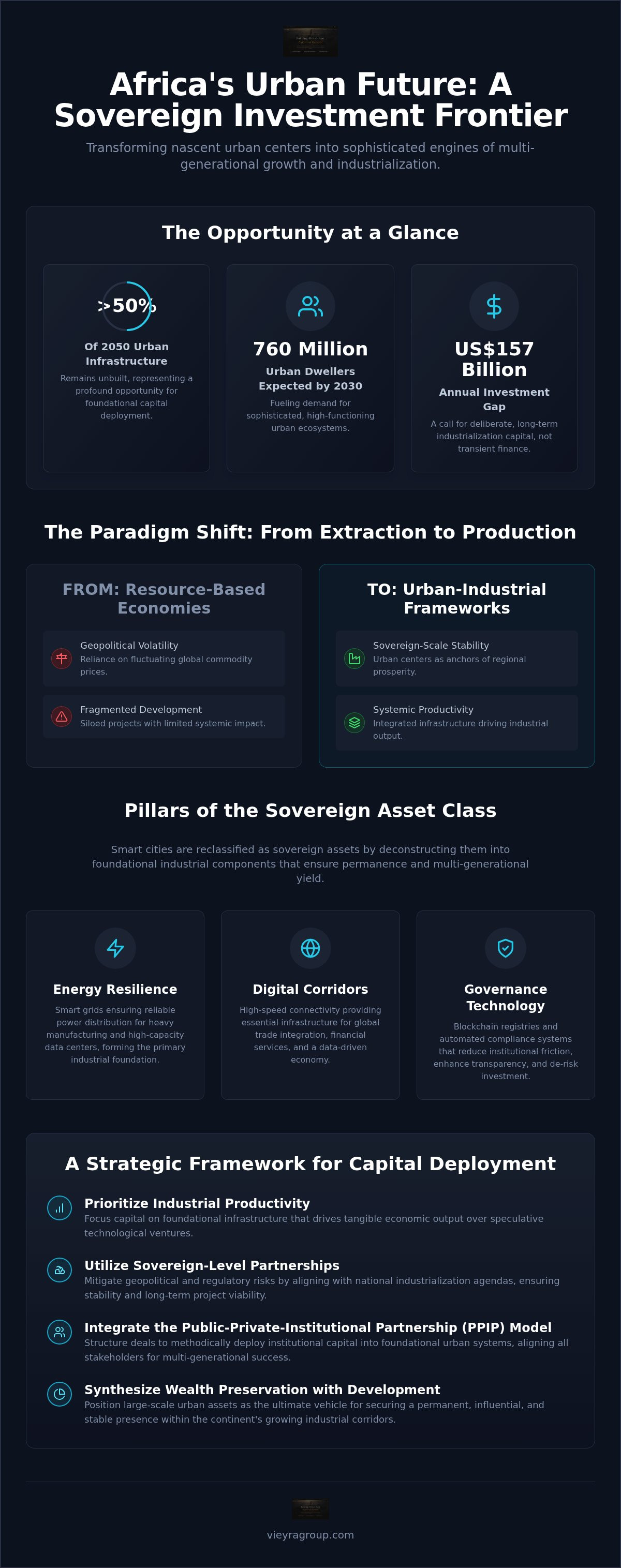
- Discern the strategic transition from resource-based economies to urban-industrial frameworks through the reclassification of the smart city as a sovereign asset class.
- Formulate a sophisticated framework for African smart cities investment that prioritizes systemic industrial productivity over speculative technological ventures.
- Evaluate institutional risk mitigation strategies that utilize sovereign-level partnerships to address geopolitical volatility and regulatory fragmentation.
- Integrate the Public-Private-Institutional Partnership model to facilitate the methodical deployment of capital into foundational urban infrastructure.
- Synthesize multi-generational wealth preservation with urban development to secure a permanent and influential presence within the continent's growing industrial corridors.
Urbanization as an Industrial Imperative in the African Century
The African continent stands at a pivotal juncture where urbanization serves as the primary catalyst for systemic economic transformation. By late 2026, urban centers are projected to generate a majority share of the continent's GDP, as the historical reliance on volatile resource extraction yields to a more sophisticated urban-industrial model. This evolution requires a precise application of African smart cities investment. Here, technology is not a decorative addition but a foundational layer for industrial zones. Unlike speculative technological experiments seen in some global smart city initiatives, the African framework focuses on leapfrogging legacy systems to establish climate-resilient and economically productive hubs.
The Convergence of Technology and Industrialization
Smart infrastructure acts as the invisible architecture supporting modern industrial corridors. The transition from traditional, siloed utilities to integrated, data-driven urban systems allows for unprecedented levels of sovereign-level productivity. In this context, smart water meters, AI-enabled traffic management, and blockchain-based financial registries aren't mere conveniences. They're essential tools that mitigate the systemic inefficiencies of rapid growth. By embedding these technologies into the urban fabric, cities transform into high-functioning industrial engines capable of supporting the 760 million urban dwellers expected by 2030. This digital integration ensures that power, water, and transport systems operate with the precision required by global manufacturing standards, facilitating a seamless African smart cities investment environment.
Capital as a Catalyst for Economic Sovereignty
Bridging the annual US$157 billion investment gap requires more than transient financial interest; it demands the deliberate application of African industrialization capital. Sovereign-scale investment thresholds in 2026 are defined by the capacity to provide multi-generational stewardship over projects that require decades to mature. Strategic capital allocation by institutional actors ensures that these urban developments aren't fragmented projects but cohesive regional anchors. This long-term vision aligns capital with the preservation of African legacy, ensuring that the infrastructure built today remains a viable asset for future generations. Large-scale urban projects serve as the ultimate vehicle for wealth preservation, where permanence and stability are the primary metrics of success. Through strategic capital solutions, institutional investors can secure a dominant position in the continent's industrial future.
Defining the Smart City as a Sovereign Asset Class
The reclassification of urban development as a sovereign asset class marks a significant departure from the speculative fervor often associated with technological hubs. Institutional actors must deconstruct these environments into foundational industrial components to appreciate their true value. While traditional infrastructure focuses on static physical assets, the smart city integrates data as a core utility, creating a dynamic system capable of multi-generational yield. This distinction is vital for those evaluating the geopolitical landscape of African smart cities, where the resilience of digital and physical corridors dictates the longevity of capital. Sovereign-scale industrial cities prioritize permanence over the rapid liquidity cycles of traditional tech investments.
Core Components of Investable Urban Infrastructure
Energy resilience serves as the primary industrial foundation. Smart grids facilitate the reliable power distribution necessary for heavy manufacturing and high-capacity data centers. Digital corridors provide the connectivity required for global trade integration, while governance technologies reduce institutional friction by automating regulatory compliance. These components ensure that African smart cities investment remains anchored in tangible productivity rather than speculative trends. Governance technology acts as a critical de-risking mechanism. By implementing blockchain-based land registries and automated permit systems, cities can offer a level of transparency that invites global participation. This reduction in administrative opacity is a hallmark of sovereign-scale development, ensuring that the urban fabric remains a stable vessel for large-scale capital.
Smart City vs. Traditional Infrastructure ROI
The efficiency dividend of data-integrated city management significantly alters the risk-adjusted return profile for institutional portfolios. By utilizing AI-enabled systems to optimize resource allocation, smart cities reduce operational costs by margins that traditional urban models can't match. In the 2026 market context, these assets offer superior long-term appreciation rates due to their inherent scalability. When comparing returns, the smart urban asset class provides a unique hedge against inflation through its role as an industrial hub. The ability to capture land value appreciation while simultaneously generating utility-based revenue streams creates a robust financial profile. Unlike traditional real estate, these assets are deeply integrated into the continent's industrialization trajectory. Institutions looking to secure these high-performing assets often benefit from strategic capital solutions that align multi-generational vision with technical execution.
Navigating the Risk Landscape of Large-Scale Urban Projects
Institutional risk within the sphere of African smart cities investment is frequently mischaracterized by observers who prioritize short-term liquidity over systemic permanence. Stability requires institutional gravity. True risk management involves addressing the friction between rapid demographic expansion and the meticulous deliberation required for industrial-scale infrastructure. Success demands a multi-generational vision that views cyclical political shifts as transient events rather than fundamental disruptions to the asset's trajectory. Sovereign-scale actors don't merely react to change; they architect the environment in which change occurs. By establishing this presence, institutions can effectively anchor their projects against the currents of regulatory fragmentation that often discourage less sophisticated capital.
Geopolitical and Regulatory Safeguards
Structuring urban assets to withstand political transitions necessitates a profound integration into the established framework for smart cities in Africa. This alignment is essential for any African smart cities investment intended to survive multiple administrations. Sovereign-level partnerships offer a protective layer that typical commercial ventures cannot replicate. When an institution’s operations align with national strategic priorities, policy dialogue transforms into a mechanism for long-term stability. Permanence is the priority. Leveraging international legal frameworks further ensures that these industrial assets remain insulated from localized governance shifts, thereby preserving the structural integrity of the capital for the duration of its multi-decadal lifecycle.
Operational and Technological Risk Management
Interoperability remains a critical technological risk that requires foresight during the initial design phases of any smart industrial hub. Systems must remain functional and adaptable across several urban decades, purposely avoiding proprietary lock-ins that lead to technical obsolescence and costly retrofitting. Cybersecurity for these hubs is not merely an IT concern but a matter of national industrial security; a compromise in a smart grid or a digital logistics corridor represents a systemic failure. Resilience is non-negotiable. Additionally, climate resilience serves as a primary risk-reduction strategy. Since over half of the continent's future infrastructure remains to be constructed, embedding climate-smart protocols today mitigates the risk of large-scale asset devaluation as environmental standards tighten globally by 2030.
Strategic Capital Deployment and Governance Models
The deployment of institutional capital into urban infrastructure demands a methodical framework that prioritizes systemic stability over transient market fluctuations. For African smart cities investment to achieve its intended industrial scale, the allocation process must move beyond simple project finance into the realm of high-level strategic planning. This requires a phased orchestration where foundational utility layers are established before the integration of sophisticated digital systems. Such a sequence ensures that the city functions as a cohesive industrial engine rather than a collection of disparate technological experiments. Stability is the primary objective. By ensuring that the physical and digital cores are mutually reinforcing, investors can secure the long-term viability of the asset.
The PPIP Model for Sovereign-Scale Investors
The evolution of the Public-Private-Institutional Partnership (PPIP) marks a sophisticated shift in urban governance. While traditional models often struggle with the friction between public utility and private profitability, the PPIP introduces a third pillar: the institutional steward. This entity provides the visionary foresight necessary to navigate the US$157 billion annual investment gap while maintaining the project's industrial integrity. By acting as a stately guardian of the urban legacy, the institutional partner anchors the development against the short-termism that often plagues large-scale infrastructure. This governance structure allows for the alignment of sovereign interests with private sector efficiency, creating a stable environment for multi-generational capital. Standard models often don't account for the multi-decadal patience required for true industrial transformation.
Measuring Success: Beyond Traditional KPIs
Measuring the success of these sophisticated urban ecosystems necessitates a departure from standard quarterly reporting. Institutional actors must track the 'efficiency dividend' and the long-term industrial output of smart urban zones, focusing on metrics that reflect actual economic sovereignty. The Vieyra Foundation serves as a critical proof point in this regard, offering a sophisticated methodology for aligning social-impact objectives with sovereign-scale progress. This approach ensures that every dollar of capital contributes to the creation of a resilient, inclusive industrial landscape. By integrating these multi-dimensional metrics, investors can evaluate how urban capital allocation fosters regional dominance and permanent economic growth. To explore how these frameworks are applied at scale, consider our Strategic Capital Solutions for African industrialization.
Legacy Architecture: The Vieyra Approach to Urban Industrialization
The Vieyra Family Office operates not merely as a financial entity but as a visionary architect of African industrial legacy. Our perspective on African smart cities investment is rooted in a multi-generational heritage that prioritizes the structural permanence of the continent's urban corridors over the ephemeral gains of traditional private equity. By aligning wealth preservation with the physical manifestation of sovereign growth, we ensure that urban assets serve as enduring engines of productivity. This approach recognizes that the smart city is the ultimate vessel for institutional stability, where data-driven infrastructure and industrial zones converge to form a lasting civilization-scale contribution. We view these developments as the bedrock upon which the next century of African economic influence is constructed.
Building for Centuries, Not Quarters
The philosophy of permanence dictates every facet of our capital allocation strategy. While many market participants focus on exit horizons of five to seven years, our vision extends across decades and generations. Smart cities represent more than technological utility; they are the physical manifestation of legacy. By investing in foundational infrastructure that supports the projected 1.4 billion urban residents of 2050, we secure multi-generational continuity. This long-term stewardship ensures that the industrial zones and digital corridors we develop today remain relevant and productive for the centuries to follow. Urban assets, when managed with this degree of institutional gravity, become the primary vehicle for preserving wealth and regional influence amidst a shifting global landscape.
Engaging with Sovereign-Scale Capital Solutions
Identifying high-potential urban projects requires a rare synthesis of global investment rigor and deep-rooted African insight. The Vieyra Family Office leverages its unique position as a stately guardian to bridge the gap between institutional capital and the specific realities of African industrialization. We evaluate opportunities based on their capacity for systemic impact, ensuring that each initiative aligns with the broader objective of economic sovereignty and regional dominance. Through the Vieyra Foundation, we further ensure that social-impact alignment is not an afterthought but a core component of the urban fabric, fostering inclusive growth that supports the stability of the investment over the long term. This methodology allows us to mitigate the perceived risks of emerging markets by applying a sophisticated, sovereign-level framework to every deployment. By acting as a stabilizing force within the continent's urban-industrial corridors, we provide the certainty required for multi-generational progress. To understand how we transform these concepts into tangible industrial progress, we invite you to Explore our Strategic Capital Solutions for African Industrialization.
Architecting the Industrial Legacy of the African Century
The successful orchestration of African smart cities investment necessitates a departure from traditional, short-term financial models in favor of a sovereign-scale perspective that prioritizes industrial permanence. By reclassifying urban development as a strategic asset class, institutional actors can bridge the infrastructure gap while securing multi-generational yield. This framework identifies smart cities not as isolated technological experiments, but as the primary engines of the continent's economic sovereignty. We have explored how navigating regulatory complexity and implementing Public-Private-Institutional Partnerships can effectively mitigate systemic risk.
As a stately guardian of African legacy, the Vieyra Family Office combines multi-generational African heritage with global investment management rigor to architect these future industrial corridors. Our sovereign-scale institutional expertise ensures that capital is deployed with the deliberation required for century-long success. It's a profound responsibility that demands visionary stewardship and strategic depth. We invite you to join us in this methodical pursuit of progress through sophisticated capital allocation.
Discover our Multi-Generational Approach to African Industrialization
Frequently Asked Questions
What defines an African smart city as a sovereign-scale investment?
A sovereign-scale investment is characterized by its capacity to function as a permanent industrial anchor rather than a speculative technological hub. These developments prioritize foundational infrastructure, such as smart grids and digital logistics corridors, that align with national strategic priorities. It's a commitment to building urban environments that support the continent's projected 1.4 billion residents by 2050. This scale requires the involvement of institutional stewards capable of maintaining stability across multi-decadal timelines.
How do smart cities accelerate African industrialization compared to traditional urban zones?
Smart cities utilize data-integrated utilities to eliminate the systemic inefficiencies that often plague traditional urban centers. By providing high-precision power and water management, these cities meet the rigorous standards required for global manufacturing and heavy industry. This technological backbone allows for a seamless transition into the African Century, where urban land is utilized as a high-functioning asset. The result is a more productive industrial engine that drives inclusive growth and regional economic dominance.
What are the primary risk mitigation strategies for large-scale infrastructure in Africa?
Successful risk mitigation involves anchoring projects within sovereign-level partnerships and established international legal frameworks. This institutional gravity provides a protective layer against regulatory fragmentation and political transitions. Strategies also include ensuring technical interoperability to avoid technical obsolescence over decades. By focusing on climate resilience and permanent economic utility, investors can absorb short-term volatility. This methodical approach transforms perceived geopolitical risks into manageable variables within a sophisticated African smart cities investment framework.
How does multi-generational capital differ from private equity in urban development?
Multi-generational capital prioritizes permanence and legacy preservation over the rapid exit cycles typically associated with private equity. While standard funds often seek returns within five to seven years, sovereign-scale institutions operate with horizons spanning half a century or more. This patient capital is essential for urban industrialization, as it provides the stability needed for large-scale infrastructure to mature. It's a philosophy of stewardship that values the long-term structural integrity of the asset above immediate liquidity.
What role does the Vieyra Foundation play in smart city social impact?
The Vieyra Foundation serves as a critical mechanism for aligning philanthropic initiatives with large-scale industrialization objectives. It ensures that urban projects provide equitable access to essential services, fostering the social stability necessary for long-term investment security. By focusing on scale-ready solutions that impact millions of residents, the foundation bridges the gap between capital allocation and community resilience. This alignment demonstrates that social impact isn't an adjunct to investment but a core component of sustainable urbanism.
How do sovereign partnerships enhance the stability of urban investments?
Sovereign partnerships integrate urban developments into the host nation's primary economic trajectory, creating a mutual interest in the project's success. This collaboration offers a level of policy continuity that isolated private ventures can't achieve. When a project is recognized as a driver of national industrialization, it gains access to streamlined regulatory pathways and strategic safeguards. These partnerships act as a stabilizing force, ensuring the project's permanence remains protected through successive government administrations and shifting global landscapes.
What is the projected ROI for smart city infrastructure in 2026?
The return on African smart cities investment in 2026 is increasingly measured through the 'efficiency dividend' and long-term land value capture. Data-integrated systems reduce operational costs for utilities and transport, generating superior risk-adjusted returns compared to legacy infrastructure. While traditional assets face depreciation, smart urban zones appreciate as they become central nodes in regional trade corridors. The ability to capture this multifaceted revenue while supporting industrial growth makes these assets a robust hedge against global inflationary pressures.
How can family offices participate in sovereign-scale African projects?
Family offices can engage through sophisticated partnership models like the Public-Private-Institutional Partnership (PPIP). This allows them to act as institutional stewards, providing the strategic capital and global expertise required for large-scale industrialization. By collaborating with sovereign entities, family offices gain access to high-barrier projects that offer multi-generational wealth preservation. This involvement requires a synthesis of global investment rigor and deep-rooted African insight, ensuring that the capital deployed contributes to the continent's permanent economic legacy.


