
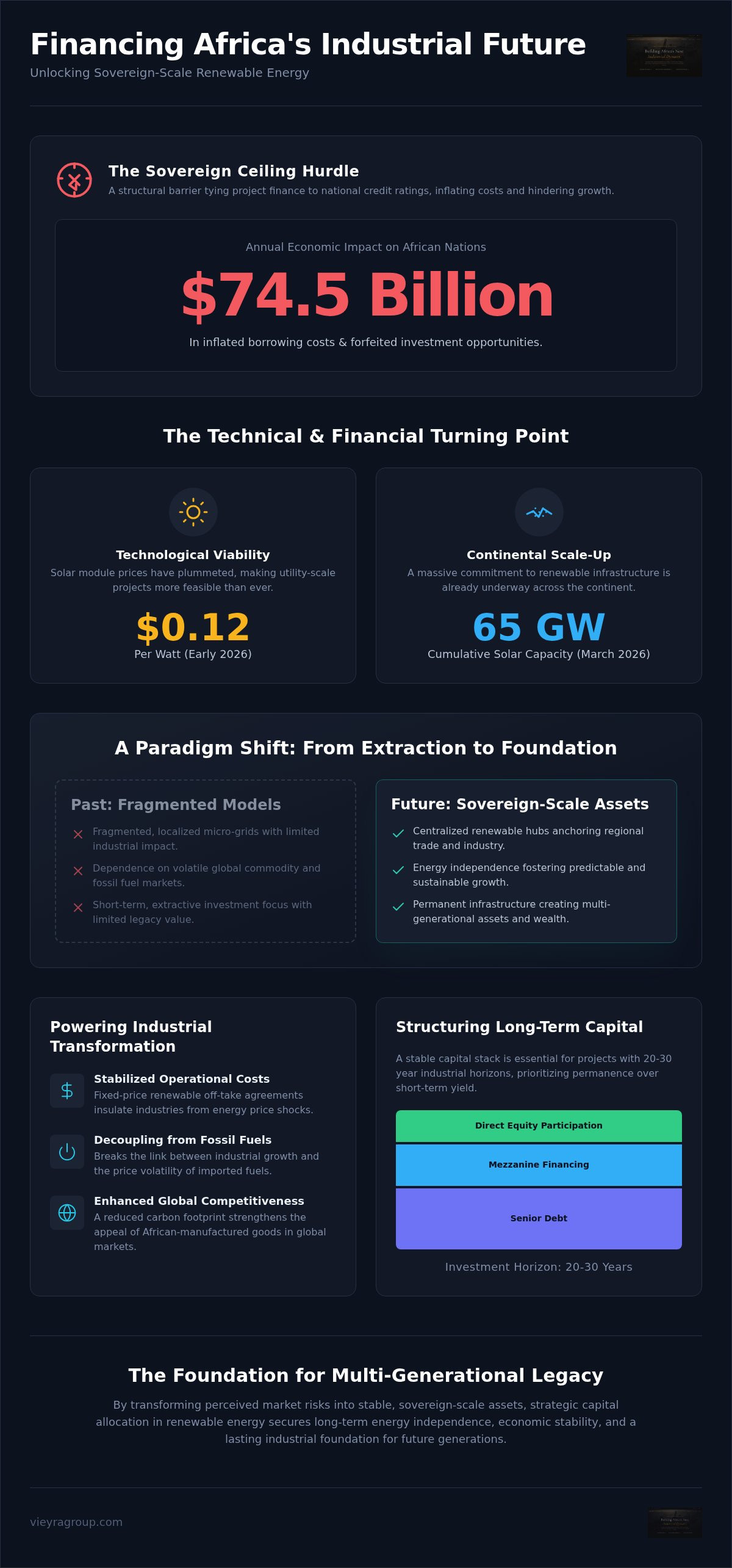
The sovereign ceiling rule, which ties the creditworthiness of a clean energy initiative to the rating of its host nation, currently costs African nations up to $74.5 billion annually in inflated borrowing costs and forfeited investment opportunities. This structural impediment remains a primary obstacle for those seeking to deploy African renewable energy project finance at a scale commensurate with the continent's industrial potential. You likely recognize that while the technical feasibility of utility-scale solar is no longer in question, especially as module prices reached approximately $0.12 per watt in early 2026, the financial architecture required to support such assets remains prohibitively complex for many institutional actors.
This article provides a rigorous examination of the strategic capital allocation and risk mitigation frameworks necessary to transcend these systemic barriers and align energy infrastructure with long-term industrialization goals. We will explore how sophisticated institutional capacity and multi-generational stewardship can transform perceived market risks into stable, sovereign-scale assets. Our analysis details the evolution of continental regulatory environments and the specific mechanisms required to preserve wealth through the development of sustainable, large-scale industrial foundations.
Key Takeaways
- Understand the critical nexus between sustainable energy security and the acceleration of sovereign-scale industrial growth across the continent.
- Analyze the sophisticated debt and equity structures essential for bridging the bankability gap within the complex landscape of African renewable energy project finance.
- Identify robust risk mitigation frameworks designed to navigate the intricate cross-border regulatory environments and systemic challenges of emerging markets.
- Evaluate how the strategic allocation of capital toward energy infrastructure serves as a foundation for multi-generational wealth preservation and industrial legacy.
- Recognize the pivotal role of institutional stewardship and global alliances in securing long-term energy independence and economic stability.
The Strategic Imperative of Renewable Energy in African Industrialization
The orchestration of sovereign-scale industrial growth in Africa necessitates a fundamental departure from the fragmented energy models of the past. As the 2026 African industrial roadmap unfolds, the strategic focus has pivoted toward the establishment of a robust energy foundation capable of sustaining high-output manufacturing and value-additive processing. This transition marks a shift from extractive paradigms, favoring instead the creation of permanent infrastructure that serves as a multi-generational asset. The deployment of sophisticated African renewable energy project finance is the primary mechanism through which this vision is realized, transforming the continental energy landscape into a stable environment for long-term capital preservation.
Energy as the Catalyst for Industrial Transformation
Large-scale manufacturing and mining operations are characterized by an inherent energy intensity that demands unwavering stability. The integration of Renewable energy in Africa into the industrial core provides the baseload power necessary to insulate these sectors from the volatility of global commodity markets. By aligning energy procurement with continental economic development goals, industrial actors can ensure a consistent output that supports regional supply chains. This alignment offers several systemic advantages:
- Stabilization of operational costs through fixed-price renewable off-take agreements.
- Decoupling of industrial growth from the price fluctuations of imported fossil fuels.
- Enhancement of the global competitiveness of African-manufactured goods through a reduced carbon footprint.
Institutional capital now prioritizes this form of stewardship, recognizing that the reliability of power is directly correlated with the viability of sovereign-scale industrial legacies.
The Shift Toward Sovereign-Scale Energy Assets
The current strategic focus emphasizes the development of national-level energy infrastructure over localized micro-grid solutions. While small-scale initiatives address immediate access, the overarching objective is the creation of centralized renewable hubs that anchor regional trade corridors. These sovereign-scale assets are valued not merely for their immediate yield but for their role in the broader architectural framework of the continent's progress. With cumulative solar capacity reaching 65 GW by March 2026, the scale of these initiatives reflects a commitment to permanent, systemic impact. This evolution in African renewable energy project finance ensures that energy infrastructure remains a cornerstone of industrialization, fostering an environment where large-scale growth is both predictable and sustainable.
Structuring Capital for Large-Scale Energy Infrastructure
The orchestration of capital for sovereign-scale initiatives requires a fundamental departure from the standard private equity paradigms that often dictate emerging market investments. For these large-scale industrial foundations, the financial architecture must prioritize long-term stability and multi-generational stewardship over immediate yield. This approach necessitates the integration of global investment management principles with a profound understanding of the local industrial context. By bridging the bankability gap through the provision of strategic capital, institutional actors can secure the foundations of continental energy independence. The deployment of African renewable energy project finance at this level is not merely an investment; it's a commitment to the structural integrity of the continent's future.
Institutional Equity and Strategic Debt Instruments
Sovereign-level projects typically utilize a combination of senior debt, mezzanine financing, and direct equity participation to manage the intensive capital requirements of utility-scale renewables. Optimizing these capital stacks for 20-30 year industrial horizons involves securing instruments that reflect the permanence of the underlying assets. Institutional-grade governance plays a decisive role in this process. Projects characterized by transparent and rigorous oversight often see a measurable reduction in financing costs, even when operating within markets perceived as high-risk. Establishing such frameworks is essential for deploying strategic capital solutions that align with the scale of national industrial ambitions.
Blended Finance and Sovereign Partnerships
The complexity of the current financial landscape necessitates a collaborative approach, often involving blended finance models where development finance institutions (DFIs) operate alongside private strategic capital. These partnerships are instrumental in attracting finance for energy transition by providing first-loss guarantees or concessional debt that lowers the overall risk profile. Public-private partnerships (PPPs) serve as the primary vehicle for large-scale energy. This model allows for the formalization of risk-sharing agreements with sovereign entities, which is critical given that public sources accounted for $40 billion of the $60 billion clean energy investment in 2024. Strategic structuring must account for several key factors:
- Mitigation of the "sovereign ceiling" rule to decouple project creditworthiness from national ratings.
- Utilization of DFI support, which currently amounts to 86% of total project costs for solar PPPs in sub-Saharan Africa excluding South Africa.
- Alignment of risk-sharing mechanisms with long-term industrial output targets.
In regions where borrowing costs can be significantly elevated, such as Zambia where rates for private developers reached 45.4% in 2023, these structured partnerships ensure that African renewable energy project finance remains a viable tool for industrial transformation. By leveraging the strengths of both public and private actors, we can create a resilient financial ecosystem that supports the continent's long-term energy requirements.
De-risking and Regulatory Frameworks in Emerging Markets
The persistent application of the sovereign ceiling rule represents one of the most significant architectural challenges in the deployment of African renewable energy project finance. By tethering the creditworthiness of individual infrastructure assets to the sovereign rating of the host nation, this financial convention imposes an estimated $74.5 billion in annual costs through elevated borrowing rates and missed opportunities. Navigating this environment requires a sophisticated understanding of cross-border regulatory frameworks and the strategic use of political risk insurance. These instruments don't merely protect against loss; they serve as the foundational stabilizers for projects intended to operate across multiple decades. Establishing a robust legal framework is the first step in transforming a perceived high-risk profile into a platform for multi-generational wealth preservation.
Geopolitical Risk and Institutional Stability
Assessing the longevity of regional energy markets involves more than a cursory review of current policy. It requires a profound evaluation of the underlying institutional stability and the strength of sovereign-level partnerships. Strategies for navigating legislative shifts in emerging economies must prioritize the establishment of binding legal protections that transcend individual political cycles. This ensures that large-scale industrial projects remain insulated from the volatility of local governance, providing a secure environment for the allocation of African industrialization capital. By positioning as a visionary architect of legacy, institutional investors can foster the type of long-term stability that attracts global strategic partners and facilitates the seamless integration of regional energy grids.
Financial Risk Mitigation and Currency Management
The high cost of capital, often two to three times higher than in advanced economies, remains a formidable barrier to continental progress. In markets like Nigeria, where the cost of debt for private solar projects reached approximately 25% in 2023, the necessity for innovative hedging and multi-lateral guarantees is absolute. The Clean energy investment in Africa report highlights how transparent governance and multi-lateral support can enhance project credit ratings, effectively lowering the barrier to entry for strategic capital. Utilizing local currency hedging mechanisms further protects long-term infrastructure assets from the erosion of value caused by volatility. This methodical approach to currency management ensures that the financial integrity of a project remains intact over its entire 30-year lifecycle. Ultimately, the integration of global investment management principles into the local context allows for the mitigation of systemic risks that would otherwise deter sovereign-scale investment.
The Multi-Generational Impact of Sustainable Energy Allocation
The allocation of capital toward continental energy infrastructure represents a fundamental shift from speculative investment to the deliberate construction of a multi-generational legacy. Unlike traditional private equity cycles that prioritize short-term exit strategies, the orchestration of African renewable energy project finance focuses on the acquisition and management of permanent assets that anchor industrial ecosystems. These sovereign-scale projects serve as the cornerstone of sophisticated family office portfolios, offering a level of stability and predictable cash flow that transcends the volatility of traditional markets. By viewing energy not as a commodity but as the essential architecture of progress, institutional actors can ensure that their capital contributes to the systemic transformation of the continent while preserving wealth across generations.
Legacy-Building Through Infrastructure
The permanence inherent in utility-scale renewable assets aligns seamlessly with the values of long-term stewardship. When an institution commits to a 30-year energy horizon, it's not merely seeking a return on investment; it's establishing a foundational presence within the African industrial landscape. This stewardship moves beyond the narrow metrics of standard ESG reporting, focusing instead on the tangible industrial transformation that occurs when reliable power is integrated into manufacturing and mining corridors. Such investments reflect a multi-generational vision where the success of the project is inextricably linked to the broader advancement of the sovereign state. This perspective transforms energy infrastructure into a vehicle for permanence, ensuring that the wealth generated is rooted in the very fabric of the continent's industrial future.
Strategic Philanthropy and Social Impact
The Vieyra Foundation exemplifies this integrated approach by aligning philanthropic initiatives with the overarching goals of industrial growth. By focusing on long-term human capital development within the energy sector, the Foundation ensures that the local workforce possesses the sophisticated technical skills required to maintain and expand these complex systems. This synergy between large-scale energy projects and community development enhances the sustainability of the infrastructure itself. It's a model of global investment management where social impact isn't an auxiliary function but a core component of the project's long-term viability. Fostering these deep-rooted connections ensures that energy assets remain protected and valued by the communities they serve. For those seeking to participate in this visionary architectural framework, exploring strategic capital solutions provides a pathway to establishing a lasting African investment legacy.
Strategic Partnerships and Global Stewardship in Energy Finance
The orchestration of sovereign-scale industrialization requires a departure from traditional government-led mandates toward a model of global stewardship that integrates the agility of private strategic capital. While international treaties provide a foundational policy layer, the actual deployment of African renewable energy project finance depends on the presence of sophisticated institutional partners capable of navigating the continent's complex geopolitical landscape. These actors serve as the bridge between global capital markets and local industrial requirements, ensuring that energy infrastructure is not merely a utility but a catalyst for permanent economic transformation. This stewardship model fosters global alliances that prioritize the stability of the industrial core; it's a framework where energy security and industrialization are viewed as inseparable objectives.
The Vieyra Approach to Institutional Partnership
The Vieyra Family Office operates at the intersection of global investment management and a profound, multi-generational commitment to the continent's progress. By positioning as a stable, long-term anchor investor, the office provides the institutional gravity necessary to de-risk large-scale initiatives and attract a broader coalition of global strategic partners. This approach prioritizes the provision of Strategic Capital for African Development, focusing on assets that offer both systemic impact and enduring value. The office's heritage allows for a nuanced understanding of regional regulatory shifts, enabling the successful navigation of environments where traditional brokerage models don't provide sufficient depth. Through this lens, partnerships are not merely transactions but are the building blocks of a continental legacy that supports the transition from extractive energy models to value-additive industrial foundations.
Architecting the Future of African Energy
Visionary leadership in infrastructure finance requires more than capital; it demands an architectural foresight that anticipates the technological and economic shifts of the next thirty years. Integrating cutting-edge innovation into sovereign-scale projects ensures that the continent's energy grid remains resilient and competitive within the global landscape. This involves the deliberate deployment of capital into the next generation of energy leaders who prioritize industrialization as the primary driver of development. The refinement of African renewable energy project finance strategies must include the integration of advanced grid technologies and regional power-sharing agreements to maximize the utility of every megawatt generated. Initiating a strategic dialogue for large-scale energy project collaboration is essential for fostering the global alliances required to achieve true energy security. For those seeking to participate in the construction of this continental legacy, we invite you to Engage with Vieyra Family Office for sovereign-level investment inquiries. This engagement represents an entry into a partnership defined by deliberation, foresight, and an unwavering commitment to the long-term prosperity of the African industrial context.
Architecting a Continental Industrial Legacy
The evolution of the continental energy landscape demands a fundamental shift from short-term yield to the deliberate construction of sovereign-scale industrial foundations. We have explored how the strategic deployment of African renewable energy project finance serves as the essential architecture for this transformation, provided it is supported by robust risk-mitigation frameworks and sophisticated capital structures. By prioritizing long-term stewardship over speculative gain, institutional actors ensure that energy infrastructure remains a permanent vehicle for wealth preservation and regional stability.
Navigating these complex regulatory environments requires a partner with a deep-rooted heritage and sovereign-level institutional capacity. The Vieyra Family Office combines global investment management expertise with a multi-generational commitment to African progress, and it's this unique perspective that allows us to serve as a stately guardian of the continent's industrial future. We invite you to engage with the Vieyra Family Office regarding sovereign-scale industrial capital to explore how your vision can align with the enduring trajectory of African industrialization. The path toward a sustainable and prosperous future is built upon these deliberate, high-impact collaborations.
Frequently Asked Questions
What is the current state of African renewable energy project finance in 2026?
The sector is currently characterized by a rapid expansion of utility-scale assets, with cumulative solar capacity reaching 65 GW by March 2026. This growth is underpinned by solar module prices falling to approximately $0.12 per watt, which enhances the commercial viability of large-scale initiatives. Despite this progress, the high cost of capital remains a persistent challenge, necessitating sophisticated African renewable energy project finance structures to bridge the bankability gap for sovereign-scale industrial foundations.
How do sovereign-scale institutions mitigate political risk in African energy projects?
Mitigation involves the establishment of binding legal frameworks and the strategic utilization of political risk insurance to insulate assets from legislative volatility. Institutions prioritize partnerships with sovereign entities and multi-lateral organizations to secure guarantees that transcend individual political cycles. This methodical approach ensures that large-scale infrastructure remains a stable component of a multi-generational portfolio, effectively decoupling project security from the immediate fluctuations of local governance and ensuring long-term institutional stability.
What are the primary differences between DFI funding and private strategic capital in Africa?
Development Finance Institutions (DFIs) provide essential concessional debt and first-loss guarantees, currently accounting for 86% of total project costs for solar PPPs in sub-Saharan Africa excluding South Africa. Private strategic capital, however, offers the agility and long-term stewardship required for visionary industrial growth. While DFIs focus on immediate development metrics, strategic capital providers like the Vieyra Family Office prioritize the creation of permanent industrial legacies and the preservation of multi-generational wealth.
Can renewable energy support heavy industrialization in emerging markets?
Yes, renewable energy provides the stable, baseload power required for energy-intensive sectors like manufacturing and mining. By integrating utility-scale solar and wind into centralized industrial hubs, nations can decouple their economic progress from the volatility of global fossil fuel markets. This transition toward sustainable power is the primary engine for the 2026 African industrial roadmap, fostering an environment where large-scale production is both predictable and globally competitive on a sovereign scale.
What role do family offices play in financing large-scale African infrastructure?
Family offices function as visionary architects and stable anchor investors for sovereign-level projects. Their unique capacity for long-term capital allocation allows them to bridge the bankability gap where traditional private equity might hesitate due to shorter exit horizons. By deploying African renewable energy project finance with a multi-generational perspective, these institutions provide the institutional gravity necessary to attract global strategic partners and secure the continent's industrial future through deliberate stewardship.
How are currency risks managed in long-term African energy investments?
Management of currency volatility involves the implementation of innovative hedging mechanisms and the utilization of multi-lateral guarantees to protect the value of long-term assets. In markets where borrowing costs are significantly elevated, such as Zambia where rates for private developers reached 45.4% in 2023, these strategies are essential for maintaining financial integrity. Transparent governance and risk-sharing agreements with sovereign entities further insulate infrastructure projects from the erosion caused by local currency fluctuations.
What are the key criteria for a bankable sovereign-scale energy project in Africa?
A bankable project requires a robust legal framework, a transparent governance structure, and a clear alignment with national industrialization goals. Key criteria include the mitigation of the sovereign ceiling rule and the presence of long-term off-take agreements with creditworthy industrial partners. The involvement of an established institutional anchor, possessing sovereign-scale capacity, is often the decisive factor that transforms a complex infrastructure proposal into a secure, multi-generational investment opportunity for global partners.
How does the Vieyra Family Office approach multi-generational wealth preservation through energy?
The Vieyra Family Office views energy infrastructure as the foundational architecture of a permanent industrial legacy. By focusing on the acquisition of sovereign-scale assets rather than speculative yields, the office ensures that capital is rooted in the continent's long-term economic stability. This stewardship involves aligning global investment management expertise with a multi-generational African heritage, creating a resilient portfolio that supports both continental progress and the preservation of institutional wealth for future generations.


