
The traditional paradigm of extractive arbitrage is rapidly yielding to a more sophisticated era of industrial integration. While many institutional actors remain preoccupied with perceived geopolitical volatility and the infrastructure deficits that historically hindered local beneficiation, the most enduring sovereign-scale wealth is now being forged through a comprehensive African mining value chain investment strategy. We recognize that the mere extraction of raw materials is an insufficient foundation for long-term capital preservation in a landscape increasingly defined by resource nationalism and mandatory local content regulations. This article provides a rigorous exploration of the transition from fragmented mining operations to integrated industrial ecosystems that align with the developmental imperatives of the continent. You will gain a strategic framework designed to navigate the complexities of modern African mineral markets, moving beyond the limitations of the extractive model toward a vision of multi-generational industrial progress. We shall examine the specific mechanisms of value-chain industrialization and the sovereign-scale solutions required to transform mineral wealth into a permanent institutional legacy that withstands the fluctuations of global commodity cycles.
Key Takeaways
- Reframe the investment thesis from simple commodity extraction to a sophisticated African mining value chain investment strategy that prioritizes long-term industrial integration.
- Architect capital deployment through a multi-generational lens, ensuring that strategic asset allocation accounts for the entire mineral lifecycle from exploration to beneficiation.
- Recognize the critical interdependence of energy and transport infrastructure, utilizing the 'Power-to-Mines' model to facilitate sustainable industrial processing.
- Navigate complex geopolitical landscapes by leveraging institutional prestige and establishing deep-rooted local partnerships that transcend traditional compliance frameworks.
- Align global investment management with sovereign-scale developmental goals to create an enduring industrial legacy that preserves capital across generations.
The Paradigm Shift: From Extraction to Value Chain Industrialization
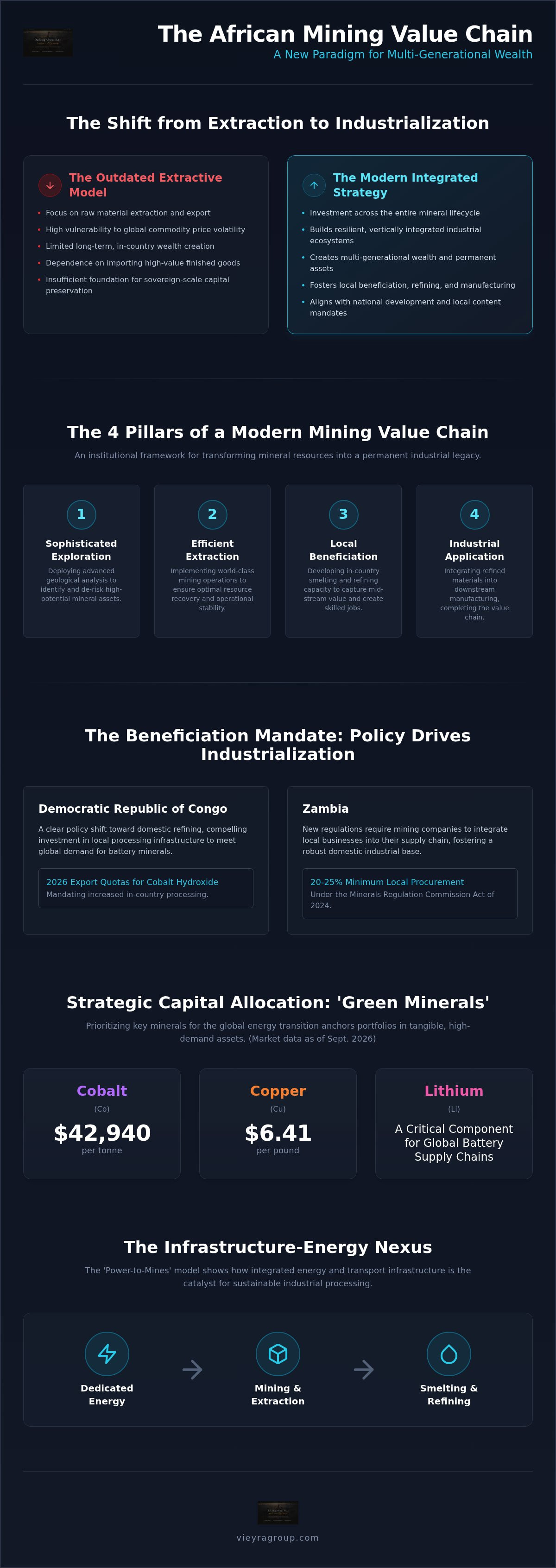
The historical reliance on a purely extractive model has often confined African economies to the periphery of global trade, characterized by the export of raw ores and the subsequent import of high-value finished goods. This paradigm, while functional for short-term revenue generation, failed to establish the structural foundations required for multi-generational wealth. Today, the African mineral industry is undergoing a fundamental transformation as sovereign-scale actors recognize that sustainable growth resides in the capture of value across the entire lifecycle. A robust African mining value chain investment strategy now encompasses four distinct pillars: sophisticated exploration, efficient extraction, local beneficiation, and eventual industrial application. By institutionalizing these stages, we move beyond the volatility of commodity cycles toward the creation of permanent industrial assets.
The transition from commodity exports to industrial assets requires a deliberate orchestration of capital and policy. We're seeing a shift where mineral wealth isn't merely a resource to be depleted, but a catalyst for systemic economic transformation. This evolution demands a high level of professional rigor and a commitment to long-term stability. It's no longer enough to focus on the pit; the focus must expand to the smelter, the refinery, and the manufacturing plant. This holistic perspective ensures that the depletion of a finite resource leaves behind a legacy of technological capacity and infrastructure.
The Beneficiation Mandate in the 2026 Global Economy
Regulatory frameworks across the continent are increasingly mandating local processing to ensure domestic economies retain a greater share of mineral wealth. In the Democratic Republic of Congo, for instance, 2026 export quotas for cobalt hydroxide signify a clear shift toward domestic refining. Similarly, Zambia's Minerals Regulation Commission Act of 2024 and subsequent local content regulations now mandate that mining companies allocate a minimum of 20-25% of their annual procurement to local entities. Strategic capital must bridge the mid-stream gap where infrastructure deficits currently hinder the transition from raw ore to refined product. This isn't merely a matter of compliance. It's a prerequisite for sovereign-scale portfolio stability. By investing in smelting and refining capacity, institutional partners secure their position within the global supply chain for critical minerals like lithium and copper.
Industrialization as a De-Risking Mechanism
Vertical integration serves as a primary defense against the inherent volatility of global markets. When an investment strategy integrates extraction with industrial processing, it creates a buffer against the price fluctuations that often destabilize single-stage mining projects. Building resilience requires a commitment to local value-add infrastructure, such as dedicated power grids and specialized transport corridors. This systemic approach transforms a mining project into an industrial ecosystem. It's through this architectural foresight that we achieve multi-generational wealth preservation. Industrialization provides the stable cash flows and diversified economic activity necessary to protect capital over the long term, ensuring that the project remains viable even when commodity spot prices face downward pressure.
Strategic Capital Allocation Across the Mineral Lifecycle
Deploying capital in the current era requires a departure from speculative exploration toward the institutionalization of production. The prioritization of 'Green Minerals', specifically copper, cobalt, and lithium, forms the bedrock of modern strategic pillars. As of September 2026, with cobalt trading at $42,940 per tonne and copper at $6.41 per pound, the economic justification for integrated African mining value chain investment is indisputable. Balancing global market liquidity with direct industrial participation allows sovereign-scale actors to capture upside while anchoring the portfolio in tangible assets. It's about stability. It's about permanence.
Successful asset allocation for family offices necessitates a profound alignment between investment horizons and industrial cycles. Unlike retail-focused models, institutional frameworks prioritize asset stability over trade velocity. Diversification across jurisdictions remains essential to mitigate systemic risk, particularly as states like the DRC and Zambia refine their mining codes to increase local participation. We believe that true resilience is found in the ability to withstand short-term volatility in favor of long-term industrial dominance.
The Architecture of Multi-Generational Mining Portfolios
The construction of a sovereign-scale portfolio demands a methodical approach to risk. It's not a matter of chasing spot prices but of securing the supply chains that will define the next century. By matching capital duration with the long-term nature of industrial development, investors can bypass the noise of quarterly fluctuations. This patient stance allows for the steady accumulation of high-quality production assets that serve as the foundation for multi-generational wealth preservation. It requires a vision that extends beyond the immediate horizon.
Financing the Mid-Stream: Beneficiation Infrastructure
The most significant void in the current market isn't a lack of mineral wealth, but a deficit in mid-stream processing infrastructure. Institutional capital must move beyond the mine gate to finance the smelting, refining, and precursor chemical production facilities that define Africa's value chain potential. Public-private partnerships offer a viable mechanism for these sovereign-scale projects, distributing risk while ensuring the infrastructure serves broader industrialization goals. Strategic capital is defined as the long-term, patient deployment of resources specifically designed to catalyze industrial capacity while ensuring the preservation of institutional legacy.
Integrating these complex elements requires a partner with deep-rooted heritage and global execution capabilities. Those seeking to architect a legacy through African mining value chain investment and Strategic Capital Solutions will find that the synergy between global management and local industrial growth is the only path to permanent wealth. This methodical approach ensures every dollar deployed contributes to a systemic transformation rather than a temporary extraction.
The Infrastructure-Energy Nexus: Catalysing Systemic Growth
The realization of a comprehensive African mining value chain investment remains contingent upon the deliberate integration of energy and transport systems into the primary mining strategy. We recognize that mineral extraction can't achieve systemic impact if it remains isolated from the broader industrial landscape. This infrastructure-energy nexus is the foundational architecture required to transform localized extraction into regional industrial hubs. By treating infrastructure as a strategic prerequisite rather than a secondary consideration, institutional actors ensure that capital deployment catalyzes the entire economic ecosystem. It's a shift from site-specific efficiency to regional economic stewardship.
Energy Sovereignty and Industrial Processing
The transition toward high-value beneficiation is fundamentally a challenge of energy security. Stable, base-load power is the primary economic necessity for smelting and refining operations, which are the cornerstones of strategic mineral development. The 'Power-to-Mines' model utilizes sovereign-scale solar and hydro projects to decarbonize the value chain while providing the reliability required for industrial processing. Decarbonizing the value chain isn't merely an environmental mandate; it's a core mining strategy that secures the long-term viability of industrial assets. When energy sovereignty is achieved, the cost profile of mid-stream processing becomes predictable, protecting the portfolio from the volatility of external energy markets.
Transport and Logistics: The Arteries of Value
Logistics corridors serve as the vital link between mineral-rich hubs and the global markets they supply. The role of rail and port infrastructure is paramount in maximizing returns, as efficient transport reduces the cost of moving high volumes of processed materials. Regional integration, accelerated by the African Continental Free Trade Area (AfCFTA), provides a unique opportunity to harmonize trade across borders and create economies of scale. Within a sophisticated portfolio, infrastructure functions as a standalone asset class that offers predictable yields. A strategic infrastructure portfolio prioritizes:
- Multi-modal transport networks connecting inland mines to deep-water ports.
- Dedicated energy grids powered by renewable sources for mid-stream processing.
- Digital corridors for real-time supply chain transparency and management.
It's the physical manifestation of institutional stewardship, ensuring that the wealth generated through mining is anchored in permanent, regional development. This methodical construction of transport arteries ensures that value isn't just extracted, but effectively circulated within the continent's growing industrial corridors. By bridging the gap between isolated extraction and global markets, we establish a framework for multi-generational wealth preservation.
Institutional Risk Management and Sovereign-Scale Governance
Navigating the intricate geopolitical landscape of Sub-Saharan Africa requires a sophisticated synthesis of institutional prestige and strategic diplomacy. While conventional risk models often fixate on surface-level volatility, a sovereign-scale framework prioritizes the preservation of multi-generational investment integrity through robust legal structures and financial de-risking mechanisms. This high-level governance is essential for any enduring African mining value chain investment, as it provides the stability necessary to withstand shifting global trade alliances and domestic policy evolutions. We don't merely react to change; we architect environments where capital can remain permanent.
Effective risk management involves a multi-layered approach that includes specialized insurance, commodity hedging, and the cultivation of deep-rooted local partnerships. These elements work in concert to protect the portfolio from systemic shocks while ensuring that industrial operations continue without interruption. It's a posture of composed authority that suggests long-term stability in a region often mischaracterized by its complexity.
The Governance of Legacy: ESG as Strategic Stewardship
In the 2026 mining landscape, the social license to operate has evolved from a secondary compliance requirement into a primary driver of institutional value. Integrating community development with industrial value chains ensures that the benefits of mineral wealth are shared, thereby securing the project's long-term viability. The Vieyra approach to transparency and institutional accountability moves beyond standard reporting to establish a culture of stewardship. When community interests are aligned with industrial progress, the resulting stability becomes a formidable barrier against operational risk. We believe that ethical governance isn't just a moral imperative but a prerequisite for capital preservation.
Mitigating Geopolitical Volatility
Evaluating jurisdictional risk requires an analytical rigor that accounts for the rapid evolution of mining codes across the continent. For example, Zambia's transition to a single regulator under the Minerals Regulation Commission Act of 2024 and the Geological and Minerals Development Act of 2025 demonstrates a move toward centralized, predictable oversight. Similarly, the Nigeria Tax Act of 2025 has unified the royalty system to eliminate conflicting provisions. Sovereign-scale partnerships play a vital role in ensuring regulatory stability, as they provide a channel for strategic diplomacy that can resolve potential disputes before they escalate. By maintaining a multi-generational vision, investors can navigate short-term legislative shifts without losing sight of their long-term objectives.
Securing these complex assets requires a partner capable of merging local insight with world-class execution. Those who demand the highest standards of protection for their African mining value chain investment should align with a leader in Global Investment Management to ensure their legacy remains unassailable. This methodical approach to governance provides the quiet confidence required to operate at scale in the world's most promising mineral markets.
The Vieyra Approach: Strategic Capital for African Industrialization
The Vieyra Family Office operates with the deliberation and foresight required for sovereign-scale progress. Our approach doesn't merely facilitate extraction; it architects the systemic economic transformation of the continent. By deploying African Industrialization Capital, we ensure every initiative contributes to a broader industrial ecosystem. This synergy between Global Investment Management and local growth creates a framework where mineral wealth becomes a permanent foundation for prosperity. As we look toward 2026 and beyond, our vision remains rooted in the belief that African mineral sovereignty is achieved through the institutionalization of the entire value chain. It's a commitment to permanence.
Our role extends beyond that of a traditional service provider. We act as a visionary architect of legacy, blending established heritage with a forward-looking commitment to large-scale development. This methodical rhythm of communication and operation reflects the long-term nature of our objectives. We don't rush to make a point or secure a trade; we unfold with a steady pace that mirrors the multi-generational impact of our investments. This creates a substantial experience for our partners, emphasizing quality and depth over the transience of market trends.
Strategic Capital Solutions for Large-Scale Projects
Our methodology for allocating capital into high-impact industrial initiatives is defined by a rigorous commitment to professional excellence. We bridge the gap between global liquidity and African industrial potential by providing the institutional expertise necessary for complex industrial finance. This isn't just about funding; it's about the strategic alignment of resources with long-term developmental goals. By focusing on the mid-stream processing and downstream industrialization gaps identified in previous sections, we ensure that the African mining value chain investment remains resilient against global volatility. We prioritize projects that demonstrate the capacity for technological transfer and local capacity building. These initiatives ensure the industrial footprint extends far beyond the mine gate. It's a methodical transition. We build legacies.
The Legacy of Stewardship: A Multi-Generational Vision
Preserving wealth through the industrialization of the African continent requires a perspective that spans decades, not fiscal quarters. The Vieyra Family Office serves as both a global actor and a regional guardian, blending traditional values of heritage with a forward-looking commitment to progress. This dual role allows us to navigate the complexities of international finance while remaining deeply rooted in the developmental imperatives of the continent. Through the Vieyra Foundation, we align philanthropic initiatives with industrial development, ensuring that social progress and economic growth move in tandem. This holistic approach to stewardship ensures the legacy we build today will sustain future generations. We invite those who share this vision for systemic transformation to explore our strategic capital solutions. Our role as an architect of African mineral sovereignty is defined by our ability to turn mineral wealth into a permanent, industrial reality.
Architecting the Future of African Industrial Sovereignty
The transition from extractive arbitrage to a comprehensive industrial framework represents the definitive path for multi-generational wealth preservation. By prioritizing the infrastructure-energy nexus and institutional risk management, sovereign-scale actors can navigate the complexities of the global economy with composed authority. This shift ensures that mineral wealth isn't merely depleted but serves as the bedrock for permanent industrial progress across the continent. A sophisticated African mining value chain investment strategy requires more than capital; it demands the foresight of an established institution. We remain committed to our multi-generational institutional heritage, utilizing sovereign-scale strategic capital deployment to catalyze systemic growth. Our comprehensive global investment management ensures that every initiative aligns with a broader vision of stability and influence. We invite you to explore the Vieyra approach to sovereign-scale capital allocation as we continue to architect the future of African industrialization. The opportunity to transform finite resources into an enduring legacy has never been more profound.
Frequently Asked Questions
What defines the African mining value chain in the current 2026 investment landscape?
In the 2026 landscape, the value chain is defined by the integration of exploration, extraction, local beneficiation, and downstream industrial application. It's no longer sufficient to focus on raw material exports. Instead, a successful African mining value chain investment prioritizes the development of domestic refining and smelting capacities. This shift aligns with new regulatory mandates in jurisdictions like the DRC and Zambia, where state participation and local processing have become essential components of operational legality.
How does strategic capital differ from traditional private equity in African mining?
Strategic capital is characterized by its multi-generational horizon and its focus on systemic industrialization rather than short-term liquidity events. Unlike traditional private equity, which often seeks rapid exits and high-velocity returns, strategic capital deployment mirrors the pace of large-scale industrial cycles. It provides the stability required for sovereign-scale projects, ensuring that capital remains anchored in tangible assets that support the long-term economic trajectory of the continent while preserving institutional legacy.
What is the importance of beneficiation for institutional investors in Africa?
Beneficiation is a primary mechanism for de-risking portfolios against commodity price volatility and ensuring compliance with evolving local content regulations. By processing minerals domestically, institutional investors capture a greater share of the value chain and reduce exposure to raw ore trade fluctuations. This industrial integration creates stable cash flows and establishes a permanent footprint in the global supply chain, which is essential for maintaining portfolio stability in a rapidly shifting geopolitical environment.
How can sovereign-scale institutions mitigate geopolitical risk in African mineral projects?
Mitigation is achieved through the synthesis of institutional prestige and deep-rooted local partnerships that transcend traditional compliance frameworks. Sovereign-scale entities utilize strategic diplomacy and multi-layered risk management, including specialized insurance and commodity hedging, to protect assets from systemic shocks. By aligning investment objectives with national developmental goals, institutions create a social license to operate that serves as a formidable barrier against regulatory instability and shifting political alliances across Sub-Saharan jurisdictions.
What role does infrastructure play in the success of mining value chain investments?
Infrastructure serves as the foundational architecture that transforms isolated mines into integrated industrial hubs. Reliable energy grids and multi-modal transport corridors are essential for the high-volume movement of processed materials and the operation of energy-intensive refineries. Within a sophisticated African mining value chain investment framework, infrastructure is treated as a standalone asset class that provides predictable yields while catalyzing regional economic development and ensuring the long-term viability of the entire industrial ecosystem.
How does the Vieyra Family Office approach multi-generational wealth preservation in Africa?
The Vieyra Family Office approaches wealth preservation through the deliberate deployment of African Industrialization Capital into projects with multi-generational lifecycles. By acting as a visionary architect of legacy, the institution focuses on the industrialization of the continent rather than mere resource extraction. This methodical strategy ensures that capital is preserved through the creation of permanent industrial assets and a commitment to stewardship that aligns global investment management with sovereign-level developmental progress.
Why are critical minerals like Lithium and Copper central to African industrialization?
These minerals are the essential pillars of the global energy transition, driving unprecedented demand for African resources in the 2026 economy. Copper and lithium provide the raw materials required for renewable energy technologies and electric vehicle supply chains, positioning African jurisdictions as vital global actors. By focusing on these critical minerals, the continent can leverage its significant reserves to catalyze domestic manufacturing and high-tech industrialization, moving beyond the periphery of the global trade system.
What is the impact of the AfCFTA on regional mining investment strategies?
The African Continental Free Trade Area (AfCFTA) harmonizes trade regulations and reduces cross-border barriers, allowing for the creation of regional industrial corridors. This integration enables mining projects to achieve economies of scale by facilitating the movement of equipment, labor, and processed minerals across the continent. Investors can now architect regional strategies that utilize the comparative advantages of different jurisdictions, thereby enhancing the efficiency of the value chain and supporting the broader goal of continental industrialization.


