
The prevailing perception of African industrialisation as a frontier of insurmountable volatility is a fundamental misapprehension of the continent's structural evolution. While institutional investors often hesitate before the specter of currency fluctuations and regulatory opacity, the true challenge lies not in the environment itself but in the absence of a sophisticated mechanism for engagement. The strategic imperative of de-risking infrastructure investments Africa requires a transition from speculative entry points toward a sovereign-scale institutional framework that prioritizes systemic stability. We acknowledge that the preservation of legacy wealth necessitates a departure from traditional risk-aversion strategies in favor of a proactive architecture of institutional alignment.
This analysis provides an authoritative examination of the strategic mechanisms required to mitigate multi-faceted risks while securing multi-generational returns within the African industrial landscape. By aligning industrial yields with the requirements of long-term capital preservation, we establish a robust pathway for institutional participation. We shall explore the integration of the AfCFTA Protocol on Investment, the mobilization of domestic capital, and the identification of strategic partnership models that transform perceived volatility into a predictable engine for global progress.
Key Takeaways
- Comprehend the geopolitical necessity of shifting focus from basic infrastructure toward large-scale industrialisation as the primary engine for continental economic sovereignty.
- Learn to differentiate between the historically inflated Africa Risk Premium and the manageable operational realities found within a structured, institutional investment environment.
- Identify the strategic capital mechanisms, including blended finance and political risk insurance, essential for de-risking infrastructure investments Africa at a sovereign scale.
- Evaluate how the integration of social infrastructure through the Vieyra Foundation mitigates community friction and secures the long-term viability of industrial projects.
- Establish a framework for aligning high-yield industrial capital with the rigorous requirements of multi-generational legacy preservation and institutional stability.
The Geopolitical Imperative of African Infrastructure Investment
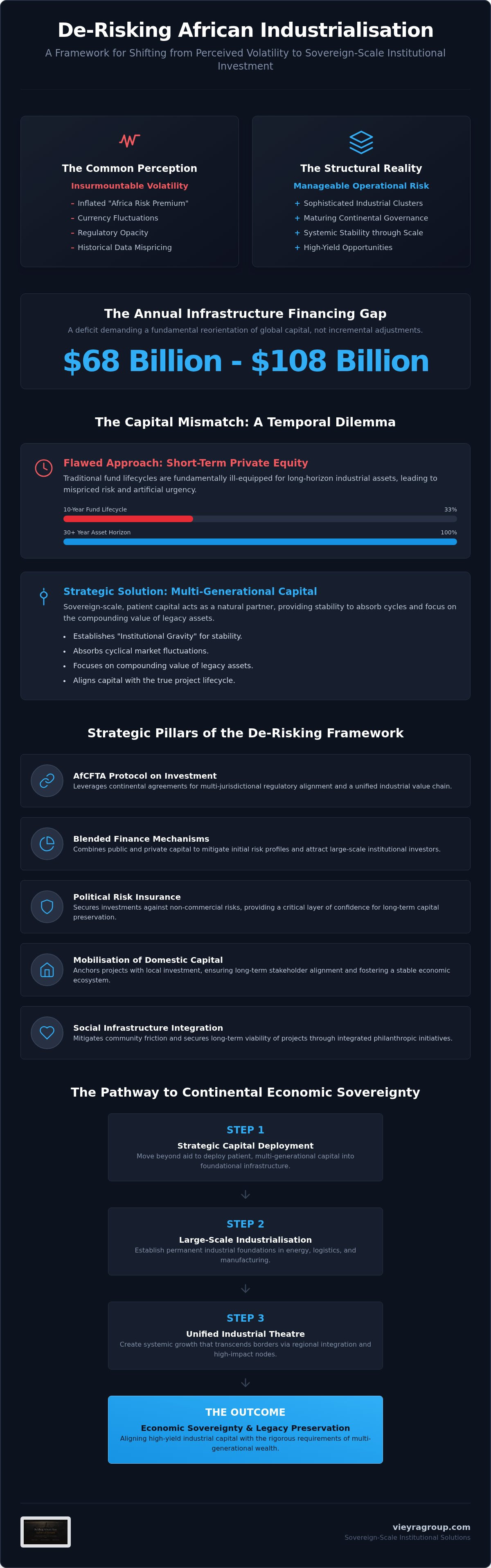
The narrative of African industrialisation remains inextricably linked to the physical and digital conduits that facilitate the movement of goods, energy, and information across the continent's diverse jurisdictions. Current estimates indicate a persistent annual financing gap ranging from $68 billion to $108 billion, a deficit that requires more than mere incremental adjustment. It demands a fundamental reorientation of how global capital engages with the continent. Transitioning from the legacy of developmental aid toward the deployment of strategic capital is the essential precursor for de-risking infrastructure investments Africa. This strategic pivot prioritizes the establishment of permanent industrial foundations over transient assistance, positioning sovereign-scale intervention as the only viable mechanism to bridge the existing investment chasm.
Infrastructure as the Foundation of Industrialisation
Industrial productivity cannot exist in a vacuum; it requires the reliable convergence of energy security and logistical efficiency to thrive. The viability of large-scale manufacturing is predicated on the strength of regional integration, where projects like the Trans-African Highway network serve as the circulatory system for a nascent continental market. Sovereign-scale infrastructure in 2026 represents the synthesis of multi-jurisdictional regulatory alignment and institutional capital deployment designed to underpin a continent-wide industrial value chain. By focusing on these high-impact nodes, investors can catalyze systemic growth that transcends individual borders and creates a unified industrial theatre. It's the deliberate alignment of capital with long-term industrial objectives that ultimately secures the continent's future.
The Limitations of Short-Term Capital Allocation
A significant portion of the perceived volatility in African markets stems from a profound temporal mismatch between capital sources and asset requirements. Traditional private equity models, constrained by ten-year fund lifecycles, are fundamentally ill-equipped to manage the thirty-year operational horizons typical of major industrial assets. This structural short-termism forces an artificial urgency onto projects that require patient, methodical development, often leading to mispriced risk and premature exits. Multi-generational capital acts as the natural partner for African industrialisation, providing the stability necessary to absorb cyclical fluctuations while focusing on the compounding value of legacy assets. When capital is aligned with the actual lifecycle of the infrastructure it funds, the phantom risks of short-term volatility begin to dissipate, revealing the underlying strength of the African economic trajectory.
Structural Risk vs. Perceived Volatility: A Sophisticated Dichotomy
The "Africa Risk Premium" frequently functions as a mispriced metric, rooted in historical datasets that fail to account for the contemporary maturation of continental governance and the rise of sophisticated industrial clusters. This perceived volatility often obscures the vital distinction between manageable operational friction and genuine systemic instability, leading to a paralysis of capital that overlooks high-yield opportunities. For those seeking the most effective methods for de-risking infrastructure investments Africa, the objective is to move beyond reactionary hedging toward the cultivation of institutional gravity. Institutional gravity is the stabilizing force exerted by a sovereign-scale entity whose presence ensures regulatory adherence and social equilibrium through its sheer scale and multi-generational permanence. By establishing a presence that is perceived as an immutable fixture of the industrial landscape, an institution can effectively anchor the legal and social expectations of all stakeholders.
The Architecture of Institutional Stability
Sovereign-scale institutions serve as the indispensable anchors of industrial progress, providing a level of permanence that transient private equity capital cannot replicate. Their involvement signals a commitment to transparent governance frameworks that transcend individual political cycles, thereby reducing the probability of arbitrary regulatory shifts or contract frustrations. This institutional permanence acts as a shield against the erraticism often associated with emerging markets, fostering an environment where long-term industrialization can flourish without the constant threat of systemic disruption. Organizations that prioritize global investment management through a lens of multi-generational stewardship are uniquely positioned to navigate these complexities with a poise that smaller actors lack. Such entities don't merely observe the environment; they actively shape the regulatory and social architecture to ensure systemic stability for all partners involved.
Currency and Inflationary Resilience
Mitigating currency risk requires a strategic shift from expensive, short-term derivatives toward structural revenue matching and local currency financing. In the 2026 landscape, the implementation of the AfCFTA Protocol on Investment provides a more harmonized framework for managing cross-border capital flows, effectively reducing the friction previously inherent in regional industrial projects. Inflation-linked infrastructure yields offer a robust mechanism for wealth preservation, as industrial assets inherently maintain value relative to the underlying economic activity and the essential nature of the services they provide. As African monetary policies continue to align with global standards of fiscal discipline, the focus shifts toward securing yields that are resilient to inflationary pressures through meticulously structured off-take agreements. This structural approach ensures that the capital remains protected, regardless of the temporary fluctuations in foreign exchange markets, by anchoring returns to the tangible productivity and the indispensable utility of the industrial asset itself, providing a definitive roadmap for de-risking infrastructure investments Africa.
The Framework of De-risking: Strategic Capital Mechanisms
The technical architecture of de-risking infrastructure investments Africa relies upon the seamless integration of sophisticated capital tools and rigorous legal protections designed to withstand the complexities of large-scale industrial development. In the 2026 landscape, the maturation of Political Risk Insurance (PRI) and credit enhancement mechanisms has provided a necessary buffer for institutional capital, effectively insulating investors from non-commercial risks such as expropriation or breach of contract. These tools don't merely provide a safety net; they function as a catalyst for participation, allowing sovereign-scale entities to deploy capital with the certainty that their multi-generational objectives remain protected. This mechanical approach to risk mitigation ensures that the focus remains on industrial productivity and long-term yield generation rather than the management of exogenous shocks.
Blended Finance and Multilateral Alignment
Blended finance represents a pivotal evolution in the deployment of Strategic Capital Solutions, where the synergy between Multilateral Development Banks (MDBs) and sovereign-scale family offices creates a formidable investment vehicle. By layering concessional capital alongside commercial tranches, these structures allow MDBs to absorb first-loss positions, thereby significantly improving the risk-adjusted returns for private institutional partners. Evidence of this collaborative efficacy is found in the African Development Bank Group's 2025 performance, where the institution mobilized $4.3 billion from partners to complement its own $10.9 billion in approvals. This strategic alignment ensures that industrial projects possess the necessary financial resilience to navigate early-stage development hurdles while maintaining a trajectory toward commercial viability and systemic impact.
Contractual Rigour and Dispute Resolution
The bedrock of industrial stability is found in the adoption of stable contractual environments, often anchored in English Law and reinforced by international arbitration clauses that provide a predictable path for dispute resolution. The implementation of the AfCFTA Protocol on Investment has further fortified this legal landscape; as of early 2026, member states initiated systematic Regulatory Audits to align domestic investment frameworks with these continental standards. Such alignment is critical when structuring long-term Power Purchase Agreements (PPAs) or logistical concessions, as it mitigates the threat of regulatory change and ensures that the terms of engagement remain immutable over the asset's lifecycle. By embedding these protections into the project's DNA, investors can secure their legacy against the shifting tides of local policy, ensuring that the industrial assets continue to serve as pillars of continental growth for decades to come.
Implementation through Strategic Stewardship and Philanthropy
The implementation of sovereign-scale industrialisation requires more than the mere allocation of capital; it demands the cultivation of a stable socio-economic tapestry. Strategic philanthropy acts as the essential precursor to high-impact investment by establishing the social infrastructure necessary for long-term operational success. Through the Vieyra Foundation, our institution addresses the systemic gaps in education and community welfare that often precipitate operational friction. This method of de-risking infrastructure investments Africa ensures that industrial hubs are not isolated enclaves but integrated components of a thriving regional economy. When the local populace is empowered through skill-building and healthcare, the resulting community prosperity acts as a natural shield for the project's security.
Systemic Stability through Social Impact
Integrating philanthropic goals with industrial investment mandates creates a synergy that traditional investment models frequently ignore. By focusing on the human element of industrialisation, we reduce the probability of community-led delays or political hostility that can derail even the most technically sound projects. The Vieyra Approach to social stewardship is the deliberate cultivation of socio-economic equilibrium to ensure that industrial progress and community development remain inextricably linked. This strategy ensures that the longevity of the asset is secured by the very people who live within its sphere of influence. It's a methodical process of building trust and shared value that reinforces the institutional gravity of the investment, transforming social impact into a quantifiable risk-mitigation tool. Effectively, this social integration is as critical as any financial instrument for de-risking infrastructure investments Africa over a multi-decade horizon.
The Multi-Generational Stewardship Model
Moving from a landlord mindset to a stewardship model is fundamental for ensuring the permanence of capital in emerging markets. This transition requires a profound commitment to institutional legacy and a deep understanding of the sovereign-level relationships that underpin continental progress. By acting as a stately guardian of African capital, an institution can manage industrial assets with the foresight required for multi-generational returns. This approach relies on local knowledge to anticipate regulatory shifts and social trends, allowing for the proactive adjustment of strategic capital solutions. Stewardship is about more than management; it's about the visionary architecting of a future where industrial assets serve as permanent landmarks of economic sovereignty. For those seeking to align their legacy with these high-impact objectives, we invite you to examine our African Industrialization Capital frameworks.
Aligning with the Vieyra Legacy: Sovereign-Scale Solutions
The Vieyra Family Office serves as a primary catalyst for continental transformation, moving beyond the role of a traditional financier to become a visionary architect of economic sovereignty. Our approach to capital allocation is rooted in the preservation of multi-generational wealth, ensuring that every industrial project we undertake contributes to a permanent legacy of progress. By facilitating de-risking infrastructure investments Africa, we create a secure environment where global institutional partners can align their objectives with the continent's industrial potential. This isn't merely a commercial endeavor; it's the deliberate construction of a future where African industrialisation is the cornerstone of global stability. Legacy is built through permanence. The meticulous orchestration of global capital and industrial necessity requires a partner whose vision spans decades, not fiscal quarters.
Global Investment Management with an African Heart
Bridging the gap between global capital markets and African industrial needs requires more than technical proficiency; it demands a level of institutional prestige that commands respect on the world stage. Our expertise in Global Investment Management allows us to translate the complexities of the African landscape into the language of global finance, providing the clarity and confidence required for sovereign-scale allocation. We don't just manage capital; we curate opportunities that reflect the dignity and ambition of the continent. This institutional gravity ensures that our partners are not merely investors but co-architects of a new industrial era. To explore how your capital can be aligned with this vision, we invite you to Engage with Vieyra Family Office for strategic capital solutions. Through this partnership, we secure the foundations of wealth while driving systemic progress.
The Path Toward African Industrialisation
Our vision for the 2026-2035 development cycle centers on the creation of a self-sustaining, industrialised African continent that no longer relies on external volatility for its economic health. This cycle represents a unique window where the alignment of the AfCFTA, domestic capital mobilization, and sophisticated Strategic Capital Solutions can yield unprecedented results. We view industrial assets as the ultimate legacy instruments, providing inflation-linked yields that are resilient to the shifting tides of global geopolitics. As we move toward this future, the permanence of African infrastructure yields will become the benchmark for institutional stability. It's a journey defined by the quiet confidence of an institution that knows its trajectory and understands the profound responsibility of its heritage. The industrialisation of Africa is not an aspiration; it's an unfolding reality that we are uniquely positioned to steward for generations to come.
Architecting the Future of African Economic Sovereignty
The transition from speculative engagement toward a structured, sovereign-scale framework is the essential requirement for long-term success. By distinguishing between manageable operational friction and systemic instability, institutional partners can unlock the profound potential of continental industrialisation. The strategy of de-risking infrastructure investments Africa depends upon the synthesis of contractual rigour, strategic capital mechanisms, and a deep commitment to social stewardship. It's a methodical process that transforms perceived volatility into a predictable engine for wealth preservation and industrial progress.
As a stately institutional guardian of African capital, we provide a multi-generational investment perspective that transcends the limitations of traditional finance. Our sovereign-scale global influence ensures that industrial assets are managed with the poise and foresight required to secure a lasting legacy. We invite you to Explore our Sovereign-Scale Capital Solutions and join us in architecting a future defined by permanence and stability. The path toward a self-sustaining African industrial landscape is clear, and the foundations for multi-generational returns are already being laid. We look forward to a future where African industrial excellence serves as a global standard of success.
Frequently Asked Questions
What are the primary instruments used to de-risk infrastructure in Africa?
The primary instruments for de-risking infrastructure investments Africa include Political Risk Insurance (PRI), partial credit guarantees, and blended finance structures that integrate developmental tranches with commercial capital. These mechanisms are reinforced by rigorous legal frameworks, typically anchored in English Law, and international arbitration clauses. By utilizing these tools, sovereign-scale institutions can isolate non-commercial risks and ensure that capital remains protected throughout the extended lifecycle of large-scale industrial projects.
How does blended finance improve the risk-adjusted return of African projects?
Blended finance improves risk-adjusted returns by utilizing concessional capital from Multilateral Development Banks to absorb first-loss positions or provide lower-interest debt. This layering of capital reduces the overall cost of financing and provides a buffer for commercial investors against early-stage project volatility. In 2025, the African Development Bank mobilized $4.3 billion from partners using such structures, demonstrating the efficacy of aligning developmental mandates with the requirements of private institutional capital.
What is the role of Political Risk Insurance (PRI) in sovereign-scale investments?
Political Risk Insurance serves as a critical safeguard against non-commercial interruptions, including expropriation, currency inconvertibility, and breach of contract by host governments. In sovereign-scale investments, PRI provides the necessary certainty to deploy significant capital into jurisdictions where perceived volatility might otherwise deter participation. This instrument effectively transfers geopolitical risk to the insurance market, allowing the investor to focus on the operational excellence and long-term industrial productivity of the asset.
How do multi-generational family offices approach African industrialisation differently than PE firms?
Multi-generational family offices, such as the Vieyra Family Office, prioritize the permanence of capital and the creation of industrial legacy over the restricted ten-year cycles typical of private equity firms. This extended time horizon allows for the patient development of infrastructure assets that align with long-term wealth preservation goals. While PE firms focus on exit-driven returns, sovereign-scale family offices act as stately guardians, fostering industrialisation through stable, long-term partnerships that survive short-term market fluctuations.
What impact does regional integration (AfCFTA) have on infrastructure risk?
Regional integration through the AfCFTA Protocol on Investment significantly lowers infrastructure risk by harmonizing investment regulations and terminating inconsistent bilateral investment treaties across the continent. This framework initiates systematic regulatory audits to align domestic laws with continental standards, creating a more predictable environment for cross-border industrial projects. By facilitating the free movement of capital and reducing jurisdictional friction, the AfCFTA enhances the bankability of regional value chains and large-scale logistical networks.
How can currency volatility be managed in long-term African infrastructure assets?
Currency volatility is managed through structural revenue matching, where project off-take agreements are indexed to hard currencies or aligned with the inflationary reality of local markets. Additionally, the increasing use of local currency financing and credit enhancement tools helps mitigate the impact of foreign exchange fluctuations on debt service. These strategies ensure that infrastructure yields remain resilient, providing a stable foundation for capital preservation even during periods of significant monetary adjustment across African jurisdictions.
What is the importance of social impact in de-risking large-scale industrial projects?
Social impact is a fundamental de-risking tool that reduces community friction and secures the long-term license to operate for industrial projects. Through initiatives led by the Vieyra Foundation, investors create social infrastructure that fosters community prosperity and skill-building, thereby mitigating the risk of operational delays or local hostility. This proactive stewardship ensures that industrial hubs are perceived as beneficial fixtures of the local economy, rather than isolated enclaves, enhancing systemic stability.
Why is institutional gravity essential for sovereign-scale capital deployment?
Institutional gravity is the stabilizing force exerted by a sovereign-level entity whose scale and permanence ensure regulatory adherence and social equilibrium. For sovereign-scale capital deployment, this gravity acts as an anchor, discouraging arbitrary policy shifts and fostering a culture of contractual rigour among all stakeholders. It's the presence of an immutable institution that provides the psychological and structural certainty required to navigate the complexities of African industrialisation with quiet confidence and multi-generational vision.


