
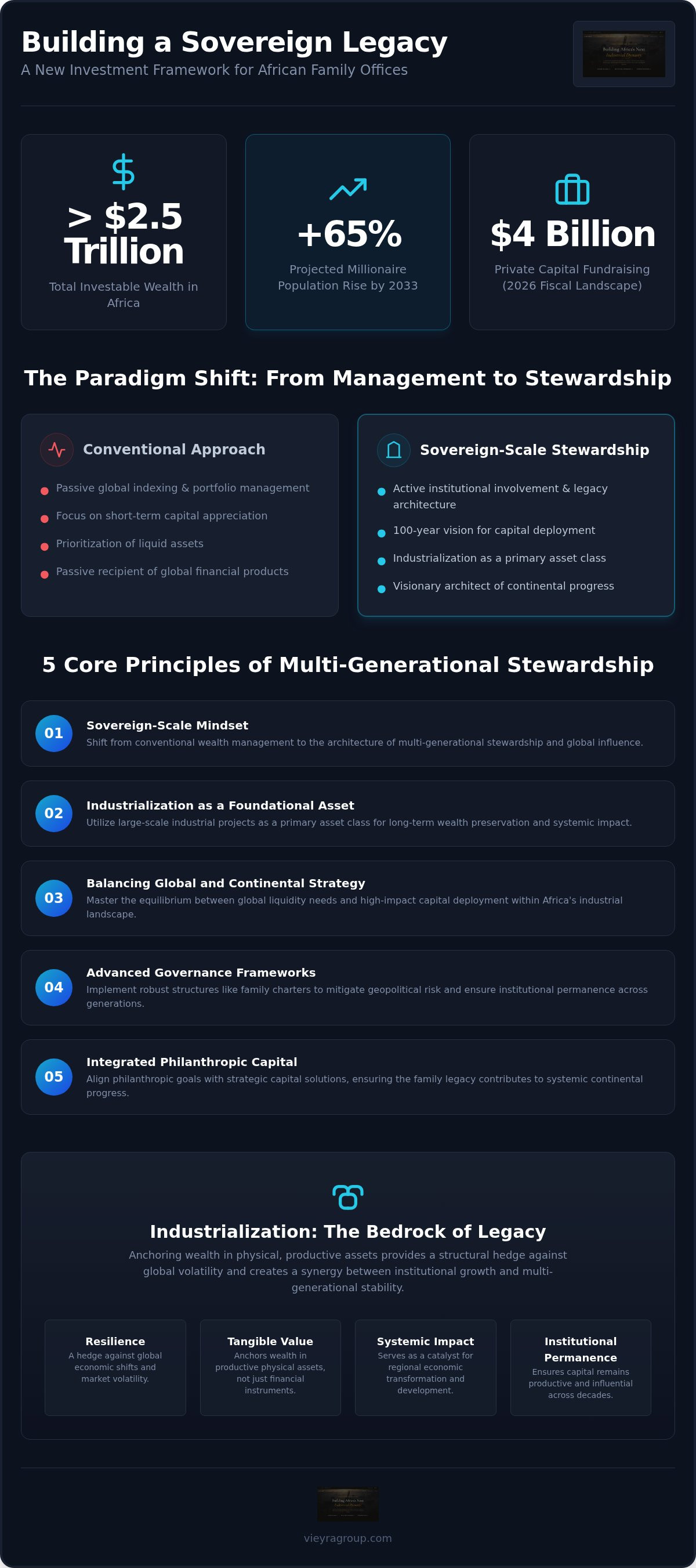
With Africa’s investable wealth now exceeding USD 2.5 trillion and the millionaire population projected to rise by 65 percent by 2033, the traditional paradigms of wealth management are proving insufficient for the continent’s emerging sovereign-scale legacies. The discerning principal understands that the preservation of multi-generational capital requires more than passive global indexing; it demands a sophisticated long-term investment strategy for African family offices that balances international diversification with direct participation in continental industrialization. While the perceived risks of local markets often deter institutional-grade commitment, the reality of the 2026 fiscal landscape, characterized by stabilizing corporate tax rates and robust private capital fundraising reaching USD 4 billion, presents a unique window for systemic impact.
This article provides an authoritative exploration of the institutional principles and capital allocation frameworks necessary to transform family wealth into a permanent engine of progress. By adopting a sovereign-scale perspective, we shall examine the integration of global investment returns with large-scale industrial projects, ensuring that your legacy remains both resilient and transformative. We will detail the methodologies for navigating divergent monetary policies across key hubs like Nigeria and Kenya, the formalization of governance through family charters, and the strategic deployment of capital into infrastructure to catalyze both institutional permanence and continental development.
Key Takeaways
- Define the conceptual shift from conventional private wealth management to the architecture of multi-generational stewardship and sovereign-scale influence.
- Identify the strategic imperatives of a long-term investment strategy for African family offices that utilizes industrialization as a foundational asset class for wealth preservation.
- Master the equilibrium between global liquidity requirements and high-impact capital deployment within the African industrial landscape.
- Implement advanced governance structures that mitigate geopolitical risk while fostering institutional permanence across successive generations.
- Integrate philanthropic objectives with strategic capital solutions to ensure that family legacies contribute to systemic continental progress.
The Paradigm of Multi-Generational Stewardship in the African Context
Within the context of the African continent, stewardship represents more than the simple administration of wealth; it's a philosophy of permanence and global influence. The transition from a passive recipient of global financial products to a visionary architect of legacy defines the modern African principal. Establishing a robust long-term investment strategy for African family offices requires a departure from the transient nature of short-term capital appreciation in favor of sovereign-scale legacy building. A sophisticated family office serves as the central node in this ecosystem, acting as a significant global actor that blends traditional values with a forward-looking commitment to large-scale progress.
The Architecture of Permanence: Beyond Liquid Assets
True wealth preservation necessitates a shift from passive portfolio management to active institutional involvement. It's about creating institutional gravity. This concept refers to the weight and stability an organization projects within the global financial landscape. While conventional services focus on the velocity of trades, a sovereign-scale framework prioritizes the depth of impact. It requires a 100-year vision for capital deployment, ensuring that assets are not merely held but are actively utilized to secure the family's position across generations. This involves moving beyond liquid holdings into strategic capital solutions that offer both resilience and a hedge against global market volatility. Legacy is not accidental. It's a deliberate construction.
Cultural Heritage as a Strategic Investment Filter
Intellectual sophistication is the cornerstone of managing complex global portfolios. For the African principal, this involves aligning investment mandates with multi-generational family values. Africa's investable wealth, currently exceeding USD 2.5 trillion, provides the foundation for this transformation. Legacies across the continent are uniquely positioned to lead regional economic transformation by filtering opportunities through the lens of cultural heritage. It's not just about profit; it's about the systemic impact of industrialization. By integrating these values into a long-term investment strategy for African family offices, families ensure their wealth remains a catalyst for continental development. This alignment creates a sense of purpose that transcends financial returns, fostering institutional permanence that survives the critical first-generation transition.
Strategic Capital Allocation: Industrialization as a Primary Asset Class
The evolution of global capital markets necessitates a fundamental reevaluation of traditional asset classes. For entities operating with the foresight of a stately guardian, industrialization emerges not merely as a developmental objective but as a primary asset class characterized by tangible value and systemic impact. Sovereign-scale capital refers to the deployment of resources with the deliberation and magnitude typically associated with state institutions. This approach allows families to transcend the inherent volatility of public equities and fixed-income markets. By anchoring wealth in physical, productive assets, a robust long-term investment strategy for African family offices provides a structural hedge against global economic shifts. These industrial commitments create a profound synergy between institutional growth and multi-generational stability, ensuring that capital remains productive across several decades while serving as a catalyst for regional economic transformation.
Financing the African Industrial Renaissance
Large-scale infrastructure and industrial projects require a sophisticated understanding of project finance and geopolitical complexity. According to the World Investment Report 2026, strategic sectors in Africa are increasingly attracting sophisticated capital that prioritizes long-term resilience over immediate liquidity. Navigating these complexities demands a level of institutional expertise that goes beyond standard wealth management. Financing an industrial renaissance involves coordinating with regional development banks and sovereign entities to secure projects that offer long-term strategic value. This methodical approach to capital deployment ensures that industrial initiatives are not only profitable but also foundational to the continent's economic architecture. It requires the poise of an entity that is deeply rooted in its identity and certain of its trajectory.
Direct Investment vs. Fund Participation in African Markets
The choice between direct capital allocation and fund participation represents a pivotal strategic decision for sovereign-scale entities. Direct investment offers the distinct advantage of total alignment with a family's multi-generational vision, allowing for active participation in the governance of industrial assets. It enables the institution to build the internal capacity necessary to manage complex industrial portfolios, ensuring that every initiative reflects the family's core values and long-term objectives. By leveraging strategic capital solutions, family offices can effectively de-risk continental projects through sophisticated structuring and strategic depth. This shift from passive fund participation to active stewardship is what distinguishes a sovereign-level institution from a standard service consumer, reinforcing the aura of permanence and global influence required to preserve wealth through African industrialization.
Balancing Global Diversification with Continental Economic Transformation
The synthesis of global capital preservation and continental industrial transformation represents the definitive challenge for the modern African principal. Achieving this equilibrium requires a sophisticated capital allocation framework that views global markets not as an end, but as a strategic reserve. A robust long-term investment strategy for African family offices must intentionally structure portfolios to absorb the shocks of regional currency fluctuations while maintaining the firepower necessary for large-scale industrial commitments. This Global-African architecture ensures that the institution remains a visionary architect of legacy, capable of deploying capital with the deliberation of a sovereign entity. By reconciling the stability of mature markets with the high-growth potential of African industrialization, the family office secures its position as a stately guardian of multi-generational progress.
Global Markets as a Liquidity Engine for African Projects
Maintaining a presence in international capital markets provides the essential liquidity engine required to sustain multi-year industrial initiatives. Through sophisticated global investment management, family offices capture returns from mature economies to offset the inherent illiquidity of domestic infrastructure assets. This interplay is particularly critical given the divergent monetary policies observed across the continent in 2026. With Nigeria maintaining a high monetary policy rate of 26.50 percent to combat inflation and Kenya prioritizing growth through more accommodative stances, sophisticated global syntactical arrangements are mandatory to manage currency risk. Utilizing international equity returns as a buffer allows the family office to maintain its commitment to African development without compromising the stability of the core estate.
The Multi-Generational Portfolio Mix for 2026
The institutional portfolio of 2026 reflects a significant shift toward complexity and long-term strategic depth. Current data indicates that approximately 42 percent of assets within leading family offices are now allocated to alternatives, including private equity, infrastructure, and industrial capital. This multi-generational mix prioritizes systemic impact as a core measure of portfolio success, moving beyond traditional benchmarks. Integrating these alternative assets into a cohesive strategy allows the office to function as a significant global actor, ensuring wealth is both preserved and actively contributing to the continent's industrial renaissance. Success in this landscape is defined by the resilience of the industrial ecosystem the family helps construct, providing a foundation for institutional permanence that survives across several generations.
Institutional Risk Mitigation and Governance Frameworks
Navigating the geopolitical intricacies of the 2026 African economic environment requires more than mere administrative diligence; it demands a level of institutional poise that transforms risk into a manageable variable. A robust long-term investment strategy for African family offices incorporates proactive sovereign-scale risk management to protect against systemic shocks. This involves a shift from defensive compliance to the cultivation of strategic depth, where the family office operates as a significant global actor with the foresight to anticipate shifts in the continental landscape. By moving beyond traditional risk assessments, the principal ensures that the estate maintains its trajectory of influence and stability despite the inherent complexities of large-scale industrial investments.
Sovereign-Level Partnerships and Risk Sharing
Entering into partnerships with sovereign entities and regional development banks provides a powerful mechanism for risk sharing in large-scale industrialization projects. These alliances allow for the structuring of agreements that protect multi-generational interests while aligning capital with national development goals. Institutional gravity serves as a beacon, attracting stable, long-term investment partners who value the deliberation and multi-generational vision of a sovereign-scale entity. By anchoring projects in these institutional alliances, family offices can effectively mitigate the uncertainties of emerging markets. This methodical approach to partnership ensures that every capital deployment is reinforced by a network of stakeholders committed to the project's long-term viability and success.
Governance as the Guardian of Legacy
Governance is the essential guardian of a multi-generational legacy. It requires establishing sophisticated arrangements, such as family charters and formal constitutions, to ensure continuity and stability across successive generations. Considering that only 3 to 5 percent of African family businesses survive beyond the first generation, the role of a formal Investment Committee becomes paramount. This committee, comprised of specialists with deep expertise in African industrialization capital, provides the intellectual sophistication needed to manage a complex global portfolio. This structure ensures that a long-term investment strategy for African family offices is not merely a financial document but a living framework for institutional permanence. It prepares the next generation of wealth stewards to lead as visionary architects of progress, deeply rooted in the family’s core identity.
To ensure your estate maintains its trajectory of influence and stability, it's essential to partner with an institution that understands the weight of legacy. Explore our Strategic Capital Solutions to formalize your sovereign-scale governance framework and secure your family's future.
The Vieyra Model: Integrating Global Investment with African Legacy
The Vieyra Model functions as a sophisticated synthesis of global investment management and profound continental commitment, rejecting the historical dichotomy between international returns and African progress. By integrating the Vieyra Foundation directly into the institutional framework, the office ensures that philanthropic initiatives aren't merely peripheral activities; they're essential components of a broader vision for systemic impact. This alignment allows for the deployment of strategic capital that supports large-scale industrialization, fostering an environment where multi-generational wealth is preserved through the very growth it catalyzes. It's a model built on the premise that true stewardship involves presiding over a legacy that contributes to the fundamental architecture of the continent's economy.
Implementing a long-term investment strategy for African family offices requires this level of deliberation and foresight. It's about building an institution that operates with the quiet confidence of a sovereign actor, prioritizing the creation of industrial assets that serve as the bedrock of the family estate. These assets provide a structural stability that transcends market cycles, ensuring that the family's influence remains constant across generations. The Vieyra approach provides the intellectual sophistication necessary to manage these complex arrangements, blending traditional values with a forward-looking commitment to large-scale progress.
Sovereign-Scale Capital Solutions for Global Africans
The architecture of continental transformation is built on the unique perspective of those who are both globally fluent and deeply rooted in African heritage. This multi-generational lens provides a distinct advantage in identifying sovereign-level initiatives that offer enduring value and regional impact. We invite principals seeking to formalize their institutional vision to explore our Strategic Capital Solutions. These frameworks provide the necessary depth to manage complex, multi-asset portfolios while securing a permanent seat at the table of global influence. It's through these structured solutions that the Global African can effectively bridge the gap between international liquid markets and the high-impact potential of domestic industrialization.
The Future of African Institutional Investment
As we look toward 2026 and beyond, the role of the family office as a primary driver of African prosperity has become undeniable. With the number of formal family offices on the continent having increased by 75 percent since 2015, the shift toward institutional professionalization is well underway. The future belongs to those who view wealth as a tool for systemic progress rather than mere financial accumulation. A robust long-term investment strategy for African family offices must therefore be anchored in the principles of institutional permanence and strategic depth. The Vieyra institution remains dedicated to this vision, acting as a stately guardian for legacies that will shape the continent's trajectory and ensure stability for the next century.
Architecting a Legacy of Permanent Influence
The preservation of multi-generational wealth in the 2026 economic landscape demands a departure from conventional administration toward the architecture of sovereign-scale influence. By integrating industrialization as a foundational asset class and formalizing governance through institutional frameworks, principals can secure their position as visionary architects of continental progress. A robust long-term investment strategy for African family offices isn't merely a financial requirement; it's a commitment to the systemic transformation of the region. This approach ensures that capital remains a productive force, capable of withstanding global volatility while fostering institutional permanence across successive generations.
Vieyra stands as a stately guardian of this vision, blending a multi-generational African heritage with sovereign-scale global investment capacity to secure the futures of the continent’s most influential estates. We invite you to Discover the Vieyra Approach to Sovereign-Scale Stewardship and begin the process of aligning your capital with a legacy of enduring impact. The path toward systemic prosperity is built upon the deliberation and foresight of established institutions. We look forward to architecting this future alongside you.
Frequently Asked Questions
What defines a sovereign-scale investment strategy for African family offices?
A sovereign-scale investment strategy involves deploying capital with the deliberation and magnitude typically associated with state institutions. It represents a shift from passive portfolio management to active participation in foundational economic sectors. This long-term investment strategy for African family offices prioritizes institutional gravity and the creation of systemic impact over transient capital gains. It requires a 100-year vision that aligns family wealth with the continent's industrial transformation and global influence.
How do African family offices mitigate political and currency risk in long-term projects?
Mitigation involves utilizing sophisticated global syntactical arrangements and sovereign-level partnerships to distribute risk. By leveraging international liquidity from global portfolios, families can buffer domestic currency fluctuations and inflationary pressures. Partnering with regional development banks provides a layer of institutional protection and strategic depth. This methodical approach ensures that large-scale industrial commitments remain resilient despite divergent monetary policies in hubs like Nigeria, where interest rates reached 26.50 percent in July 2026.
Why is industrialization considered a critical asset class for multi-generational wealth in Africa?
Industrialization provides tangible, productive assets that serve as a structural hedge against global market volatility. These assets offer the long-term stability required to preserve wealth through the critical first-generation transition and beyond. By anchoring capital in infrastructure and manufacturing, family offices create a legacy that is both profitable and foundational to continental growth. This strategic focus ensures that family wealth grows in tandem with the very industrial ecosystems it helps to construct.
What is the role of institutional philanthropy in a family office investment strategy?
Institutional philanthropy, facilitated through entities like the Vieyra Foundation, aligns social impact with long-term capital objectives. It's not a peripheral activity but a core component of systemic economic development that strengthens the family's legacy. By funding initiatives that support the broader industrial ecosystem, such as specialized education or regional infrastructure, philanthropy de-risks the primary investment portfolio. This integration ensures that the family's influence is defined by both financial resilience and transformative progress.
How should an African family office balance global diversification with local industrial focus?
Balancing requires a Global-African architecture where international capital markets function as a liquidity engine for domestic projects. A sophisticated long-term investment strategy for African family offices typically allocates a significant portion to global equities to ensure stability and diversification. Simultaneously, a concentrated portion of capital is deployed into high-impact African industrialization capital. This dual-track approach allows the institution to capture global growth while driving systemic transformation within home markets.
What are the core principles of institutional stewardship for African legacies?
The core principles include permanence, intellectual sophistication, and the role of a visionary architect. Stewardship isn't merely about administration; it involves presiding over a legacy with the poise of an entity that is certain of its trajectory and global influence. It requires moving beyond simple compliance toward proactive risk management and the formalization of family governance through charters. This ensures that the estate operates as a significant global actor, blending traditional heritage with progress.
How does strategic capital differ from traditional private equity in the African context?
Strategic capital is distinguished by its sovereign-scale horizon and its alignment with multi-generational institutional objectives. Unlike traditional private equity, which often prioritizes short-term exit cycles, strategic capital solutions focus on institutional permanence and long-term industrialization. It involves active involvement in the governance of assets and a commitment to systemic economic development. This approach provides the flexibility and depth required to navigate the complexities of large-scale infrastructure projects across the African continent.
What governance structures are essential for multi-generational wealth preservation in Africa?
Essential governance structures include a formal Investment Committee and a comprehensive family charter to ensure continuity. Given that only 3 to 5 percent of African family businesses survive the first generation, these frameworks provide the necessary institutional gravity for wealth preservation. They ensure that decision-making remains methodical and aligned with a multi-generational vision. Incorporating intellectual sophistication into the next generation's training is equally critical, preparing them to manage complex global portfolios and industrial initiatives.


