
The endurance of an industrial dynasty is not measured by the accumulation of capital but by the institutionalization of the vision that first summoned it into existence. For the stewards of the continent’s most significant enterprises, the transition of leadership represents a critical juncture where the risk of institutional erosion meets the necessity of strategic evolution. You understand that the preservation of a legacy requires more than simple inheritance; it demands a sophisticated architecture capable of bridging the gap between founding industrial legacies and the liquid expectations of the next generation. Effective family office succession planning Africa necessitates a profound alignment of purpose that transcends individual lifespans to secure the permanence of sovereign-scale capital.
This exploration details a robust governance framework designed to survive the founder while maintaining the momentum of Africa’s industrialization mission. We examine the methodologies for achieving legal and fiscal efficiency across diverse African jurisdictions, ensuring that the transfer of wealth remains unburdened by regulatory friction. By the conclusion of this institutional overview, you will possess a clearer understanding of how to align the next generation with a vision of large-scale progress, transforming potential volatility into a structured continuity of global influence.
Key Takeaways
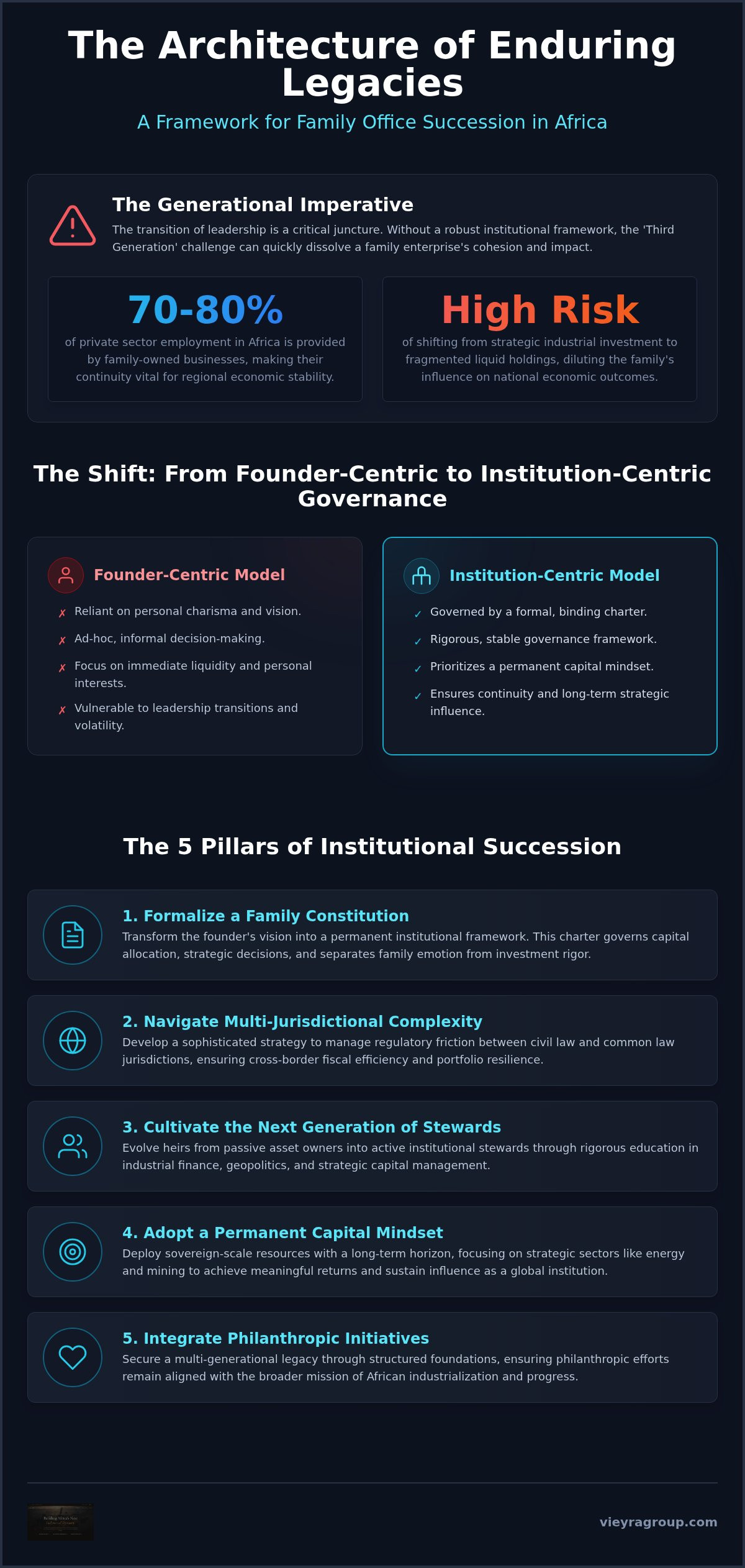
- Formalizing a Family Constitution transforms a founder’s individual vision into a permanent institutional framework that governs capital allocation and strategic decision-making.
- Strategic family office succession planning Africa requires a sophisticated understanding of the regulatory friction between civil law and common law jurisdictions to ensure cross-border fiscal efficiency.
- The transition of the next generation focuses on evolving heirs from passive asset owners into institutional stewards through a rigorous educational path in industrial finance and geopolitics.
- Adopting a permanent capital mindset allows for the deployment of sovereign-scale resources with the deliberation and long-term horizon of a global institution.
- Integrating philanthropic initiatives through structured foundations secures a multi-generational legacy that remains aligned with the broader mission of African industrialization.
The Intergenerational Imperative: Defining Succession for African Sovereign-Scale Institutions
The transfer of significant wealth within the African industrial landscape is frequently mischaracterized as a mere exercise in estate planning. While traditional estate management focuses on the terminal distribution of assets, true institutional succession involves the perpetual stewardship of influence and the preservation of systemic impact. For families operating at a sovereign scale, family office succession planning Africa represents the deliberate construction of an enduring legacy that aligns with the continent's broader industrialization trajectory. It's not just about who inherits the capital, but how that capital continues to serve as a catalyst for regional progress. This permanence is vital given that family-owned businesses in Africa account for an estimated 70% to 80% of private sector employment, making their continuity a matter of regional economic stability.
The 'Third Generation' challenge remains a formidable obstacle in emerging markets, where heightened volatility can quickly dissolve the cohesion of a family enterprise. Without a transition from the founder’s personal charisma to a more rigorous, institution-centric governance model, the gravity that once held the organization together begins to fail. This erosion often leads to a shift from industrial investment toward fragmented liquid holdings, ultimately diluting the family’s ability to influence national economic outcomes. A permanent capital mindset ensures that resources remain deployed in strategic sectors like energy and mining, where long-term horizons are necessary to achieve meaningful returns.
The Shift from Founder-Centric to Institution-Centric Governance
The transition from an individual-led enterprise to a systemic institution marks the maturity of a Family office. It requires the replacement of ad-hoc decision-making with a governance framework that values stability over immediate liquidity. Institutional succession is the preservation of strategic capital for regional development. By establishing these structures, families ensure that their industrial footprint remains a permanent fixture of the African economy, regardless of leadership changes. This shift creates an aura of institutional gravity that attracts global partners and secures the family’s position as a visionary architect of progress.
Geopolitical Considerations in African Wealth Transfer
The evolution of pan-African trade agreements and shifting regulatory environments creates a complex backdrop for the transfer of sovereign-scale capital. Family offices must navigate the intersection of private legacy and national economic interests, ensuring their portfolios remain resilient across multiple jurisdictions. These entities act as vital financiers for large-scale infrastructure and mining projects, filling a gap that traditional banking institutions often cannot bridge. Their role in maintaining regional economic influence is increasingly tied to their ability to manage wealth across borders with legal and fiscal precision. It's this strategic depth that allows a family to remain a significant global actor across multiple generations.
The Architecture of Governance: Formalizing the Family Constitution
The establishment of a Family Constitution serves as the foundational bedrock for any sovereign-scale entity seeking to ensure the permanence of its industrial footprint. Within the sphere of family office succession planning Africa, this document functions as a living testament to institutional intent, translating the often ephemeral oral traditions of stewardship into a formal, binding charter. It provides the necessary clarity to distinguish between the emotional bonds of kinship and the rigorous demands of global investment management. By codifying these values, a family office transitions from a collection of private interests into a significant global actor with a unified strategic trajectory. This governance architecture ensures that the scale of operations is sustained through the weight of established protocols rather than the individual will of a single leader.
A critical component of this framework is the clear delineation of roles between family members and professional institutional managers. While the family remains the ultimate guardian of the legacy and the architect of its long-term vision, professional managers bring the intellectual sophistication required to navigate complex global markets. This synergy is particularly vital when educating the next generation of stewards, as it provides a structured environment where they can observe the application of systemic discipline to large-scale capital solutions. It's this methodical approach that prevents the erosion of institutional gravity during generational shifts, maintaining the family’s position as a visionary architect of progress.
Codifying Values and Strategic Intent
The formalization of a charter is not merely a bureaucratic exercise; it's a strategic necessity for maintaining alignment across generations. These documents must explicitly align investment management protocols with the family’s overarching industrialization goals, ensuring that capital remains committed to projects that foster systemic impact. By establishing formal mechanisms for conflict resolution and intergenerational consensus, the constitution mitigates the risk of fragmentation that often plagues wealth transfers in volatile markets. Integration of the Vieyra Foundation further solidifies this framework, providing a structured vehicle for philanthropic continuity that reinforces the family's identity as a stately guardian of progress and social development.
The Role of the Investment Committee in Succession
The Investment Committee functions as the engine of continuity, ensuring that the family's commitment to strategic capital solutions remains unwavering during leadership transitions. This body must balance the preservation of multi-generational wealth with the aggressive pursuit of industrial growth, a task that requires a high level of professional rigor. Utilizing external advisors within this committee introduces a layer of objective scrutiny that protects the institution from the biases of internal family dynamics. It's through this methodical approach that a family office maintains its poise and stability, even as it navigates the rapid shifts of the African industrial landscape. For those seeking to refine these governance structures, exploring Strategic Capital Solutions offers a path toward establishing a truly permanent legacy.
Navigating Multi-Jurisdictional Complexity: African and Global Structures
The strategic execution of family office succession planning Africa demands a sophisticated mastery of the divergent legal architectures that define the continent’s economic landscape. Institutions must reconcile the civil law tenets of the OHADA region, which governs commercial activity across 17 states, with the common law frameworks prevalent in significant jurisdictions such as Nigeria, Kenya, and South Africa. This friction necessitates a meticulous approach to asset protection, where the integration of offshore and onshore structures serves to insulate sovereign-scale capital from localized volatility. By utilizing these multi-layered structures, a family office maintains the institutional gravity required to facilitate large-scale industrial projects while ensuring that the transfer of wealth remains unencumbered by jurisdictional boundaries. In an era of heightened global transparency, maintaining rigorous regulatory compliance is no longer a peripheral concern but a core component of institutional stability.
The implementation of trusts and foundations within a pan-African capital management strategy provides a robust mechanism for the consolidation of fragmented assets. These vehicles allow for the centralized administration of wealth, ensuring that the family’s industrialization mission is supported by a unified fiscal policy. This centralization is particularly vital for managing the systemic risks associated with cross-border operations, including the navigation of varied anti-money laundering protocols and complex tax reporting requirements. By establishing these frameworks, the family office functions as a stately guardian of legacy, possessing the structural depth to withstand the shifting geopolitical tides of the African continent.
Comparative Analysis of African Investment Hubs
The selection of a primary domicile requires a careful evaluation of the legal protections and fiscal efficiencies offered by various regional hubs. Mauritius remains a preeminent choice, particularly following the introduction of the Financial Services (Family Office) Rules 2026, which established a minimum capital requirement of USD 50,000 for Multi-Family Offices while removing such requirements for Single-Family Offices. Conversely, South Africa offers a deep pool of institutional expertise but requires navigation of a complex tax environment where estate duty reaches 25% for assets exceeding R30 million. The strategic use of double taxation treaties in these jurisdictions is essential for the efficient deployment of African industrialization capital, ensuring that resources are preserved for multi-generational growth rather than eroded by redundant fiscal burdens.
Harmonizing Global Assets with African Interests
Managing a global investment portfolio while simultaneously financing local industrial initiatives requires a disciplined approach to currency risk and capital controls. The family office must ensure that its global investment management activities provide the necessary liquidity to support capital-intensive projects in sectors such as energy and mining. Jurisdictional agility is the prerequisite for institutional permanence in a landscape where regulatory borders are as fluid as the capital that crosses them. By maintaining this flexibility, a family office ensures that its legacy is not confined by geography but is instead empowered by a global reach that serves its regional mission. This harmonization of interests creates a resilient capital base that can withstand the unique challenges of the African industrial landscape.
Preparing the Next Generation: Stewardship of Industrial Capital
The evolution of the heir within a sovereign-scale entity is a deliberate transformation, moving beyond the simplistic role of a beneficiary toward the profound responsibilities of an institutional steward. This metamorphosis requires the dismantling of the founder myth, a psychological transition that replaces individual charisma with a commitment to the family’s enduring industrialization mission. Such a shift is increasingly vital as data from Citizen Digital (June 2026) indicates that between 6,800 and 7,200 dollar millionaires in Kenya are currently managing approximately US$90 billion in assets that are beginning to pass to the next generation. Within the framework of family office succession planning Africa, this process ensures that capital is viewed not as a personal resource, but as a systemic tool for regional development. Through the curation of an educational path centered on industrial finance and the nuances of global geopolitics, the institution prepares its future leaders to navigate the complexities of an evolving continent with the poise of a significant global actor.
Younger generations must be integrated into strategic capital allocation decisions early, fostering a sense of shared responsibility for the family’s industrial footprint. This involvement allows for the gradual transfer of decision-making authority, ensuring that the transition of power is methodical rather than disruptive. It's about building a bridge between traditional heritage and future progress, ensuring the family remains a visionary architect of legacy.
Mentorship and Institutional Immersion
The immersion of future leaders into the daily operations of large-scale industrial projects provides the practical foundation necessary for sovereign-scale interaction. Shadowing senior leadership allows heirs to gain firsthand exposure to the strategic depth required to manage complex infrastructure and mining initiatives. A rigorous rotation through global investment management divisions further refines their intellectual sophistication, enabling them to balance the preservation of multi-generational heritage with the demands of modern markets. This methodical exposure ensures that the scale of operations remains consistent across generations, reinforcing the institutional gravity of the family office and its approach to family office succession planning Africa.
Fostering an Entrepreneurial Legacy within the Family Office
While the preservation of legacy remains paramount, the survival of an institution often depends on its ability to identify and capture new growth vectors within the African landscape. Encouraging an entrepreneurial mindset allows the next generation to innovate within the established governance framework, ensuring that the family’s industrial mission remains relevant in a shifting economic environment. The Vieyra Foundation plays a pivotal role here, serving as a laboratory for social impact leadership and reinforcing the family’s identity as a stately guardian of progress. To ensure your institution is prepared for this transition, explore our expertise in Global Investment Management.
The Vieyra Framework: Securing a Permanent African Legacy
The Vieyra Framework represents the culmination of systemic discipline applied to the preservation of multi-generational influence. It moves beyond the traditional advisory model, positioning the family office as a significant global actor that operates with the deliberation and foresight of a sovereign institution. Within the context of family office succession planning Africa, this approach ensures that the strategic transfer of capital is not merely a legal event but a comprehensive institutional evolution. By leveraging deep institutional expertise, the framework allows families to navigate the continent’s growth potential with a composed and authoritative stance that suggests long-term stability. This synergy between strategic capital deployment and the philanthropic mission of the Vieyra Foundation creates a holistic architecture for continuity, ensuring that the legacy remains a permanent force in Africa’s industrial landscape. It's this commitment to systemic impact that distinguishes a stately guardian of progress from a mere manager of assets, providing a roadmap for those who view their wealth as a tool for large-scale industrialization.
Institutional Stability in an Evolving Continent
The Vieyra Family Office maintains a composed stance through market cycles by adhering to a long-term vision for African industrialization. This perspective provides a unifying force that shields the institution from the volatility inherent in emerging markets, allowing for the steady deployment of strategic capital solutions. The permanence of these initiatives ensures that the family office remains a reliable partner in regional development, transcending the short-term fluctuations of the global economy. This stability is the hallmark of an entity that is deeply rooted in its identity and certain of its trajectory, operating with the poise of an established guardian. By prioritizing depth over speed, the institution secures its position as a visionary architect of legacy in an evolving continent.
Commencing the Transition: Strategic Next Steps
The transition toward a permanent institutional structure, a core tenet of family office succession planning Africa, begins with a rigorous audit of existing governance frameworks to determine institutional readiness for the next generation. This evaluation identifies the critical gaps between current operations and the sophisticated requirements of a sovereign-scale entity. Engaging in high-level dialogue regarding the future of the family legacy is essential for aligning the interests of all stakeholders and ensuring a smooth leadership transfer. It's through this methodical and measured process that families can secure The Architecture of Multi-generational Wealth, ensuring their industrial footprint remains a permanent fixture of the continent's progress. This strategic path transforms private heritage into a global influence that survives the founder.
Architecting the Permanent Industrial Legacy
The endurance of an industrial dynasty is defined by its ability to maintain institutional gravity across generations while navigating the intricacies of a shifting geopolitical landscape. This exploration has underscored the necessity of transitioning from founder-centric leadership to an institution-centric governance model, a shift secured through the formalization of a Family Constitution. Mastery of family office succession planning Africa involves the harmonious integration of global investment management with local industrial initiatives, ensuring that capital remains a catalyst for systemic regional development. By cultivating the next generation as sophisticated stewards of sovereign-scale resources, families transform private heritage into a permanent global influence that transcends individual lifespans.
As architects of African industrialization rooted in a multi-generational heritage, we provide the strategic depth required for sovereign-scale investment management. We invite you to engage with the Vieyra Family Office to architect your institutional legacy. The trajectory toward a permanent legacy is built upon the deliberation and foresight of today's stewardship, ensuring that your family's contribution to the continent's progress remains an enduring testament to visionary leadership.
Frequently Asked Questions
What defines a sovereign-scale family office in the African context?
A sovereign-scale family office is an institution that manages capital with the discipline, magnitude, and long-term horizon typically associated with sovereign wealth funds. These entities focus on large-scale industrialization and infrastructure, acting as significant global actors rather than mere wealth managers. They prioritize systemic impact over short-term liquidity, often becoming vital financiers for national development projects. This scale allows them to influence regional economic trajectories while maintaining a multi-generational vision of stability and progress.
How do African family offices navigate the complexities of OHADA and Common Law?
Navigation requires a sophisticated multi-jurisdictional architecture that reconciles the civil law commercial codes of the OHADA region with common law precedents found in other significant markets. Institutions often utilize holding companies in neutral hubs to bridge these legal divides, providing a unified governance layer that protects assets from localized regulatory friction. By maintaining jurisdictional agility, family offices ensure that their industrial footprint remains resilient across the diverse legal and fiscal landscapes of the African continent.
What is the role of a family constitution in industrial wealth preservation?
The family constitution serves as a formal institutional charter that codifies the family’s values and strategic intent while establishing clear protocols for capital allocation. It prevents the fragmentation of assets during leadership transitions by defining the roles of family members versus professional managers. This document is essential for family office succession planning Africa, as it transforms a private legacy into a permanent institutional framework capable of sustaining large-scale industrialization goals across multiple generations.
How can the next generation be prepared for the stewardship of industrial capital?
Preparation involves a deliberate transition from asset ownership to institutional stewardship through structured mentorship and rigorous education in industrial finance. Heirs should undergo rotations in global investment management and shadow senior leadership during the execution of large-scale projects. This immersion fosters the intellectual sophistication required to interact with sovereign-level entities and global partners. By dismantling the founder myth, the institution ensures that future leaders are committed to a systemic mission of regional progress.
Why is institutional philanthropy critical to a family office succession plan?
Philanthropy, managed through entities like the Vieyra Foundation, serves as a unifying tool for multi-generational purpose and social impact leadership. It provides a structured environment where younger family members can develop professional skills while reinforcing the family's identity as a stately guardian of progress. These initiatives align the family’s wealth with broader societal development, creating a legacy that extends beyond financial returns. This synergy between capital deployment and social responsibility ensures long-term institutional stability and cohesion.
What are the primary risks of a disrupted leadership transfer in a family office?
A disrupted transfer often leads to the erosion of institutional gravity and the fragmentation of strategic capital into smaller, less impactful holdings. Without a clear succession framework, intergenerational misalignment can cause a shift from productive industrial assets to fragmented liquid positions. This dilution of influence often results in the loss of global partnerships and diminished regional economic impact. Such volatility threatens the permanence of the family’s legacy and its ability to contribute to large-scale industrialization projects.
How does strategic capital allocation differ across multiple African generations?
Founding generations typically focus on the direct creation of industrial assets, while subsequent generations evolve toward the management of diversified global portfolios. Strategic capital allocation must balance the preservation of this industrial heritage with the necessity of innovation in emerging sectors. This evolution requires a shift toward systemic discipline and professionalized investment committees. Effective family office succession planning Africa ensures that capital remains deployed in strategic sectors like energy and mining, maintaining the institution's regional influence and poise.
Can a family office operate as a sovereign-scale investment institution?
Yes, by adopting the rigorous governance and long-term horizon of a sovereign wealth fund, a family office can function as a significant global actor. This involves deploying Strategic Capital Solutions into large-scale infrastructure and industrialization projects that foster continental economic development. Such institutions operate with a sense of permanence and global reach, transcending the limitations of traditional wealth management. Their scale and strategic depth allow them to act as visionary architects of progress within the African industrial landscape.


