
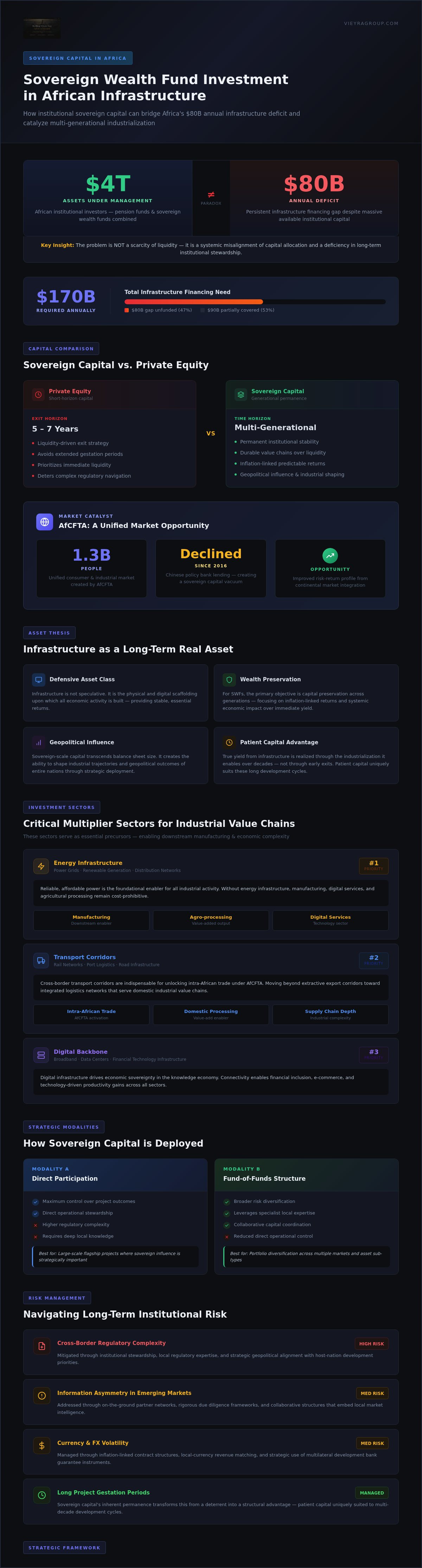
While African institutional investors, including pension funds and sovereign wealth funds, collectively manage approximately $4 trillion in assets, the continent continues to face a persistent $80 billion annual deficit in infrastructure financing. This paradox suggests that the primary obstacle to progress is not a scarcity of liquidity but a systemic misalignment of capital allocation and a deficiency in long-term stewardship. Effectively channeling sovereign wealth fund investment in African infrastructure requires more than mere financial participation; it demands the construction of an enduring architectural framework that prioritizes industrial legacy over transient market fluctuations.
The complexity of cross-border regulations and the inherent information asymmetry in emerging capital markets often deter the very institutions best positioned to drive structural transformation. This analysis provides a rigorous examination of how sovereign-scale capital can bridge these gaps to catalyze multi-generational industrialization across the continent. By exploring the strategic link between large-scale infrastructure deployment and economic sovereignty, this framework outlines the methodologies necessary for institutional actors to secure both systemic impact and the preservation of long-term wealth.
Key Takeaways
- Examine the fundamental distinction between sovereign-scale capital and conventional private equity, emphasizing the institutional stability required for multi-generational development.
- Identify the critical multipliers within energy and transport sectors that serve as the essential precursors for large-scale industrial value chains.
- Navigate the sophisticated modalities of sovereign wealth fund investment in African infrastructure by assessing the efficacy of direct participation versus collaborative fund-of-funds structures.
- Formulate a comprehensive framework for mitigating regulatory and currency risks through the application of institutional stewardship and strategic geopolitical alignment.
- Establish a paradigm for wealth preservation that prioritizes the creation of an enduring industrial legacy through the deliberate deployment of strategic capital solutions.
Defining the Paradigm of Sovereign-Scale Infrastructure Investment in Africa
The conceptual framework for sovereign wealth fund investment in African infrastructure has undergone a fundamental transformation, moving beyond passive portfolio management toward active industrial stewardship. Unlike traditional private equity, which typically operates within the constraints of a five to seven year exit horizon, sovereign-scale capital is defined by its capacity for permanence. It functions as the foundational architecture for economic stability, prioritizing the creation of durable value chains over immediate liquidity. This institutional gravity allows for the deployment of resources into large-scale projects that commercial lenders often find prohibitive due to their extended gestation periods and complex regulatory requirements.
Within this paradigm, infrastructure is not viewed as a speculative venture but as a defensive, long-term asset class. It provides the physical and digital scaffolding upon which all other economic activity is built. For a Sovereign Wealth Fund, the primary objective is the preservation of capital across generations; therefore, the focus shifts toward assets that offer predictable, inflation-linked returns and systemic impact. Defining the scope of "sovereign-scale" involves more than calculating the size of a balance sheet. It refers to the ability to influence geopolitical outcomes and shape the industrial trajectory of entire nations through strategic capital allocation.
The Shift Toward Long-Term Real Assets
There's a discernible transition occurring within global capital markets as institutional actors rotate from volatile liquid equities into illiquid, real assets. Infrastructure serves as a premier vehicle for wealth preservation because it is intrinsically linked to the essential needs of a growing population. These entities don't merely seek profit; they seek to anchor their portfolios in the physical reality of industrial progress. By investing in power grids, transport corridors, and digital backbones, they secure a stake in the systemic growth of the continent. This patient capital is uniquely suited for the long cycles of infrastructure development, where the true yield is realized through the industrialization it enables over decades.
Africa as the New Frontier for Sovereign Allocation
The current landscape presents a compelling investment logic, driven by an infrastructure financing gap that requires approximately $170 billion annually. While African institutional investors, including pension funds and insurers, collectively manage around $4 trillion in assets, the persistent $80 billion annual shortfall highlights a need for more strategic coordination. The implementation of the African Continental Free Trade Area (AfCFTA) has fundamentally altered the risk-return profile of these assets by creating a unified market of 1.3 billion people. This integration necessitates cross-border infrastructure that can only be realized through the deliberate coordination of sovereign capital. As Chinese policy bank lending has decreased significantly from its 2016 peak, a vacuum has emerged that requires the steady, stabilizing force of institutional investors who view the continent's structural transformation as a prerequisite for global stability.
The Nexus of Infrastructure and Industrialization: Beyond Basic Connectivity
The provision of robust physical infrastructure constitutes the indispensable prerequisite for the emergence of sophisticated industrial value chains across the continent. Historically, investment patterns in the region focused on extractive corridors designed for the outward shipment of raw commodities, a model that frequently bypassed the developmental needs of local economies. A modern framework for sovereign wealth fund investment in African infrastructure must pivot toward value-added industrial models that foster domestic processing and manufacturing capabilities. This strategic shift ensures that sovereign capital acts as a catalyst for structural transformation, aligning the fiduciary duties of wealth preservation with the broader imperatives of national economic sovereignty.
The transition from a resource-dependent economy to an industrial powerhouse requires a deliberate orchestration of capital that traditional, short-term finance cannot sustain. This necessity is underscored in the NYU analysis of African SWFs, which illustrates how these institutions are uniquely positioned to finance the foundational assets required for sustainable development. By prioritizing projects that facilitate the internal movement of goods and the local conversion of resources, sovereign investors establish a durable industrial legacy that transcends the volatility of global commodity cycles.
Energy Infrastructure and Industrial Productivity
Stable and scalable power generation remains the primary determinant of manufacturing competitiveness. Without consistent energy baseloads, the cost of industrial production remains prohibitively high, stifling the growth of energy-intensive sectors such as steel production and chemical processing. The mathematical correlation between per capita energy density and industrial gross domestic product remains an absolute determinant of a nation's capacity for complex manufacturing. Sovereign mandates are increasingly focusing on industrial decarbonization, utilizing renewable energy to future-proof manufacturing hubs against global carbon adjustments while ensuring long-term energy security. Securing this future requires African Industrialization Capital that is committed to the long-cycle nature of energy deployment.
Logistics and Trade Corridors
The physical integration of regional markets through rail and port infrastructure is essential for reducing the "cost of distance" that currently penalizes African manufactured goods. Strategic capital deployment in trans-continental trade corridors enables the seamless flow of components and finished products, allowing for the creation of regional specialized clusters. By investing in multi-modal logistics hubs, sovereign funds don't just facilitate trade; they create the physical architecture for regional industrial integration. This systemic approach reduces logistical bottlenecks and enhances the overall efficiency of the continental supply chain, ensuring that African industry can compete effectively on a global scale.
Strategic Modalities for Sovereign Capital Deployment
The effective execution of sovereign wealth fund investment in African infrastructure necessitates a rigorous selection of deployment modalities tailored to the specificities of the industrial landscape. The choice between direct asset ownership and fund-of-funds participation isn't merely a tactical decision; it reflects the institution's internal maturity and its requirement for operational stewardship. While fund-of-funds structures offer immediate diversification across varied geographies, direct investment provides the granular oversight necessary to ensure projects remain aligned with multi-generational industrial objectives. This strategic deliberation is central to constructing a portfolio that can withstand the cyclical pressures of global markets while securing essential domestic assets.
The landscape of sovereign-scale allocation is currently being reshaped by sophisticated co-investment platforms that bridge the gap between global liquidity and regional opportunity. The June 2026 launch of the Africa-Middle East Corridor Initiative exemplifies this shift, aiming to mobilize capital for infrastructure while deepening Africa's debt capital markets through cross-border collaboration. Similarly, the December 2025 announcement of a $500 million Pan-African Infrastructure Fund by Angola's Fundo Soberano de Angola (FSDEA) and Gemcorp highlights the trend of collaborative capital. These vehicles allow sovereign actors to pool resources for high-impact projects, accelerating the deployment of Strategic Capital Solutions across the continent.
The Direct Investment Framework
Developing the internal capacity for direct infrastructure oversight is a hallmark of sophisticated sovereign stewardship. This modality requires the assembly of specialized teams capable of managing the unique operational risks inherent in large-scale industrial projects. Direct control allows the investor to influence governance structures and ensure that long-term maintenance cycles aren't sacrificed for short-term liquidity. For the multi-generational steward, the ability to directly steer the trajectory of an asset ensures that the investment remains a cornerstone of the broader industrial ecosystem, rather than a mere financial entry.
Co-Investment and Strategic Partnerships
Strategic partnerships serve as a critical mechanism for de-risking sovereign capital in complex jurisdictions. Leveraging the localized expertise of established African family offices and regional institutions provides a layer of cultural and regulatory intelligence that global funds often lack. Multilateral development banks also play a pivotal role. In 2025, the African Development Bank Group approved $10.9 billion for new operations, providing a robust framework for co-financing. Public-Private Partnerships (PPPs) at a sovereign scale further refine this approach, integrating private sector efficiency with the long-term vision of state-backed entities to ensure that pan-African infrastructure initiatives benefit from both commercial rigor and developmental alignment.
Navigating the Complexity of Long-Term Risk and Institutional Stewardship
The effective management of sovereign wealth fund investment in African infrastructure requires a fundamental transition from traditional risk avoidance toward the cultivation of institutional stewardship. While technical risks often dominate the discourse surrounding engineering projects, the primary challenges for sovereign actors are rooted in geopolitical shifts and regulatory volatility. Institutional gravity, characterized by a composed and permanent presence, serves as a vital stabilizing force. It allows investors to absorb short-term macroeconomic shocks while maintaining a steadfast focus on multi-generational industrialization objectives. This patient stance is not merely a preference; it's a strategic necessity for those acting as the architects of a continental legacy.
Currency risk management remains a paramount concern for long-term projects where revenues are often localized while capital expenditures are denominated in global currencies. The June 2026 investment of $125 million by the African Development Bank into the African Trade and Investment Development Insurance (ATIDI) underscores the systemic effort to enhance investment risk coverage. Such initiatives provide a necessary buffer for sovereign capital, allowing it to remain deployed even during periods of fiscal tightening. To ensure the longevity of these initiatives, institutions must seek Strategic Capital Solutions that balance immediate operational requirements with long-term fiduciary responsibilities.
Institutional Risk Mitigation Strategies
Resilience in African markets isn't built through isolation but through the integration of multi-jurisdictional legal frameworks that provide clarity across borders. Utilizing political risk insurance and sovereign guarantees creates a layer of institutional protection that allows capital to flow into regions that might otherwise be deemed too complex for standard commercial finance. These frameworks don't just protect capital; they establish the ground rules for industrial cooperation between nations. By anchoring projects in established legal precedents, sovereign investors mitigate the risk of arbitrary regulatory changes, ensuring that the industrial scaffolding they build remains secure for decades.
ESG and Sustainable Industrialization
Social impact is no longer an ancillary consideration but a core component of the sovereign investment thesis. The Vieyra Foundation exemplifies this by aligning community-aligned growth with large-scale industrial projects, ensuring that infrastructure development translates into tangible economic opportunities for local populations. This alignment is critical because the 'S' in ESG functions as a fundamental stabilizer for long-term infrastructure assets by fostering the social license to operate and reducing the likelihood of localized disruptions. Integrating these social outcomes into the investment lifecycle ensures that industrialization is both sustainable and inclusive, reflecting the values of a stately guardian committed to progress.
The Vieyra Approach: Pioneering the Future of African Industrialization
The Vieyra Family Office functions as a visionary architect of legacy, bridging the gap between global institutional capital and the specific industrial requirements of the African continent. Our operations are defined by a profound sense of institutional gravity, where the scale of our initiatives reflects a commitment to permanent, systemic impact. We don't view the continent as a series of disparate markets but as a singular, emerging industrial powerhouse that requires the steady hand of an established institution. By facilitating sovereign wealth fund investment in African infrastructure, we ensure that capital isn't merely deployed but is strategically anchored to the foundational assets that drive multi-generational prosperity.
Our approach is characterized by the methodical deliberation required for large-scale industrialization. We prioritize high-impact transformation over short-term financial gains, focusing on projects that create durable value chains and enhance economic sovereignty. It's through this lens of stewardship that we approach sovereign wealth fund investment in African infrastructure, recognizing that such capital must be deployed with the deliberation of an established institution. Through Global Investment Management expertise, we provide the sophisticated arrangements of capital necessary to navigate the complexities of the current geopolitical environment while maintaining a composed and authoritative stance.
A Legacy of Sovereign-Scale Impact
The deliberate pace of our capital deployment mirrors the long-term nature of the industrial assets we curate. We manage global investments with a rigorous African-centric focus, ensuring that every allocation contributes to the broader objective of continental structural transformation. This strategy allows us to maintain a stable position even during periods of global market volatility. For those interested in the nuances of Managing Multi-generational Capital in Africa, our framework offers a robust model for aligning fiduciary duty with long-term economic development and the preservation of heritage.
Engaging with the Vieyra Family Office
Strategic partnerships are the cornerstone of our methodology for catalyzing industrial growth. We apply stringent criteria for capital partnerships, seeking institutional actors who share our vision for a stable and prosperous African industrial landscape. Our role involves more than just capital allocation; we act as a catalyst for sovereign-scale industrial projects by providing the necessary Strategic Capital Solutions to bridge global capital with local potential. We invite like-minded institutions to join us in constructing the architecture of the African industrial legacy. Contact the Vieyra Family Office for sovereign-scale investment inquiries to explore how we can collaboratively shape the future of the continent.
Architecting a Sovereign Legacy of Industrial Progress
The structural transformation of the African continent necessitates a profound shift in capital allocation, moving toward the deliberate orchestration of patient, sovereign-scale resources. Infrastructure serves not merely as a physical asset class but as the fundamental architecture of industrialization; this requires a commitment to stewardship that transcends the cyclical pressures of global finance. By bridging the critical gap between connectivity and value-added manufacturing, institutional actors can secure a legacy of economic sovereignty and multi-generational prosperity.
Effectively executing sovereign wealth fund investment in African infrastructure requires a sophisticated synthesis of global investment management expertise and a deep-rooted understanding of regional industrial dynamics. As a stately guardian of this industrial legacy, the Vieyra Family Office leverages its multi-generational African heritage to guide capital toward its highest and most enduring purpose. We invite you to explore our institutional approach to African industrialization and join a visionary trajectory defined by permanence and progress. The path toward continental industrialization is a long-cycle endeavor. Yet it's through such steadfast commitment that the foundations of future wealth are truly secured.
Sovereign Investment and Industrialization: Frequently Asked Questions
What is the typical investment horizon for sovereign wealth funds in African infrastructure?
The typical investment horizon for these institutions extends across fifteen to thirty years, reflecting a commitment to multi-generational wealth preservation rather than transient capital gains. This extended timeframe allows sovereign actors to absorb the initial volatility associated with the construction and commissioning phases of large-scale projects. By prioritizing long-term stability, these funds align their fiduciary mandates with the lifecycle of industrial assets. Such patience ensures durable yields.
How do sovereign wealth funds mitigate political risk when investing in Africa?
Sovereign wealth funds mitigate political risk by leveraging institutional gravity and strategic partnerships with multilateral entities like the African Development Bank. Utilizing investment risk coverage from institutions such as the African Trade and Investment Development Insurance (ATIDI), which received a $125 million investment in June 2026, provides a critical buffer. These funds also prioritize multi-jurisdictional legal frameworks and co-investment platforms to create a collective defensive posture against localized geopolitical volatility.
What role does the AfCFTA play in infrastructure investment decisions?
The African Continental Free Trade Area (AfCFTA) serves as a fundamental catalyst for sovereign wealth fund investment in African infrastructure by creating a unified market of 1.3 billion people. This integration reduces the perceived risk of infrastructure projects by ensuring a broader user base and facilitating the development of trans-continental trade corridors. Investment decisions are increasingly guided by the AfCFTA’s requirements for regional connectivity, unifying fragmented national markets into cohesive industrial zones.
Why is infrastructure considered a key driver for African industrialization?
Infrastructure is the indispensable prerequisite for industrialization because it provides the essential energy baseloads and logistics networks required for manufacturing competitiveness. Without robust power grids and efficient transport corridors, the cost of production remains prohibitively high for domestic processing. By establishing these foundational assets, sovereign investors enable the transition from extractive economic models to value-added industrial systems. This transition is necessary for creating durable economic sovereignty across the continent.
How can family offices operate at a sovereign scale in African capital markets?
Family offices, such as the Vieyra Family Office, operate at a sovereign scale by deploying multi-generational capital into large-scale industrialization projects that mirror the mandates of state-backed funds. This institutional approach involves managing global portfolios with an African-centric focus, utilizing Strategic Capital Solutions to anchor wealth in durable physical assets. By blending traditional heritage with global investment management expertise, these offices act as stately guardians of industrial legacy, bridging the gap between international liquidity and regional development.
What are the primary differences between AC and DC infrastructure financing models?
The primary distinction between Availability Charge (AC) and Demand Charge (DC) financing models lies in the allocation of revenue risk. In the AC model, the sovereign or public entity pays the investor based on the infrastructure’s readiness for use, effectively insulating the fund from fluctuations in usage volume. Conversely, the DC model relies on user fees and market demand, placing the volume risk on the investor. Sovereign funds often prefer AC models for foundational assets to ensure predictable, long-term returns.
How does ESG integration affect the returns of African infrastructure projects?
ESG integration enhances the returns of sovereign wealth fund investment in African infrastructure by securing the social license to operate and mitigating the risk of localized disruptions. By incorporating social impact through initiatives like the Vieyra Foundation, sovereign investors create community-aligned growth that stabilizes the long-term operational environment. This alignment reduces the likelihood of regulatory friction and enhances the resilience of the asset, ensuring that industrial output remains consistent and financial yields remain protected.
Which sectors of African infrastructure are currently attracting the most sovereign capital?
Sovereign capital is currently gravitating toward strategic sectors that facilitate regional integration, specifically renewable energy, digital infrastructure, and multi-modal logistics hubs. The June 2026 Africa-Middle East Corridor initiative highlights the increasing focus on energy and transport corridors that connect industrial clusters to global markets. Digital backbones and food security infrastructure are also receiving significant allocations, as these sectors are viewed as essential pillars for the continent’s structural transformation and the preservation of multi-generational wealth.


