
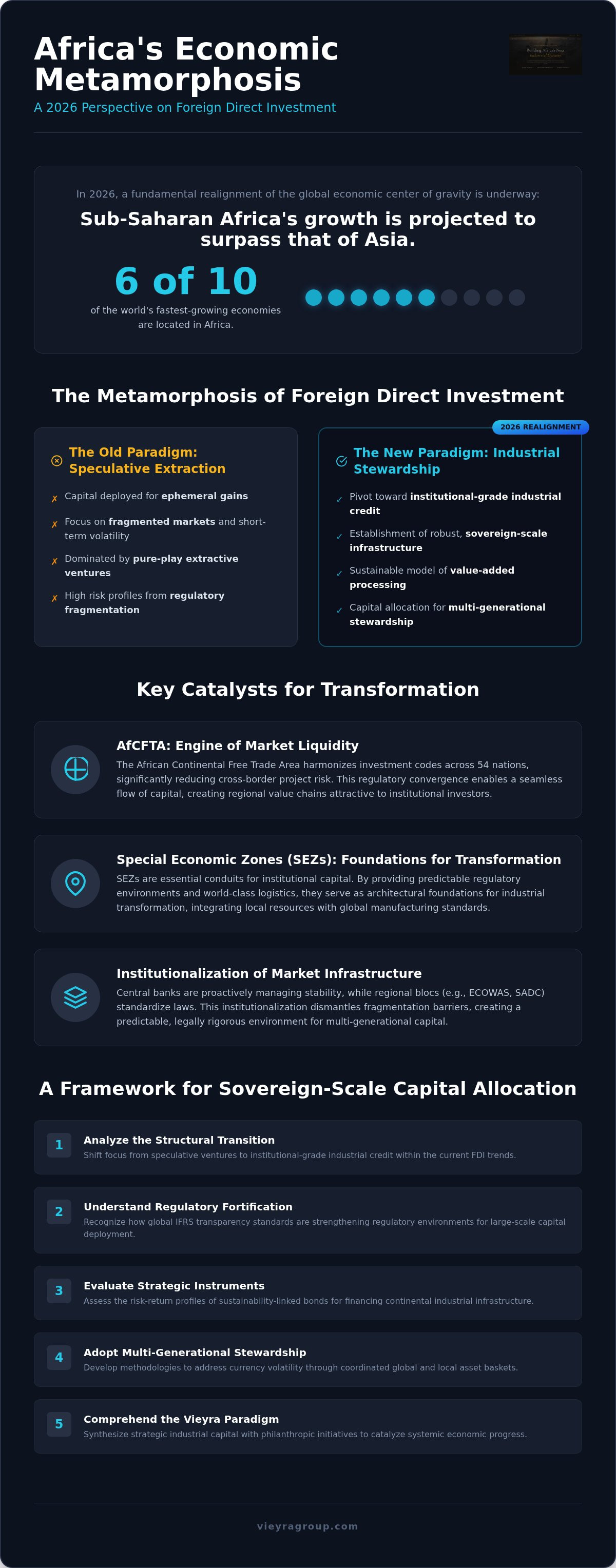
In 2026, the global economic center of gravity is undergoing a fundamental realignment as Sub-Saharan Africa's growth is projected to surpass that of Asia, with six of the world's ten fastest-growing economies situated on the continent. This shift signals a profound maturation in foreign direct investment trends Africa presents to the institutional observer, marking a transition from historical speculative extraction toward the establishment of sovereign-scale industrial infrastructure.
While the complexities of regulatory fragmentation and short-term market volatility may appear daunting, they often obscure the underlying stability of the continent's emerging industrial ecosystems. This article provides a rigorous framework for sovereign-scale capital allocation, ensuring that multi-generational investors can navigate the current landscape with the poise of a visionary architect. We shall examine the strategic nexus between the African Continental Free Trade Area and large-scale industrialization, offering a blueprint for aligning institutional deployment with the enduring principles of global stewardship.
Key Takeaways
- Analyze the structural transition from speculative frontier ventures to institutional-grade industrial credit within the current context of foreign direct investment trends Africa exhibits in 2026.
- Understand how the implementation of global IFRS transparency standards is fortifying African regulatory environments to facilitate large-scale; multi-generational capital deployment.
- Evaluate the strategic risk-return profiles of sustainability-linked bonds as sophisticated instruments for the financing of continental industrial infrastructure.
- Adopt a methodology for multi-generational stewardship that addresses currency volatility through the deliberate coordination of global and local asset baskets.
- Comprehend the Vieyra Paradigm of synthesizing strategic industrial capital with philanthropic initiatives via the Vieyra Foundation to catalyze systemic economic progress.
The Metamorphosis of Foreign Direct Investment in Africa: A 2026 Perspective
The current calendar year represents a definitive watershed in the structural evolution of the African economic landscape. We're observing a decisive departure from the era of "frontier speculation," a period characterized by capital deployed for ephemeral gains in fragmented markets. Instead, the contemporary foreign direct investment trends Africa presents reflect a sophisticated pivot toward institutional-grade industrial credit. This metamorphosis is propelled by a collective institutional recognition that the continent's enduring stability necessitates the establishment of robust, sovereign-scale infrastructure. This shift is further amplified by a notable surge in intra-African investment, where domestic sovereign-scale actors are increasingly taking the lead in financing large-scale logistics and energy networks, moving the continent away from the periphery of global finance toward a central role in the multi-generational allocation of strategic capital.
The Shift from Extraction to Industrialization
The historical precedence of pure-play extractive ventures is yielding to a more sustainable model of value-added processing. This shift is most visible in the maturation of Special Economic Zones (SEZs), which have become essential conduits for attracting institutional-grade capital by providing predictable regulatory environments and world-class logistics. These zones don't merely host factories; they serve as the architectural foundations for systemic industrial transformation by integrating local resources with global manufacturing standards. The 2026 FDI paradigm serves as a strategic instrument for the consolidation of continental sovereignty through the internal development of industrial capacity.
AfCFTA as a Catalyst for Market Liquidity
The African Continental Free Trade Area (AfCFTA) has advanced beyond its foundational milestones to become the primary engine of market liquidity and regional integration. By harmonizing investment codes across the 54-nation bloc, the agreement has effectively reduced the risk profile once associated with cross-border industrial projects. This regulatory convergence allows for the seamless flow of capital and goods, enabling the creation of regional value chains that attract the world's most discerning institutional investors. The stabilization of these frameworks is a cornerstone of the foreign direct investment trends Africa is currently navigating, as it provides the certainty required for multi-generational stewardship. This integration ensures that industrialization is not an isolated event but a coordinated continental movement toward economic permanence, where the scale of opportunity finally matches the ambition of sovereign-level actors.
The Institutionalization of Market Infrastructure and Regulatory Frameworks
The structural maturation of financial markets across the continent is currently defined by an unprecedented institutionalization of regulatory frameworks. Central banks have assumed a more proactive stance in managing systemic liquidity and currency stability; they're implementing sophisticated monetary tools to mitigate the volatility that previously deterred large-scale deployment. This shift is a cornerstone of the foreign direct investment in Africa, where the focus has moved toward creating a predictable environment for multi-generational capital. By standardizing securities laws within regional economic blocs such as ECOWAS and SADC, jurisdictions are effectively dismantling the barriers of fragmentation that once hindered sovereign-scale allocation. These efforts ensure that the broader foreign direct investment trends Africa demonstrates are rooted in a foundation of permanence and legal rigor.
Regional Regulatory Convergence
The West African Capital Markets Integration (WACMI) initiative serves as a primary example of this systemic evolution. Through the implementation of cross-listing protocols, regional exchanges are experiencing a significant enhancement in liquidity, allowing for the efficient movement of capital across borders. These advancements are supported by the refinement of dispute resolution mechanisms; these frameworks provide institutional investors with the legal certainty required for long-term industrial commitments. Such structural depth is essential for those seeking strategic capital solutions that transcend short-term market cycles. The evolution of these mechanisms reflects a broader commitment to protecting the interests of the sovereign-scale investor.
Transparency and Global Compliance
The widespread adoption of global transparency standards, specifically the IFRS S1 and S2 sustainability disclosures, marks a definitive era of accountability. Aligning African reporting requirements with OECD and G20 mandates ensures that continental assets are compatible with the rigorous compliance needs of global institutional portfolios. The integration of robust anti-money laundering (AML) frameworks further fortifies this environment, establishing institutional trust as a prerequisite for wealth preservation. These initiatives aren't merely administrative; they're foundational to the multi-generational stewardship of industrial assets. By fostering a culture of transparency, African nations are positioning themselves as reliable partners for the world's most discerning capital allocators.
Strategic Asset Classes: Balancing Liquidity with Industrial Transformation
The sophisticated investor in 2026 recognizes that the maturation of African markets demands a nuanced approach to asset allocation, moving beyond the binary choice of risk versus safety. Current foreign direct investment trends Africa displays indicate a convergence where liquidity and industrial transformation are no longer mutually exclusive objectives. Institutional portfolios are increasingly characterized by a strategic blend of high-yield sovereign instruments and corporate debt designed to fund the continent’s industrial backbone. This evolution is particularly evident in the rise of sustainability-linked bonds; these have become a preferred vehicle for financing large-scale energy and logistics projects while adhering to global ESG imperatives. By integrating these instruments, capital allocators can achieve a balance between immediate fiscal performance and the long-term objective of continental industrialization.
Debt Markets and Infrastructure Finance
Debt markets have evolved into a primary engine for bridging the industrialization funding gap. Long-term yield opportunities are increasingly found in continental infrastructure and energy development, where sovereign-backed industrial bonds provide a secure mechanism for deploying capital into essential projects. These instruments allow for the aggregation of institutional funds to support the construction of regional transport corridors and power grids. The strategic utilization of structured debt serves as the primary architectural framework for the construction of a multi-generational industrial legacy. By prioritizing infrastructure debt, investors contribute to the systemic resilience of the broader economic landscape while securing predictable, long-term returns that are insulated from the volatility of more speculative asset classes.
Equity Markets and Value Creation
Equity markets offer a distinct pathway for value creation through the identification of undervalued industrial conglomerates within maturing regional exchanges. While the Johannesburg Stock Exchange (JSE) remains a bastion of liquidity and established regulatory oversight, emerging hubs like the Nigerian Exchange (NGX) are demonstrating increased depth as sectoral diversification takes hold. Institutional portfolio resilience is often predicated on the ability to navigate these varying levels of market maturity with the deliberation of a visionary architect.
- Sectoral Diversification: Mitigates the impact of localized market volatility by spreading exposure across multiple industrial ecosystems.
- Regional Hubs: Emerging exchanges provide access to high-growth potential within nascent industrial sectors that are often overlooked by traditional capital.
- Liquidity Management: Balancing positions in established markets like the JSE with strategic entries into growth-oriented exchanges ensures a robust capital structure.
Selecting assets within these exchanges requires a profound understanding of the interconnectedness of regional trade and industrial policy. It’s through this rigorous analysis that the institutional actor can identify opportunities that align with a multi-generational vision for progress. This methodical approach ensures that equity positions aren't merely speculative but are rooted in the enduring growth of the continent’s industrial base.
Navigating Volatility through Multi-Generational Stewardship
The prevailing discourse often characterizes African markets through the lens of volatility, a perspective that frequently ignores the resilience inherent in industrial assets when managed with a multi-generational ethos. For the sovereign-scale actor, the distinction between speculative entry and long-term stewardship isn't merely philosophical. It's a structural necessity. While short-term participants may react with haste to cyclical corrections, the institutional entity remains anchored by an outlook that prioritizes the permanence of industrial infrastructure. This composed approach allows for the navigation of foreign direct investment trends Africa presents without the reactionary impulses that often erode value. By maintaining a posture of quiet confidence, one can leverage institutional memory to interpret geopolitical shifts as opportunities for strategic realignment rather than threats to portfolio integrity.
The Multi-Generational Investment Horizon
Adopting a 50-year vision serves as a profound mitigant against the turbulence of shorter market cycles, transforming perceived instability into a theater of strategic patience. This temporal advantage enables the architecture of wealth preservation to flourish within a developing economic landscape, as the focus shifts from quarterly benchmarks to the multi-generational accumulation of industrial capacity. Strategic patience is a rare commodity. Yet, it remains a potent competitive advantage in African capital allocation. It's the deliberation of the visionary architect that ensures investments are rooted in the systemic growth of the continent. This methodical pace allows for the steady maturation of assets that will serve as the foundation for future generations.
Risk Mitigation and Capital Preservation
Managing currency risk and geopolitical exposure requires a sophisticated arrangement of diversified global and local asset baskets. Hedging strategies for sovereign-scale portfolios don't rely on simple derivatives but on the deliberate coordination of industrial assets that generate value across multiple jurisdictions. Global diversification is critical. It provides a necessary buffer that protects continental industrial investments from localized shocks. Within the multi-generational family office, governance frameworks must be established to ensure that the principles of heritage and progress remain in perfect alignment. Those seeking to master these complexities should consult with experts in global investment management to secure their institutional legacy. By fostering an environment of rigorous professional oversight, the stately guardian ensures that the trajectory of growth remains certain, regardless of the rhythm of global finance. This level of diligence ensures that foreign direct investment trends Africa reveals are met with the necessary institutional rigor.
The Vieyra Paradigm: Allocating Strategic Capital for Continental Economic Transformation
The Vieyra Family Office operates with a philosophy rooted in the conviction that the most profound economic transformations are those built upon the bedrock of industrial permanence. This paradigm moves beyond the ephemeral nature of speculative cycles; it focuses on the deployment of strategic capital to catalyze systemic industrialization. By prioritizing high-impact projects that align with the sovereign-scale objectives of the continent, the institution ensures that its allocation of African industrialization capital serves as a definitive anchor for regional growth. This approach recognizes that the current foreign direct investment trends Africa displays are merely the initial stages of a broader, more significant realignment toward continental self-sufficiency and industrial sovereignty.
The Architecture of Industrialization
Identifying high-impact industrial projects requires a level of deliberation and foresight that only a multi-generational institution can provide. The synergy between capital allocation and systemic social development isn't merely an incidental benefit; it's a core component of the architectural design. By building resilient industrial infrastructure, the Vieyra Group creates a legacy that transcends fiscal performance, fostering an environment where economic progress and social stability are inextricably linked. These sovereign partnerships are essential. They provide the collaborative framework necessary for large-scale deployment that respects the unique cultural and political heritage of each jurisdiction. The focus remains on the construction of assets that will endure for generations, ensuring that the wealth generated is preserved and multiplied through the steady growth of the continent’s industrial base.
A Vision for Global African Stewardship
The integration of philanthropic initiatives via the Vieyra Foundation further fortifies this mission, supporting the market sophistication and educational advancement required for a 21st-century industrial economy. This dual commitment ensures that the progress achieved is both sustainable and inclusive, preparing the workforce for the complexities of the 2030 African economy. We invite strategic partners who share this vision of multi-generational stewardship to participate in this continental transformation. Those seeking a sophisticated framework for their deployment should engage with the Vieyra Family Office for strategic capital solutions that reflect a commitment to permanence and global influence. As we look toward the next decade, the role of the Vieyra Group as a visionary architect of African legacy remains certain, guided by the principles of heritage and a forward-looking dedication to large-scale progress. The foreign direct investment trends Africa continues to exhibit will be shaped by those who understand the weight of their responsibility as global actors and the importance of industrialization as a tool for sovereign-scale transformation.
Architecting the Future of Continental Industrialization
The structural realignment of 2026 establishes a new standard for global capital, where the integration of AfCFTA milestones and global transparency disclosures provides the necessary rigor for sovereign-scale deployment. By transitioning from ephemeral ventures toward the construction of enduring industrial ecosystems, investors can align their objectives with the systemic growth of a continent whose economic trajectory is now certain. These foreign direct investment trends Africa exhibits are the hallmarks of a market that has matured beyond speculation into a theater for institutional-grade progress. It's no longer a matter of navigating volatility but of architecting a legacy through strategic patience.
Navigating this landscape requires the deliberation of a stately guardian and the foresight of a visionary architect. As a sovereign-scale institution with a multi-generational investment perspective and deep expertise in African industrialization projects, the Vieyra Family Office remains committed to fostering regional growth through strategic partnerships. We invite you to engage with the Vieyra Family Office for strategic capital solutions that ensure your legacy is rooted in the continent's industrial transformation. The opportunity for meaningful, large-scale impact has never been more profound.
Frequently Asked Questions
What are the primary drivers of African FDI trends in 2026?
The primary drivers include the maturation of regional trade blocs and a decisive shift toward value-added industrial processing. Institutional investors are moving away from extractive models to focus on energy infrastructure and logistics. These foreign direct investment trends Africa displays are underpinned by the continent's projected economic growth, which is expected to surpass Asia's in 2026. Six of the world's ten fastest-growing economies are now located within the continent, attracting institutional capital seeking long-term stability.
How does the AfCFTA influence foreign direct investment in African industrialization?
The AfCFTA acts as a structural catalyst by harmonizing trade rules and reducing tariffs across the 54-nation bloc. This integration creates a unified market that effectively mitigates the risks associated with cross-border industrial projects. It allows for the development of regional value chains, making large-scale manufacturing more viable for global institutional portfolios. By providing a predictable regulatory environment, the agreement incentivizes the deployment of capital into infrastructure that supports continental trade and industrial sovereignty.
What defines a sovereign-scale investment in the contemporary African context?
Sovereign-scale investment refers to the deployment of capital at a magnitude and duration that impacts national or regional economic infrastructure. It isn't defined merely by the size of the allocation but by its strategic alignment with long-term industrial goals. Such investments typically involve partnerships with state entities or established family offices like the Vieyra Family Office. These initiatives focus on building permanent assets, such as power grids or transport corridors, that serve as the foundation for multi-generational growth.
How can institutional investors manage currency volatility in African markets?
Institutional investors manage currency risk through the deliberate coordination of diversified global and local asset baskets. This strategy involves balancing exposure to local currencies with hard-currency-denominated industrial assets. Sophisticated hedging mechanisms and the use of structured debt instruments also play a critical role in preserving capital. By maintaining a multi-generational horizon, investors can absorb short-term fluctuations, focusing instead on the intrinsic value and long-term yield of the underlying industrial infrastructure.
What is the role of green bonds in financing African industrial infrastructure?
Green bonds have emerged as a primary vehicle for financing sustainable energy and low-carbon industrial infrastructure. These instruments allow institutional actors to align their portfolios with global ESG imperatives while securing predictable returns. In 2026, the rise of sustainability-linked bonds reflects the maturing foreign direct investment trends Africa is experiencing. They provide the necessary liquidity for large-scale projects, such as Egypt's renewable energy expansion, which targets approximately 45% of the energy mix by the end of 2028.
How do African regulatory frameworks compare to OECD transparency standards?
African jurisdictions are increasingly aligning their reporting requirements with global standards, such as the IFRS S1 and S2 sustainability disclosures. This convergence ensures that continental regulatory frameworks are compatible with the transparency mandates of OECD and G20 nations. Many nations have fortified their anti-money laundering protocols and standardized securities laws within regional blocs like SADC and ECOWAS. This institutionalization of market infrastructure fosters the trust required for the multi-generational preservation of strategic capital.
Can multi-generational wealth preservation be achieved through African industrial assets?
Wealth preservation is achieved by anchoring capital in industrial assets that possess inherent permanence and systemic utility. Unlike speculative ventures, large-scale industrial projects generate value that is resilient to cyclical market corrections. These assets provide a steady yield and capital appreciation over decades, aligning with the stewardship goals of a multi-generational family office. By focusing on the industrialization of the continent, investors create a legacy of progress that protects and multiplies wealth across several generations.
What is the importance of strategic capital in African economic transformation?
Strategic capital is essential for catalyzing the systemic transformation required to move the continent toward industrial sovereignty. It provides the patient, long-term funding necessary for complex projects that traditional retail or public brokerage services cannot support. This form of capital allocation, championed by the Vieyra Family Office, prioritizes the construction of resilient infrastructure over short-term gains. It bridges the funding gap in critical sectors, ensuring that economic development is both sustainable and capable of supporting future growth.


