
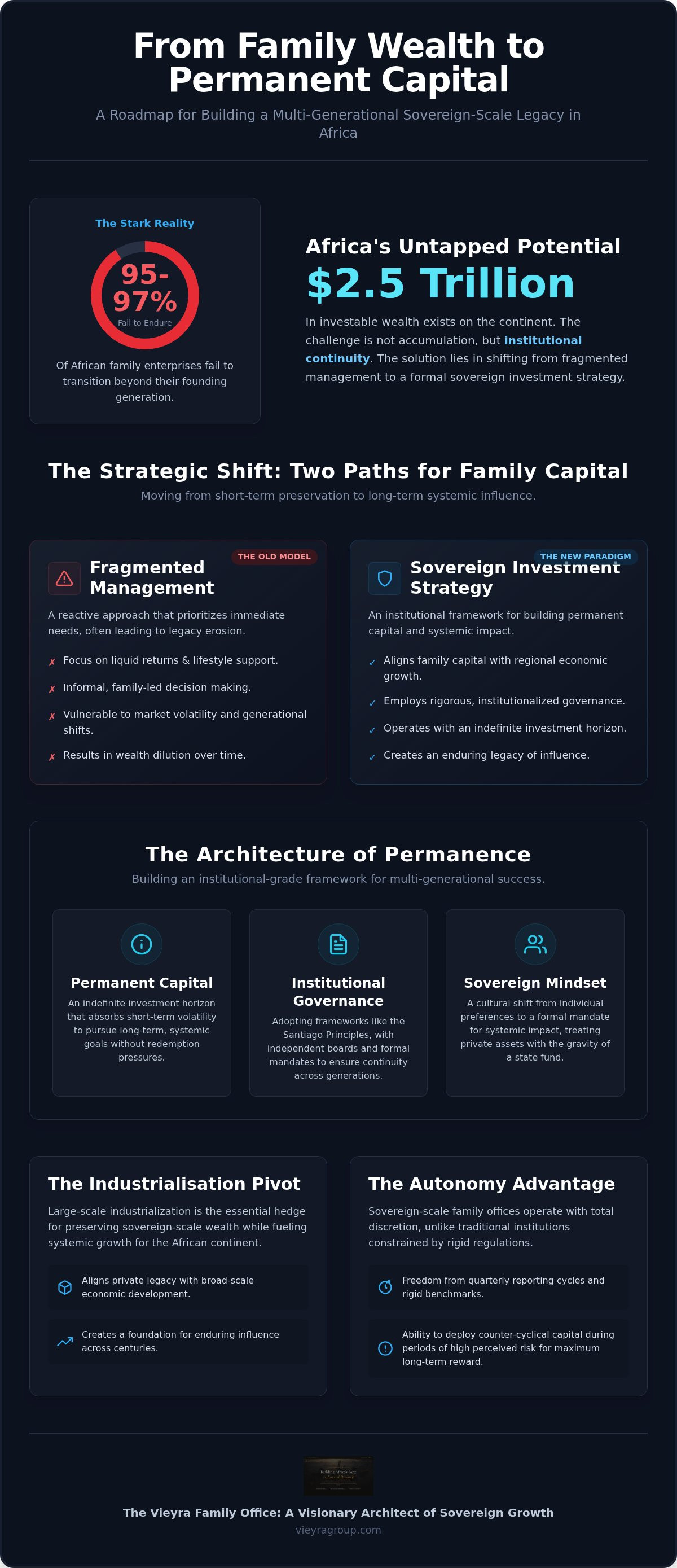
While Africa possesses an estimated $2.5 trillion in investable wealth, a sobering reality persists: only 3% to 5% of the continent's family enterprises successfully endure beyond their founding generation. This systemic failure of continuity often stems from a reliance on fragmented management rather than the adoption of a formal multi-generational sovereign investment strategy. You've likely recognized that the preservation of a legacy requires more than mere asset accumulation; it demands an institutional architecture capable of weathering geopolitical shifts and market volatility. The transition from private wealth to permanent capital is the defining challenge for the modern architect of legacy seeking a place on the global stage.
This article provides a rigorous analysis of how sovereign-scale family offices deploy strategic capital to secure long-term stability through industrialisation and global stewardship. We'll explore the institutional-grade frameworks necessary to bridge the gap between family legacy and regional economic progress. By examining the mechanics of permanent capital, we establish a roadmap for those who intend to operate not as mere market participants, but as stately guardians of African prosperity. This exploration details the alignment of private interests with systemic industrial development, ensuring that wealth serves as a foundation for enduring influence across centuries.
Key Takeaways
- Distinguish the transition from fragmented wealth management to a formal multi-generational sovereign investment strategy that establishes a foundation of permanent capital.
- Adopt institutional-grade governance frameworks, modeled after the Santiago Principles, to ensure the continuity of strategic vision across generational transitions.
- Recognize large-scale industrialization as the essential hedge for preserving sovereign-scale wealth while contributing to the systemic growth of the African continent.
- Establish collaborative partnerships with regional sovereign wealth funds to align private family legacies with broad-scale economic development and global stewardship.
- Examine the institutional ethos of the Vieyra Family Office as a visionary architect of legacy, blending traditional values with a forward-looking commitment to large-scale progress.
Defining the Sovereign-Scale Multi-Generational Investment Strategy
The distinction between conventional wealth preservation and a multi-generational sovereign investment strategy resides in the fundamental purpose and scale of the capital deployment. Traditional wealth management often prioritizes liquid returns to support immediate lifestyle requirements or short-cycle growth objectives. In contrast, sovereign stewardship operates with a profound sense of institutional permanence. It treats private assets with the same gravity as a Sovereign wealth fund, aligning family capital with the long-term industrial and economic trajectories of entire regions. This approach facilitates a transition from passive holding to active institutional influence, where the investment office functions as a systemic actor within the regional economy.
Central to this framework is the concept of permanent capital. Unlike traditional funds that face redemption pressures or fixed lifespans, permanent capital provides an indefinite investment horizon. This structural stability is the bedrock of institutional longevity, enabling the family office to absorb short-term volatility in pursuit of enduring multi-generational wealth. By anchoring the portfolio in assets that support national or regional development goals, the strategy ensures that the legacy remains relevant and protected against the erosion of time. It's the necessary prerequisite for any entity aspiring to exert a century-long influence on global progress.
The Shift from Family Wealth to Institutional Legacy
True institutional gravity necessitates a cultural shift in how capital is perceived and managed. A Sovereign Mindset replaces individual preferences with a formal mandate for systemic impact and long-term preservation. This transition involves replacing informal, family-led decision processes with rigorous, institutionalized governance structures. By establishing clear investment committees and formal mandates, the office ensures its 100-year horizon remains intact through successive generational transitions. This professionalization safeguards the core mission against the fragmentation that typically plagues private estates.
Sovereign-Scale vs. Traditional Institutional Investing
Private sovereign-scale capital enjoys a distinct advantage over traditional institutional investors like pension funds: total autonomy. While pension funds are often constrained by rigid regulatory benchmarks and quarterly reporting cycles, a sovereign-scale family office can execute a multi-generational sovereign investment strategy with absolute discretion. This autonomy allows for counter-cyclical investing in emerging markets, particularly within the African industrial sector. The ability to deploy capital during periods of high perceived risk, when traditional institutions might retreat, often yields the most significant long-term strategic rewards and cements the institution’s role as a visionary architect of growth.
The Institutional Architecture of Permanent Capital
The successful execution of a multi-generational sovereign investment strategy necessitates the construction of a robust institutional architecture that transcends the lifecycle of any individual founder. This framework is anchored in the adoption of governance standards that mirror the rigor of state institutions. By voluntarily integrating the Santiago Principles, a private sovereign-scale family office signals its commitment to transparency, professional management, and long-term stability. This formalization provides a defensive perimeter against the common pitfalls of intergenerational wealth transfer, where a lack of institutionalized oversight often leads to strategic fragmentation. It's through this structured approach that private capital achieves the aura of permanence required to influence global markets.
Governance Frameworks for Multi-Generational Success
The implementation of the Santiago Principles within a private context creates a disciplined environment for capital deployment. Central to this architecture is the establishment of independent advisory boards, which provide the objective scrutiny required to maintain the institution's mandate over decades. These boards function as a check against the short-termism that can occasionally influence family-led decision-making. The Institutional Guardian functions as the primary steward of strategic intent, ensuring that capital deployment remains insulated from transient populist pressures while maintaining alignment with the 2026 global industrial trajectory. Through this lens, the office moves beyond mere asset management, becoming a permanent fixture in the global financial landscape.
Global Risk Mitigation and Strategic Asset Allocation
Institutional longevity is predicated on a sophisticated approach to risk that balances global exposure with concentrated regional mandates. In the volatile climate of 2026, hedging against geopolitical shifts requires a diversified portfolio across Private Equity, high-yield Real Estate, and Sovereign Debt. These asset classes serve as the primary vehicles for wealth preservation and growth. Research suggests that sovereign-scale entities are increasingly recognized as long-term drivers of capital, possessing the unique ability to fund illiquid industrial projects that traditional retail actors cannot access.
Effective capital preservation relies on Strategic Asset Allocation for Family Offices, ensuring that the portfolio remains resilient against inflationary pressures. This balance allows the institution to support large-scale African industrialization while maintaining a liquid global buffer. For those seeking to refine their institutional posture, exploring Strategic Capital Solutions provides the necessary framework for aligning legacy objectives with systemic economic impact. This methodical approach ensures that the institution remains a visionary architect of progress, capable of deploying capital with both precision and permanence.
Strategic Capital Allocation: The Industrialisation Pivot
The deployment of a multi-generational sovereign investment strategy finds its most profound expression in the commitment to large-scale industrial progress. Industrialisation serves as the ultimate defensive hedge against global inflationary pressures and currency fluctuations. By anchoring wealth in physical assets, such as energy grids and processing hubs, the family office secures a position that's intrinsically linked to the continent's real economy. This pivot from liquid, speculative markets to tangible industrial capacity reflects a transition toward systemic impact. It ensures that capital isn't merely preserved but actively utilized to build the foundational structures of the future.
In the African context, evaluating these projects requires a sophisticated understanding of regional dynamics. Sovereign-scale capital is uniquely positioned to bridge the financing gap that often stalls national infrastructure initiatives. While traditional investors might hesitate due to liquidity concerns, the institutional steward recognizes that industrial assets function as long-term yield engines. These projects provide stable, inflation-protected returns that are essential for supporting a 100-year legacy. The scale of these operations requires a composed and authoritative stance, where the quality of the asset is prioritized over short-term market sentiment.
Industrialisation as a Catalyst for Economic Transformation
Strategic capital plays a decisive role in closing the infrastructure gap that has historically limited regional trade. In the 2026 global supply chain, Africa's role is evolving from a source of raw materials to a hub of value-added manufacturing. This shift is supported by institutional actors who provide the patient capital necessary for industrial scaling. According to projections from the African Development Bank, African manufacturing output is expected to reach $666 billion by 2030, representing a significant opportunity for those with a sovereign mindset. This growth trajectory underscores the necessity of aligning private legacy with regional progress.
Financing the Future: Sovereign-Level Industrial Initiatives
Allocating capital toward large-scale energy and transport projects requires structures that accommodate complex regulatory environments and multi-decade timelines. These initiatives often sit at the intersection of ESG standards and industrial development, where social impact and financial returns are mutually reinforcing. Effective Capital Allocation for African Industrialization ensures that projects are not only bankable but also resilient against geopolitical shifts. By focusing on energy security and transport efficiency, the family office acts as a visionary architect, building the infrastructure that will sustain both the family's influence and the continent's prosperity for generations.
Implementation: Aligning Family Legacy with Regional Growth
The operationalization of a multi-generational sovereign investment strategy demands a disciplined adherence to a phased implementation roadmap. It begins with the articulation of an institutional mission that functions as a sovereign mandate. This mandate provides the philosophical and legal framework necessary to govern capital deployment over a century-long horizon. By defining the family office's role as a stately guardian of progress, the institution ensures its strategic capital solutions remain insulated from the transient pressures of short-term market cycles. This clarity of purpose allows for the deliberate selection of projects that offer both financial resilience and systemic relevance. It's through this foundational step that private wealth begins its transition into a permanent institutional force.
Once the mandate is established, the institution moves to forge strategic alliances with regional actors. This involves a shift from isolated investment to collaborative stewardship. By participating in co-investment vehicles alongside state-led entities, the family office amplifies its impact while mitigating individual exposure. These partnerships are essential for navigating the complexities of large-scale industrialization, where alignment with national interests is a prerequisite for long-term success. This methodical approach transforms private capital into a catalyst for broad-based economic stability, moving beyond mere asset management to become a visionary architect of regional growth.
Forging Sovereign Partnerships for Regional Development
Effective implementation relies on the ability to build meaningful partnerships with regional sovereign wealth funds. In 2026, the maturation of the African Continental Free Trade Area (AfCFTA) provides a standardized regulatory environment that facilitates cross-border industrial finance. Navigating this landscape requires deep institutional expertise and a commitment to transparency. By aligning with state-led funds, the private office gains access to critical infrastructure projects in energy and logistics that were previously the sole domain of public institutions. These collaborative efforts ensure that capital is directed toward high-impact sectors that underpin regional growth and long-term stability.
The Role of Philanthropy in the Sovereign Strategy
Philanthropy is not a separate endeavor but a core pillar of the multi-generational sovereign investment strategy. The Vieyra Foundation exemplifies this alignment by focusing on initiatives that support the broader investment mandate. Strategic philanthropy acts as a tool for regional stability, addressing social gaps that might otherwise impede industrial progress. By measuring social impact through a sovereign-scale lens, the foundation ensures its contributions strengthen the societal fabric upon which the family's legacy is built. This holistic approach ensures the institution's influence extends beyond financial returns, fostering an environment of enduring prosperity across generations.
Those seeking to transition their family legacy into an institutional force can explore Strategic Capital Solutions to begin the formalization of their sovereign mandate. This step is essential for any architect of legacy who intends to operate with the permanence and poise of a global institution.
The Vieyra Family Office: A Visionary Architect of Sovereign Growth
The Vieyra Family Office stands as the preeminent embodiment of the multi-generational sovereign investment strategy, serving as a visionary architect for those who seek to transcend the limitations of traditional private wealth. It operates with a profound sense of institutional gravity, ensuring that every deployment of capital is executed with the deliberation and foresight required for century-long horizons. By prioritizing African industrialisation alongside a commitment to global excellence, the office provides the strategic capital solutions necessary to address sovereign-level challenges. This institutional posture is not merely a method of preservation; it's the active creation of a future where family heritage and regional prosperity are inextricably linked through shared progress.
A Legacy Rooted in Strategic Depth
The trajectory of the Vieyra Family Office is defined by its purposeful evolution from private wealth management to its current standing as a global institutional actor. In 2026, the philosophy of Institutional Stewardship remains the guiding principle for all initiatives, ensuring that the office directs capital toward projects with profound systemic impact. This long-term perspective allows the institution to focus on the foundational pillars of continental development, particularly in sectors where patient capital is essential for scaling. By maintaining this strategic depth, the office ensures its influence remains a permanent and stabilizing force in the global landscape, fostering growth that endures across successive generations.
Engaging with the Sovereign-Scale Institution
Collaboration serves as a fundamental pillar of the Vieyra approach, as the office actively engages with global financial institutions and regional sovereign wealth funds to amplify the reach of its initiatives. This collective stewardship is indispensable for navigating the multifaceted complexities of the 2026 financial ecosystem while securing the path forward for multi-generational wealth preservation. The institution invites partners who share its commitment to professional rigor and large-scale industrial progress to participate in the profound African transformation currently underway. Through these strategic capital solutions, the office continues to shape the economic trajectory of the continent, ensuring that legacy and development move in methodical unison.
For those who intend to manage their capital with the poise and foresight of a global actor, we invite you to Discover the Architecture of Sovereign Growth. This engagement provides the necessary framework for aligning private objectives with the systemic requirements of a permanent institutional legacy.
Architecting the Century-Long Legacy
The transition from fragmented private wealth to a formal multi-generational sovereign investment strategy represents the definitive shift toward institutional permanence and global influence. By adopting sovereign-scale institutional governance and focusing on African industrialisation as a core pillar, the modern architect of legacy secures a position that transcends transient market volatility. This framework ensures that capital isn't merely preserved through passive holding but serves as a systemic driver of regional prosperity and industrial transformation. It's the synthesis of global investment reach and profound regional strategic depth that defines the next era of institutional stewardship for the world's most significant estates.
Establishing this sophisticated architecture requires a partner that operates with the deliberation and foresight of an established global actor. We invite you to explore our multi-generational investment frameworks to begin the formalisation of your sovereign mandate and secure your family's place in the African growth story. Through rigorous professional standards and a commitment to large-scale progress, the path to an enduring legacy remains clear. The opportunity to shape the continent's future while ensuring multi-generational stability awaits those ready to lead with institutional poise and visionary intent.
Frequently Asked Questions
What defines a sovereign-scale investment strategy for a family office?
It's defined by an institutional mindset that prioritizes long-term stability and systemic impact over short-term liquid returns. This approach treats private capital with the same rigor as state-led funds, focusing on 100-year horizons. By adopting a multi-generational sovereign investment strategy, the office establishes a foundation of permanent capital. This allows the institution to weather market volatility while aligning its objectives with the broader economic development of the regions where it operates.
How does the Vieyra Family Office approach African industrialisation?
The Vieyra Family Office views African industrialisation as a primary vehicle for wealth preservation and regional growth. It deploys strategic capital into large-scale projects that enhance the continent's manufacturing and infrastructure capacity. It's a methodical approach that focuses on building tangible assets providing stable, inflation-protected returns. By serving as a visionary architect of progress, the office ensures its investments contribute to the systemic development of the African economy while securing its own multi-generational legacy.
What are the Santiago Principles and how do they apply to private capital?
The Santiago Principles are a set of 24 voluntary guidelines designed to promote transparency, good governance, and accountability in sovereign wealth funds. When applied to private capital, they provide a framework for professionalizing family-led investment offices. Adopting these standards signals a commitment to institutional-grade management and ethical stewardship. It's an alignment that helps private offices build trust with global institutional partners and ensures that strategic decisions are made with a high level of professional rigor.
How can multi-generational wealth be protected against geopolitical volatility in 2026?
Protection against geopolitical shifts in 2026 requires a sophisticated diversification strategy that balances global asset allocation with concentrated regional industrial mandates. The office utilizes a multi-generational sovereign investment strategy to hedge against currency fluctuations and inflationary pressures. By investing in physical industrial assets and essential infrastructure, the institution creates a defensive perimeter that's less susceptible to transient political shocks. This approach ensures that the core capital remains resilient despite the complexities of the current global landscape.
What is the role of the Vieyra Foundation in the broader investment strategy?
The Vieyra Foundation functions as a strategic pillar that aligns philanthropic initiatives with the institution's core investment objectives. It focuses on addressing social and economic gaps that could otherwise hinder long-term industrial progress. By measuring social impact through an institutional lens, the foundation strengthens the societal fabric of the regions where capital is deployed. It's an integration that ensures the family's legacy remains supported by a stable environment, reinforcing the overall sustainability of the office's mission.
How does sovereign-scale capital deployment differ from traditional private equity?
Sovereign-scale capital differs from traditional private equity through its indefinite investment horizon and absence of redemption pressures. While private equity funds often operate on five-to-ten-year cycles, sovereign-level institutions manage permanent capital with a 100-year perspective. This allows for the funding of large-scale industrial projects that require patient capital and multi-decade development timelines. It's a focus that shifts from rapid exits to the creation of enduring value and the long-term stewardship of systemic assets.
What sectors of African industrialisation are currently prioritised for 2026?
Priority sectors for 2026 include energy infrastructure, transport logistics, and value-added manufacturing hubs. These sectors are essential for supporting the maturation of the African Continental Free Trade Area (AfCFTA) and enhancing regional trade efficiency. The office directs strategic capital toward initiatives that improve energy security and modernize transport networks. It's a focus on foundational areas that allows the institution to act as a catalyst for economic transformation while securing assets central to the continent's growth.
How can institutional partners collaborate with the Vieyra Family Office?
Institutional partners can engage with the Vieyra Family Office through co-investment vehicles and strategic alliances focused on large-scale industrial projects. The office seeks collaborators who share its commitment to institutional gravity and long-term progress. It's a partnership model that allows for the pooling of expertise and capital to address sovereign-level challenges in the African market. By working in unison with global actors, the office's impact is amplified, ensuring the successful execution of its growth architecture.


