
The enduring prosperity of a continent is rarely the product of chance; it is the deliberate result of structural foresight and the rigorous application of institutional investment governance Africa requires to secure its future. While the mobilization of sovereign-scale capital presents an immense opportunity for regional transformation, the inherent volatility of emerging markets often creates a persistent tension between immediate liquidity needs and the patient requirements of large-scale industrialization. You recognize that the stewardship of multi-generational assets demands a sophisticated architecture that transcends the limitations of standard compliance or the transient nature of political cycles.
This article provides a definitive examination of the governance frameworks essential for architecting industrial legacies that remain resilient across centuries. We shall explore the strategic alignment of wealth with systemic economic transformation, ensuring that capital serves as a foundation for permanent progress rather than a victim of short-term market fluctuations. By establishing robust private governance benchmarks, institutional actors can enhance their prestige among global partners and secure their position as visionary architects of the African economic landscape. This exploration serves as a blueprint for those committed to the profound responsibility of managing capital at a sovereign scale.
Key Takeaways
- Understand the transition from transactional oversight to strategic stewardship as the foundational requirement for aligning sovereign-scale capital with long-term industrialization.
- Discover how a refined framework for institutional investment governance Africa ensures the preservation of multi-generational wealth while managing the inherent illiquidity of regional industrial projects.
- Learn how robust governance structures act as vital stabilizers, de-risking large-scale initiatives and providing strategic depth amidst shifting geopolitical landscapes.
- Gain insights into the implementation of institutional board structures and investment policy statements that bridge global standards with the specific nuances of African markets.
- Explore the philosophy of stewardship as a governance imperative for architecting a legacy of systemic economic transformation and enduring continental prosperity.
The Evolution of Institutional Governance in the African Context
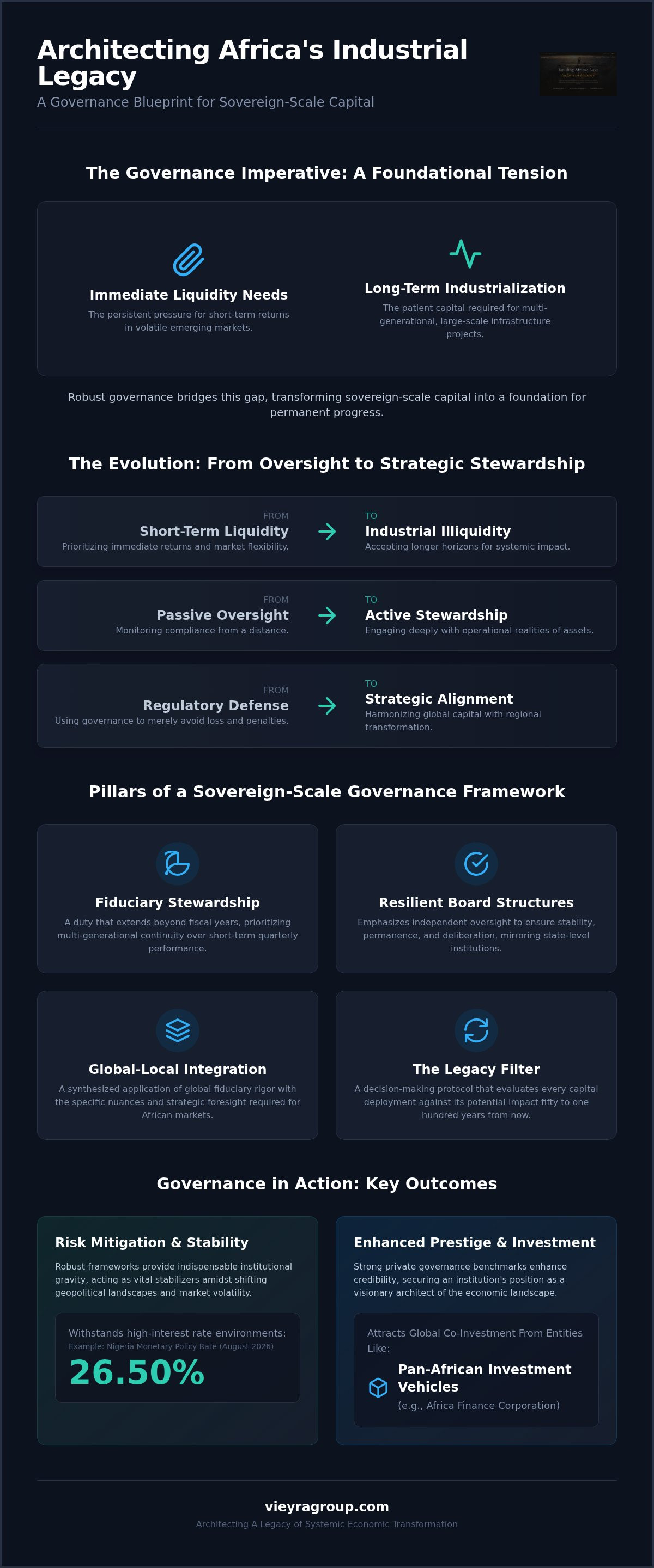
The landscape of institutional investment governance Africa currently experiences is undergoing a profound transformation, moving beyond the rudimentary confines of regulatory compliance toward a sophisticated model of strategic stewardship. As of early 2026, the implementation of Regulatory Audits under the AfCFTA Protocol on Investment has catalyzed a shift in how sovereign-scale capital is structured. This era marks a turning point where governance is recognized not merely as a defensive mechanism against volatility, but as the very architecture that enables systemic industrialization. It's the deliberate alignment of capital, risk mitigation, and a multi-generational vision that ensures wealth isn't merely preserved but actively deployed to build the continent's industrial backbone.
The transition toward strategic stewardship involves several key shifts in institutional philosophy:
- From Short-Term Liquidity to Industrial Illiquidity: Accepting longer time horizons in exchange for systemic impact and multi-generational value.
- From Passive Oversight to Active Stewardship: Engaging deeply with the operational realities and governance of large-scale industrial assets.
- From Regulatory Defense to Strategic Alignment: Utilizing internal frameworks to harmonize global capital requirements with regional economic transformation goals.
From Compliance to Strategic Architecture
Traditional governance often prioritized the avoidance of loss; however, the current climate demands a framework that facilitates large-scale industrial projects. By reconceptualizing governance as a strategic facilitator, institutions can bridge the gap between global fiduciary standards and the unique requirements of local industrial development. This institutional prestige is vital for attracting global co-investment from entities such as the Africa Finance Corporation (AFC), which exemplifies the power of structured, pan-African investment vehicles. Within this context, African Institutional Governance is defined as a synthesized application of global fiduciary rigor and regional strategic foresight, designed to transform sovereign-scale capital into permanent industrial legacies.
The Rise of the African Family Office at Sovereign Scale
While traditional development finance institutions have long been the primary drivers of infrastructure, a new class of private multi-generational institutions is emerging to fill critical gaps in the capital stack. These entities operate at a sovereign scale, requiring governance structures that mirror the permanence and deliberation of state institutions. In markets characterized by high interest rates, such as Nigeria's 26.50% Monetary Policy Rate recorded in August 2026, the stability provided by institutional gravity is indispensable. It's this commitment to permanence that allows private capital to withstand short-term volatility and remain focused on the long-term industrial goals that define true economic transformation across the continent.
The Pillars of Sovereign-Scale Governance Frameworks
The bedrock of institutional investment governance Africa requires is a fiduciary duty that extends far beyond the immediate fiscal year. Sovereign-scale governance isn't merely about compliance; it's about the systemic alignment of multi-generational wealth with the continent's industrial needs. This necessitates a "Legacy Filter," a decision-making protocol that evaluates every capital deployment against its potential impact fifty to one hundred years from today. For institutions managing assets at this magnitude, the challenge lies in creating a structure that is both resilient to volatility and flexible enough to capture transformative opportunities.
Fiduciary Stewardship and Wealth Longevity
Effective stewardship at this scale requires a board structure that prioritizes continuity over quarterly performance. Independent oversight is paramount, especially for non-public entities that manage assets equivalent to a significant portion of regional GDP. As highlighted in a study on corporate governance in South Africa, the influence of institutional investors in shaping governance standards is a primary driver of market stability. By integrating independent voices, family offices and private sovereign entities can mitigate the risks of concentrated decision-making. This ensures the institution's mandate remains untainted by transient internal or external pressures, preserving the integrity of the capital for future generations.
Strategic Capital Allocation Frameworks
The architecture of capital allocation must navigate the inherent tension between global liquidity and the necessary illiquidity of African industrial projects. While global assets provide a vital hedge against regional volatility, the mission of continental transformation requires a sophisticated approach to risk. Redefining risk for a multi-generational horizon means looking past short-term currency fluctuations to the underlying value of industrial sovereignty. It involves a methodical deployment of capital into sectors that offer high systemic impact, such as energy infrastructure or advanced manufacturing.
Transparency in this context doesn't mean public disclosure in the retail sense. Instead, it involves rigorous reporting to a closed circle of stakeholders, which include the family, the institutional board, and the state partners involved in large-scale industrialization. Aligning these interests requires a clear governance charter that defines the boundaries of influence and the metrics of success. Entities seeking to formalize these frameworks often benefit from strategic capital solutions that align institutional rigor with regional industrial goals. This balance ensures that capital remains a tool for progress, rather than a source of friction, across the generations.
Risk Mitigation and Strategic Alignment in Industrialization
Large-scale industrialization on the continent is frequently perceived through a lens of heightened risk, yet the institutional investment governance Africa implements can transform these challenges into structured opportunities for growth. Rather than viewing political or economic shifts as external shocks, a sovereign-scale governance framework internalizes these variables, creating a stabilizer for strategic capital. This approach moves beyond the high-risk premiums often demanded by traditional investors, opting instead for a model where institutional prestige and a local footprint act as primary de-risking mechanisms. By aligning capital with regional transformation goals, governance facilitates the sovereign-level collaborations necessary for enduring industrial progress.
Institutionalizing Geopolitical Resilience
Navigating the complexities of cross-border investment requires rigorous protocols that account for divergent monetary policies and regulatory environments. In August 2026, the contrast between Nigeria's 26.50% Monetary Policy Rate and South Africa's 7.00% repo rate illustrates the necessity of a governance structure that can manage substantial currency and inflationary variance. By utilizing the 2026 Regulatory Audits initiated under the AfCFTA Protocol on Investment, institutions can align their domestic investment laws with continental standards. This structured deployment of capital ensures that projects remain resilient against local volatility while benefiting from the broader harmonization of African trade and investment frameworks.
- Regulatory Audits: Leveraging AfCFTA compliance to ensure legal and sustainability obligations are met across diverse jurisdictions.
- Sovereign Presence: Utilizing a deep local footprint to navigate informal regulatory nuances and secure institutional standing within host nations.
- Structured Capital: Implementing multi-layered financing models that mitigate the impact of sudden central bank policy shifts or liquidity constraints.
Philanthropy as a Strategic Governance Tool
The Vieyra Foundation serves as an essential extension of this institutional stewardship, focusing on the broader ecosystem required for industrial success. By aligning social impact with industrial growth, the Foundation ensures that the "social license to operate" is integrated into the core investment governance model. This isn't merely an exercise in corporate social responsibility; it's a strategic alignment that fosters the human capital and regional stability necessary for multi-generational projects to thrive. Measuring the systemic impact of these initiatives allows the institution to refine its role as a visionary architect of legacy, ensuring that industrial progress and societal well-being remain inextricably linked across the generations.
Implementation: Integrating Global Standards with Local Realities
The translation of theoretical frameworks into the tangible reality of institutional investment governance Africa necessitates a methodical and deliberate implementation roadmap. This process begins with the formalization of a multi-generational Investment Policy Statement (IPS), which serves as the foundational constitution for capital deployment. Unlike documents designed for retail or short-term horizons, a sovereign-scale IPS must explicitly define the interplay between global liquidity management and the illiquid, patient requirements of regional industrialization. It's the primary instrument that ensures every tactical decision remains subservient to the overarching mission of continental transformation and wealth preservation.
The structural implementation proceeds through five critical phases designed to ensure institutional permanence:
- Step 1: The Multi-Generational IPS. Establishing the long-term risk parameters and industrial focus areas that define the institution's mandate.
- Step 2: Institutional Board Design. Constructing a governance body that integrates independent directors to ensure continuity and global credibility.
- Step 3: Sovereign-Grade Reporting. Implementing rigorous audit protocols and transparency standards that satisfy both international partners and regional stakeholders.
- Step 4: AfCFTA Alignment. Harmonizing internal governance rules with the 2026 Regulatory Audits and the binding obligations of the Protocol on Investment.
- Step 5: The Perpetual Audit. Creating a mechanism for continuous evolution to ensure the governance architecture remains resilient through the 22nd century.
The Institutional Roadmap
Selecting appropriate governance technology is vital for tracking assets across diverse jurisdictions at a sovereign scale. These systems must provide real-time visibility into capital flows while maintaining the highest standards of cybersecurity and data sovereignty. Within this framework, a Governance Audit is defined as a multi-generational health check that assesses whether an institution's structural integrity remains aligned with its visionary goals. For entities seeking to establish these sophisticated frameworks, Strategic Capital Solutions provide the necessary technical and intellectual architecture to bridge global standards with regional needs.
Adapting to the African Industrial Landscape
Specific considerations must be made for heavy industry and infrastructure, where the "Sovereign Partnership" lifecycle often spans decades and involves complex state relations. Governance here acts as the bridge between private capital and state-led initiatives, requiring a formal yet agile framework that can navigate the complexities of long-term development. This agility doesn't imply a lack of rigor; rather, it's the ability to pivot strategically without compromising the institution's core fiduciary duties. By institutionalizing these relationships, private offices can secure their position as permanent actors in the continent's industrial narrative, ensuring that their legacy is measured by the scale of the progress they facilitate.
The Vieyra Model: Stewardship as a Governance Imperative
The Vieyra Model represents the definitive culmination of multi-generational heritage and sovereign-scale foresight. It's a framework where the institutional investment governance Africa requires is treated as a sacred trust rather than a mere administrative function. This philosophy recognizes that the stewardship of capital at this magnitude carries a profound responsibility to the future. By prioritizing long-term stability over transient market trends, the model ensures that wealth isn't just maintained but transformed into a catalyst for continental progress. It's the architecture of a legacy that refuses to be constrained by the short-termism of modern finance. This model operates on the principle that true institutional gravity is achieved when the preservation of wealth is inextricably linked to the prosperity of the region in which it's rooted.
A Vision of African Industrialization
Capital deployment under the Vieyra Model is characterized by an unwavering commitment to industrial excellence. It's not enough to seek passive returns; capital must actively support systemic economic growth. This involves a deliberate focus on large-scale industrialization that builds local capacity and regional resilience. As a stately guardian of African capital, the institution operates with the deliberation of a sovereign entity, ensuring that every project contributes to a permanent industrial narrative. This multi-generational commitment ensures that the legacies built today will remain robust for the 22nd century and beyond. By institutionalizing this vision, the model provides a blueprint for how private sovereign-scale capital can act as a permanent stabilizer in an often-volatile global economy.
Key pillars of this industrial vision include:
- Systemic Alignment: Ensuring every investment serves the broader goal of regional economic transformation.
- Industrial Sovereignty: Prioritizing projects that reduce external dependencies and build domestic manufacturing depth.
- Generational Continuity: Structuring assets to survive and thrive across century-long horizons.
The Architecture of Global Stewardship
Balancing global investment management with the specific mission of African industrialization requires a sophisticated dual-mandate approach. Global assets provide the necessary liquidity and risk diversification, while regional investments drive transformative change. This architecture ensures wealth preservation across generations while maintaining a forward-looking commitment to progress. The approach internalizes the complexities of the African market, turning volatility into a structured path for growth. It's an invitation to engage in partnerships for sovereign-scale transformation, where capital is aligned with the highest standards of institutional rigor and multi-generational foresight. This isn't merely a service; it's a significant global act of architecting a sustainable and sovereign African future. Explore the Vieyra Family Office approach to Strategic Capital to understand how this model of stewardship architects the future of the continent.
Architecting the Industrial Century
The architecture of permanence requires a deliberate departure from the ephemeral nature of standard market cycles. By establishing the rigorous institutional investment governance Africa requires to secure its industrial future, visionary actors can transform sovereign-scale capital into a force for systemic progress. We've explored how the alignment of wealth with regional industrialization creates a resilient framework capable of withstanding geopolitical shifts while fostering multi-generational prosperity. This structural foresight is what distinguishes a mere investment from a permanent continental legacy.
This commitment to stewardship ensures that capital isn't merely managed but is guided by a profound sense of heritage and global responsibility. It's a trajectory that blends global investment management with a steadfast commitment to African industrial excellence. We invite those who share this vision of long-term stability and continental transformation to join us in this pursuit. Discover the Principles of Multi-Generational Stewardship at Vieyra Family Office. The path to a sovereign-scale legacy is built with the deliberation of an institution that understands its place in history and its potential to shape the future.
Frequently Asked Questions
What defines institutional investment governance in the African context?
The institutional investment governance Africa requires is defined as the rigorous alignment of sovereign-scale capital with long-term industrialization and multi-generational wealth preservation. It transcends basic compliance, functioning instead as a strategic architecture that manages the tension between global liquidity and regional industrial illiquidity. This framework ensures that capital remains a tool for systemic transformation rather than a victim of short-term market volatility or shifting political cycles across the continent.
How do multi-generational family offices manage sovereign-scale risk in Africa?
Multi-generational institutions manage sovereign-scale risk by internalizing geopolitical variables into their core governance protocols. This involves maintaining a deep local footprint to navigate informal regulatory nuances while utilizing structured capital deployment to mitigate currency and inflationary variance. By adopting a century-long horizon, these offices can withstand the immediate volatility that often deters traditional investors, ensuring that their strategic objectives remain aligned with the continent's foundational economic growth.
What is the role of strategic capital in African industrialization?
Strategic capital serves as the primary engine for large-scale industrialization by providing the patient, sovereign-scale funding necessary for infrastructure and heavy industry. Unlike speculative capital, strategic capital is deployed with a mandate for systemic impact and regional economic development. It bridges the gap between state-led initiatives and private institutional rigor, fostering the development of local manufacturing depth and reducing external dependencies to secure a sovereign African future.
How does the Vieyra Family Office balance global investments with African development?
The Vieyra Family Office utilizes a sophisticated dual-mandate approach that integrates global investment management with a steadfast commitment to African industrialization. Global assets provide essential liquidity and risk diversification across diverse asset classes, while regional capital is strategically allocated to transformative industrial projects. This balance ensures multi-generational wealth preservation while actively driving the systemic economic growth required for the continent's long-term prosperity and industrial sovereignty.
Why is institutional philanthropy critical to investment governance?
Institutional philanthropy is critical because it secures the social license to operate and supports the broader ecosystem required for industrial success. By aligning social impact with industrial growth, institutions can address the human capital and regional stability needs that underpin large-scale projects. This strategic alignment ensures that industrial progress is socially sustainable, fostering a stable environment where multi-generational assets can thrive without the friction of local societal misalignment.
How can African institutions align with global governance standards?
African institutions align with global standards by implementing sovereign-grade reporting and audit protocols alongside independent board oversight. They increasingly utilize frameworks like the 2026 AfCFTA Protocol on Investment to harmonize domestic laws with international expectations regarding sustainability and anti-corruption. This synthesis of institutional investment governance Africa needs with global fiduciary rigor enhances credibility with international partners while ensuring the institution remains deeply rooted in the specific realities of the African market.
What are the key governance challenges for large-scale industrial projects in Africa?
The primary challenges include navigating complex regulatory environments and balancing short-term market volatility with the decades-long timelines inherent in heavy industry. Institutions often face a lack of established private governance benchmarks in emerging markets, necessitating the creation of internal, sovereign-scale frameworks. Managing the sovereign partnership lifecycle also requires a formal yet agile structure that can maintain fiduciary integrity while collaborating with state entities on systemic infrastructure developments.
How does the Vieyra Foundation support the family office's investment strategy?
The Vieyra Foundation acts as a strategic extension of the family office's stewardship mission, focusing on initiatives that reinforce the industrial ecosystem. By pursuing philanthropic projects that align with the core investment strategy, the Foundation fosters the societal stability and vocational depth necessary for large-scale industrialization. This holistic approach ensures that the institution's presence on the continent is viewed as a permanent, stabilizing force that benefits both the capital and the community.


