

What if the strongest emerging-market opportunity is not the one with the highest projected growth, but the one whose execution, partners, and risk allocation can withstand scrutiny? For institutional investors, a capital deployment strategy for emerging markets must look beyond headline momentum to the conditions that determine whether capital can be converted into durable outcomes.
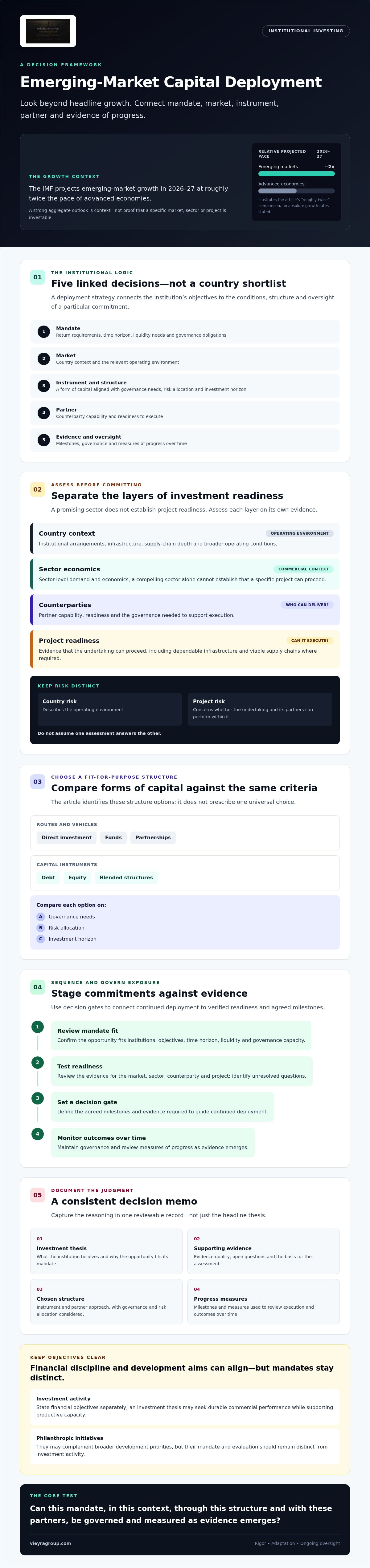
The opportunity is substantial: the IMF projects emerging-market growth in 2026-27 at roughly twice the pace of advanced economies. Yet aggregate growth cannot establish whether a particular market, sector, or project is investable. Differences in institutional capacity, operating environments, capital controls, and partner readiness call for a disciplined approach rather than a single template. Investors must decide not only where to commit, but through which structure, with whom, and in what sequence.
This article sets out a repeatable institutional framework for assessing markets, sectors, counterparties, and execution readiness; comparing direct, intermediated, and blended structures; and staging commitments against defined milestones. It also considers how long-horizon capital can align financial discipline with measurable industrial development while keeping investment and philanthropic mandates distinct. The aim is to provide a clear basis for acting with rigor, adapting as evidence emerges, and monitoring outcomes over time.
Key Takeaways
- Build a capital deployment strategy for emerging markets around linked decisions on mandate, market, instrument, partners, and ongoing oversight.
- Assess country context, sector economics, counterparties, and project readiness separately before reaching an investment judgment.
- Compare direct investment, funds, partnerships, debt, equity, and blended structures against governance needs, risk allocation, and investment horizon.
- Stage commitments against clear decision gates, using verified readiness and agreed milestones to guide continued deployment.
- Use a consistent decision memo to document the investment thesis, supporting evidence, chosen structure, governance, and measures of progress.
What a capital deployment strategy for emerging markets must solve
A capital deployment strategy for emerging markets is not a catalogue of attractive countries or projects. It is the connected set of decisions that determines whether an investor’s mandate can be pursued in a particular context, through an appropriate instrument and partner, with governance and monitoring suited to the commitment.
“A capital deployment strategy is the institutional logic that connects mandate to market, instrument, partner, and evidence of progress.” This distinguishes strategy from asset allocation, which sets portfolio-level exposures, and from project finance, which examines the funding and economics of an individual undertaking. Deployment strategy connects those levels without replacing either. It asks how a specific opportunity fits the institution’s objectives and capacity to oversee it.
Market opportunity alone cannot establish readiness. A sector may have compelling demand while a proposed project lacks capable counterparties, dependable infrastructure, viable supply chains, or evidence that execution can proceed. A disciplined framework supports institutional judgment. It is neither a market forecast nor a guarantee of financial or development outcomes.
How mandate, investment horizon, and objectives shape deployment
Before assessing opportunities, investors should clarify return requirements, time horizon, liquidity needs, and governance obligations. These parameters define which commitments are eligible and how much oversight they require. A long-horizon investor may be positioned to consider complex industrial development, while liquidity constraints or limited governance capacity may narrow the feasible options.
State financial objectives separately from development or strategic objectives, even where they may align. For example, an investment thesis may seek durable commercial performance while also supporting productive capacity. Philanthropic initiatives can complement broader development priorities, but their mandate and evaluation should remain distinct from investment activity. Vieyra Family Office’s focus on African industrialisation and long-term economic development offers relevant context, not a template for every investor.
Why emerging markets require a context-first assessment
The label emerging market is a starting point for understanding a broad category, not a sufficient basis for comparing investment conditions. Countries and sectors differ in institutional arrangements, infrastructure, supply-chain depth, counterparties, and execution capacity. Examine these factors at the level relevant to the commitment rather than inferring them from a regional classification.
A market may be suitable for one sector or instrument and unsuitable for another. An assessment should distinguish national context from sector economics and project readiness. The central question is not simply whether an opportunity appears promising, but whether its requirements, risks, partners, and oversight can be reconciled with the investor’s mandate.
How to assess an emerging market before committing capital
A disciplined review moves from the institution’s eligibility criteria to the evidence supporting a particular opportunity. The Harvard Business School framework for assessing emerging markets emphasizes political, social, and market context. Institutional investors can extend that lens through sector and project diligence. Keep country-level conditions distinct from the economics and execution requirements of an individual investment.
Country risk and project risk require separate analysis: the first describes the operating environment, while the second concerns whether a specific undertaking and its partners can perform within it. A project may have capable sponsors in a challenging market, or a supportive national context but an unready project. Neither conclusion should be assumed from the other.
Use a documented sequence. For each step, record the evidence, its quality, open questions, and the person responsible for resolving each issue:
- 1. Confirm mandate fit. Test the proposed geography, sector, instrument, return profile, time horizon, liquidity, and governance requirements against the institution’s approved objectives.
- 2. Assess market conditions. Examine relevant institutions and policy direction using current, attributable sources. Record currency exposure and distinguish verified facts from assumptions or interpretation.
- 3. Establish the sector case. Test demand durability, access to critical infrastructure and inputs, workforce availability, supply-chain depth, and credible routes to market.
- 4. Evaluate counterparties. Review ownership, governance, track record, decision rights, reporting capacity, and the resources available for local execution.
- 5. Test execution readiness. Examine feasibility, financing plans, operating models, dependencies, and implementation milestones. Identify prerequisites that remain unmet.
- 6. Define monitoring before commitment. Set the evidence, indicators, review responsibilities, and escalation conditions that will inform subsequent decisions.
Which market and sector signals deserve institutional attention?
Signals matter only in relation to the proposed activity. For an industrial project, test whether required power, transport, inputs, skills, and customer access are available on terms consistent with its operating assumptions. Verify policy claims against dated primary or otherwise attributable sources, and distinguish national conditions from those affecting a particular sector or location. Avoid treating a regional label as a substitute for analysis.
How to test project readiness and partner capacity
Readiness depends on more than an attractive thesis. Determine whether feasibility work supports the operating model, governance assigns clear decision rights, and financing and milestones are sufficiently developed to support execution. Assess whether partners can provide reliable reporting and mobilize local resources. Classify each gap as further diligence, a need for additional partnership, or a reason to stage development before committing further capital.
A decision record should preserve the thesis, source dates, evidence quality, unresolved questions, and accountable decision owners. This creates a basis for review as conditions change and supports a more rigorous capital deployment strategy for emerging markets. Vieyra Family Office’s investment perspective provides context on long-horizon investment and African industrialisation.
Which capital structures fit different emerging-market opportunities?
Structure determines more than the legal form of a commitment. It shapes decision authority, exposure to operating risk, oversight requirements, and the evidence an investor can expect to receive. The governing principle is simple: choose a structure by mandate and execution needs, not by label alone. A suitable choice depends on the investor’s objectives, jurisdiction, counterparties, and diligence findings. No structure is universally preferable.
Direct investment may provide closer involvement but requires sufficient internal capacity to assess and oversee the undertaking. Fund exposure delegates investment decisions and day-to-day oversight within the agreed mandate. A strategic partnership may combine complementary capabilities and share defined responsibilities. Debt and equity describe distinct forms of financing, each with different rights and exposure. Blended finance combines capital with differing objectives or risk tolerances where the parties’ mandates and terms permit.
These choices also sit within the broader conditions of the local market. The OECD’s analysis of developing local capital markets offers context for considering market depth, investor participation, and governance alongside the needs of a particular investment.
| Structure | Control | Duration | Governance needs | Risk allocation | Monitoring |
|---|---|---|---|---|---|
| Direct investment | Potentially closer investor influence | Set by investment terms and thesis | Substantial internal oversight | Investor bears exposure defined by its position | Direct, regular review of operations and milestones |
| Fund exposure | Investment decisions delegated within mandate | Determined by fund terms | Manager oversight and investor review | Shared through fund structure | Manager reporting and mandate monitoring |
| Strategic partnership | Shared or allocated by agreement | Aligned with partnership objectives | Clear decision rights and accountability | Allocated among parties by agreed terms | Joint review of commitments and progress |
| Debt or equity | Rights depend on instrument and terms | Linked to repayment or investment horizon | Appropriate to rights, covenants, and exposure | Varies with seniority, ownership, and terms | Track financial and operating evidence |
| Blended structure | Depends on participating parties | Designed around combined objectives | Coordination across mandates and capital | Distributed according to agreed roles | Monitor financial and stated development objectives separately |
When risk-sharing may be relevant
Where a project’s risk profile or development purpose limits the fit of a single source of capital, investors may examine blended arrangements or risk-sharing instruments. Guarantees and political risk insurance warrant specific diligence, not assumptions. Investigate scope, exclusions, eligibility, counterparties, and applicable terms before relying on them. IFC, MIGA, and the African Development Bank are relevant institutions to research, but current programmes and eligibility should be verified directly.
A sound capital deployment strategy for emerging markets matches structure to institutional capacity and project readiness. Direct oversight may suit an investor with the necessary expertise. Delegated management or a capable partner may address a capacity gap, provided governance and reporting are adequate. The final decision should document why the selected arrangement fits the mandate, how risks are allocated, and what evidence will guide continued oversight.
How to sequence capital, govern exposure, and measure progress
Staged deployment makes each further commitment conditional on evidence that the investment remains aligned with its mandate and can advance as planned. For a long-term industrial project, this may mean distinguishing initial diligence and preparation from later funding tied to defined implementation milestones. The purpose is not to eliminate uncertainty, but to preserve the ability to proceed, pause, redesign, or exit as new information emerges.
Specify decision gates before committing capital. Each gate needs a clear evidentiary standard, a decision owner, and an agreed response if requirements are not met:
- Diligence completion: Confirm that material assumptions, dependencies, and unresolved questions have been examined and documented.
- Partner readiness: Verify that counterparties have agreed decision rights, governance responsibilities, reporting expectations, and resources appropriate to the next stage.
- Execution evidence: Assess whether agreed milestones and operating prerequisites have been achieved, rather than relying solely on plans or projections.
- Continued allocation: Review updated risks, performance evidence, and any changes in mandate fit before authorizing further commitments.
For projects involving multiple capital providers, coordination matters. A shared milestone calendar, consistent reporting definitions, and documented responsibilities can reduce duplicated requests and conflicting oversight. Each institution should retain clear authority over its own decisions while agreeing how material changes, delays, or emerging risks will be communicated and escalated.
How to monitor financial and strategic outcomes
Monitoring should translate the investment thesis into indicators with a defined baseline, timeframe, calculation method, and responsible data owner. Financial measures might track performance against the approved investment case and changes in liquidity or exposure. Separately, strategic or industrial measures should reflect the project’s stated objectives, such as progress against agreed operating or capacity milestones. Do not present intended outcomes as achieved impact. Report evidence, limitations, and variance from plan.
Governance reporting should cover execution status, significant changes in assumptions, partner responsibilities, and decisions requiring escalation. Scenario analysis and sensitivity testing can show how results may respond to changes in relevant assumptions, such as demand, input access, or currency exposure. They clarify vulnerabilities, but cannot predict every development or remove uncertainty. A related discussion of sovereign investment risk management in Africa can extend this governance perspective.
A disciplined capital deployment strategy for emerging markets links the timing of commitments to verified evidence and ongoing review. Vieyra Family Office’s strategic capital solutions are part of its institutional perspective on long-horizon investment and development.
A practical institutional framework for emerging-market capital deployment
A repeatable process turns institutional objectives into decisions that can be reviewed and revised as evidence develops. In summary, define the mandate, select the relevant context, assess readiness, compare structures, stage capital, and review outcomes. Each step should leave a documented rationale for the next, so the investment case remains connected to the institution’s obligations rather than resting on an isolated opportunity.
Use the following decision memo checklist to make that reasoning visible to investment committees and oversight teams:
- Mandate and thesis: State the strategic rationale, mandate fit, financial objectives, and any separate development objectives.
- Market evidence: Record the market and sector rationale, diligence sources and dates, evidence quality, and assumptions that remain unresolved.
- Counterparties: Identify each partner’s role, relevant capabilities, decision rights, reporting responsibilities, and outstanding readiness questions.
- Proposed structure: Explain why the selected instrument and deployment approach fit the institution’s time horizon, oversight capacity, and risk considerations.
- Governance: Name decision owners, oversight responsibilities, escalation routes, and review triggers.
- Milestones and measures: Set conditions for staged commitments, with a baseline, timeframe, and accountable data owner for each financial and strategic measure.
A decision memo that supports disciplined review
The memo should distinguish verified information from estimates and identify what evidence would change the recommendation. For each proposed stage, specify what would justify proceeding, pausing, redesigning, or ending further allocation. Keep financial performance measures distinct from strategic or development outcomes. Alignment between them may be sought, but one should not be presented as proof of the other. This record supports institutional scrutiny and future learning.
When to engage a long-horizon capital partner
A capital partner is most relevant when objectives, time horizon, governance expectations, execution capacity, and measures of progress can be meaningfully aligned. Vieyra Family Office describes itself as a multi-generational African family office with global investment management and a focus on African industrialisation and long-term economic development. That context may be pertinent to institutions considering durable development, but it does not establish the suitability or availability of any specific transaction or partnership.
For institutional readers considering whether their objectives align with this perspective, Vieyra Family Office provides further information. A considered discussion should begin with mandate, readiness, governance, and the evidence each party would require before proceeding.
Build a disciplined path from mandate to lasting outcomes
A durable capital deployment strategy for emerging markets begins with institutional purpose and proceeds through evidence: assess the context, confirm readiness, select a structure that fits, and tie further commitments to measurable progress. This sequence helps investors distinguish a compelling opportunity from one their mandate, partners, or oversight capacity cannot yet support.
Its strength lies not in predicting every market development, but in making assumptions, responsibilities, and decision points clear. Financial performance and strategic or development outcomes should each be measured on their own terms, then reviewed together to determine whether capital remains aligned with the original thesis.
Vieyra Family Office is a multi-generational African family office operating at sovereign scale, with a stated focus on global investments, African industrialisation, and long-term growth projects. For institutional readers considering how long-horizon capital can serve complex development priorities, explore Vieyra Family Office and its investment perspective.
With a clear mandate and disciplined governance, investors can approach emerging-market opportunities with rigor, patience, and confidence in the quality of their decisions.
Frequently Asked Questions
What is a capital deployment strategy for emerging markets?
A capital deployment strategy for emerging markets is the institutional framework for deciding where capital may be committed, through which structure, with which counterparties, and under what oversight. It connects the investor’s mandate to market context, project readiness, and continued monitoring. Unlike a list of promising opportunities, it records why an opportunity fits, what evidence supports commitment, and which conditions should guide further allocation or a change in direction.
How do institutional investors assess emerging-market investment opportunities?
Institutional investors assess opportunities by testing mandate fit, market context, sector economics, counterparties, execution readiness, and monitoring capacity. Country-level conditions should be considered separately from project-specific feasibility and partner capability. Relevant evidence may include demand, infrastructure, supply chains, policy conditions, currency exposure, governance, financing plans, and implementation milestones. Investors should document source quality, assumptions, unresolved questions, and who is responsible for resolving them before a commitment decision.
Which capital structure is best for emerging markets?
No single capital structure is best across emerging markets. Direct investment may allow closer oversight but demands internal capacity; fund exposure delegates investment decisions within agreed terms; partnerships can combine capabilities, while debt and equity allocate rights and exposure differently. Blended arrangements may also be considered where mandates permit. The appropriate structure depends on the investor’s objectives, time horizon, governance capacity, jurisdiction, counterparties, and the requirements of the opportunity.
What risks should investors consider when deploying capital in emerging markets?
Investors should examine risks relevant to both the operating environment and the specific investment. These may include policy or institutional uncertainty, currency exposure, infrastructure constraints, supply-chain dependencies, demand assumptions, governance weaknesses, partner capacity, and execution delays. The importance of each varies by country, sector, structure, and project. Country context should not stand in for project diligence: a favorable broad outlook cannot establish that a particular undertaking is ready or that its counterparties can deliver.
How can investors reduce risk when funding large industrial projects?
Investors can manage exposure through rigorous feasibility and partner diligence, clearly assigned governance responsibilities, and staged commitments linked to verified readiness and agreed milestones. Before each allocation, review the financing plan, operating assumptions, dependencies, and evidence of execution. Scenario analysis and sensitivity testing can reveal where assumptions are most consequential, but they cannot remove uncertainty. Establish reporting duties, decision rights, escalation routes, and criteria for proceeding, pausing, redesigning, or exiting.
What is blended finance, and when might it be appropriate?
Blended finance combines capital from parties with different objectives or risk tolerances within an agreed structure. It may be relevant when a project’s development aims, financing needs, or risk profile are not well served by a single source of capital. Its suitability depends on mandate alignment, structure, counterparties, and project diligence. Guarantees or political risk insurance should be evaluated as specific instruments, with their terms and limits verified rather than assumed to provide protection.
How should investors measure the success of an emerging-market deployment?
Measure success against the investment thesis using defined financial and strategic indicators, each with a baseline, timeframe, and responsible data owner. Financial measures should track the approved investment objectives; development or industrial measures should reflect the outcomes the project set out to pursue. Report these separately, alongside execution progress, governance issues, and material changes in assumptions. Review actual evidence against milestones, explain variances, and use the findings to inform continued allocation and institutional learning.


