
For generations, conventional charity has addressed immediate symptoms of distress while leaving systemic economic dependencies intact. To fundamentally alter this trajectory, the practice of strategic philanthropy Africa demands today must abandon fragmented, non-scalable grants in favor of sovereign-scale capital deployment. Philanthropic capital shouldn't merely subsidize perpetual social deficits. It must actively construct the institutional governance and industrial capacity that render external dependency obsolete.
Institutional stewards and multi-generational family offices rightly recognize that conventional, donor-driven aid agendas rarely align with indigenous economic priorities. You've likely experienced how isolated charitable gifts dissipate without achieving systemic scale, making it exceptionally difficult to benchmark non-financial returns across multi-decade horizons. In this discussion, you'll discover how sovereign-scale institutional philanthropy transcends conventional charity to build enduring industrial and social infrastructure across Africa. We examine the precise governance architectures and catalytic deployment frameworks required to safeguard an enduring family legacy while advancing sovereign economic transformation.
Key Takeaways
- How modern architectures of strategic philanthropy Africa replace short-term palliative aid with catalytic capital designed for permanent economic self-determination.
- Structural deployment models, including catalytic equity and concessionary risk facilities, that crowd in commercial capital to de-risk foundational regional projects.
- The strategic nexus between industrialization and technical human capital, illustrating how institutional endowments bridge capability gaps across productive sectors.
- Multi-decade governance frameworks engineered to maintain programmatic fidelity and rigorously quantify non-financial returns over generational horizons.
- Sovereign-scale stewardship models that demonstrate how institutional family offices successfully synthesize global investment discipline with transformative continental progress.
Defining Strategic Philanthropy in the African Geopolitical Landscape
Strategic philanthropy transcends conventional charitable giving. Rather than treating symptoms through fragmented, short-term grants, it represents the deliberate allocation of catalytic capital to build self-sustaining societal infrastructure. While traditional charity functions as a palliative measure, institutional philanthropy targets the root mechanisms of economic friction. It treats social investment as an enduring sovereign capability rather than a recurring operating subsidy.
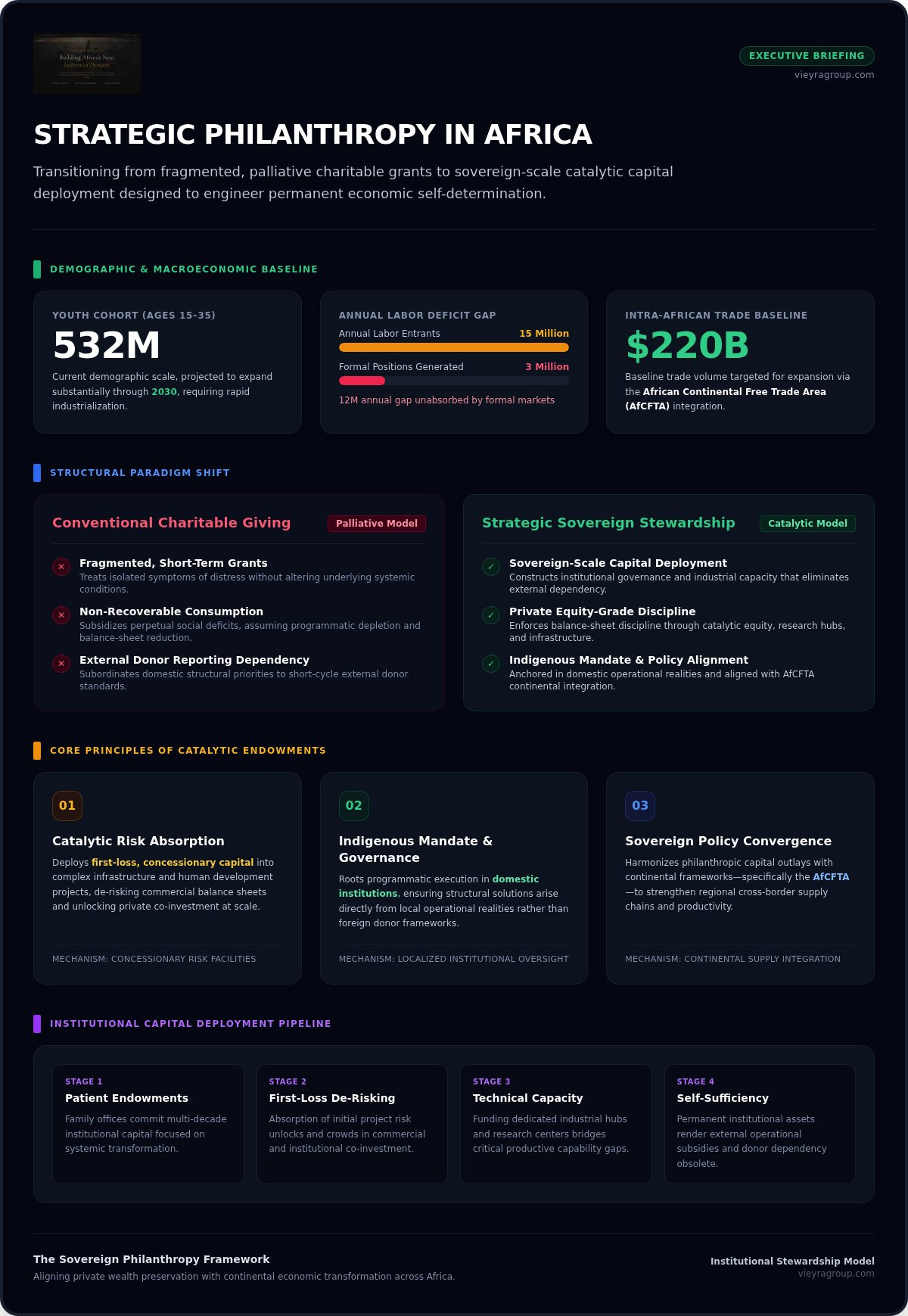
This structural recalibration unfolds against an unprecedented demographic reality. With Africa's youth cohort aged 15 to 35 standing at roughly 532 million individuals and projected to expand substantially through 2030, systemic stability requires accelerated industrialization. Sub-Saharan Africa must absorb an estimated 15 million new entrants into its labor force annually, yet formal markets generate merely three million positions each year. Under such macroeconomic pressures, wealth preservation for multi-generational allocators cannot occur in isolation. Preserving family capital over multi-decade horizons demands stable, productive continental environments. Sovereign progress and private wealth preservation are inextricably linked.
The Evolution from Palliative Aid to Sovereign-Scale Stewardship
For decades, conventional foreign non-governmental organizations operated under episodic grant cycles. This structure routinely subordinated local structural needs to external donor reporting standards, inducing systemic fragility rather than local institutional capability. Sovereign-scale stewardship rejects this dependency model entirely. Within the evolving discipline of venture philanthropy, institutional allocators deploy capital with the discipline of private equity, prioritizing structural self-sufficiency over perpetual external subsidization.
Indigenous family endowments don't treat capital deployment as non-recoverable consumption. Instead, they position programmatic allocations to build permanent institutions, research centers, and industrial training hubs that safeguard regional stability for generations.
Core Principles of Catalytic African Endowments
Operationalizing strategic philanthropy Africa requires institutional adherence to several rigorous structural tenets:
- Catalytic Risk Absorption: Deploying first-loss, concessionary capital into complex infrastructure and human development projects, thereby de-risking commercial balance sheets and unlocking private co-investment at scale.
- Indigenous Mandate and Localized Governance: Rooting programmatic execution in indigenous institutions, ensuring solutions emerge from domestic operational realities rather than theoretical donor frameworks.
- Sovereign Policy Convergence: Aligning capital outlays with continental integration frameworks, notably the African Continental Free Trade Area, to support cross-border supply chains and expand intra-African trade beyond its $220 billion baseline.
When deployers combine patient philanthropic capital with sovereign policy harmonization, programmatic outlays become self-perpetuating engines of continental productivity.
Structural Paradigms: Moving from Subsistence Aid to Systemic Catalytic Capital
Conventional charitable disbursements operate on an assumption of programmatic depletion. They treat capital allocation as a permanent balance-sheet reduction rather than an investment in durable capacity. In contrast, institutional strategic philanthropy Africa practices must deploy sophisticated capital structures that enforce balance-sheet discipline. Sovereign-scale institutions don't view social intervention as pure operational subsidy. They structure programmatic capital alongside institutional liquidity to construct permanent domestic resilience.
Comparative Analysis of Philanthropic Capital Architectures
Institutional allocators employ a calibrated spectrum of structures designed to maximize capital longevity and societal transformation:
- Concessionary Programmatic Facilities: Patient debt instruments with subordinate repayment terms, allowing industrial initiatives to overcome early operational friction without crippling servicing liabilities.
- First-Loss Guaranty Tranches: De-risking mechanisms positioned beneath commercial tiers to absorb foundational execution volatility, thereby mobilizing conservative private and sovereign liquidity.
- Evergreen Programmatic Vehicles: Reinvestable capital pools that harvest returns from subsidized industrial ventures to self-fund subsequent regional initiatives indefinitely.
Deploying these blended structures ensures capital stacks protect institutional endowments while delivering systemic impact. Establishing an institutional enabling environment for African philanthropy guarantees the regulatory clarity required to operate these hybrid financing models across borders.
The Role of Concessionary Capital in De-risking Strategic Initiatives
The primary barrier to sovereign industrialization rarely stems from a lack of aggregate global capital. Rather, it originates from the acute risk premiums assigned to pioneering regional assets. When institutional endowments absorb asymmetric developmental risks, commercial viability emerges for surrounding value chains.
Subordinated philanthropic capital de-risks critical social and physical infrastructure, transforming unbankable regional imperatives into institutional-grade co-investment opportunities. Multi-generational endowments seeking to orchestrate these structures frequently deploy bespoke Strategic Capital Solutions to systematically align philanthropic mandates with regional macroeconomic development. Through disciplined concessionary allocation, strategic endowments transform continental vulnerabilities into self-funding economic engines.
The Nexus of Industrialization, Human Capital, and Philanthropic Deployment
Industrialization serves as the indispensable foundation for enduring human self-determination. Without productive manufacturing, processing, and logistics ecosystems, social spending yields diminishing returns. Strategic philanthropy Africa initiatives must bridge the historical divide between social development and industrial expansion. Philanthropic deployment shouldn't fund basic literacy programs in isolation from the real economy. It must deliberately align human capital formation with sovereign manufacturing capabilities.
Targeting Catalytic Capital into Foundational Capabilities
A severe structural mismatch currently undermines continental labor potential. World Bank development indicators reveal that only 8.5% of upper-secondary students in Sub-Saharan Africa participate in vocational programs, compared to an OECD average of 44%. Only 28% of African youth complete upper secondary school. Strategic endowments can systematically bridge this capability deficit.
- Specialized Technical Institutes: Underwriting advanced vocational centers directly integrated with regional industrial parks to cultivate specialized mechanical, electrical, and process engineering competencies.
- Advanced Technical Consortia: Establishing endowed research laboratories dedicated to applied materials science, agricultural processing technology, and industrial automation.
- Industrial Apprenticeship Facilities: Structuring blended co-funding mechanisms with domestic manufacturing firms to subsidize high-skill apprenticeships at scale.
Deploying programmatic capital into specialized vocational infrastructure ensures regional labor markets can support capital-intensive industrialization. This approach transforms demographic expansion into a competitive continental advantage.
Infrastructure Resiliency as a Prerequisite for Societal Flourishing
Sovereign industrial progress requires deeply resilient domestic ecosystems. Industrial assets cannot thrive without robust public health frameworks and localized logistics architecture. Strategic philanthropic allocations directed into clinical research infrastructure, localized pharmaceutical manufacturing capacity, and regional cold-chain networks protect the human baseline required for industrial output.
These catalytic outlays don't function as passive social spending. They structurally insulate domestic supply chains against global disruption, reducing productivity loss and de-risking the broader manufacturing environment. By funding the critical non-commercial layers of regional logistics and healthcare networks, institutional endowments create the stability required for sovereign industrial acceleration.
Institutional Governance Frameworks for Measuring Generational Social Return
Allocators frequently cite operational opacity and ambiguous impact metrics as primary obstacles to expanding endowment allocations across the continent. When evaluation frameworks rely on superficial outputs, such as attendees tallied or short-term relief distributed, they obscure whether deployed capital generated durable progress. Strategic philanthropy Africa requires institutional governance architectures engineered for multi-decadal scrutiny. Philanthropic deployment shouldn't depend on transient monitoring cycles. It demands quantifiable benchmarks that measure systemic capacity over generational time horizons.
Designing Multi-Decadal Impact Methodologies
Rigorous impact evaluation requires decoupling transactional reporting from structural institutional health. Sovereign-scale endowments move beyond three-year grant horizons, utilizing calibrated metrics that verify permanence:
- Institutional Durability Indices: Measuring whether targeted entities achieve financial self-sufficiency through diversified revenue models and domestic capital mobilization.
- Regulatory and Policy Harmonization: Evaluating how initiatives inform modern statutory environments, ensuring alignment with codified governance standards such as Kenya's 2026 Public Benefit Organizations regulations.
- Systemic Capability Retention: Benchmarking the retention, repatriation, and continuous development of indigenous technical and industrial leadership within critical sectors.
Codifying these indicators within the founding charter insulates programmatic facilities from subjective shifts in allocator sentiment, securing strategic continuity across successions.
Integrating Family Governance with Foundational Oversight
Maintaining programmatic fidelity across generational transitions represents a complex structural imperative. Without codified family constitutions and transparent operational mandates, family endowments often succumb to mission drift. Sovereign-scale institutions resolve this vulnerability by structuring family assembly charters that clearly delineate fiduciary responsibilities between commercial asset stewardship and programmatic philanthropic allocations.
Independent advisory councils comprising continental economists, legal authorities, and sovereign industry leaders provide vital technical oversight. These bodies ensure that deployed capital advances the foundational mandate of regional self-determination while insulating the endowment from short-term family dynamics. Principals seeking to unify generational legacy preservation with sovereign economic transformation can partner with the institutional platform at vieyragroup.com to structure enduring philanthropic governance frameworks.
Sovereign-Scale Stewardship: The Vieyra Foundation Model of Strategic Endowment
The imperative of sovereign self-determination requires private capital allocators to transcend passive grant allocations. The Vieyra Foundation exemplifies this philosophy, operating as an institutional instrument engineered to catalyze long-term African economic capability. Rather than disbursing capital across disparate, non-scalable social projects, the institution unites institutional balance-sheet discipline with sovereign developmental priorities. This integrated approach ensures that social investments reinforce the productive capacity of the broader continental ecosystem.
The Integrated Architecture of the Vieyra Family Office
The Vieyra Family Office unifies Global Investment Management capabilities with dedicated African Industrialization Capital. Operating at sovereign scale, this architecture leverages the Vieyra Foundation to address structural bottlenecks that commercial investment alone cannot resolve.
Through this symbiotic relationship, philanthropic resources de-risk foundational institutional capabilities, technical research centers, and industrial training academies. These initiatives directly support broader industrial value chains. When catalytic capital absorbs initial developmental friction, downstream industrial assets achieve operational viability much faster. Programmatic capital doesn't dissipate into transient relief. It permanently strengthens domestic manufacturing and engineering ecosystems across target regions.
Engaging Sovereign Partners and Multi-Generational Peers
Achieving continental transformation requires strategic synthesis among aligned institutional peers. The practice of strategic philanthropy Africa must cultivate today demands co-endowment platforms capable of transcending electoral cycles and temporary market volatility. Fragmented initiatives cannot withstand macroeconomic turbulence. Enduring institutions can.
To establish durable continental architectures, sovereign-scale allocators must implement coordinated co-investment models:
- Syndicated Catalytic Facilities: Pooling multi-family philanthropic reserves into structured first-loss facilities that de-risk foundational industrial corridors and cross-border energy grids.
- Endowed Continental Knowledge Centers: Co-financing specialized technological and industrial research bodies that establish autonomous intellectual property regimes within Africa.
- Sovereign Institutional Co-Investment: Partnering directly with regional development finance institutions to align private catalytic grants with public infrastructure master plans.
Generational African wealth custodians face a historic mandate. By moving beyond conventional charitable spending and committing patient capital to institutional architectures, family offices protect their ancestral legacy while securing sovereign continental prosperity.
Architecting Sovereign Autonomy Through Generational Capital
The paradigm of external, subsistence-driven charity has reached its structural limit. For multi-generational wealth custodians, lasting continental prosperity requires a fundamental transition toward institutional resilience. By replacing short-term disbursements with catalytic risk-absorption facilities, anchoring technical human competencies directly to domestic manufacturing bases, and enacting multi-decadal governance charters, family endowments transform liquid wealth into permanent sovereign infrastructure. Through this disciplined model of strategic philanthropy Africa possesses the architecture necessary to achieve durable economic self-determination.
Operating as a multi-generational African family office at sovereign scale, the Vieyra Family Office demonstrates how the seamless integration of catalytic philanthropy with large-scale industrialization strategies creates self-perpetuating regional transformation. The opportunity to shape the continent's trajectory across the coming century rests with visionary allocators. We invite institutional principals to explore the sovereign endowments and strategic initiatives of the Vieyra Foundation to forge an enduring legacy.
Frequently Asked Questions
How does strategic philanthropy in Africa differ from traditional charitable donations?
Strategic philanthropy Africa initiatives replace palliative, short-term relief with structural capital deployment aimed at building self-sustaining ecosystems. While conventional charity consumes principal on immediate consumption needs, strategic endowments invest in institutional capacity, technical training centers, and regional policy development. This disciplined deployment targets systemic bottlenecks directly, transforming recipients into autonomous economic actors who no longer require external subsidies to maintain operational vitality.
Can institutional philanthropic capital generate measurable financial returns alongside social impact?
Yes, institutional allocators frequently structure philanthropic capital through recoverable grants, subordinated programmatic loans, and evergreen equity facilities. These mechanisms preserve foundational principal by recycling capital repayments into subsequent initiatives. While non-financial systemic transformation remains the primary benchmark, recycling concessionary capital creates a self-funding architecture. It proves that programmatic discipline and balance-sheet preservation can reinforce one another across multi-decade operating horizons.
How do sovereign-scale family offices prevent mission drift across multi-generational horizons?
Multi-generational institutions prevent mission drift by establishing codified family constitutions with immutable programmatic mandates. By separating executive operational management from advisory oversight, family assemblies protect foundational objectives against shifting personal inclinations. Involving independent continental scholars, industry leaders, and technical experts on foundation boards ensures capital deployment remains strictly aligned with long-term regional development charters across succeeding generations of family custodians.
What role does catalytic capital play in accelerating African industrialization?
Catalytic capital absorbs asymmetric early-stage operational risks that standard commercial financiers refuse to underwrite. By funding feasibility assessments, establishing specialized manufacturing curricula, and providing first-loss balance sheet protection, catalytic allocations de-risk foundational infrastructure assets. This strategic intervention unlocks private debt and equity flows, transforming high-risk industrial ventures into bankable sovereign projects that drive continental manufacturing self-sufficiency.
How should family offices structure governance between investment arms and philanthropic foundations?
Institutional family offices must maintain clear legal separation between profit-seeking investment management entities and dedicated philanthropic foundations while preserving overarching strategic alignment. Dual-mandate investment committees ensure programmatic endowments don't conflict with core portfolio goals. Meanwhile, collaborative capital committees identify opportunities where concessionary capital can de-risk industrial supply chains, creating an integrated ecosystem where market returns and sovereign progress continually reinforce each other.
Why is local institutional context critical for philanthropic efficacy in African markets?
External aid models routinely flounder because they impose foreign assumptions on complex domestic environments. Strategic philanthropy Africa initiatives succeed by partnering directly with indigenous regulatory bodies, local universities, and domestic industry associations. This ground-level alignment ensures programmatic solutions respect jurisdictional nuances, comply with statutory frameworks like modern non-profit governance codes, and address the precise technical requirements of regional labor markets.
What frameworks best assess generational social returns in emerging industrial ecosystems?
Allocators must look past short-term output tallies and evaluate systemic capacity metrics over multi-decadal timelines. Robust frameworks measure institutional financial longevity, indigenous leadership retention rates within technical sectors, and policy improvements that ease commercial trade barriers. Tracking these systemic indicators reveals whether deployed capital established durable domestic capacity or merely sustained temporary activities that cease once grant funding concludes.


