
Enduring industrial transformation across emerging markets cannot be sustained through perpetual concessional subsidization; it requires the structural discipline of commercial financial governance. With mounting sovereign fiscal pressures and persistent foreign exchange volatility constraining public balance sheets, institutional allocators increasingly recognize that blended finance models for development projects provide the definitive architecture to mobilize private capital at scale while insulating strategic assets from macro-level distress.
Institutional fiduciaries rightly exercise caution when confronted with asymmetric frontier risks, sovereign transfer barriers, and the structural friction between philanthropic intentions and institutional return thresholds. This institutional examination details how sovereign-scale allocators structure resilient, multi-tiered capital stacks, deploying catalytic first-loss equity and multilateral credit wraps to insulate private senior tranches against downside shocks. What follows is a strategic evaluation of risk-mitigation stacking, empirical recovery data, and currency de-risking mechanisms engineered to advance transformative industrialization while rigorously preserving multi-generational capital.
Key Takeaways
- Master the capital stack architectures within established blended finance models for development projects, balancing junior equity, mezzanine tranches, and partial credit guarantees to reconcile commercial return hurdles with systemic development mandates.
- Examine institutional de-risking frameworks, evaluating how synthetic local-currency facilities and multilateral breach-of-contract guarantees decouple strategic infrastructure assets from underlying sovereign credit distress.
- Navigate the structural requirements of bankable vehicle design, ensuring multi-tiered syndicates fulfill Basel regulatory capital criteria while maintaining operational velocity and fiduciary rigor.
- Discover the emerging paradigm of multi-generational stewardship, where sovereign-scale family offices and catalytic foundations deploy patient capital to anchor resilient, large-scale industrialization programs.
The Architecture of Blended Finance: Catalytic Capital in Sovereign-Scale Development
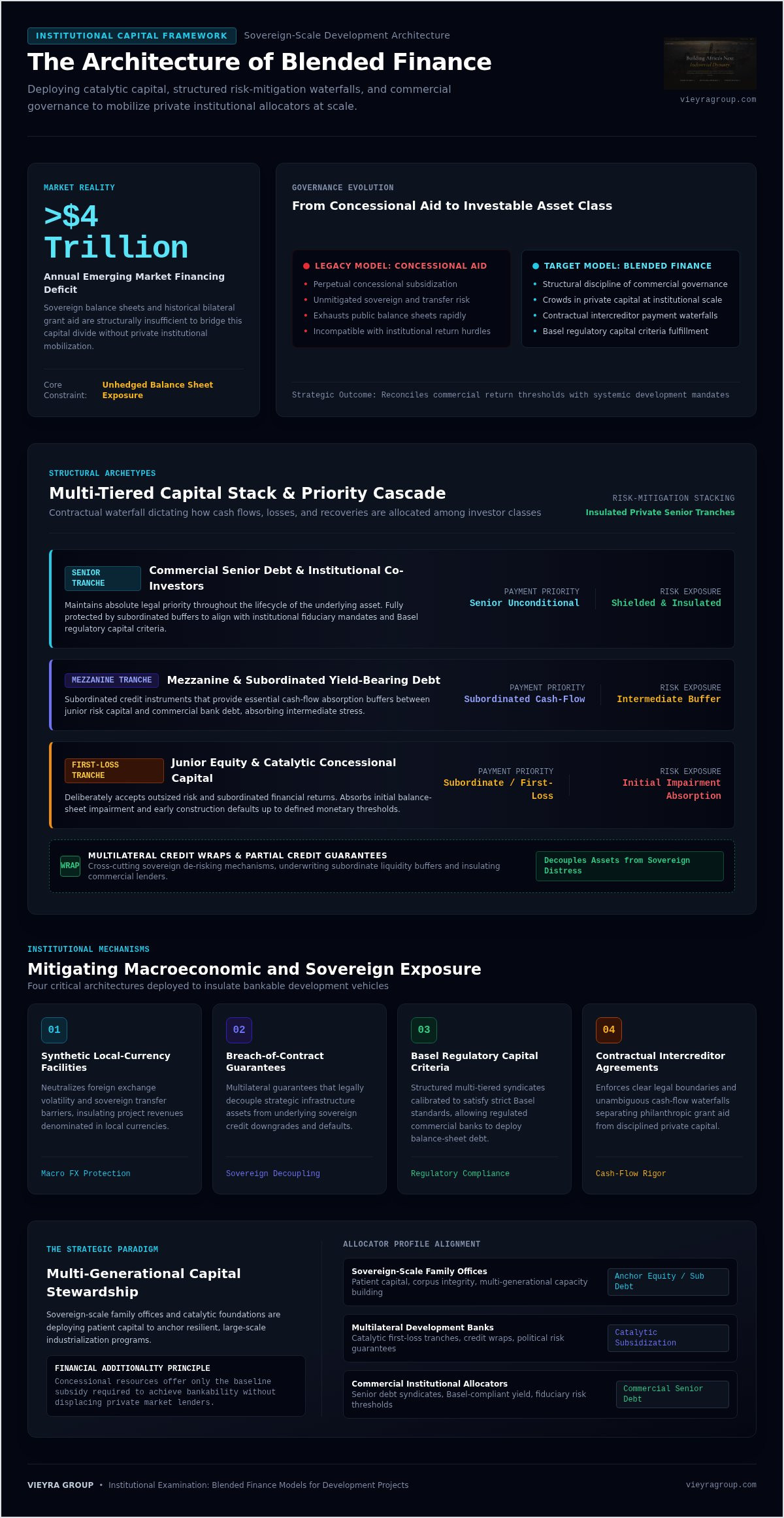
Blended finance operates as a deliberate structuring architecture rather than an exercise in public subsidy. At its core, it deploys targeted catalytic funds to re-engineer asymmetric risk-return metrics, thereby crowding institutional private capital into essential sectors that traditional markets systematically overlook. Emerging market development contends with an annual financing deficit exceeding $4 trillion. Institutional allocators cannot compromise their fiduciary mandates to bridge this divide through unhedged balance-sheet exposure alone. Structuring sophisticated blended finance structures resolves this impasse. It establishes distinct legal boundaries separating non-repayable philanthropic distributions, multilateral development finance, and commercially disciplined private capital. For institutional allocators, this framework serves as the primary gateway for mobilizing private capital for African industrialization.
The Institutional Definition and Mechanics of Catalytic Capital
Catalytic capital deliberately accepts outsized risk or subordinated financial returns to unlock commercial viability for private co-investors. By absorbing first-loss positions or underwriting subordinate liquidity buffers, these tranches shield commercial debt from early construction defaults and sovereign payment volatility. Multilateral development institutions calibrate these interventions against rigorous financial additionality criteria. They ensure that concessional resources offer only the baseline subsidy required to make an asset bankable without displacing private lenders. Within mature blended finance models for development projects, contractual intercreditor agreements enforce transparent cash-flow waterfalls, guaranteeing that commercial partners maintain unambiguous seniority throughout the lifecycle of the underlying asset.
The Evolution from Aid Allocation to Investable Asset Classes
Global economic architecture has shifted from bilateral donor disbursements toward structured institutional co-investment platforms. Historical grant aid proved structurally insufficient to sustain industrialization at sovereign scale. Sovereign-scale family offices and institutional asset managers now evaluate vital infrastructure as an investable, multi-generational asset class. This disciplined perspective reflects the foundational principles of global investment management, ensuring that capital deployments generate measurable industrial capacity while safeguarding long-term corpus integrity. By adopting proven blended finance models for development projects, strategic allocators reconcile global developmental imperatives with institutional preservation mandates.
Structural Archetypes: Comparing Blended Finance Models for Development Projects
Institutional structuring requires dissecting the legal priority of payment cascades. Standard market definitions often obscure the precise legal mechanisms governing capital recovery. Robust blended finance models for development projects depend upon unambiguous contractual waterfalls that dictate how cash flows, losses, and recoveries are allocated among disparate investor classes. When examining blended finance archetypes and catalytic capital, institutional investors evaluate three primary risk-mitigation layers across the balance sheet:
- Junior Equity and First-Loss Capital: Subordinated capital positions that absorb initial balance-sheet impairment, sheltering senior lenders up to defined monetary thresholds.
- Mezzanine and Subordinated Debt: Subordinated yield-bearing credit instruments that provide essential cash-flow buffers between junior risk capital and commercial bank loans.
- Risk Guarantees and Insurance Facilities: Unconditional, third-party off-balance-sheet commitments that transfer defined project, political, or sovereign default risks to AAA rated multilateral guarantors.
Deploying these structures methodically marks a turning point in the evolution of private capital markets in Africa, moving execution away from ad-hoc donor interventions toward standardized private market syndications.
First-Loss Capital and Subordinated Debt Facilities
First-loss capital functions as the contractual shock absorber of the capital stack. In structured project funds, non-repayable philanthropic contributions or junior equity tranches absorb initial defaults, protecting senior commercial debt up to pre-agreed attachment points. Concurrently, mezzanine tranches subordinate their cash-flow claims behind senior obligations. This dynamic enhances coverage ratios for institutional lenders while capturing higher yields, aligning private risk appetites with capital preservation objectives.
Guarantee Facilities and Political Risk Insurance Instruments
Guarantee instruments deliver capital efficiency without requiring immediate public fiscal outlays. Partial Credit Guarantees (PCGs) cover debt service shortfalls regardless of the underlying cause, whereas Partial Risk Guarantees (PRGs) protect lenders against specific government contractual breaches, tariff defaults, or off-taker payment failures. Under the Multilateral Investment Guarantee Agency (MIGA), political risk insurance covers expropriation, currency inconvertibility, and breach of contract. However, sovereign counter-indemnity mandates often constrain host governments with existing debt ceilings. Navigating these complex trade-offs requires experienced advisory, leading sovereign asset holders to consult specialized Strategic Capital Solutions when architecting multi-tiered syndicates.
De-risking Mechanisms: Mitigating Macroeconomic and Sovereign Exposure
Systemic macroeconomic volatility presents the primary impediment to institutional co-investment in emerging markets. When private asset managers decline frontier allocations, they are rarely rejecting asset-level unit economics; they are pricing out sovereign default contagion, unhedged foreign exchange depreciation, and abrupt regulatory interventions. Overcoming these barriers requires implementing sophisticated de-risking mechanisms for emerging market investments within blended finance models for development projects. By executing structured balance-sheet hedges and contractual protections, syndicates establish an impermeable legal boundary between project cash flows and broader macroeconomic distress, adhering to disciplined standards of sovereign investment risk management in Africa.
Structuring Liquidity and Foreign Exchange Convertibility Buffers
Currency mismatch represents a persistent vulnerability across frontier infrastructure assets. Strategic projects routinely generate domestic currency revenues while servicing dollar-denominated senior obligations. To neutralize this exposure, blended vehicles integrate synthetic local currency hedging facilities provided by institutions like The Currency Exchange Fund (TCX). Concurrently, sponsors structure specialized debt service reserve accounts (DSRAs) funded via standby concessional liquidity lines. These reserves link directly to offshore cash-sweep escrow accounts in neutral legal jurisdictions, insulating senior lenders against sudden central bank exchange controls or temporary dollar shortages.
Political Risk Insurance and Expropriation Mitigation
Regulatory creep and retroactive tariff repudiation demand robust contractual firewalls. Structuring teams mitigate these sovereign exposures through specialized political risk insurance (PRI) policies that cover breach of contract, expropriation, and non-honoring of sovereign financial obligations (NHSFO). Enforceability rests upon binding international arbitration frameworks, predominantly seated under the International Centre for Settlement of Investment Disputes (ICSID) or the International Chamber of Commerce (ICC). Co-investing alongside host sovereign wealth entities creates substantial economic and political alignment, making unilateral state expropriation prohibitively costly. Through these layered protocols, blended finance models for development projects preserve capital integrity across complex political cycles.
Institutional Structuring: Designing Bankable Blended Vehicles for Large-Scale Assets
Transforming complex industrial initiatives into bankable opportunities requires moving past ad-hoc concessions into standardized transactional structures. Fiduciary mandates require definitive governance, transparent debt servicing, and unambiguous recourse mechanisms across every tier of the balance sheet. Executing institutional blended finance models for development projects follows a disciplined sequence: origination feasibility, capital stack structuring, documentation standardization, and syndicated financial close. Institutional sponsors align developmental mandates with private sector investment speed by codifying objective key performance indicators (KPIs) and enforceable intercreditor compacts.
Capital Stacking and Waterfall Engineering
Disciplined payment cascades dictate cash distributions during operations, refinancing events, and asset wind-downs. Structuring teams engineer distinct operational accounts, routing gross project revenues into protected offshore accounts. Senior commercial debt claims take absolute priority for service payments, followed by maintenance reserves and mezzanine yield distributions. Concessional tranches absorb payment deferrals when cash flow falls below contractual thresholds. When underlying operations generate excess liquidity, structured clawback covenants return capital to junior tranches, ensuring public funds rotate back into future development initiatives.
Multi-Jurisdictional SPV Governance and Legal Structuring
Special Purpose Vehicle (SPV) jurisdiction forms the bedrock of legal neutrality and enforceability. Sponsors incorporate holding vehicles in established, stable financial hubs that offer extensive bilateral investment treaty networks and clear tax neutrality. Shareholder compacts establish reserved matters that require supermajority consensus, preserving institutional governance oversight without stalling day-to-day industrial operations. By removing dispute resolution from localized courts and anchoring it in recognized international commercial arbitration tribunals, sponsors eliminate home-jurisdiction bias. Institutional leaders seeking to originate and anchor bankable capital architectures can explore our Strategic Capital Solutions to align multi-tiered syndicates around lasting industrial assets.
Multi-Generational Stewardship: Aligning Sovereign Capital and Philanthropic Mandates
Mainstream discourse frequently treats sovereign infrastructure finance as an exclusive arena for state actors and multilateral development banks. This perspective misses the growing influence of private multi-generational family offices. Unlike standard private equity vehicles that operate under strict ten-year divestment mandates, generational balance sheets possess the patience required to support complex industrial ecosystems through their full maturity cycle. By integrating patient balance sheets with catalytic grant capital, institutional allocators engineer blended finance models for development projects that deliver tangible industrial capacity while preserving long-term capital integrity. This institutional approach underpins modern deployments of strategic philanthropy for African industrialization.
The Synergy Between Family Office Capital and Multilateral Institutions
Traditional private equity horizons create structural friction when applied to sovereign-scale assets. Large-scale transport corridors, power infrastructure, and processing plants require protracted development phases that resist arbitrary exit windows. Sovereign-scale family offices step into this void. By partnering directly with development finance institutions, these private allocators leverage their operational agility and unencumbered governance to anchor strategic syndications. Their involvement provides stability across cyclical macroeconomic shifts, assuring institutional co-investors that foundational balance-sheet commitments remain rock-solid over multi-decade operating horizons.
Catalytic Philanthropy as an Infrastructure Catalyst
Grant capital plays its most potent role at the conceptual inception of an industrial ecosystem. Rather than dispersing non-repayable distributions across disparate social programs, institutional family foundations deploy programmatic grants to fund pre-feasibility engineering, environmental assessments, and sovereign regulatory reforms. This upfront catalytic intervention directly addresses the early preparation deficit that stalls hundreds of viable frontier initiatives. Strategic allocators looking to participate in this structural alignment can examine the systemic execution led by the Vieyra Family Office. Through this deliberate integration of patient equity, catalytic foundation grants, and multilateral risk-mitigation facilities, blended finance models for development projects translate long-term stewardship into lasting economic autonomy.
Institutionalizing the Future of Sovereign Capital Architecture
Sovereign-scale industrial transformation requires moving beyond short-term concessionary reliance toward enduring balance-sheet engineering. When structured with contractual precision, robust blended finance models for development projects insulate senior institutional debt through catalytic first-loss equity, synthetic local-currency hedging, and multilateral risk wraps. This systematic alignment reconciles strict fiduciary preservation mandates with the expansive funding requirements of frontier economies.
Lasting industrial sovereignty is achieved when patient capital converges with catalytic intent. Operating through an established multi-generational governance framework, sovereign-scale allocators bridge the historic divide separating public development institutions from commercial capital markets. By harmonizing rigorous commercial discipline with catalytic foundation initiatives, strategic allocators structure resilient co-investment syndicates capable of underwriting national infrastructure. Explore strategic capital deployment and sovereign-scale co-investment with the Vieyra Family Office to anchor transformative industrial assets designed for permanent generational impact.
Frequently Asked Questions
How do blended finance models for development projects differ from traditional public-private partnerships?
Blended finance explicitly requires catalytic, concessional funding deployed to crowd in private capital that would otherwise reject the asset's risk-return balance. Traditional public-private partnerships typically rely on purely commercial debt and equity underpinned by statutory host-government concessions or sovereign availability payments. Conversely, blended finance models for development projects incorporate junior equity, concessional mezzanine debt, or first-loss donor capital, legally re-engineering the waterfall to insulate private institutional lenders against unhedged sovereign and macroeconomic default risks.
What constitutes catalytic capital within an institutional blended finance architecture?
Catalytic capital comprises investment funds or grant resources that deliberately accept outsized financial risk or below-market returns to mobilize private commercial investment. Provided predominantly by philanthropic foundations, development finance institutions, and donor agencies, these resources bridge structural bankability gaps. They absorb preliminary project development liabilities, fund subordinate loss cushions, or provide credit guarantees, ensuring commercial tranches meet institutional hurdle rates without displacing market-rate capital or distorting local financial ecosystems.
How does first-loss equity protect commercial institutional investors in development projects?
First-loss equity acts as a contractual buffer that absorbs initial project defaults and asset impairments before any financial loss impacts senior commercial debt tranches. Held by concessional allocators or catalytic foundations, this subordinated equity tranche sits at the lowest tier of the payment waterfall. By establishing clear loss-attachment thresholds, it insulates private institutional investors against construction cost overruns, operational revenue volatility, and early-stage sovereign payment interruptions, directly enhancing the credit rating of senior asset-level facilities.
What role do multilateral development banks play in structuring blended finance facilities?
Multilateral development banks serve as transactional anchors that calibrate concessionality, originate bankable governance architectures, and issue critical credit enhancement instruments. Beyond providing direct senior and mezzanine lending, multilateral institutions structure partial risk guarantees and political risk insurance policies. Their preferred creditor status deters host-government expropriation and contract breach, reassuring private commercial syndicates while standardizing legal documentation and environmental covenants to facilitate multi-jurisdictional institutional capital deployment across emerging markets.
How are foreign exchange and currency risks hedged within blended finance models?
Currency volatility is mitigated through synthetic hedging facilities, non-deliverable cross-currency swaps, and concessional foreign exchange liquidity buffers. Facilities like The Currency Exchange Fund absorb long-term currency risk by converting hard-currency debt obligations into local-currency payment streams for domestic off-takers. Structured vehicles also maintain dedicated debt service reserve accounts funded by catalytic capital, protecting commercial senior tranches against sudden central bank exchange controls, sovereign convertibility moratoria, or sharp macro devaluations.
Can multi-generational family offices participate in sovereign-scale blended finance syndicates?
Sovereign-scale family offices actively participate as anchor equity investors and catalytic grant providers within blended finance models for development projects. Unlike cyclical private equity funds bound by rigid five-to-ten-year divestment horizons, generational family offices possess permanent, patient capital aligned with the multi-decade lifecycles of industrial infrastructure. Through institutions like the Vieyra Family Office and aligned catalytic foundations, generational allocators bridge the gap between development finance institutions and commercial debt markets, anchoring transformative sovereign-scale assets.
What are the primary governance challenges when public, philanthropic, and private capital converge?
The primary governance challenge lies in harmonizing contradictory stakeholder timelines, fiduciary return requirements, and development impact accountability. Commercial lenders prioritize capital preservation and cash flow predictability, while multilateral institutions enforce exhaustive policy covenants and philanthropic donors require measurable socio-economic outputs. Resolving this tension requires establishing legally neutral Special Purpose Vehicles with standardized intercreditor compacts, transparent cash waterfalls, and pre-defined dispute resolution mechanisms seated under international commercial arbitration bodies.


