
The preservation of sovereign-scale capital within the African continent necessitates a profound paradigm shift, moving beyond the mere mitigation of volatility toward the deliberate stewardship of systemic stability. Institutional actors often confront the complex intersection of systemic geopolitical volatility and the profound trust deficits inherent in regional markets, recognizing that the standard framework for sovereign investment risk management Africa necessitates is often insufficient for the scale of the task at hand. It's increasingly clear that the alignment of short-term industrial growth with the imperative of multi-generational legacy preservation requires a more sophisticated, institutionalized approach to capital deployment.
This article provides an authoritative exploration of the strategic frameworks required to navigate these complexities, offering a robust methodology for risk-adjusted capital allocation. By integrating strategic industrialization goals with the rigorous standards of global institutional stewardship, we illustrate how to transform regional volatility into a foundation for long-term progress. The following analysis details the mechanisms of strategic capital solutions and the deliberate foresight necessary to ensure that today’s investments become the enduring pillars of a permanent economic legacy.
Key Takeaways
- Understand why institutional stewardship necessitates a transition from tactical volatility mitigation to the implementation of multi-layered governance structures that endure across political cycles.
- Identify the sophisticated frameworks of sovereign investment risk management Africa necessitates, specifically regarding the balance between high-growth industrial potential and systemic institutional fragility.
- Examine the strategic advantages of private institutional capital, which often possesses the agility required to navigate complex regulatory landscapes more effectively than traditional sovereign entities.
- Learn how the strategic deployment of capital into domestic industrial value chains serves as a definitive hedge against risks associated with commodity dependency and currency fluctuations.
- Recognize the methodology for synthesizing global investment rigor with a profound African heritage to safeguard and grow sovereign-scale capital for multi-generational legacy preservation.
The Landscape of Sovereign Investment Risk in the African Context
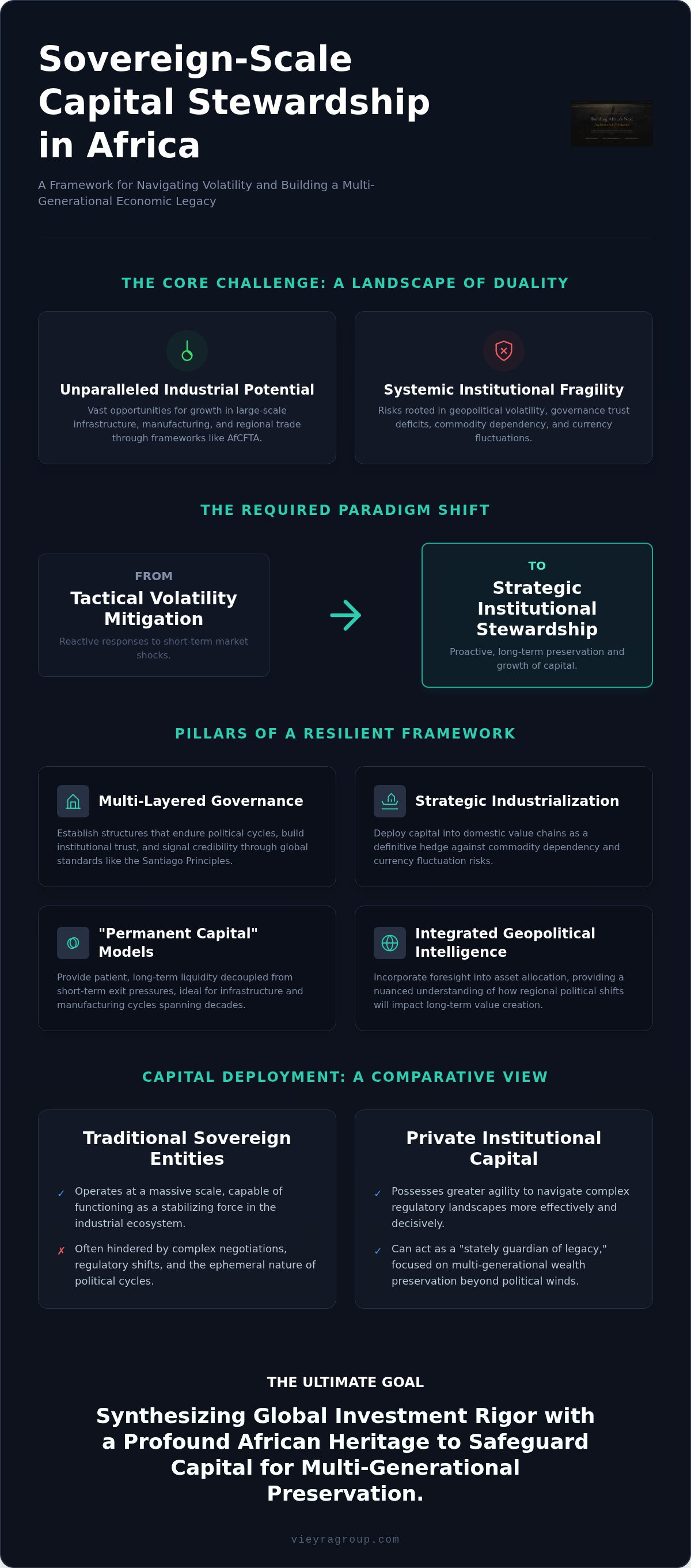
The architecture of sovereign investment risk management Africa demands is built upon the recognition that capital preservation is a multi-generational endeavor. It requires an analytical depth that transcends the superficial metrics of credit ratings or short-term currency fluctuations. Institutional actors must navigate a landscape defined by a striking duality where unparalleled industrial potential is frequently juxtaposed against systemic institutional fragility. For entities operating at a sovereign scale, the risk profile is inextricably linked to the political economy of the host nation. Large-scale infrastructure projects aren't merely engineering feats; they're complex negotiations with local governance, regulatory shifts, and the long-term stability of the regional environment. Quantifying the sovereign-scale threshold requires a departure from traditional retail or private equity mindsets, focusing instead on the systemic impact of capital that functions as a stabilizing force within the broader industrial ecosystem.
Systemic vs. Idiosyncratic Risks in Emerging Economies
The emergence of regional trade frameworks, most notably the African Continental Free Trade Area (AfCFTA), introduces a new layer of cross-border investment stability by harmonizing regulatory expectations. However, these systemic advancements remain vulnerable to global commodity cycles that dictate domestic sovereign liquidity. When the price of primary exports fluctuates, the resulting volatility ripples through the industrial sector, affecting everything from logistics costs to the availability of strategic capital solutions. In the African context, sovereign risk is fundamentally a function of institutional maturity and resource dependency. This necessitates a framework that accounts for idiosyncratic regional shocks while maintaining a global perspective on capital flow and liquidity requirements.
The Trust Deficit: Governance as a Primary Risk Factor
Governance remains the primary pivot upon which institutional capital rotates, as there's a direct correlation between transparency and the cost of deploying strategic capital. Adopting global benchmarks, such as the Santiago Principles, serves as a vital signal of credibility for institutions seeking to manage large-scale funds with professional rigor. The Libyan Investment Authority provides a compelling historical example of how governance structures and the pursuit of institutional permanence influence the trajectory of sovereign-scale capital. For a family office acting as a stately guardian of legacy, the perception of permanence is the ultimate mitigant against the ephemeral nature of political cycles. Establishing multi-layered governance structures that survive individual administrations is not merely a compliance exercise; it's a strategic necessity for ensuring the survival and growth of industrial capital across generations. When institutional trust is established, the perceived risk of large-scale deployment diminishes, allowing for the deliberate, methodical growth of a global investment portfolio.
Pillars of Institutional Risk Management and Stewardship
The transition from reactive risk mitigation to a philosophy of institutional stewardship represents the cornerstone of modern sovereign investment risk management Africa requires. Unlike tactical responses to immediate market fluctuations, strategic stewardship views capital as a permanent instrument of stability. This approach necessitates the adoption of "Permanent Capital" models, which are uniquely suited to the African industrial landscape where infrastructure and manufacturing cycles often span decades. By decoupling capital from the volatility of short-term exit requirements, institutions can provide the patient liquidity necessary to foster industrial growth while insulating the core portfolio from transient geopolitical shocks. Integrating geopolitical intelligence into the asset allocation framework allows for a more nuanced understanding of how regional shifts affect long-term value. It's about foresight. This methodology ensures that capital isn't merely surviving the environment but actively shaping it through deliberate, large-scale intervention.
The Multi-Generational Vision as a Risk Mitigant
The adoption of a multi-generational vision serves as a primary risk mitigant, allowing an institution to absorb cyclical market corrections that would destabilize shorter-term investors. In volatile jurisdictions, the architecture of wealth preservation is built upon the ability to remain solvent and operational throughout multiple political cycles. This requires a sophisticated balancing act. Global liquidity requirements must be met to ensure the institution's international standing. Simultaneously, domestic industrial commitments must be honored to drive regional progress. This dual focus creates a resilient foundation where the scale of operations is protected by the depth of its strategic roots. Stability is the goal.
Governance Frameworks for Sovereign-Scale Entities
Robust governance frameworks are essential for maintaining the independence of sovereign-scale entities, particularly when insulating capital from external pressures. Establishing independent investment committees composed of global experts ensures that fiduciary duty remains the guiding principle of every allocation. Within the context of African nation-building, this duty transcends simple profit-seeking; it becomes a commitment to the structural integrity of the economy itself. Institutional gravity is maintained through rigorous syntactical and synthetical decision-making that prioritizes long-term systemic health over immediate optics. Those seeking to align their portfolios with these principles of permanence often find that strategic capital solutions provide the necessary bridge between global rigor and local impact. Such frameworks ensure that the institution remains a visionary architect of legacy, standing firm against the shifting sands of global finance.
Sovereign Scale vs. Private Agility: A Comparative Analysis
The distinction between public sovereign wealth funds and private family offices operating at a commensurate scale is a critical element of the sovereign investment risk management Africa requires. While government-led entities often operate under the scrutiny of public budgetary cycles and political mandates, private sovereign-scale institutions possess a unique form of agility. This private institutional capital is frequently better positioned to navigate the intricate regulatory environments of African markets because it doesn't answer to short-term political pressures. Instead, it functions as the strategic glue that binds global capital to local industrial projects. This ensures that long-term developmental goals aren't sacrificed for immediate political optics. The resulting partnership model, where private institutional rigor meets sovereign-scale ambition, is a primary vehicle for regional economic transformation.
The Flexibility of Private Sovereign-Scale Institutions
Decision-making speed is a decisive advantage when identifying and acquiring distressed industrial assets during periods of market correction. Unlike public institutions that may be slowed by bureaucratic oversight, private sovereign-scale entities can move with the precision of global finance while maintaining the patience of a multi-generational steward. They aren't constrained by the rigid timelines of public fiscal years. This allows for the deployment of patient capital into sectors that require long-term nurturing, such as heavy manufacturing or energy infrastructure. By maintaining global investment standards while executing local strategic mandates, these institutions ensure that capital is both protected and productive. It's about the poise of an entity certain of its trajectory.
Alignment of Interests in Large-Scale Partnerships
The success of public-private industrial initiatives depends on the meticulous alignment of interests between capital providers and the sovereign state. Co-investment frameworks allow global institutions to leverage the local expertise and multi-generational heritage of established African family offices. These frameworks incorporate risk-sharing mechanisms that protect the interests of all stakeholders, ensuring that the burden of systemic risk is distributed proportionally. It's a matter of shared legacy. When private African industrialization capital is deployed alongside sovereign objectives, it creates a stabilizing force that transcends individual administrations. This alignment ensures that sovereign investment risk management Africa strategies are met with the necessary strategic depth and financial resilience to endure for decades.
The Architecture of Resilience: Industrialization as Risk Mitigation
The deliberate construction of domestic industrial capacity serves as the ultimate structural hedge against the inherent volatility of primary commodity markets and the subsequent erosion of sovereign currency value. Industrialization functions as a sophisticated mechanism for sovereign investment risk management Africa requires to achieve true economic autonomy, as it shifts the economic base from extraction to value addition. It's this focus on structural depth that distinguishes true stewardship from speculative interest. By internalizing value chains, institutions transform vulnerable export-dependent economies into resilient, self-sustaining ecosystems that are less susceptible to the caprice of global trade shocks. Strategic investment in foundational infrastructure provides the physical architecture necessary for this transition, acting as a stabilizing anchor within an institutional portfolio. This approach treats capital allocation not merely as a pursuit of yield, but as a form of systemic insurance that preserves the integrity of the broader economic landscape.
Developing Robust Industrial Value Chains
Developing robust value chains requires a move from the exportation of raw materials to the sophisticated processing of high-value industrial goods, representing a fundamental shift in a nation's risk profile. This resilience is built through the meticulous alignment of local production with regional demand. Mitigating logistical risks through the development of integrated transport and energy networks ensures the uninterrupted flow of commerce, even during periods of regional instability. The systematic advancement of industrial capacity creates a virtuous cycle where increased employment opportunities foster social stability, which in turn reinforces the permanence of institutional capital.
Strategic Capital Deployment in Essential Sectors
Identifying sovereign-critical industries, such as energy production and advanced manufacturing, allows for capital allocation into sectors with defensive growth profiles that remain resilient across economic cycles. The integration of technology transfer protocols de-risks these long-term projects by ensuring local operational excellence and global competitiveness. Incorporating the philanthropic initiatives of the Vieyra Foundation allows for the cultivation of social capital, effectively reducing operational risks by aligning industrial progress with community development. For those seeking to participate in this transformative process, the deployment of African industrialization capital provides a structured pathway toward building a resilient, multi-generational legacy. It's a commitment to the future that transcends simple financial returns, focusing instead on the creation of a permanent and prosperous industrial heritage.
Synthesizing Stewardship: The Vieyra Approach to African Investment
The synthesis of global investment rigor with a deep-rooted African perspective represents the definitive evolution of sovereign investment risk management Africa requires for the modern era. This methodology transcends simple capital allocation, manifesting instead as a profound commitment to the continent’s long-term industrial fortitude. The Vieyra Family Office operates as a stately guardian, ensuring that a multi-generational industrial legacy isn't compromised by the caprice of global market sentiment or transient regional shifts. By deploying Strategic Capital Solutions, the institution facilitates large-scale economic transformation that remains anchored in institutional stability. The future of sovereign-scale investment lies in this deliberate blend of heritage and innovation, where the scale of operations reflects a permanent and global influence. It's a philosophy of permanence.
Institutional Expertise in Industrial Finance
Navigating the intricate mechanics of sovereign-level capital requires more than financial acumen; it demands an institutional presence that commands respect across international borders. Strategic wealth management at this scale serves a higher purpose, acting as the primary mechanism for preserving the African investment legacy through periods of global transition. By positioning the institution as a visionary architect, it's possible to design an industrial future that is both technologically advanced and structurally resilient. This involves the careful orchestration of resources to ensure that every initiative contributes to a larger, cohesive narrative of systemic progress. The goal is the creation of an enduring economic framework that survives the volatility of the present to secure the prosperity of the future.
A Call to Multi-Generational Action
Engaging with the African century necessitates the selection of partners who possess both sovereign-scale vision and undeniable institutional gravity. It's no longer sufficient to seek short-term gains in a landscape that demands the deliberation of a century-long horizon. The Vieyra Family Office facilitates Global Investment Management by providing the necessary bridge between sophisticated international capital and the unique requirements of African industrialization. Our commitment to long-term stewardship ensures that every deployment of capital leaves a systemic impact, fostering a legacy of prosperity that will endure for generations to come. The trajectory is set. It's a journey defined by poise, certainty, and a profound sense of duty to the future. Those who align with this vision don't just invest in a market; they participate in the architectural drafting of a continent's destiny.
The Architecture of a Permanent African Legacy
The evolution of capital within the continent requires a transition from the mere mitigation of immediate volatility to the deliberate stewardship of systemic stability through strategic industrialization. This framework ensures that sovereign-scale investments serve as permanent anchors of growth, effectively insulating portfolios from the cyclical nature of commodity markets and geopolitical shifts. Implementing the sophisticated approach to sovereign investment risk management Africa necessitates allows institutional actors to transform regional challenges into foundations for multi-generational progress. It's this commitment to structural depth that defines the modern era of African finance.
As a stately guardian of heritage, the Vieyra Family Office leverages sovereign-scale institutional management and global asset allocation expertise to safeguard capital across political cycles. Our multi-generational African industrial focus provides the strategic depth required to navigate complex regulatory landscapes with poise and certainty. Discover the Institutional Framework of the Vieyra Family Office and align your portfolio with a vision of permanence. The path toward a prosperous African century is built upon the foresight of those who act as architects of legacy. It's a journey where institutional gravity meets visionary ambition to secure a lasting impact.
Frequently Asked Questions
What defines a sovereign-scale investment institution in the African context?
A sovereign-scale institution is defined by the systemic nature of its capital deployment and its ability to influence the structural trajectory of regional economies. It's not merely a matter of asset volume but the deliberation with which capital is utilized to foster industrial stability. These entities operate as stately guardians, prioritizing the permanence of infrastructure and manufacturing over the transient yields of speculative markets.
How does the Vieyra Family Office manage geopolitical risk in its African portfolio?
Geopolitical risk is managed through the rigorous application of institutional stewardship and the integration of sophisticated intelligence into the asset allocation framework. By establishing governance structures that transcend individual political cycles, the office ensures that its portfolio remains resilient against regional volatility. This method is central to the sovereign investment risk management Africa demands for the successful preservation of multi-generational wealth.
What role does industrialization play in long-term wealth preservation?
Industrialization functions as a foundational hedge against the volatility inherent in commodity-dependent economies and the resulting erosion of currency value. By internalizing high-value processing and building robust domestic value chains, an institution creates a resilient economic base that survives external shocks. This structural depth provides a form of systemic insurance, ensuring that capital remains productive while contributing to the long-term stability of the host nation.
How can global institutions partner with African family offices for sovereign-level projects?
Global institutions can engage in large-scale African projects by utilizing co-investment frameworks that pair international liquidity with the deep-rooted heritage of local family offices. These partnerships provide the strategic glue necessary to navigate complex regulatory environments and ensure alignment with national industrialization goals. Such collaborations often rely on Strategic Capital Solutions to create risk-sharing mechanisms that protect the interests of all sovereign-level stakeholders.
What are the Santiago Principles and why are they relevant to African investment?
The Santiago Principles are a framework of 24 guidelines designed to ensure that sovereign-scale entities operate with transparency, accountability, and professional rigor. For investors in Africa, these principles serve as a vital benchmark for institutional credibility, helping to mitigate the perceived trust deficit in emerging markets. Adherence to these standards signals an institution’s commitment to global excellence and the long-term stewardship of systemic stability.
How does multi-generational stewardship differ from traditional asset management?
Multi-generational stewardship differs from traditional asset management by prioritizing the permanence of the legacy over short-term exit requirements or quarterly yield targets. It utilizes Permanent Capital models that allow for the patient nurturing of industrial projects with lifespans stretching across decades. This philosophy views capital as a stabilizing instrument, focusing on the preservation of value and the architectural drafting of a continent's future.
What is the relationship between institutional philanthropy and investment risk management?
Institutional philanthropy, such as the initiatives led by the Vieyra Foundation, serves as a strategic mitigant by cultivating social capital and fostering regional stability. By aligning industrial growth with community advancement, an institution secures its social license to operate and reduces the risk of local operational disruptions. This synthesis of social commitment and capital deployment ensures that large-scale projects are harmoniously integrated into the broader societal fabric.
How does the AfCFTA impact the risk profile of sovereign-scale investments?
The implementation of the AfCFTA transforms the risk landscape by harmonizing regulatory expectations and facilitating the seamless movement of goods across borders. This integration reduces the idiosyncratic risks associated with individual markets and enhances the overall stability of the sovereign investment risk management Africa requires. It provides a more predictable environment for the deployment of African Industrialization Capital, allowing for the creation of broader, more resilient value chains.


