
The enduring survival of multi-generational prosperity is rarely a consequence of market performance alone; it's the result of a deliberate, sovereign-scale institutional architecture. You likely recognize that as capital scales and family branches multiply, the original vision that established the enterprise often faces the corrosive pressures of dilution and internal misalignment. This realization necessitates a transition from informal management to a robust system of family office governance for wealth preservation. Such a framework ensures that the collective intent of the founders remains the guiding force, even as the scale of operations expands to encompass global industrial transformation.
This article provides a comprehensive exploration of the sophisticated governance structures required to institutionalize family values and professionalize decision-making for sovereign-scale capital. We'll examine the specific mechanisms that align individual family needs with institutional investment goals, thereby fostering a legacy that survives the founders. By adopting these rigorous frameworks, an institution enhances its credibility with global sovereign partners and secures its position as a stately guardian of long-term strategic capital.
Key Takeaways
- Distinguish between passive wealth management and the sovereign-scale institutional architecture required for multi-generational permanence.
- Implement sophisticated family office governance for wealth preservation by establishing a clear separation between family ownership and professional investment management.
- Analyze the strategic transition from founder-led decision-making to a model of institutional sovereignty that ensures stability across successive generations.
- Leverage strategic capital solutions to bridge the gap between global investment standards and large-scale industrialization projects.
- Align philanthropic vision with core investment strategies to reinforce the institution’s role as a stately guardian of legacy and global progress.
The Architecture of Permanence: Defining Sovereign-Scale Governance
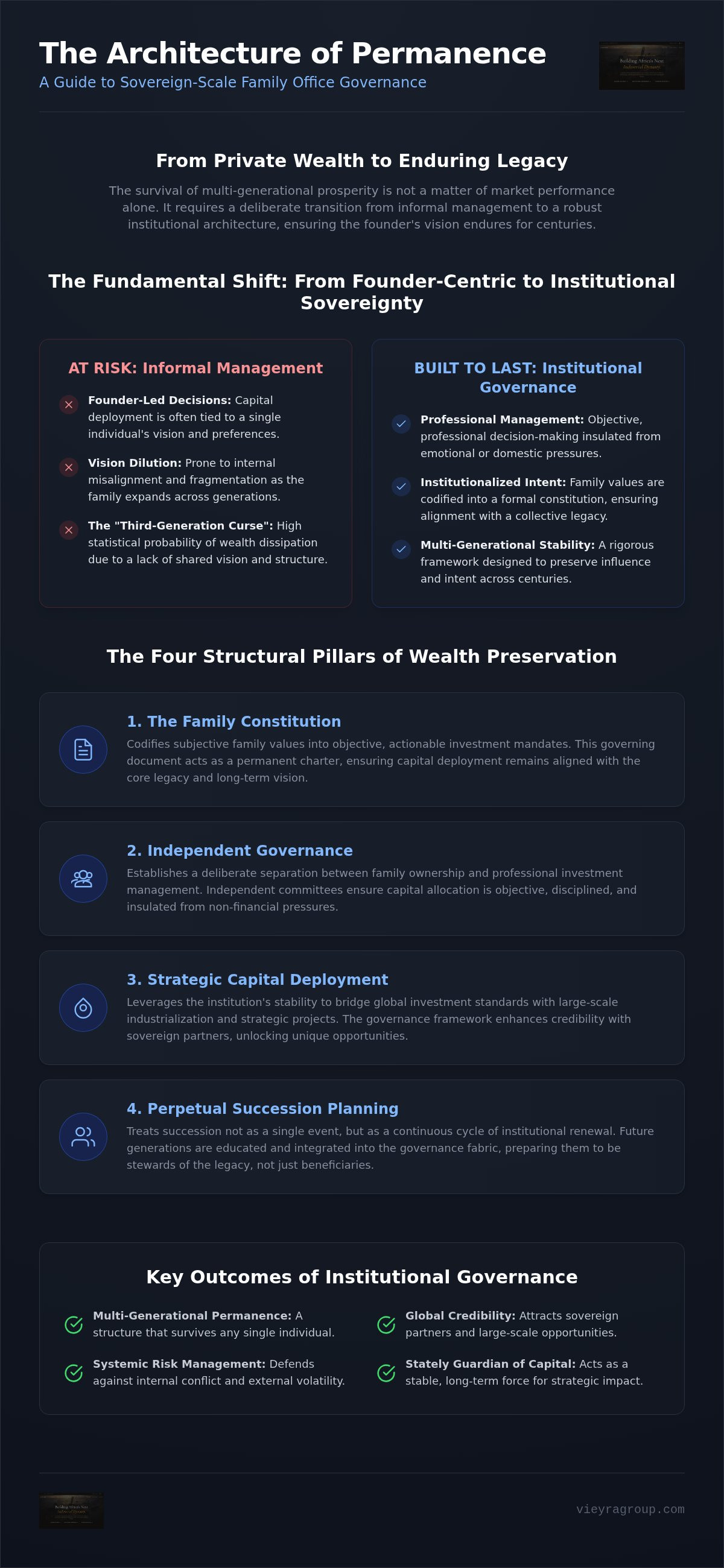
True wealth preservation isn't a byproduct of passive capital accumulation; it's an intentional act of institutional design. While standard wealth management focuses on the tactical optimization of portfolios, institutional stewardship seeks the enduring preservation of a family’s influence and intent across centuries. This distinction is vital for those seeking to understand what a family office is in its most sophisticated form. At this level, the objective isn't merely the maintenance of liquidity but the creation of a sovereign-scale entity capable of driving global industrial transformation while protecting the core legacy from the third-generation curse. This phenomenon, where wealth is often dissipated by the third generation due to a lack of shared vision, is mitigated through a rigorous architecture of family office governance for wealth preservation.
A formal governance structure acts as a sovereign-level constitution, formalizing family values into a permanent governing body that survives any single individual. When an institution demonstrates this level of structural maturity, it develops an institutional gravity that naturally attracts global partners and sovereign-scale opportunities. This depth of organization signals to the market that the capital is not fleeting. Instead, it represents a stable, long-term force dedicated to systemic impact and multi-generational stability.
The Institutionalization of Family Intent
Governance serves as the mechanism that translates subjective family values into objective, actionable investment mandates. Without a formal Family Constitution, the transition from a founder-led enterprise to a multi-generational institution often collapses under the weight of divergent interests. A robust framework codifies the institution’s scope, ensuring that capital deployment remains aligned with both global asset management and regional objectives, such as African industrialization. By institutionalizing intent, the family office operates with a clarity of purpose that commands respect from sovereign entities and industrial partners alike. It allows the family to move beyond individual desires, focusing instead on the collective legacy of the institution.
Governance as a Risk Management Framework
A sophisticated governance model functions as a primary defense against both internal fragmentation and external geopolitical volatility. It establishes a clear fiduciary duty to future generations, ensuring that short-term individual needs don't compromise long-term institutional stability. Transparency and professionalized decision-making frameworks are not merely administrative requirements; they're essential for maintaining the integrity of the legacy. This systemic approach to family office governance for wealth preservation creates an aura of permanence. It allows the institution to act as a stately guardian of capital in an increasingly unpredictable global environment, ensuring that the wealth remains a tool for progress rather than a source of conflict.
Structural Pillars of Multi-Generational Wealth Preservation
The structural integrity of a legacy institution relies on the deliberate separation of family ownership from professional investment management. While the family remains the ultimate arbiter of vision, the execution of complex mandates requires a level of fiduciary rigor that transcends individual preferences. By establishing key governance structures such as independent investment committees, an institution ensures that capital allocation remains objective and insulated from domestic or emotional pressures. This separation is the foundation of family office governance for wealth preservation, transforming the entity from a private pool of capital into a disciplined institutional actor.
Succession planning doesn't function as a terminal event; it's a perpetual cycle of institutional renewal. It requires the integration of multi-generational education into the very fabric of the governance cycle. The objective is to prepare the next generation to act as stewards of a global legacy rather than mere beneficiaries. This process involves exposing future leaders to the complexities of global investment management and the strategic importance of regional industrialization. It's about ensuring the family's core values survive the transition from one generation to the next without losing the momentum of the institution's global mission.
The Role of Independent Oversight
The integration of independent oversight isn't merely an administrative layer. It's a strategic necessity that provides the friction required to challenge internal biases in capital deployment. By leveraging external experts within the Board of Directors, the office ensures that its strategic depth remains robust against market volatility. This balance between family representation and professional institutional standards reinforces the office's identity as a visionary architect of legacy. Such oversight ensures the institution operates with the deliberation of a sovereign entity, maintaining credibility with global industrial partners and ensuring long-term stability.
Capital Allocation Frameworks
Within a mature governance model, capital allocation must be categorized with precision. Distinguishing between passive investment and strategic capital allows the institution to pursue sovereign-scale industrial projects that align with its long-term global vision. This alignment ensures that every deployment of capital serves the broader objective of family office governance for wealth preservation, maintaining the institution's trajectory through periods of global transformation. Families seeking to bridge the gap between legacy preservation and large-scale industrial growth often benefit from Strategic Capital Solutions that provide the necessary framework for global impact.
Governance Models: From Founder-Centric to Institutional Sovereignty
The maturation of a family office often mirrors the evolution of a sovereign state. In its nascent stages, the institution typically revolves around the singular vision and intuitive decision-making of its founder. While this agility is beneficial during the initial phase of wealth creation, it becomes a structural liability as the entity scales. A move toward committee-based systems is essential. This transition represents the shift into a model of Institutional Sovereignty, where the office operates with the deliberation and strategic depth of a state-level actor. Adopting a rigorous framework of family office governance for wealth preservation ensures that the institution's trajectory remains stable, regardless of the presence of any single individual.
Operating with institutional sovereignty allows the family office to interface effectively with global industrial partners and sovereign entities. This is particularly relevant for families managing diverse global interests or those spearheading complex African industrialization projects. These large-scale initiatives require more than just capital; they demand a governance architecture capable of navigating geopolitical nuances and long-term industrial cycles. By institutionalizing decision-making, the family office transforms from a private investment vehicle into a stately guardian of progress, capable of driving systemic change across multiple generations.
The Evolution of Decision-Making Authority
Transitioning from individual intuition to data-driven institutional logic requires a fundamental re-engineering of the office's DNA. Managing the patriarchal transition is often the most delicate phase of this journey. It necessitates the formalization of voting rights and the establishment of clear protocols for dispute resolution. The Family Council serves as a critical mediator in this process. It provides a formal forum where inter-generational priorities are debated and aligned with the institution's broader mandates. This structure ensures that the family’s collective intent is translated into objective investment strategies that prioritize the permanence of the legacy over short-term individual gains.
Comparative Analysis of Governance Maturity
Evaluating an institution's maturity requires an understanding of where it sits on the governance spectrum. Most offices progress through three distinct stages:
- Stage 1: Foundational Governance. Decision-making is centralized and founder-led. The focus is primarily tactical, and structures are often informal.
- Stage 2: Professionalized Governance. The office adopts committee-based structures and introduces independent oversight. Diversification becomes a strategic priority.
- Stage 3: Sovereign-Scale Governance. The institution is fully institutionalized with global influence. It operates as a stately guardian, utilizing family office governance for wealth preservation to manage multi-generational legacy and large-scale industrial impact.
Reaching the final stage of maturity allows the family office to act with a level of poise and certainty that is recognized by global peers. It creates a reading of the institution as a permanent fixture in the global financial landscape, deeply rooted in its identity and certain of its long-term trajectory.
Integrating Global Stewardship with African Industrialization
A sophisticated governance framework serves as the vital conduit between global capital markets and regional economic transformation. It moves beyond internal management to become an instrument of strategic capital deployment, enabling the execution of large-scale industrial projects that define the future of a continent. For an institution operating at this magnitude, family office governance for wealth preservation is the mechanism that ensures financial returns are inextricably linked to systemic impact. By institutionalizing this connection, the family office transcends traditional wealth management, positioning itself as a pivotal actor in the global industrial landscape.
Measuring success within such a framework requires a dual-lens approach. It's not enough to monitor portfolio volatility; one must also quantify the contribution to industrial progress and regional stability. This alignment of financial objectives with broader developmental goals creates a cycle of reinforced credibility. It signals to international partners that the institution's capital is patient, strategic, and deeply committed to the long-term prosperity of the regions in which it operates. This poise is characteristic of an entity that isn't merely reacting to market trends but is actively shaping the economic environment through deliberate, long-term stewardship.
The Mandate for African Development
Formalizing a commitment to African industrialization within the core investment policy is a hallmark of a mature governance architecture. This mandate acknowledges that sovereign-scale projects in Africa present unique risks, yet it also recognizes the unparalleled opportunities for long-term growth and systemic development. By building formal partnerships with regional development banks and sovereign funds, the office creates a collaborative ecosystem that mitigates individual risk while maximizing collective impact. This strategic approach ensures that the family's heritage is preserved through the creation of tangible, industrial assets that drive economic sovereignty. For families seeking to lead this transformation, African Industrialization Capital provides the necessary institutional depth to navigate these complex markets.
Philanthropy as Strategic Stewardship
Within the broader governance ecosystem, the Vieyra Foundation represents the integration of philanthropic vision into the multi-generational legacy. This isn't merely about traditional charity; it's about the governance of social impact. The foundation operates with the same rigor as the investment arm, ensuring that philanthropic initiatives reinforce the long-term investment strategy. By focusing on systemic progress, the foundation acts as a stately guardian of the family’s values, ensuring they're projected onto the global stage with clarity and purpose. This holistic approach to family office governance for wealth preservation ensures that the institution’s influence is felt not only in the boardroom but also in the communities it helps to transform, creating a legacy of permanence and progress.
The Vieyra Framework: Institutional Permanence for the Next Century
The Vieyra Framework stands as a testament to the belief that true legacy is not merely inherited but is meticulously engineered. It represents the final stage of institutional maturity, where the family office assumes the role of a stately guardian, ensuring that its operations reflect a commitment to permanence. This methodology integrates a multi-generational African heritage with the rigorous demands of global capital markets, creating a unique synthesis that defines our approach to family office governance for wealth preservation. By prioritizing strategic depth over short-term gains, the framework allows the institution to act with the poise of a sovereign entity, inviting partners to align with a vision of enduring global impact.
This approach isn't a passive defensive strategy; it's an active architecture of influence. It ensures that the transition between generations doesn't lead to the dilution of intent but rather to the reinforcement of the institution’s core mandates. By utilizing strategic capital solutions, the office remains a significant global actor, capable of navigating the complexities of industrial growth while maintaining the stability of the family’s primary assets. This ensures that the wealth remains a tool for systemic progress, deeply rooted in its identity and certain of its trajectory through the next century.
A Vision of Sovereign-Scale Impact
This model operates with the deliberation and foresight characteristic of established global institutions. It bridges the gap between heritage and industrialization, ensuring that global capital allocation is directed toward projects that secure the legacy of the African investment landscape. The synthesis of these elements allows for the deployment of strategic capital in ways that drive systemic transformation. It's a commitment to permanent progress that transcends the typical investment horizon, focusing instead on the stability of the institution across multiple generations. By acting as a stately guardian, the office provides the institutional gravity necessary to facilitate large-scale African industrialization capital projects.
Next Steps in Institutional Governance
Moving toward this paradigm requires a candid assessment of an institution's current maturity. Is the governance structure tactical or visionary? Does it possess the institutional gravity required to attract sovereign-scale partners? Establishing a roadmap for institutionalization is a critical step for families who seek to move beyond the limitations of founder-led decision-making. This journey involves professionalizing every aspect of the office, from investment committees to philanthropic stewardship through the Vieyra Foundation. Families ready to institutionalize their intent can begin by formalizing their investment policy to reflect a commitment to family office governance for wealth preservation and global investment management.
Discover the Vieyra approach to sovereign-scale stewardship.
Securing the Institutional Horizon for Future Generations
The transition from a founder-centric model to a state of institutional sovereignty is the definitive step in safeguarding a family's global legacy. By establishing a rigorous framework for family office governance for wealth preservation, an institution ensures its intent remains clear across centuries, even as it navigates the complexities of large-scale African industrialization projects. This architecture of permanence doesn't just protect capital; it professionalizes decision-making and aligns family values with systemic global impact. Our multi-generational African heritage and sovereign-scale institutional expertise provide the foundation for this enduring stability.
True stewardship requires a vision that extends beyond immediate financial returns toward a horizon of permanent progress. By integrating strategic capital with a commitment to regional transformation, the modern family office becomes a stately guardian of both heritage and future growth. It's a journey toward a legacy that remains deeply rooted in its identity while driving the industrial evolution of the continent. We invite you to explore our multi-generational approach to strategic capital and global stewardship as we build a future of institutional permanence together.
Frequently Asked Questions
What is the primary objective of family office governance for wealth preservation?
The primary objective is to institutionalize family intent into a permanent architecture that ensures capital survives successive generations. By formalizing decision-making, family office governance for wealth preservation mitigates the risks of vision dilution and internal fragmentation. This allows the institution to act as a stately guardian of legacy, moving beyond individual preferences toward a model of institutional sovereignty.
How does a family constitution differ from a standard investment policy statement?
A family constitution serves as a foundational governing document that codifies the family’s values, vision, and multi-generational priorities. While an investment policy statement focuses on tactical asset allocation and risk parameters, the constitution provides the philosophical framework that guides all institutional actions. It establishes the underlying purpose of the capital, ensuring that every investment strategy remains aligned with the broader legacy.
What are the key components of a sovereign-scale governance framework?
Sovereign-scale governance requires a deliberate separation of family ownership from professional management, an independent board of directors, and formalized voting rights. These components allow the office to operate with the deliberation of a state-level actor. Such a framework also includes clear protocols for succession and conflict resolution, ensuring the institution maintains its credibility with global industrial partners and sovereign funds.
How can family offices balance multi-generational needs with large-scale industrial investments?
Balancing these needs requires a dual-mandate approach that distinguishes between liquidity for family requirements and strategic capital for long-term industrial projects. This balance is maintained through a robust capital allocation framework that sets clear thresholds for industrialization initiatives. By segregating these objectives, the office ensures that large-scale progress doesn't compromise the immediate needs of the family branches.
Why is independent oversight critical for multi-generational wealth preservation?
Independent oversight provides the necessary friction to challenge internal biases and domestic pressures that can lead to suboptimal capital deployment. By integrating external experts into the board or investment committees, the institution gains a broader perspective on global market shifts and geopolitical risks. This objectivity is essential for maintaining the institutional integrity required for family office governance for wealth preservation across centuries.
How does governance facilitate African industrialization and economic development?
Governance acts as a bridge that translates global capital standards into regional industrial impact. A formalized investment policy that includes a mandate for African industrialization allows the office to navigate the unique risks of the continent with institutional poise. This structured approach builds trust with development banks and sovereign entities, facilitating the execution of large-scale projects that drive economic sovereignty.
What role does philanthropy play in a formalized family office governance model?
Philanthropy, managed through entities like the Vieyra Foundation, serves as a strategic extension of the family’s stewardship mission. It isn't a separate charitable activity but a core component of the governance ecosystem that reinforces the institution’s values. By formalizing social impact within the governance model, the family ensures that its philanthropic legacy supports its broader industrial and investment objectives.
How often should a family office review its governance architecture?
A comprehensive review of the governance architecture should occur every three to five years, or whenever a significant generational transition begins. While the core constitution is designed for permanence, the operational frameworks must adapt to evolving global regulations and shifts in the family’s strategic priorities. Regular audits ensure that the institutional architecture remains robust enough to withstand contemporary geopolitical volatility.


