
The enduring legacy of a sovereign-level institution is rarely reflected in the transient metrics of traditional charity; rather, it is etched into the permanent architecture of a continent’s industrial and social progress. The current complexity of philanthropic impact measurement Africa demands a transition from rudimentary oversight toward a sophisticated methodology capable of capturing the profound interdependencies between strategic capital and systemic economic evolution. You likely recognize the persistent challenges inherent in this pursuit, particularly the ambiguity surrounding qualitative social transformation and the difficulty of isolating institutional contributions within the vast, fragmented data landscapes of diverse African regions.
This guide serves as a definitive resource for the visionary architect of legacy, offering a robust framework to evaluate multi-generational impact within the specific context of African industrialization. We shall examine the rigorous reporting standards necessary to align philanthropic results with strategic industrial goals, thereby reinforcing institutional prestige through the precision of global investment management principles. By transcending the limitations of conventional evaluation, your organization can substantiate its role as a primary catalyst for the long-term stability and sovereign growth of the African continent.
Key Takeaways
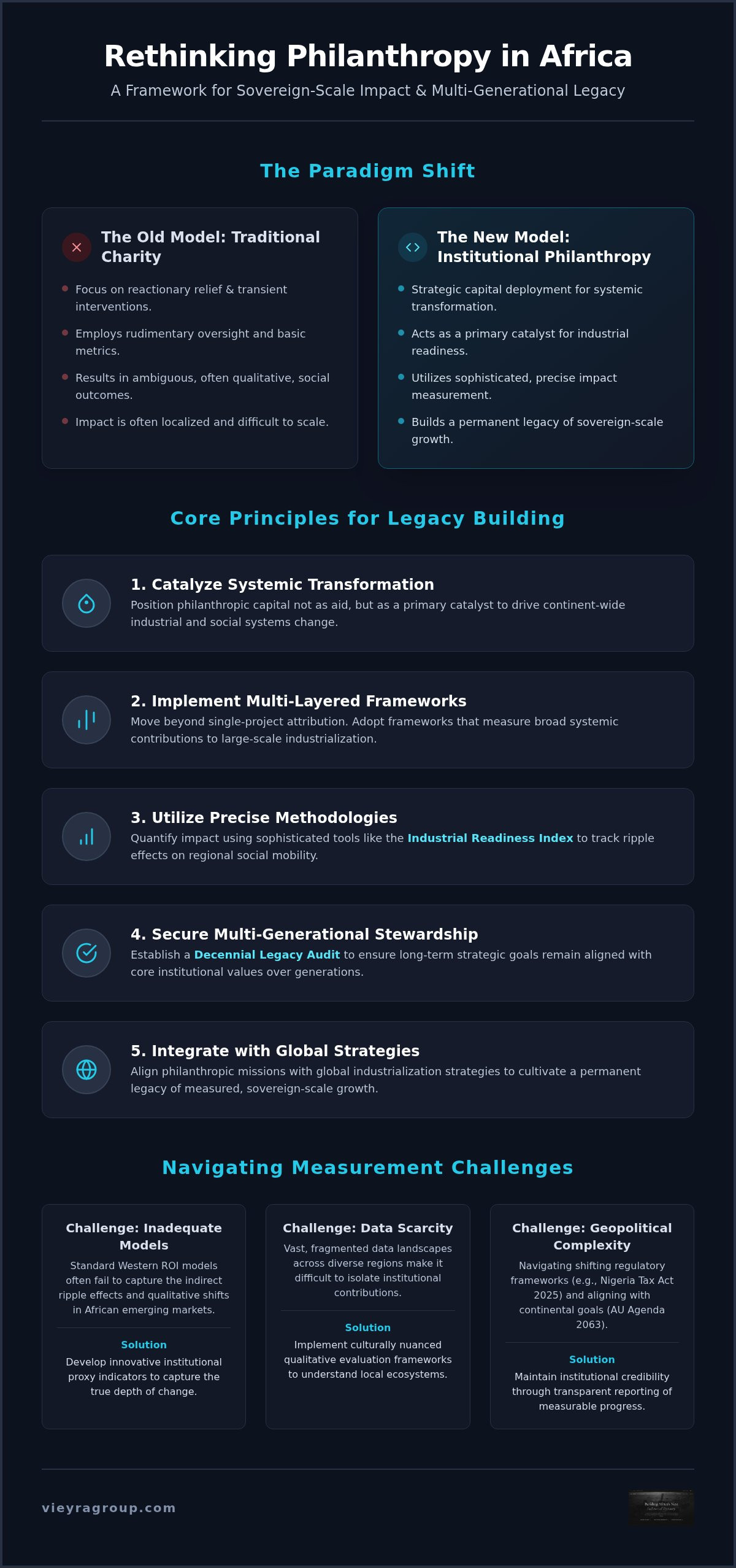
- Transcend the limitations of conventional charity by adopting an institutional model that positions philanthropic capital as a primary catalyst for systemic continental transformation.
- Implement multi-layered frameworks that distinguish between singular project attribution and the broader systemic contribution required for large-scale industrialization.
- Utilize precise methodologies for philanthropic impact measurement Africa to quantify the Industrial Readiness Index and the subsequent ripple effects on regional social mobility.
- Secure multi-generational stewardship through the establishment of a decennial Legacy Audit, ensuring that long-term strategic objectives remain aligned with institutional values.
- Explore the integration of the Vieyra Foundation’s mission with global industrialization strategies to cultivate a permanent legacy of measured, sovereign-scale transformation.
The Paradigm of Institutional Philanthropy in the African Context
The evolution of institutional philanthropy represents a fundamental departure from the historical patterns of reactionary relief efforts. This paradigm defines philanthropy as a cornerstone for systemic transformation, where capital isn't merely distributed but strategically deployed to foster industrial readiness across the continent. Historically, the narrative of Humanitarianism in Africa focused on immediate, often transient, interventions. Today's visionary institutions seek permanence through the synthesis of social progress and large-scale industrialization. This requires a transition from the ambiguity of traditional "charity" toward a rigorous discipline of strategic stewardship and capital deployment.
Effective philanthropic impact measurement Africa serves as the foundational mechanism that ensures these multi-generational legacies remain resilient and relevant. It's the process by which an institution validates its contribution to the continental fabric, separating long-term systemic change from broader, unrelated economic trends. Without this level of intellectual rigor, the scale of global operations risks being obscured by fragmented data and localized complexities. Measuring impact isn't an administrative afterthought; it's an essential component of the architecture of influence.
The Geopolitical Imperative for Rigorous Assessment
Operating at a sovereign scale requires navigating a dense tapestry of regulatory frameworks and shifting geopolitical priorities. As of March 2026, the South African Revenue Service enforces stricter requirements for tax-deductible donation receipts, while the Nigeria Tax Act 2025 mandates that charitable organizations maintain rigorous books of account to preserve their exempt status. Aligning philanthropic outcomes with the African Union’s Agenda 2063 isn't just a matter of compliance; it's a strategic necessity for maintaining institutional credibility. Credibility is the currency of sovereign-scale partnerships, and it's sustained through the transparent reporting of measurable progress toward continental self-sufficiency.
Challenges in Transposing Global Metrics to Local Realities
Standard Western return-on-investment models frequently prove inadequate when applied to the nuances of African emerging markets. These models often fail to account for the indirect ripple effects of industrial infrastructure or the qualitative shifts in social mobility that define true progress. Addressing data scarcity requires the development of innovative institutional proxy indicators that capture the depth of change. A culturally nuanced qualitative evaluation framework is essential to understand how philanthropic capital interacts with local industrial ecosystems, ensuring that the architecture of impact is both rigorous and relevant to the specific regions it serves.
Architectural Frameworks for Sovereign-Scale Impact Evaluation
The construction of a legacy requires more than intent; it demands a structured methodology that accounts for the intricate interdependencies of continental development. A robust framework for philanthropic impact measurement Africa must move beyond isolated metrics to embrace a multi-layered approach that reflects the scale of sovereign-level engagement. This involves integrating Environmental, Social, and Governance (ESG) criteria directly into the philanthropic reporting cycle, ensuring that every allocation of capital serves the broader objective of industrial stability. The implementation of a 'Sovereign Impact Matrix' allows an institution to evaluate its long-term influence with the same rigor applied to global investment portfolios. This matrix moves beyond simple output tracking to assess how philanthropic initiatives strengthen the foundational pillars of sovereign resilience and multi-generational prosperity.
The Theory of Change in Industrial Philanthropy
Within the context of African industrialization, the Theory of Change is defined as the strategic blueprint that maps the causal sequence from institutional capital deployment to the realization of systemic industrial self-sufficiency. It's not enough to fund schools; one must map the direct links between specific educational initiatives and the resulting readiness of the industrial workforce. This requires designing sophisticated feedback loops that involve sovereign partners and local stakeholders to ensure alignment with national development agendas. By utilizing evidence-based social impact data, institutions can refine these pathways, moving from theoretical projections to validated outcomes that withstand the scrutiny of multi-generational oversight.
Attribution vs. Contribution: Navigating Complex Interdependencies
Refining philanthropic impact measurement Africa requires a clear distinction between direct attribution and systemic contribution, a critical challenge for any entity operating within a multilateral development ecosystem. While attribution seeks to claim sole responsibility for a specific outcome, the reality of large-scale projects often involves complex, multi-stakeholder joint ventures where impact is shared. Methodologies for isolating the effect of strategic capital must account for these interdependencies. Contribution analysis offers a more sophisticated alternative, providing a logical narrative that substantiates the institution's role in driving change without ignoring the influence of broader economic trends or partner activities. This analytical depth is essential for separating the genuine impact of a philanthropic intervention from the background noise of regional economic growth.
Institutions that prioritize this level of analytical rigor often find that their reporting gains a level of authority that resonates with global stakeholders. Those seeking to refine their approach to strategic capital solutions often find that this distinction is the key to maintaining institutional prestige in rigorous reporting. It's through this meticulous separation of variables that a family office can truly articulate the value of its stewardship.
Systemic Metrics: Evaluating Industrial and Social Transformation
The transition from theoretical framework to operational reality necessitates a precise set of systemic metrics that capture the dual nature of continental progress. Within the landscape of philanthropic impact measurement Africa, the evaluation of success must extend beyond basic output tracking to quantify the Industrial Readiness Index of a specific region. This index serves as a sophisticated measure of how institutional capital prepares a local ecosystem for large-scale industrialization, accounting for the availability of specialized labor and the robustness of utility infrastructure. It's through this lens that a family office can determine whether its interventions are merely temporary or are truly building the foundational capacity required for sovereign economic resilience.
Technology transfer stands as a primary metric for institutional success, representing the movement of intellectual and technical capital from global centers to African industrial zones. Unlike simple financial grants, the successful integration of advanced manufacturing processes or sustainable energy technologies provides a permanent uplift to local capabilities. This transfer is often the most significant indicator of an institution's long-term influence. We must also measure the ripple effects of infrastructure development on local social mobility, tracking how the establishment of industrial hubs catalyzes the growth of secondary service economies and enhances the standard of living for multi-generational community structures.
Quantitative Indicators of Economic Resilience
The quantification of impact requires a rigorous tracking of job creation and high-level skill acquisition within strategic industrial zones. It's essential to evaluate the increase in regional trade capacity that occurs when philanthropic support aligns with industrial goals. For instance, a 2024 report by EPIC-Africa indicates that 65% of African non-profits receive individual donations, yet the institutional-scale deployment of capital requires a more robust Continental Impact Score to assess portfolio-wide success. This score aggregates data on export growth, workforce certification levels, and the reduction of regional supply chain dependencies, providing a comprehensive view of how philanthropic initiatives bolster the broader industrial ecosystem.
Qualitative Narratives of Multi-Generational Progress
While data provides the skeleton of impact, high-level qualitative narratives provide the substance. Capturing long-term shifts in institutional governance and community agency is vital for understanding the true depth of transformation. The Most Significant Change (MSC) technique proves invaluable in sovereign-scale reporting, allowing stakeholders to identify the most profound shifts in social architecture that quantitative data might overlook. Documenting the evolution of the African investment legacy through detailed case studies ensures that the institution's vision is preserved and communicated with the gravity it deserves. These narratives illustrate how strategic capital fosters a sense of ownership and stability that transcends individual projects, creating a permanent record of the institution’s contribution to the continent’s forward-looking trajectory.
Implementing a Multi-Generational Protocol for Continuous Stewardship
The preservation of institutional prestige across successive generations requires a transition from ad hoc reporting to a formalized, multi-generational protocol. Central to this architecture is the implementation of a decadal Legacy Audit, a rigorous institutional review designed to assess the alignment of philanthropic outcomes with the enduring vision of the founding family. This audit serves as a high-level corrective mechanism, ensuring that the trajectory of systemic change remains consistent even as regional economic variables fluctuate. The Family Office Board maintains ultimate responsibility for the integrity of these assessments, overseeing the standardization of reporting protocols to ensure that data captured in the current era remains comparable and relevant for those who will lead the institution fifty years from now.
Leveraging advanced digital architecture is essential for those operating at a sovereign scale. Immutable impact records, secured through sophisticated data management systems, provide a permanent account of the institution’s contribution to continental progress. This digital infrastructure ensures that the nuances of philanthropic impact measurement Africa are preserved against the erosion of time, allowing for a transparent, evidence-based narrative of transformation. Such meticulous record-keeping reinforces the institution’s standing as a stately guardian of African industrial progress, providing the empirical foundation necessary to justify long-term strategic capital deployment.
The Governance of Impact Data
The contemporary regulatory environment, exemplified by the Nigeria Tax Act 2025 and the 2026 South African tax reforms, necessitates a robust approach to data governance. Establishing institutional privacy standards within a global investment context is essential for protecting the sensitive interdependencies between private capital and public benefit. Independent third-party audits are vital for maintaining the sovereign-scale trust required for large-scale partnerships. By creating a Knowledge Repository, an institution can preserve multi-generational wisdom, ensuring that the lessons learned from current industrialization projects inform future strategic decisions and maintain the continuity of the institutional mission.
Future-Proofing Philanthropic Strategy
Intellectual rigor in the assessment of impact data allows for the refinement of capital allocation over a fifty-year horizon. This foresight is critical for adapting measurement frameworks to emerging trends, such as the strategic focus on processing mineral wealth at its source, as announced by the Vieyra Family Institution in March 2026. By anticipating the shifts in African industrial landscapes, the institution maintains its position as a visionary architect of legacy. Those who seek to integrate these sophisticated methodologies into their own operations should explore the advantages of global investment management tailored for systemic impact. This commitment to long-term stewardship ensures that the institution’s influence remains both permanent and profound.
The Vieyra Foundation: Cultivating a Legacy of Measured Transformation
The Vieyra Foundation operates as the intellectual and philanthropic vanguard of a broader institutional strategy, ensuring that the deployment of capital transcends transient relief to achieve systemic continental transformation. By integrating the Foundation’s mission directly with the Family Office’s industrialization objectives, the institution creates a seamless synergy between large-scale industrial projects and social architecture. This alignment isn't merely philosophical; it's an operational imperative that ensures every initiative contributes to the overarching goal of African economic sovereignty. Through this integrated approach, the Foundation functions as a visionary architect, constructing the frameworks necessary for a self-sufficient industrial future where progress is both deliberate and permanent.
Transparent, sovereign-scale reporting remains the hallmark of this endeavor. The institution’s commitment to philanthropic impact measurement Africa provides the empirical evidence required to validate long-term stewardship across diverse jurisdictions. By maintaining a rigorous standard of accountability, the Foundation ensures that its efforts are recognized by global stakeholders as a primary catalyst for progress. This transparency reinforces institutional prestige, demonstrating that the scale of operations is matched by the depth of intellectual rigor applied to evaluating success. It's through this meticulous documentation that the Foundation substantiates its role as a significant global actor in the development of the continent’s industrial landscape.
Strategic Alignment of Capital and Social Mission
The efficacy of the Foundation is rooted in its ability to measure its contribution to economic sovereignty with the same precision applied to global investment management. Transformative stewardship is evidenced through industrial project support that prioritizes local value addition and technology transfer, moving beyond the limitations of traditional aid. For instance, the Foundation’s strategic focus on the domestic processing of mineral wealth directly supports the creation of high-value industrial ecosystems. This synergy between strategic capital and social mission ensures that the ripple effects of investment are both measurable and permanent, fostering a landscape where social mobility and industrial growth are inextricably linked.
A Vision for the Next Century of African Growth
As we look toward the next century, the Foundation’s role in preserving the African investment legacy becomes increasingly critical for the stability of the region. This multi-generational vision requires an unwavering commitment to ongoing methodology refinement in impact assessment, ensuring that the institution remains at the forefront of philanthropic innovation. The objective is to build a permanent record of achievement that serves as a blueprint for future generations of leaders. We invite those who share this commitment to systemic progress to explore strategic capital solutions that align with this visionary trajectory. Through collective effort and rigorous measurement, we can ensure that the architecture of impact remains a cornerstone of the continent’s enduring prosperity.
Establishing the Foundation for a Sovereign Industrial Future
The transition from transient relief to the construction of a permanent industrial legacy requires an unwavering commitment to intellectual rigor and strategic foresight. By adopting sophisticated frameworks for philanthropic impact measurement Africa, an institution ensures its capital serves as a primary catalyst for systemic transformation. This process moves beyond the tracking of isolated outputs to evaluate the broader architecture of continental sovereignty; it aligns multi-generational social objectives with the precision of global investment management principles. We've examined how the implementation of decadal audits and systemic metrics preserves the integrity of an institutional mission across generations.
The Vieyra Foundation remains dedicated to this vision, blending a multi-generational African heritage with sovereign-scale institutional expertise and global investment portfolio management. We invite you to explore the Vieyra Foundation’s Strategic Vision for African Industrialization to understand how strategic capital solutions can foster a self-sufficient industrial landscape. It's through this meticulous stewardship that we collectively secure the continent's forward-looking trajectory and ensure the impact of today becomes the heritage of tomorrow.
Frequently Asked Questions
What are the primary challenges of impact measurement in Africa for family offices?
The primary challenges involve navigating fragmented data landscapes across diverse regions and the inherent ambiguity in measuring qualitative social transformation. Family offices must also contend with the difficulty of isolating specific philanthropic contributions from broader macroeconomic trends. Stricter regulatory requirements, such as the 2026 South African Revenue Service mandates for detailed donor receipts, add further layers of administrative complexity to the reporting process.
How does the Theory of Change apply to large-scale industrial philanthropy?
The Theory of Change serves as a strategic blueprint that maps the causal links between institutional capital deployment and the realization of systemic industrial self-sufficiency. It identifies the specific pathways through which initiatives, such as specialized technical training, directly enhance workforce readiness and regional productivity. This structured approach allows an institution to move beyond transactional giving toward the deliberate construction of foundational economic capacity.
What is the difference between attribution and contribution in institutional giving?
Attribution seeks to claim sole responsibility for a specific outcome, while contribution analysis acknowledges the institution’s role within a multi-stakeholder ecosystem. In complex industrial projects, multiple sovereign and private actors often share influence. Sophisticated philanthropic impact measurement Africa prioritizes contribution analysis to provide a credible narrative of how strategic capital catalyzed progress without ignoring the influence of broader market shifts or partner activities.
How can qualitative social change be quantified for sovereign-scale reporting?
Qualitative transformation is quantified through the utilization of innovative proxy indicators and structured methodologies such as the Most Significant Change technique. These frameworks allow institutions to capture shifts in community agency and governance that traditional financial metrics often overlook. By aggregating these nuanced narratives into a formal index, a family office can substantiate its role in the social architecture of a region with institutional rigor.
Why is multi-generational stewardship essential for African philanthropic impact?
Multi-generational stewardship ensures that philanthropic objectives remain aligned with the institution’s founding vision over a horizon of fifty years or more. It requires the implementation of decadal Legacy Audits and standardized reporting protocols to maintain comparability across leadership transitions. This long-term perspective is essential for addressing systemic continental challenges that require sustained capital deployment rather than short-term, reactionary interventions.
What role does ESG play in the evaluation of African industrialization projects?
ESG criteria provide a standardized framework for evaluating the environmental, social, and governance interdependencies inherent in large-scale industrialization. Integrating these metrics into philanthropic reporting ensures that capital deployment supports sustainable development and sovereign resilience. This alignment reinforces institutional prestige by demonstrating a commitment to global standards of responsible investment and ethical stewardship within the African industrial landscape.
How can data scarcity be managed when assessing long-term philanthropic results?
Data scarcity is managed through the development of proprietary institutional data sets and the use of innovative proxy indicators, such as satellite imagery or regional trade capacity statistics. Institutions often collaborate with local sovereign partners to access fragmented labor and economic data. By leveraging these diverse sources, a family office can construct a comprehensive view of impact even in jurisdictions where traditional census data is limited.
What are the hallmarks of a sophisticated institutional impact report?
A sophisticated institutional impact report is characterized by its analytical depth, transparent methodology, and focus on systemic transformation. It avoids superficial metrics in favor of complex indices, such as the Industrial Readiness Index, which capture the dual nature of social and economic progress. Such reports utilize immutable digital records to ensure data integrity and present a cohesive narrative that links philanthropic results to strategic industrial goals.


