
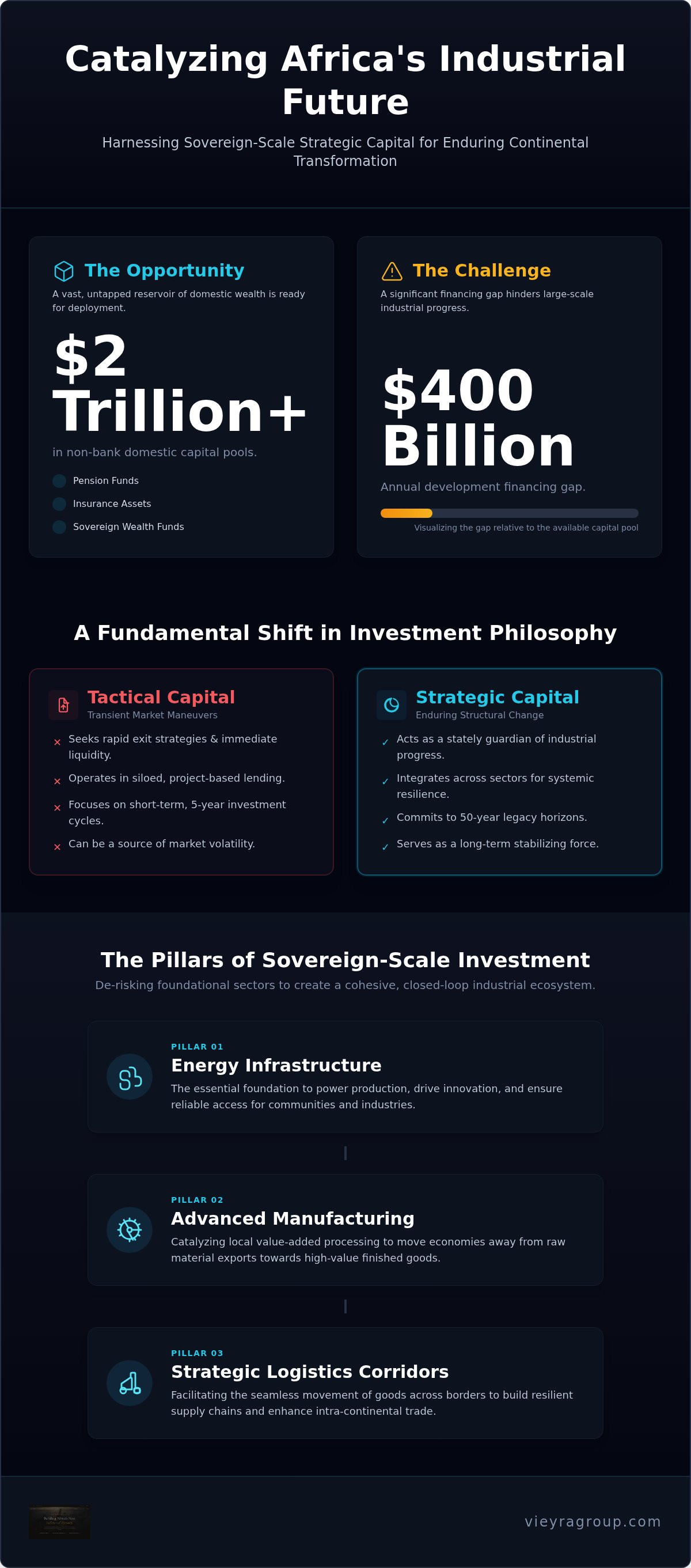
With non-bank domestic capital pools in Africa now surpassing two trillion dollars, the discourse surrounding the continent's economic trajectory has shifted from a reliance on external aid to the sophisticated mobilization of internal resources. This unprecedented accumulation of wealth, held within pension funds, insurance assets, and sovereign wealth funds, presents a unique opportunity for the deployment of strategic capital for African industrialization. While short-term market volatility often masks the underlying potential of these emerging markets, the requirement for sovereign-scale investment partners has never been more critical to ensure that this liquidity translates into tangible, large-scale industrial progress.
You likely recognize that mastering the complexities of diverse regulatory landscapes requires more than tactical agility; it demands a partner with the permanence and vision to see beyond the immediate horizon. This article provides an authoritative exploration into the deployment of sovereign-scale strategic capital designed to catalyze an enduring industrial transformation across the continent. We shall examine a multi-generational institutional framework that aligns global investment management with the Fourth Industrial Development Decade for Africa, ensuring that capital deployment results in a legacy of systemic stability and continental prosperity.
Key Takeaways
- Distinguish between transient market maneuvers and the deployment of strategic capital for African industrialization to catalyze systemic, enduring structural change.
- Examine the critical role of sovereign-scale investment in de-risking foundational sectors such as energy infrastructure, advanced manufacturing, and strategic logistics corridors.
- Appreciate how a multi-generational institutional framework mitigates the perceived African Risk Premium by prioritizing long-term stability over short-term volatility.
- Gain insights into identifying jurisdictions that offer regulatory clarity and the strategic importance of aligning with established sovereign entities.
- Understand the role of a family office as a visionary architect in building a continental industrial legacy that transcends individual lifetimes.
Defining Strategic Capital for African Industrialization
The pursuit of economic autonomy across the continent necessitates a fundamental re-evaluation of how resources are allocated and sustained over time. Within the current global financial architecture, a distinction must be drawn between transient, tactical market participation and the deliberate deployment of strategic capital for African industrialization. While traditional investment often seeks rapid exit strategies and immediate liquidity, strategic capital is characterized by its patience, its sovereign scale, and its unwavering focus on systemic transformation. It represents a shift from being a mere participant in the market to acting as a stately guardian of industrial progress, ensuring that capital serves as a stabilizing force rather than a source of volatility.
The year 2026 marks a decisive juncture for institutional capital allocation, coinciding with the commencement of the Fourth Industrial Development Decade for Africa (IDDA IV). This period requires a sophisticated response to the continent's annual development financing gap, which is estimated at 400 billion dollars. Addressing structural deficits in infrastructure and manufacturing isn't a task for speculative funding; it's a challenge that demands a sovereign-scale institutional stewardship capable of absorbing long-term risks while architecting the foundations of future prosperity. By prioritizing industrial depth over superficial growth, this framework provides the necessary weight to anchor the continent's economic trajectory.
The Qualitative Difference: Capital vs. Strategic Capital
The anatomy of strategic capital is defined by its ability to integrate across multiple sectors, creating a cohesive ecosystem where energy, logistics, and manufacturing flourish in tandem. Unlike standard capital, which often remains siloed, strategic capital acts as a catalyst for local value-added processing, moving the continent away from a reliance on raw material exports. This approach is deeply informed by the history of industrialization in Africa, recognizing that previous failures often stemmed from a lack of integrated, large-scale support. Strategic capital serves as the indispensable cornerstone of continental economic sovereignty. It's not simply about the volume of investment, but the quality of the intent behind it.
Industrialization as a Multi-Generational Objective
True industrial transformation cannot be compressed into five-year investment cycles; it requires a commitment to fifty-year legacy horizons. This alignment of multi-generational family office values with national development goals creates a unique synergy that transcends individual lifetimes. By establishing a permanent institutional presence in emerging industrial hubs, we move beyond the ephemeral nature of project-based lending. It's a methodical process of building heritage. This long-term perspective reframes the concept of risk, viewing it not as a deterrent, but as a manageable variable within a broader vision of continental progress. Such foresight ensures that the industrial initiatives of today become the institutional legacies of tomorrow.
The Pillars of Sovereign-Scale Industrial Investment
The architecture of a modernized continent rests upon three foundational pillars: energy infrastructure, advanced manufacturing, and strategic logistics corridors. Deploying strategic capital for African industrialization requires an understanding that these sectors don't exist in isolation. They form a closed-loop system where energy powers production, and logistics facilitate the movement of finished goods across borders. Sovereign-scale capital is essential here because it possesses the necessary weight to de-risk projects that are often too large or complex for traditional private equity. By providing a stable, long-term commitment, this capital encourages secondary investors to enter the market, thereby increasing overall liquidity and systemic resilience.
A sophisticated investment approach integrates global institutional expertise with deep localized insights. This synergy allows for the identification of high-potential industrial clusters that can benefit from economies of scale. Recent data from the UNCTAD regarding investment in strategic industries underscores the importance of turning these capital inflows into broader industrial benefits. When capital is deployed with this level of foresight, it creates a self-sustaining cycle of growth that attracts further institutional-grade participation.
Infrastructure: The Bedrock of Industrial Transformation
Infrastructure serves as the essential foundation for all industrial activity. We're seeing a shift toward financing integrated energy systems that power specific industrial clusters rather than fragmented national grids. This targeted approach ensures that manufacturing hubs have the reliable power necessary for high-output production. Strategic logistics, including rail and maritime networks, are equally vital. They reduce the cost of doing business and make intra-African trade a viable reality. Institutional frameworks for financing these large-scale transport networks must be robust enough to withstand multi-decade cycles, ensuring that the bedrock of the economy remains secure.
Advanced Manufacturing and Value-Added Processing
Transitioning from raw material export to sophisticated value-added processing is the ultimate goal of any multi-generational industrial strategy. This evolution requires more than just machinery; it demands the financing of technology transfer and the systematic acquisition of technical skills. When strategic capital is applied to advanced manufacturing, it creates a multiplier effect on job creation and local economic resilience. It isn't just about building factories; it's about architecting a future where the continent's resources are refined and utilized within its own borders. Achieving this level of systemic impact requires a blend of global expertise and localized insight. Integrating Global Investment Management with deep continental roots allows for the identification of high-potential jurisdictions that others might overlook, ensuring every dollar deployed contributes to a permanent legacy of industrial strength.
The Multi-Generational Advantage: Reframing Risk and Reward
Addressing the perceived "African Risk Premium" requires a fundamental shift in the temporal horizon of institutional investment. While tactical market participants often retreat at the first sign of macroeconomic fluctuation, the deployment of strategic capital for African industrialization is predicated on a multi-generational commitment that views volatility as a transient phenomenon. This perspective allows for a more nuanced assessment of value, where the focus moves from short-term yield to the creation of enduring industrial legacies. By operating with the deliberation of a sovereign-scale entity, it's possible to transform perceived risks into structured opportunities for systemic growth.
The current economic landscape emphasizes the necessity of Mobilizing Africa's Domestic Capital to anchor large-scale industrial initiatives. This internal mobilization, when paired with global institutional expertise, creates a stabilizing influence that traditional foreign direct investment often lacks. It isn't just about the volume of capital; it's about the permanence of the institution providing it. When an investor operates with a fifty-year vision, they provide a sense of institutional gravity that reassures partners and stabilizes the broader industrial ecosystem against geopolitical shifts.
Institutional Gravity as a Risk Mitigant
Institutional gravity serves as a powerful mitigant against the cyclical nature of emerging markets. A multi-generational family office maintains a composed and authoritative stance, refusing to be swayed by the ephemeral noise of short-term market cycles. This stability is the ultimate hedge, providing the quiet confidence necessary to sustain industrial projects through their most capital-intensive phases. Institutional permanence reduces the cost of capital for industrial projects by providing a predictable, multi-generational equity anchor that absorbs the perceived volatility of emerging jurisdictions. This steadfastness builds a foundation of trust with local governments and international stakeholders alike, ensuring that strategic capital for African industrialization remains a constant force for progress.
The Architecture of Legacy: Beyond Financial Returns
Success in this framework is measured not merely by balance sheets, but by the systemic impact on the continent's industrial fabric. The architecture of legacy involves wealth preservation through the lens of social and economic advancement. Through the Vieyra Foundation, we ensure that industrial growth is inextricably linked to social progress, creating a symbiotic relationship between corporate success and community prosperity. This alignment ensures that industrial legacies contribute to the long-term prosperity of the continent, fostering an environment where technical skill acquisition and infrastructure development become self-sustaining. It's a commitment to building a future where the continent's industrial strength is as permanent as the institutions that architected it.
Navigating the Landscape of African Industrial Transformation
Identifying jurisdictions with robust industrial policies and regulatory clarity is the primary requirement for architecting a continental legacy. As of March 2026, twenty-five nations have gazetted their tariff schedules under the African Continental Free Trade Area (AfCFTA), facilitating a transition from country-specific strategies to regional value-chain integration. This movement allows strategic capital for African industrialization to be deployed with greater certainty, targeting sectors where cross-border trade is now a gazetted reality. Evaluating project scalability requires a methodical assessment of how individual initiatives fit into this burgeoning regional framework, ensuring that industrial growth in one jurisdiction supports the broader stability of the continent. Strategic partnerships with sovereign entities and local institutions are the essential mechanisms for navigating these diverse landscapes, providing the localized insight necessary to complement global investment management expertise.
Identifying Strategic Opportunities in 2026
The rise of Special Economic Zones (SEZs) represents a significant shift in the target landscape for institutional-scale investors. These zones provide the necessary concentration of infrastructure and policy support to catalyze advanced manufacturing while minimizing the complexities of broader jurisdictional landscapes. By focusing on Regional Economic Communities (RECs), we can identify industrial clusters that possess the scale to compete on a global stage. Criteria for selecting sovereign-scale partners must include a shared commitment to multi-generational impact, ensuring that every partnership is rooted in the permanence of heritage rather than the transience of a single trade cycle. This alignment is particularly critical as we enter the Fourth Industrial Development Decade for Africa, where the focus has shifted toward implementation and regional market integration.
The Role of Institutional Expertise in Capital Allocation
Applying rigorous intellectual sophistication to project due diligence is the hallmark of an established institution. The mechanics of deploying multi-generational capital into industrial finance involve a careful balancing of global asset management principles with deep continental insights. It's a process that avoids the haste of tactical lending, opting instead for the deliberate pace of visionary architecture. Balancing global portfolio diversification with concentrated African industrial bets allows for the creation of a resilient investment structure that survives short-term market volatility. Success in this realm is not a product of chance but of a methodical approach to risk and reward. To engage with a framework designed for this level of systemic impact, explore our Strategic Capital Solutions, which offer a sovereign-scale approach to the continent's industrial future.
The Vieyra Vision: Architecting a Continental Industrial Legacy
The Vieyra Family Office functions with the deliberation of a sovereign-level entity, serving as a stately architect of continental industrial progress. Our commitment to large-scale initiatives is rooted in a philosophy that transcends individual lifetimes, prioritizing the establishment of a permanent industrial heritage over the pursuit of transient financial gains. By leveraging global investment management expertise, we provide the necessary weight to fuel a systemic continental transformation. This approach ensures that the capital deployed today serves as a stabilizing force for generations to come, creating a legacy of industrial strength and economic sovereignty. It's a vision that requires the poise of an institution deeply rooted in its identity and certain of its trajectory.
This institutional perspective allows us to operate as a stately guardian of progress, blending the traditional values of heritage with a forward-looking commitment to large-scale development. As we move through the Fourth Industrial Development Decade for Africa, the requirement for such visionary stewardship becomes increasingly apparent. We don't merely observe the market; we participate in the deliberate construction of the continent's industrial future, ensuring that strategic capital for African industrialization is deployed with the precision and scale necessary for multi-generational impact.
Sovereign-Scale Capital Solutions for a New Era
The deployment of strategic capital for African industrialization requires a bespoke methodology that reflects the unique complexities of the continent's diverse jurisdictions. Our Strategic Capital Solutions are designed with a multi-generational perspective, informing every allocation decision with the foresight required for long-term stability. This institutional framework is further strengthened by the Vieyra Foundation, which ensures that our philanthropic alignment supports the broader goals of social progress and technical skill acquisition. By integrating these elements, we create a cohesive strategy that addresses the continent's structural needs while preserving wealth across multiple generations. It's through this rigorous intellectual sophistication that we're able to identify and nurture the industrial hubs of the future.
Engaging with the Future of African Industry
Building enduring partnerships requires more than just financial resources; it demands institutional gravity and a shared vision of a prosperous future. We invite our institutional peers to join in the stewardship of the continent's industrial trajectory, recognizing that the current era presents an unprecedented opportunity for collective impact. Strategic capital for African industrialization is the essential engine of the African century, providing the momentum necessary to achieve a modernized, self-sustaining economy. The path forward is one of methodical growth and unwavering commitment to the continent's potential. To understand the depth of our commitment, we encourage you to discover the multi-generational vision of the Vieyra Family Office and explore how we are architecting a future of permanent industrial strength.
Architecting the Continental Industrial Legacy
The industrial transformation of the continent represents the most significant geopolitical and economic undertaking of our era. Success in this endeavor requires a departure from the transience of tactical investment in favor of a sovereign-scale institutional presence that operates with the deliberation of a stately guardian. By prioritizing the foundational pillars of energy infrastructure and advanced manufacturing, we ensure that every allocation decision contributes to a permanent legacy of economic sovereignty and systemic stability. This multi-generational framework provides the necessary weight to anchor the continent's trajectory, transforming perceived market volatility into a managed variable within a broader vision of progress.
As a multi-generational African family office, we blend global investment management expertise with a profound commitment to the continent's heritage. The deployment of strategic capital for African industrialization is the indispensable mechanism for achieving these objectives, fostering an environment where technical skill acquisition and industrial depth become self-sustaining realities. We remain certain of our trajectory and invite those who share this vision of permanence to engage with our sovereign-scale initiatives.
Explore the Architecture of Multi-Generational Wealth and Industrial Progress
The future of the continent is being architected today through the steady, methodical application of vision and capital.
Frequently Asked Questions
What defines strategic capital in the context of African industrialization?
Strategic capital is characterized by its patience, sovereign scale, and a deliberate intent to foster systemic structural change across the continent. Unlike tactical funding that seeks immediate liquidity, strategic capital for African industrialization acts as a permanent anchor for large-scale projects. It provides the necessary weight to support initiatives in energy and manufacturing that require decades to reach full maturity and systemic impact.
How does a multi-generational family office mitigate investment risk in Africa?
A multi-generational institution mitigates risk by utilizing an extended temporal horizon that effectively absorbs short-term market volatility. By reframing the perceived African Risk Premium through the lens of fifty-year legacy cycles, the office provides a stabilizing influence that traditional investors often lack. This institutional gravity ensures that capital remains committed during periods of geopolitical or economic fluctuation, maintaining the steady progress of industrial initiatives.
What are the primary sectors for strategic capital allocation in Africa for 2026?
The primary sectors for capital allocation in 2026 include energy infrastructure, advanced manufacturing hubs, and regional logistics corridors that facilitate intra-continental trade. These sectors are critical for leveraging the opportunities presented by the African Continental Free Trade Area. Focusing on these foundational pillars ensures that every dollar deployed contributes to a cohesive industrial ecosystem capable of supporting long-term economic growth and regional integration.
How does sovereign-scale capital differ from traditional private equity in Africa?
Sovereign-scale capital differs from traditional private equity through its commitment to permanence and its rejection of short-term exit strategies. While private equity often operates within five-year to seven-year cycles, sovereign-scale capital functions as a stately guardian of industrial progress. It provides the enduring equity necessary for infrastructure and production facilities that serve as the bedrock of the continent's economic sovereignty for multiple generations.
What is the role of the Vieyra Foundation in African industrial development?
The Vieyra Foundation serves to align philanthropic objectives with the broader goals of industrial and social progress. It focuses on facilitating technical skill acquisition and ensuring that industrial growth translates into enduring community prosperity. By integrating social impact with industrial finance, the foundation ensures that the human capital of the continent is equipped to lead and sustain the advanced manufacturing sectors of the future.
How can institutional investors partner with the Vieyra Family Office?
Institutional investors partner with the office through an alignment of vision and a shared commitment to architecting a continental industrial legacy. We offer Strategic Capital Solutions and Global Investment Management expertise that allow for the sophisticated deployment of resources into high-potential jurisdictions. These partnerships are rooted in institutional gravity, providing a collaborative framework for those seeking to contribute to the continent's multi-generational economic transformation.
Why is industrialization critical for African economic sovereignty?
Industrialization is the essential mechanism for transitioning the continent from a reliance on raw material exports to a sophisticated, value-added economic model. It fosters a self-sustaining ecosystem that reduces vulnerability to global commodity price shocks and creates a robust domestic market. This structural evolution is fundamental to achieving true economic autonomy, ensuring that the continent's vast resources are refined and utilized within its own borders.
How does the Vieyra Family Office balance global investments with African industrial focus?
The office maintains this balance by utilizing its Global Investment Management expertise to manage a diversified portfolio across multiple asset classes while making concentrated bets on African industrialization. This synergy allows global returns to fuel continental transformation, creating a resilient financial structure. It's a methodical approach that leverages global market participation to anchor and protect the long-term industrial legacies being built across the African continent.


