
The traditional paradigm of private wealth management is undergoing a profound metamorphosis as the institutional family office Africa ascends to a position of sovereign-scale influence, transcending the conventional boundaries of passive capital preservation. This evolution positions these entities as the primary architects of continental industrialization and systemic economic stability, utilizing the deliberate deployment of strategic capital to foster multi-generational prosperity and long-term institutional stability.
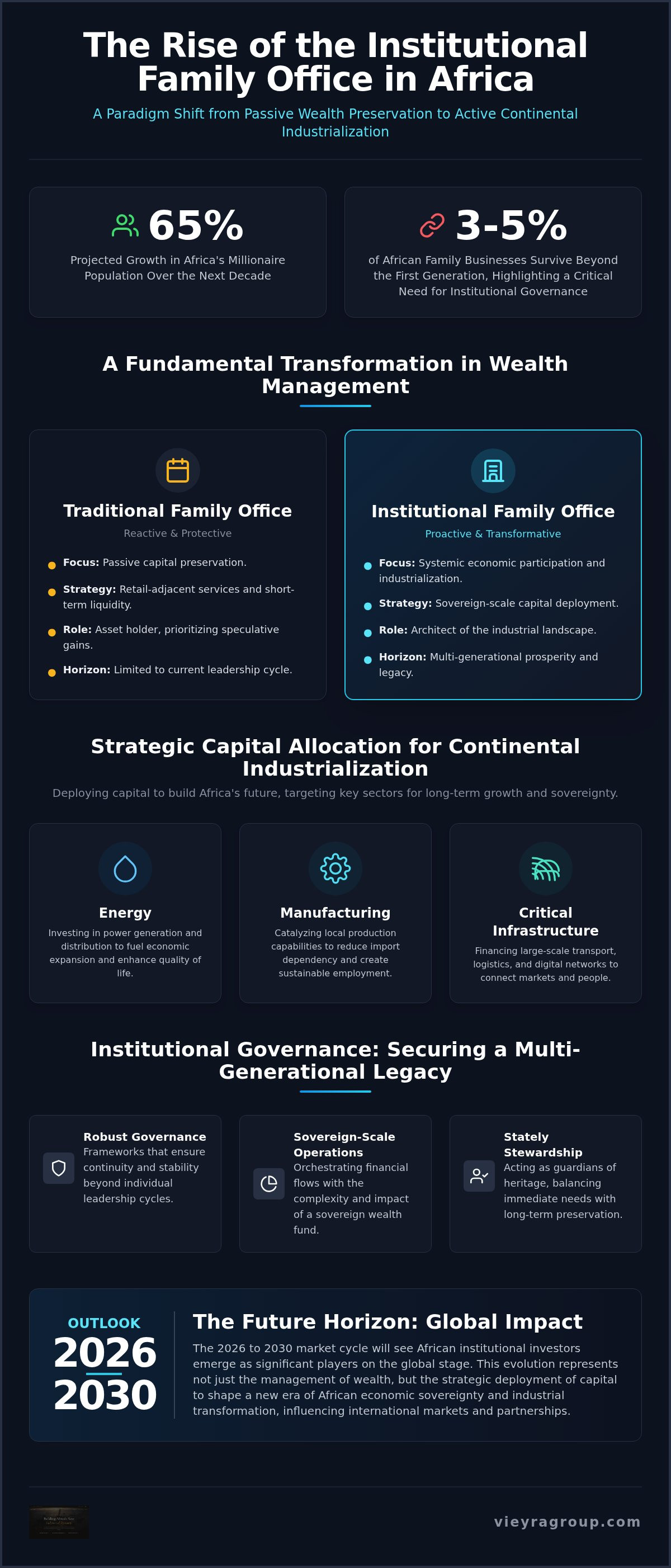
You've likely recognized that the effective navigation of African capital markets requires far more than rudimentary financial acumen, particularly as the continent's millionaire population is projected to grow by 65% over the next decade. It necessitates a sophisticated partner capable of aligning global asset management strategies with the profound requirements of local industrial growth and the complex preservation of institutional heritage across diverse jurisdictions.
This article provides an authoritative examination of the mechanisms through which these institutional structures redefine the synergy between private wealth and continental development. We'll explore the strategic frameworks and governance models that allow these offices to function as stately guardians of legacy while simultaneously acting as visionary catalysts for the next era of African economic sovereignty and industrial transformation.
Key Takeaways
- The transition from conventional wealth management to the institutional family office Africa represents a fundamental shift toward sovereign-scale influence and systemic economic participation.
- Effective capital allocation now prioritizes the advancement of continental industrialization through strategic investments in energy, manufacturing, and critical infrastructure.
- Implementing robust governance frameworks is paramount for securing multi-generational wealth preservation and ensuring institutional continuity that transcends individual leadership cycles.
- Readers will understand the mechanics of deploying strategic capital solutions at a scale that rivals sovereign wealth funds to drive long-term industrial progress.
- The analysis provides a roadmap for the projected global impact of African institutional investors within the 2026 to 2030 market cycle.
Defining the African Institutional Family Office
The landscape of private wealth on the continent is undergoing a fundamental realignment. The traditional family office, historically characterized by passive asset management and retail-adjacent services, is being superseded by a more robust architecture. The institutional family office Africa represents a deliberate departure from mere capital preservation, emerging instead as a sovereign-scale entity that functions with the permanence and strategic depth of a global institution. This shift signifies the maturation of the financial ecosystem, where the deployment of capital is no longer reactive but serves as a primary driver of industrialization and systemic progress.
Unlike conventional investment vehicles that prioritize short-term liquidity or speculative gains, these institutional actors operate with a multi-generational horizon. They transition away from being passive holders of assets to becoming active architects of the industrial landscape. This involves the direct orchestration of large-scale projects and the cultivation of strategic partnerships that remain beyond the capacity of traditional retail-focused firms. The institutional model is built upon the premise that wealth is a tool for transformation, requiring a level of sophistication that mirrors the operations of a sovereign wealth fund.
The Structural Framework of Institutional Capital
The sophistication of the modern African institutional entity is rooted in its rigorous adherence to global regulatory frameworks and international standards. This structural alignment ensures that risk management is not merely a compliance exercise but a core component of the strategic vision. By 2026, the institutional family office Africa is defined as a sovereign-scale entity that manages complex global portfolios while maintaining a primary mandate to catalyze large-scale industrial development across the continent. Such institutions utilize advanced arrangements of capital, blending private equity and direct infrastructure investment to achieve a holistic impact. This framework allows for the seamless integration of global investment management with localized strategic capital solutions.
The Mandate of Multi-generational Stewardship
Stewardship at this level requires a profound balance between the immediate requirements of liquidity and the immutable goal of long-term capital preservation. The institutional mandate differs fundamentally from retail or private banking services in its scope and its commitment to legacy. While retail services focus on the individual, the institutional family office Africa acts as a stately guardian of a multi-generational heritage, ensuring that the wealth serves a purpose far beyond the current leadership cycle. This foresight is essential for navigating the complexities of the market, where the survival of family businesses beyond the first generation remains a significant challenge. Currently, only 3% to 5% of African family businesses survive beyond the first generation, a statistic that underscores the necessity of the institutional model in providing the governance and continuity required for permanent success.
The Mechanics of Sovereign-Scale Capital Solutions
The operational capacity of an institutional family office Africa is defined by its ability to orchestrate financial flows that mirror the complexity and magnitude of sovereign wealth funds. These entities don't merely participate in markets; they shape them through the deployment of strategic capital solutions designed to address the structural deficits within the continental infrastructure. By functioning as a sophisticated intermediary, the institutional model facilitates a unique architecture of public-private partnerships that aligns private interests with national development goals. This systemic approach ensures that capital is not just preserved but is actively utilized to enhance the economic fabric of the regions in which it operates.
The systemic impact of such capital is profound. It provides a level of permanence that traditional retail-focused investment firms cannot replicate. This stability is essential for projects that require decades, rather than years, to realize their full industrial potential. It's through this lens of long-term stability that the institutional model provides the necessary ballast for national economic development strategies.
Strategic Capital for Economic Development
The identification of sovereign-level initiatives requires a level of foresight that extends beyond conventional market analysis. Institutional family offices bridge the critical gap between global liquidity and local industrial needs by providing the necessary de-risking mechanisms for large-scale ventures. This is particularly vital in a landscape where Foreign Direct Investment (FDI) reached approximately $70 billion in 2025, yet often remains concentrated in extractive sectors rather than transformative industrial projects.
By providing strategic capital, these offices enable the development of manufacturing hubs and energy grids that serve as the bedrock for broader economic expansion. They act as the primary underwriters of progress, ensuring that capital is directed toward sectors with the highest potential for systemic transformation. For institutions seeking to align their legacy with these transformative objectives, exploring strategic capital solutions provides a framework for impactful continental participation.
Global Portfolio Diversification and Stability
Maintaining the solvency required for multi-generational impact necessitates a sophisticated approach to global asset management. The synergy between participation in global markets and reinvestment into the African industrial base creates a self-sustaining cycle of growth. It's this balanced allocation across diverse asset classes that ensures the ability of the institutional family office Africa to withstand regional volatility while continuing its long-term mandates. Sophisticated asset allocation strategies allow these entities to leverage the stability of developed markets to fund high-growth industrial initiatives at home. This dual-track approach ensures that the institution remains a permanent fixture in the financial landscape, capable of fulfilling its role as a visionary architect of legacy regardless of short-term market fluctuations. The result is a robust financial foundation that supports the ambitious goal of driving Sub-Saharan Africa's projected 4.3% GDP growth in 2026.
Strategic Capital Allocation for African Industrialisation
The institutional family office Africa functions as a primary architect in the continental shift from resource extraction toward sophisticated, value-added industrial processes. This transition represents a fundamental realignment of investment priorities, where the objective is no longer the mere exportation of raw materials but the cultivation of a robust domestic manufacturing base. By prioritising industrialisation as a core pillar of their investment legacy, these sovereign-scale entities ensure that capital deployment results in the creation of enduring economic value. This strategic focus is essential for navigating a global market where value is increasingly concentrated in processed goods and technological innovation rather than primary commodities.
The identification of high-impact sectors, specifically energy, manufacturing, and strategic infrastructure, serves as the cornerstone of this industrial mandate. These sectors provide the necessary scaffolding for broader economic expansion, facilitating the technological and industrial transfer required for continental sovereignty. The institutional model allows for the integration of global investment expertise with a deep understanding of local industrial requirements, ensuring that every allocation of capital contributes to the systemic transformation of the African economy.
Financing Large-Scale Industrial Projects
The orchestration of financing for complex, multi-year industrial developments requires a capital structure characterised by extreme patience and strategic depth. Unlike retail-focused investment vehicles, the institutional family office Africa utilises strategic capital as a catalyst for the development of industrial clusters and special economic zones that drive regional productivity. The Vieyra Family Office maintains a rigorous commitment to this mandate, serving as a primary conduit for African industrialisation capital by directing sovereign-scale resources into the critical infrastructure and manufacturing sectors that underpin continental progress. This approach de-risks the industrial landscape, making it more attractive for secondary tiers of global investment and ensuring that projects reach full operational maturity.
Sovereign-Scale Partnerships for Growth
The efficacy of industrial capital is significantly amplified through the cultivation of sovereign-scale partnerships with regional governments and international financial institutions. In the era of the African Continental Free Trade Area (AfCFTA), the role of the institutional investor has evolved into that of a strategic collaborator who aligns industrial projects with long-term national economic strategies. These partnerships ensure that large-scale ventures are not isolated initiatives but are deeply integrated into the broader framework of continental trade and economic integration. By fostering a collaborative environment, the institutional family office Africa ensures that industrial growth is both sustainable and aligned with the visionary goals of multi-generational economic transformation.
Institutional Governance and Multi-generational Preservation
Rigorous governance serves as the foundational bedrock upon which the longevity of any sovereign-scale institution is constructed. For the institutional family office Africa, this involves the implementation of frameworks that purposely transcend the limitations of individual leadership cycles. It's a common misconception that regional volatility represents an insurmountable barrier to permanence. In reality, sophisticated governance protocols allow for the systematic mitigation of what's often termed "African risk." By adopting the standards outlined in the February 2026 ATAF guide for high-net-worth taxation and transparency, these offices demonstrate a level of professional rigor that invites global confidence and ensures structural stability. This meticulous approach to oversight ensures that the institution remains a stable actor in the global financial landscape, regardless of transient market shifts.
The transition from a family-led enterprise to a system-led institution requires a deliberate architecture of governance. This architecture doesn't just manage capital; it manages the legacy itself. It ensures that the strategic vision remains consistent even as the custodians of that vision change over time. By formalizing these processes, the institutional family office Africa creates a sense of institutional gravity that attracts long-term strategic partners and facilitates large-scale industrial projects.
The Architecture of Wealth Preservation
The architecture of wealth preservation isn't merely a collection of legal documents. It's a systemic approach to safeguarding multi-generational capital against the unpredictable tides of global market volatility. Strategic succession planning serves as a core function here, ensuring that the transition of authority doesn't compromise the institution's trajectory. These frameworks integrate family values into formal governance, creating a cohesive identity that guides investment decisions across decades. It's this level of foresight that distinguishes an established institution from a temporary investment vehicle. To understand how these frameworks are applied in practice, one may explore the strategic capital solutions offered by the institution.
Strategic Philanthropy and Social Impact
Philanthropy, within an institutional context, acts as an extension of the office's stewardship mandate rather than a secondary pursuit. The Vieyra Foundation exemplifies this by aligning its initiatives with broader industrial and economic goals. This alignment ensures that philanthropic capital doesn't just address immediate needs but contributes to the long-term development of the continent's human and social capital. It's a vision of social progress that mirrors the institution's commitment to industrial growth. Measuring the impact of such capital requires the same analytical rigor applied to a global investment portfolio, ensuring that every initiative serves the overarching goal of continental transformation. By viewing philanthropy through this lens, the institution reinforces its role as a visionary architect of a permanent African legacy.
The Future of the African Institutional Investor
The horizon for the 2026 to 2030 global market cycle indicates a period of unprecedented institutional maturity for the African investor. As the continent's millionaire population continues its projected 65% expansion over the next decade, the institutional family office Africa will increasingly serve as a primary conduit for global capital seeking stability within high-growth industrial sectors. This period marks a transition from the foundational establishment of governance structures toward the active, visionary orchestration of continental legacy. These entities are no longer merely responding to market conditions; they're actively defining the parameters of long-term economic sovereignty. With Sub-Saharan Africa's GDP projected to grow by 4.3% in 2026, the role of these offices as stabilizers within the global financial system becomes even more pronounced, providing the necessary ballast for large-scale economic initiatives.
It's within this context of growth that the institutional model proves its worth as a permanent fixture of the financial landscape. While retail-focused firms may struggle with the complexity of emerging regulations, the institutional family office Africa utilizes its robust governance frameworks to turn regulatory evolution into strategic advantage. This foresight is what allows these entities to maintain their multi-generational vision, ensuring that wealth is not merely preserved but is actively compounding in its social and industrial impact across the continent.
Visionary Architecture of Continental Legacy
The trajectory of African-centric global investment management is characterized by a shift toward systemic impact. In the coming decade, institutional investors will play a central role in shaping the industrial landscape, moving beyond extractive models to support sophisticated manufacturing and energy infrastructure. The Vieyra Family Office stands at the culmination of this evolution, embodying the role of a stately guardian that blends traditional values of heritage with a forward-looking commitment to large-scale progress. It's an institutional positioning that views capital not as a transient resource but as a permanent instrument for continental transformation. This vision ensures that the industrialization of the continent is not a series of disparate projects but a cohesive movement toward economic permanence and multi-generational prosperity.
Partnering for Sovereign-Scale Impact
Achieving the scale required for systemic change necessitates a framework for institutional collaboration that prioritizes shared vision over short-term gain. Sovereign-level partnerships are built on a foundation of mutual institutional gravity, where the alignment of long-term objectives provides the stability needed for multi-year industrial developments. For partners seeking to participate in this era of growth, it's essential to align with entities that possess the strategic depth and governance rigor to navigate complex markets. The future of the African institutional investor is defined by these enduring alliances, where collective capital is deployed with the deliberation and foresight required for multi-generational success. This collaborative model creates a robust ecosystem where global expertise and local industrial needs converge for the benefit of the entire continent. To begin this journey of alignment, institutional partners may engage with the Vieyra Family Office on strategic capital solutions to explore the intersections of global portfolio management and continental industrial growth.
The Architecture of Permanent Continental Progress
The ascent of the institutional family office Africa signifies a permanent recalibration of the relationship between private capital and continental development. It's no longer sufficient to view wealth through the lens of passive accumulation; the modern era demands a transition toward active participation in the industrialisation of the continent. By implementing sovereign-scale institutional rigor, maintaining a commitment to African industrialisation, and utilizing multi-generational investment management expertise, these entities ensure that legacy is preserved through the creation of tangible, systemic value. This evolution provides the necessary framework for navigating global volatility while simultaneously acting as a primary catalyst for large-scale economic transformation.
As we look toward the 2026 to 2030 market cycle, the role of the stately guardian becomes paramount in securing the future of the continent's industrial landscape. The alignment of global portfolios with localized strategic capital solutions creates a self-sustaining cycle of prosperity that transcends individual leadership. We invite those who share this vision of permanence and progress to Explore the institutional depth of Vieyra Family Office. The trajectory of the continent is being reshaped by those with the foresight to build for generations.
Frequently Asked Questions
What defines an institutional family office as "sovereign-scale" in Africa?
A sovereign-scale designation is defined by the capacity to deploy capital at a magnitude comparable to national wealth funds while adhering to rigorous global institutional standards. This model transcends traditional private wealth management by prioritizing systemic impact and the orchestration of large-scale industrial projects. The institutional family office Africa requires a sophisticated framework that balances multi-generational capital preservation with active participation in continental economic transformation, ensuring that the institution remains a permanent actor in the global financial landscape.
How does the Vieyra Family Office manage risk across global and African asset classes?
Risk management is achieved through sophisticated global investment management and asset diversification that balances high-growth African ventures with stable international markets. By aligning with global regulatory standards, the institution mitigates regional volatility and ensures long-term solvency while funding critical infrastructure projects. This dual-track approach utilizes advanced risk protocols to protect the institution's multi-generational heritage from transient market fluctuations, maintaining a composed and authoritative stance within the global financial ecosystem.
What is the role of strategic capital in African industrialisation projects?
Strategic capital acts as a de-risking catalyst that bridges the critical gap between global liquidity and local industrial requirements. It provides the necessary underwriting for complex, multi-year projects in energy, manufacturing, and strategic infrastructure. This capital is essential for fostering industrial clusters that drive regional productivity and economic sovereignty. By providing long-term stability, it allows for the successful completion of sovereign-level initiatives that remain beyond the capacity of traditional retail-focused investment firms.
How does an African institutional investor differ from a standard wealth management firm?
The primary distinction lies in the multi-generational horizon and the active role an institutional family office Africa plays in shaping the industrial landscape. Unlike standard wealth management firms that focus on retail-level liquidity and short-term speculative gains, the institutional model functions as a visionary architect of legacy. It utilizes deliberate asset allocation to drive long-term progress, moving beyond passive holding to become a stately guardian of continental economic sovereignty and industrial growth.
What are the core principles of multi-generational wealth preservation in the African context?
Preservation at this level is built upon formal governance structures and succession planning that prioritize institutional continuity over individual leadership cycles. These frameworks are designed to mitigate regional volatility by integrating family values with international regulatory rigor. Such a methodical approach is essential for ensuring that the entity's strategic vision remains immutable across generations, providing a stable foundation for the permanent growth of the family's global and continental interests regardless of geopolitical shifts.
How does the Vieyra Foundation integrate with the family office’s investment strategy?
The Vieyra Foundation functions as a strategic extension of the institution's stewardship mandate by aligning philanthropy with long-term economic and industrial goals. It focuses on developing human and social capital to support the broader industrialization agenda, ensuring that every initiative serves the overarching goal of continental transformation. This alignment ensures that philanthropic efforts aren't secondary pursuits but are deeply integrated into the systemic impact of the office's capital allocations and multi-generational vision.
What sectors are prioritised for capital allocation in African industrial growth?
Priority is given to energy infrastructure, manufacturing hubs, and strategic logistics networks that facilitate value-added industrial processes. These sectors are identified as the primary drivers of continental sovereignty and economic transformation, providing the necessary scaffolding for broader expansion. Capital is directed toward initiatives that transition the continent away from raw resource extraction, focusing instead on high-impact sectors that foster technological transfer and long-term industrial maturity across diverse regions.
How can institutional partners collaborate with sovereign-scale family offices?
Collaboration is facilitated through frameworks that align global capital with sovereign-level industrial initiatives and strategic capital solutions. Institutional partners engage in public-private partnerships that leverage the family office's de-risking mechanisms and local industrial expertise. This synergy requires a profound alignment of long-term objectives, ensuring that every joint venture contributes to the overarching goal of systemic economic expansion and multi-generational stability. It's a partnership model built on shared vision and institutional gravity.


