
The preservation of African wealth no longer rests upon the passive accumulation of assets, but rather upon the deliberate orchestration of industrial transformation at a sovereign scale. You likely recognize that traditional models of global diversification often fail to account for the unique systemic requirements of the African continent, leaving a significant void between private legacy and collective economic progress. This guide provides the institutional-grade framework necessary to master investment principles for African family offices, ensuring that capital deployment serves both the family’s multi-generational longevity and the continent’s industrial future.
By adopting a posture of strategic stewardship, families can effectively navigate the complexities of managing high-growth assets within volatile environments while fostering systemic impact. We shall examine the strategic pillars of capital allocation, the integration of governance structures that mirror sovereign entities, and the methodology for aligning wealth preservation with the evolving regulatory and tax landscapes of 2026. This exploration offers a definitive path toward transforming private capital into a permanent architect of African prosperity.
Key Takeaways
- The transition from passive asset management toward an active sovereign-scale posture serves as the fundamental requirement for families intent on shaping the continent’s industrial future.
- Strategic prioritization of industrialization and structural growth assets provides a robust mechanism for capturing value within the shifting demographic and energy landscapes of the region.
- Formalizing institutional-grade governance structures creates a permanent architecture for the preservation of legacy and the orderly transition of multi-generational responsibility.
- Comprehensive mastery of investment principles for African family offices necessitates the deployment of a rigorous evaluative framework designed for high-impact capital allocation in 2026.
- Aligning individual family aspirations with the broader objectives of African economic development fosters a unique synergy between global investment excellence and local systemic progress.
Establishing the Sovereign-Scale Investment Paradigm
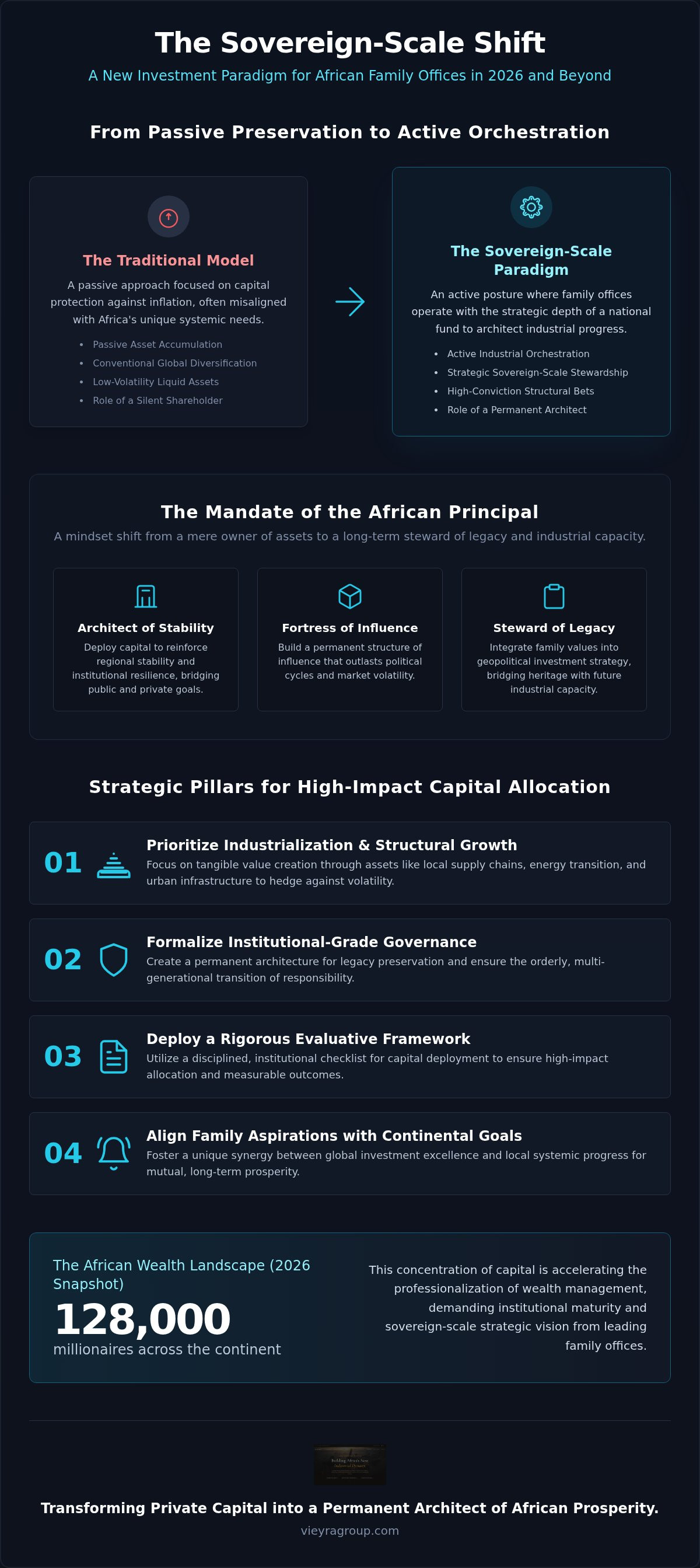
The evolution of private wealth across the continent requires a departure from the passive methodologies historically favored by Western institutions. For Africa’s most prominent families, the objective is no longer merely the protection of capital against inflation; it's the active orchestration of industrial progress. This shift necessitates a Sovereign-Scale Investment Paradigm, where family offices operate with the strategic depth and long-term horizon typically reserved for national reserve funds. By adopting these refined investment principles for African family offices, principals can ensure their capital acts as a stabilizing force within the regional economy, bridging the gap between private interests and public development goals.
Operating at this magnitude demands a rigorous alignment of investment beliefs with the multi-generational needs of the continent. It involves moving beyond the role of a silent shareholder to become a primary architect of economic stability. This transition isn't merely about the size of the balance sheet. It's about the sophistication of the governance and the intentionality of the impact. Strategic capital must be deployed with the deliberation of a sovereign entity, seeking out opportunities that offer both financial returns and the strengthening of the African industrial landscape.
Transcending Conventional Wealth Preservation
Traditional Western models of diversification often prioritize low-volatility liquid assets that fail to capture the structural growth inherent in African industrialization. These models don't account for the unique systemic requirements of emerging markets, where private capital must often provide the foundational infrastructure that public entities cannot. Systemic impact isn't a philanthropic byproduct; it's a core investment principle. Achieving this requires a delicate balance. Principals must maintain global liquidity for security while simultaneously making high-conviction, illiquid industrial bets that drive local productivity and long-term capital appreciation.
The Mandate of the African Principal
The African principal must view themselves as a steward of legacy rather than a mere owner of assets. This mindset shift is critical for the next century of growth, where the family office serves as a bridge between heritage and future industrial capacity. Integrating family values into geopolitical investment strategies allows for capital to be deployed where it reinforces regional stability and institutional resilience. It's about building a fortress of influence that survives political cycles. Sovereign-scale capital in 2026 African markets is the strategic deployment of multi-generational resources to catalyze industrial infrastructure and institutional resilience across borders.
Prioritizing Industrialization and Structural Growth Assets
The pursuit of multi-generational prosperity within the African context requires an intentional departure from the extractive investment models of the past. For the discerning principal, industrialization represents the most stable asset class for long-term capital appreciation, offering a hedge against the volatility of global commodity markets. By aligning private capital with structural growth trends like rapid urbanization and the continent's energy transition, family offices act as architects of a new economic era. These investment principles for African family offices prioritize the creation of tangible value through the development of local supply chains and industrial infrastructure, ensuring that wealth is not merely preserved but actively multiplied through systemic growth.
Identifying the convergence of demographics and infrastructure is essential for deploying capital at a sovereign scale. With approximately 128,000 millionaires across the continent as of June 2026, the professionalization of wealth management has accelerated, leading to a more sophisticated The Governance Framework among leading families. This institutional maturity allows for direct participation in sovereign-level projects, where private capital provides the necessary agility to unlock bottlenecks in logistics and energy. Such participation mitigates risk by embedding the family office within the essential value chains of the regional economy.
Strategic Capital Allocation for Industrial Development
Financing large-scale manufacturing and logistics requires a sophisticated understanding of 'Patient Capital.' Unlike short-term venture models, this approach recognizes that industrial returns accrue over decades, not quarters. Success in this arena depends on robust Capital Allocation for African Industrialization, where resources are directed toward projects that possess high barriers to entry and provide essential services to a growing middle class. By focusing on the foundational elements of the economy, families can secure their legacy while driving the continent toward self-sufficiency. Those seeking to refine their approach may benefit from exploring strategic capital solutions that bridge the gap between global standards and local industrial needs.
Navigating the Risk-Reward Spectrum in Emerging Markets
A primary challenge for the modern family office is the distinction between perceived geopolitical risk and structural investment risk. While global headlines often emphasize instability, the underlying reality is one of significant 'locked' value that can only be accessed through deep local expertise and direct participation. Leveraging this insight allows families to identify arbitrage opportunities in sectors where others see only complexity. Current economic trajectories suggest that African industrial output is poised for a significant transformation by 2030 as the continent transitions from extractive dependencies toward sophisticated manufacturing and digital infrastructure. This shift is supported by the 75% increase in Foreign Direct Investment observed in 2024, signaling a global recognition of the continent's industrial potential.
The Governance Framework for Multi-generational Perpetuity
The endurance of African wealth depends less on the assets themselves than on the structural integrity of the systems that govern them. Establishing an 'Architecture of Multi-generational Wealth' requires a deliberate transition from intuitive, centralized management to institutionalized governance. This framework serves as a sovereign-level safeguard, ensuring that investment principles for African family offices remain consistent across decades, regardless of the individuals currently at the helm. Central to this discipline is the Family Constitution, a foundational document that codifies the values, objectives, and decision-making processes of the lineage. By establishing a clear separation between family dynamics and the clinical deployment of institutional capital, principals can mitigate the risks of emotional decision-making and ensure every allocation serves the long-term industrial mandate of the firm.
Succession planning must be viewed as a continuous process of preparing the next generation for sovereign-scale stewardship. It isn't merely the transfer of assets; it's the transmission of a strategic mindset capable of navigating complex geopolitical landscapes. This rigorous preparation ensures that the transition of power doesn't dilute the office's capacity to participate in large-scale Industrialization and Structural Growth Assets, maintaining the momentum of the family’s contribution to the continent’s economic transformation. It's about building a permanent institution that survives its founders.
Institutionalizing the Family Office
Formalizing the family office involves moving beyond informal councils toward the establishment of professional investment committees. These committees should be bolstered by the presence of independent directors who bring external rigor and global perspectives to the table. In the African context, these directors serve as essential buffers, providing the objective oversight necessary to maintain institutional credibility and global trust. To assist in this transition, families should utilize a comprehensive Architecture of Multi-generational Wealth checklist to evaluate their current governance maturity and identify areas for structural refinement.
Legacy Preservation through Strategic Philanthropy
Strategic philanthropy acts as a vital extension of the family’s investment philosophy, converting financial success into enduring social capital. The Vieyra Foundation model illustrates how philanthropic initiatives can be aligned with core investment principles to create a self-reinforcing cycle of growth and impact. Rather than treating giving as a disconnected activity, institutional-grade philanthropy focuses on systemic interventions that improve the broader industrial environment. Measuring the systemic impact of these initiatives ensures that the family’s legacy is defined by its role as a visionary architect of progress, fostering a brand that commands respect across both global finance and local communities.
Institutional Checklist for Strategic Capital Deployment
The transition from theoretical governance to the physical deployment of capital represents the most critical phase in the preservation of a family's industrial legacy. In 2026, the complexity of African markets demands an evaluative rigor that transcends standard private equity models. Deploying sovereign-scale capital requires a methodology that prioritizes systemic resilience and long-term yield over speculative gains. By utilizing a standardized institutional checklist, family offices can ensure that their investment principles for African family offices are applied with clinical consistency across diverse jurisdictions and asset classes.
This rigor is particularly vital given the shifting regulatory landscape across the continent. For instance, the implementation of the Nigeria Tax Act 2025 and the updated tax frameworks in Botswana as of July 1, 2026, necessitate a sophisticated approach to cross-border capital flow. Verification steps must now include a granular analysis of how internal reorganizations and indirect transfers are treated under new Capital Gains Tax rules in East Africa. Maintaining alignment with global ESG standards is no longer optional; it's a prerequisite for the transparency required by institutional-grade partners and sovereign entities.
Pre-Investment Due Diligence Checklist
- Geopolitical Risk Mapping: Assessment of long-term policy stability and the potential for regulatory shifts over a twenty-year horizon.
- Regional Industrial Alignment: Verification that the target asset contributes to the structural goals of the African Continental Free Trade Area (AfCFTA).
- Perpetuity Modeling: Evaluation of the asset's capacity for an "exit-less" strategy, where value is derived from perpetual operational yield rather than a speculative sale.
Structural and Operational Readiness
- Transparency Protocols: Confirmation that the management entity utilizes institutional-grade reporting that satisfies international audit standards.
- Local Content Compliance: Verification of adherence to specific sector ownership requirements, such as those mandated by the 2026 Local Content Law in the Democratic Republic of Congo.
- Patient Capital Mandate: Requirement that the capital commitment for infrastructure or manufacturing projects acknowledges a minimum 15-year gestation period before structural returns are fully realized.
Establishing these rigorous protocols is essential for families intent on becoming permanent architects of the continent's progress. Those seeking to refine their deployment strategies may find value in strategic capital solutions that bridge the gap between private ambition and sovereign-scale industrialization.
The Vieyra Approach: Aligning Global Stewardship with African Growth
Vieyra Family Office functions as a primary conduit between the rigorous standards of global investment management and the profound potential inherent in African industrialization capital. By operating at a sovereign scale, we transcend the traditional limitations of private wealth management, offering a strategic perspective that prioritizes the structural evolution of the continent over mere asset accumulation. This philosophy isn't just an operational choice; it's a competitive advantage that allows for the orchestration of large-scale initiatives that mirror the depth and foresight of national reserve funds. It's this fusion of global sophistication and deep-rooted expertise that defines our contribution to the investment principles for African family offices, ensuring that private capital acts as a catalyst for systemic, long-term change.
A Multi-generational Vision for the Continent
Our commitment to the continent’s economic transformation is rooted in the belief that industrialization represents the only viable path toward permanent, multi-generational prosperity. Through the deployment of strategic capital solutions, we've orchestrated initiatives that bridge the gap between international institutional standards and the specific requirements of the African industrial landscape. Case study highlights from our recent initiatives demonstrate the efficacy of deploying capital into large-scale industrialization projects that secure supply chain sovereignty while generating consistent yields. These efforts don't just seek immediate financial returns; they're meticulously designed to build the foundational infrastructure and manufacturing capacity necessary for future generations to thrive. Engaging with the Vieyra team means aligning with a partner that understands the intricate nuances of the African value chain while maintaining the institutional gravity of a global sovereign actor.
Securing the Future of African Wealth
In an era characterized by shifting global alliances and rapidly evolving regulatory frameworks, the requirement for institutional stability has never been more acute for the continent’s leading families. Principals must view themselves as architects of progress, responsible for creating the robust governance structures that ensure family wealth remains a stabilizing force across multiple centuries. This stewardship requires a relentless adherence to the investment principles for African family offices that prioritize systemic resilience and the preservation of social capital over speculative gains. By institutionalizing the family legacy today, you ensure your capital remains a relevant and influential participant in the broader narrative of global growth. We invite you to Discover our Sovereign-Scale Capital Solutions and join us in the deliberate construction of an enduring African legacy.
Architecting a Permanent African Legacy
The transition from passive wealth accumulation to the deliberate orchestration of industrial transformation represents the definitive mandate for the continent’s leading families. By adopting institutional-grade investment principles for African family offices, principals ensure that their capital serves as a foundational pillar for regional economic stability while securing a multi-generational heritage. This framework requires a rigorous alignment between private aspirations and the sovereign-scale requirements of African industrialization, supported by governance structures that project permanence and global influence. It's through this methodical approach that private wealth becomes a permanent architect of progress.
Vieyra Family Office stands as a stately guardian of this vision, blending sophisticated global investment management with a profound commitment to the African industrial landscape. As a steward of the Vieyra Foundation and a visionary architect of industrial transformation, we provide the strategic capital solutions necessary to bridge the gap between heritage and future progress. We invite you to Explore our Sovereign-Scale Investment Framework and take the first step toward institutionalizing your family’s contribution to a prosperous and self-sufficient Africa. Your legacy remains the cornerstone of the continent's trajectory.
Frequently Asked Questions
What are the primary investment principles for African family offices?
The core investment principles for African family offices prioritize the orchestration of industrial transformation over the passive accumulation of assets. These principles advocate for a sovereign-scale perspective that aligns private capital with regional economic stability and structural growth. By focusing on the creation of tangible value within local supply chains, families ensure their wealth serves as a permanent architect of continental progress and multi-generational prosperity.
How does sovereign-scale investment differ from traditional private equity in Africa?
Sovereign-scale investment is distinguished by its commitment to a multi-decadal horizon and an "exit-less" strategy, whereas traditional private equity typically seeks shorter-term liquidity events. This institutional approach prioritizes the development of foundational infrastructure and manufacturing capacity. It operates with the deliberation of a national reserve fund, focusing on systemic resilience rather than speculative gains within volatile or extractive markets.
Why is industrialization considered a multi-generational investment strategy?
Industrialization offers a robust hedge against commodity volatility by creating assets with high barriers to entry and perpetual operational yield. This strategy aligns with the continent's rapid urbanization and demographic shifts, providing essential services to an expanding middle class. Because industrial returns accrue over decades, they provide a stable foundation for the preservation and multiplication of family wealth across successive generations.
What role does governance play in preserving African family wealth?
Governance acts as the structural safeguard that ensures investment discipline remains consistent across generations, shielding capital from emotional or centralized decision-making. By establishing professional investment committees and a formal Family Constitution, families can institutionalize their values and operational standards. This professionalization is essential for maintaining global credibility and ensuring the orderly transition of stewardship within complex geopolitical environments.
Can African family offices effectively balance global diversification with local impact?
Families can achieve this balance by maintaining global liquidity for security while dedicating significant "patient capital" to high-impact industrial projects within Africa. This dual-track approach ensures the family office remains resilient to global shocks while actively participating in the continent's structural growth. Strategic capital allocation allows for the integration of global investment excellence with deep-rooted local expertise to unlock systemic value.
What are the common mistakes in African multi-generational capital allocation?
A frequent error is the over-concentration of assets in extractive industries or speculative sectors that lack long-term structural depth. Many offices also suffer from an absence of institutional-grade governance, leading to fragmented decision-making during leadership transitions. Failing to account for the "patient capital" requirement of industrial infrastructure often results in premature exits that compromise the family office’s potential for systemic regional impact.
How should an African family office structure its philanthropic arm?
An effective philanthropic arm should be structured as a strategic extension of the family office's core investment philosophy, focusing on systemic interventions rather than isolated grants. By aligning initiatives with broader industrial and social goals, the office converts financial success into enduring social capital. This institutional-grade giving, modeled by entities like the Vieyra Foundation, fosters a brand that commands respect and reinforces the family’s role as a visionary architect.
What is the expected growth for African family offices by 2030?
The professionalization of family offices is projected to accelerate significantly by 2030, driven by the expansion of the continent’s high-net-worth population, which reached approximately 128,000 millionaires by June 2026. This growth is accompanied by an increasing shift toward formal governance and sovereign-scale participation in infrastructure. As families seek to navigate evolving tax and regulatory landscapes, the demand for sophisticated investment principles for African family offices will continue to rise.


