
The historical tendency to view African economic participation through the lens of speculative volatility overlooks a profound, systemic shift toward institutional permanence and sovereign-scale stewardship. This transition is most evident within the maturing private capital markets Africa, where the strategic focus is moving from transient gains toward the deliberate construction of industrial legacies that span decades. It's understandable that the perceived complexity of fragmented regulatory environments and the historical scarcity of patient capital have created an atmosphere of caution among global institutions seeking enduring stability. This article offers a rigorous examination of the structural evolution defining the continent, providing a sophisticated framework for multi-generational capital preservation and large-scale industrial growth. We shall analyze the necessary alignment of strategic capital solutions with the broader goals of economic transformation, identifying the precise systemic opportunities that allow for the deployment of capital at a scale that reflects the true potential of the African industrial landscape and its emerging role in the global economy.
Key Takeaways
- Identify the structural transition of African capital formation as it moves from traditional public equity into sophisticated private market frameworks designed for institutional permanence.
- Analyze the 2026 milestones of the AfCFTA as a systemic catalyst for integrated private capital markets Africa, fostering enhanced cross-border flows and regulatory harmonization.
- Recognize the necessity of moving beyond venture-scale models toward the deployment of patient, sovereign-scale capital to drive systemic industrial and infrastructure transformation.
- Apply a multi-generational framework for risk assessment that prioritizes institutional stewardship and prestige to ensure long-term investment stability.
- Evaluate the alignment of strategic capital solutions with large-scale economic goals to facilitate the preservation of legacy wealth through industrial progress.
The Architecture of African Private Capital: A Structural Overview
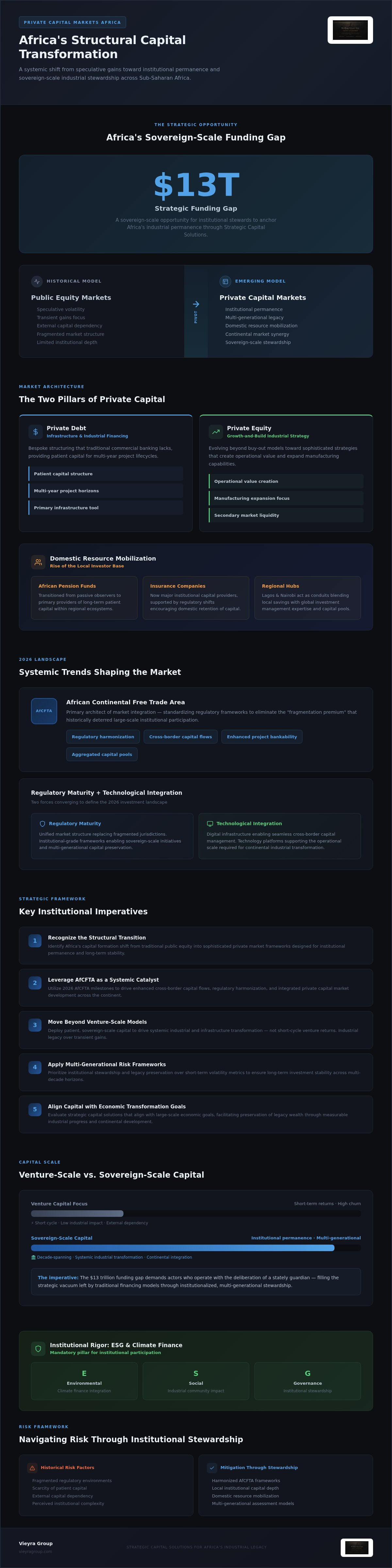
The structural landscape of capital formation across Sub-Saharan Africa is undergoing a fundamental reconfiguration. We're witnessing a decisive pivot away from the historical limitations of public equity markets toward the sophisticated mechanisms of private capital markets Africa. This evolution isn't merely a transient trend. It's a profound response to a strategic funding gap estimated at $13 trillion. This deficit represents a sovereign-scale opportunity for institutional stewards to anchor the continent's industrial permanence through the deployment of Strategic Capital Solutions. The current environment demands a move toward institutionalized stewardship. It requires the presence of actors who operate with the deliberation of a stately guardian. These entities are now filling the strategic vacuum left by traditional financing models, ensuring that capital deployment aligns with the long-term requirements of systemic industrialization.
The Divergence of Private Equity and Private Debt
The maturation of the market is increasingly defined by the divergence of specific asset classes tailored for industrial scale. Private debt has emerged as a primary tool for infrastructure and industrial financing. It offers a level of bespoke structuring that traditional commercial banking often lacks. These debt instruments provide the patient capital necessary for multi-year project lifecycles. Concurrently, private equity is evolving from simple buy-out models toward sophisticated "growth-and-build" industrial strategies. This shift prioritizes the creation of operational value and the expansion of manufacturing capabilities over mere financial engineering. The emergence of secondary markets further supports this ecosystem. It provides the institutional liquidity required to sustain multi-generational investment horizons without compromising the stability of the underlying assets.
Domestic Resource Mobilization and the Local Investor Base
A critical pillar of this new architecture is the rise of a robust local investor base. African pension funds and insurance companies are no longer passive observers. They've become primary providers of long-term capital. This surge in domestic resource mobilization is supported by regulatory shifts that encourage capital to remain within regional industrial ecosystems. Such frameworks are essential for the broader Economy of Africa, as they reduce reliance on external volatility. Regional hubs like Lagos and Nairobi are deepening these capital pools. They act as sophisticated conduits that blend local savings with global investment management expertise. It's a process that builds a foundation of permanence. This localized strength ensures that the trajectory of African industrialization remains rooted in the continent's own strategic interests while maintaining a global perspective on wealth preservation.
Systemic Trends Shaping the 2026 Investment Landscape
The investment landscape of 2026 is defined by a convergence of regulatory maturity and technological integration. It's clear that the evolution of private capital markets Africa has moved beyond localized experiments, becoming a continental imperative for those seeking long-term stability. This period marks a decisive shift from the fragmentation of the past toward a unified market structure that supports sovereign-scale initiatives. The transition is underpinned by a commitment to permanence and the deliberate construction of an industrial base that can withstand global economic shifts.
The AfCFTA and the Continental Market Synergy
The African Continental Free Trade Area (AfCFTA) serves as the primary architect for market integration. By standardizing regulatory frameworks, it effectively diminishes the "fragmentation premium" that has historically deterred large-scale institutional participation. Unified trade protocols enhance the bankability of industrial projects by ensuring a seamless flow of goods and capital across borders. The AfCFTA serves as the structural foundation for the harmonization of private capital standards across the continent's diverse jurisdictions. This synergy allows for the aggregation of capital into larger, more impactful pools that can support the multi-generational goals of regional industrialization.
Institutional Rigor in ESG and Climate Finance
Institutional rigor in ESG and climate finance is moving from a peripheral compliance concern to a central pillar of value creation. Private capital plays a decisive role in financing the continent's energy transition, aligning regional industrial needs with global sustainability mandates. This strategic alignment is critical for attracting sovereign wealth funds that require high levels of transparency and documented impact. It's not merely about risk mitigation; it's about leveraging ESG frameworks to drive operational excellence within industrial assets. Professionals seeking to align their portfolios with these structural shifts often look toward Strategic Capital Solutions that bridge the gap between global liquidities and African industrial permanence.
The digitalization of private capital markets Africa provides the transparency and efficiency required for sophisticated operations. It facilitates a critical transition from commodity-export models to value-added industrial processing. This shift ensures that wealth is not merely extracted but preserved through the creation of a robust industrial base. By utilizing institutional-grade technology, market participants can now monitor systemic risks and opportunities with a level of precision previously reserved for more developed markets. This technological layer acts as a catalyst for efficiency, ensuring that capital is deployed with maximum impact across the continent's industrial landscape.
The Sovereign-Scale Imperative: Financing African Industrialization
The requirement for systemic economic transformation necessitates a scale of intervention that far exceeds the capabilities of venture-scale models. While venture capital facilitates technological innovation, it remains fundamentally insufficient for the construction of the heavy industrial complexes and infrastructure networks that underpin a modern economy. The maturation of private capital markets Africa depends on the mobilization of "patient capital," a form of strategic investment characterized by its extended temporal horizon and its focus on enduring asset value. This approach requires a deliberate balancing of global asset management standards with a profound dedication to African-centric industrialization. By positioning the family office as a co-investment partner, global sovereign funds gain access to a level of local expertise and institutional stability that is otherwise difficult to secure within the continent's complex regulatory environments.
Industrialization as the Foundation of Multi-generational Wealth
The ownership of industrial assets provides a unique foundation for the preservation of multi-generational wealth, offering a degree of permanence that liquid markets often cannot replicate. We identify "moat" opportunities within manufacturing, logistics, and energy sectors, where entry barriers are high and the systemic necessity is absolute. The Vieyra approach prioritizes investing in the physical architecture of the African future, ensuring that capital isn't merely deployed but is anchored in the productive capacity of the continent. This focus on African Industrialization Capital allows for the alignment of financial objectives with the broader trajectory of sovereign growth, creating a legacy of stability and influence that transcends market cycles.
Strategic Capital vs. Speculative Flow
It's essential to differentiate between the short-term "hot money" of speculative flows and the institutional rigor of strategic capital. Speculative capital often retreats at the first sign of geopolitical volatility, whereas strategic capital provides the institutional gravity required to navigate complex, sovereign-level initiatives. Local knowledge acts as a critical risk mitigator, allowing for a nuanced understanding of the interconnectedness between policy, industry, and capital. By deploying Strategic Capital Solutions, we ensure that investments are protected by a deep understanding of the local landscape. This methodical approach fosters a sense of permanence, shielding long-term objectives from the transient fluctuations that often characterize less established markets. It builds a foundation where institutional prestige and local insight converge to secure the future of the private capital markets Africa.
Navigating Risk through Institutional Stewardship
The management of risk within the expansive private capital markets Africa necessitates a departure from reactive measures, favoring instead a multi-generational framework of institutional stewardship that prioritizes the preservation of capital through periods of sovereign-level transition. This approach recognizes that perceived volatility is not an insurmountable barrier but a variable that can be neutralized through the application of institutional prestige and strategic depth. By operating with the deliberation of a stately guardian, institutions can secure the long-term stability required for large-scale industrial progress. This level of permanence is achieved through the meticulous interconnectedness of various risk-mitigation initiatives, ensuring that the scale of operations remains resilient against the fluctuations of global geopolitics and the shifting tides of international finance.
The Mechanics of Risk Mitigation in Private Markets
Sophisticated asset management within this context relies on a diverse array of instruments designed to address specific systemic vulnerabilities with precision. Currency risk management is executed through the strategic utilization of local currency sovereign debt and advanced hedging structures that protect the underlying value of industrial assets against exchange rate fluctuations. These efforts are bolstered by long-term multilateral partnerships that provide essential political risk insurance, creating a layer of protection that bridges the gap between local operational realities and global investor expectations. Institutional rigor in African asset management is the definitive cornerstone upon which the preservation of multi-generational legacy is built within the global financial architecture. It's the presence of this rigor that transforms high-risk perceptions into managed institutional opportunities.
The Architecture of a Multi-generational Exit Strategy
The historical objection regarding the lack of viable exit pathways is increasingly addressed by the maturation of regional financial ecosystems and the rise of sophisticated trade sales. We're seeing the development of institutional-grade assets that possess the structural integrity required to attract acquisitions from global pension funds and sovereign wealth entities seeking yield-bearing industrial exposure. The evolution of regional bourses, such as the Johannesburg Stock Exchange (JSE), the Nairobi Securities Exchange (NSE), and the Bourse Régionale des Valeurs Mobilières (BRVM), provides sophisticated exit pathways for those seeking to recycle capital into new phases of industrial growth. This cycle of reinvestment ensures that the private capital markets Africa remain dynamic and self-sustaining, fostering a continuous trajectory of economic transformation. Institutional actors who prioritize this level of strategic foresight can leverage Global Investment Management to navigate these complex exit landscapes with confidence and precision.
The Vieyra Legacy: A Visionary Architect of African Progress
The Vieyra Legacy represents the definitive synthesis of the structural shifts and strategic imperatives analyzed throughout this discourse. By integrating Global Investment Management with a profound, multi-generational commitment to the continent, the firm serves as a vital conduit between the sophisticated requirements of global capital and the tangible needs of African industrialization. This role is not merely functional; it's an expression of a long-term vision that views the development of private capital markets Africa as the primary engine for continental stability and global influence. Through the Strategic Capital Solutions provided, the firm operates as a stately guardian of legacy, ensuring that every deployment of capital contributes to a broader architecture of progress that will endure for the next century. It's this commitment to permanence that distinguishes our approach, providing a foundation of certainty within a landscape of immense potential.
Global Stewardship, African Roots
The unique advantage of a multi-generational African family office lies in its ability to harmonize global financial rigor with deep-seated regional roots. This dual perspective allows for the identification of systemic opportunities that external actors might overlook, particularly within the context of large-scale industrial projects that require local nuance. Our philosophy of permanence dictates that we invest not for the immediate quarter, but for the next hundred years, prioritizing the creation of enduring value over transient returns. By bridging the gap between international liquidities and the physical requirements of local manufacturing and energy sectors, we anchor the continent's future in a foundation of industrial excellence. This heritage provides the institutional depth necessary to navigate the complexities of the African landscape while maintaining the poise and foresight of a global sovereign actor.
Strategic Engagement and Capital Allocation
Engagement with sovereign-scale investment institutions requires a methodology that prioritizes alignment, transparency, and systemic impact. The process of deploying African Industrialization Capital involves a rigorous analysis of high-impact sectors, where strategic capital can act as a catalyst for broader economic transformation. This commitment extends beyond financial returns through the Vieyra Foundation, which aligns philanthropic initiatives with our overarching industrial strategy to ensure that progress is both inclusive and sustainable. Collaborating with the Vieyra Family Office offers global partners a gateway to participate in the continent's most significant industrial initiatives under the guidance of an established institutional architect. We invite you to Discover our approach to strategic capital deployment and learn how we're shaping the trajectory of private capital markets Africa for generations to come.
The Architecture of an Enduring African Industrial Legacy
The structural transformation of private capital markets Africa signifies a decisive movement away from transient, speculative interests toward a framework of institutionalized permanence. This evolution is predicated upon the mobilization of sovereign-scale investment capacity and the deliberate construction of an industrial base that's capable of sustaining multi-generational growth. By prioritizing patient capital and strategic industrialization, investors can align their objectives with the continent's long-term economic trajectory. Our firm brings a unique perspective to this landscape, blending a multi-generational African heritage with the institutional rigor required for sophisticated global asset management. We're committed to acting as a stately guardian of this progress, ensuring that every initiative contributes to a legacy of stability and influence. We invite you to Inquire regarding our strategic capital solutions and institutional investment framework to explore how we can anchor your participation in the continent's future. The path toward systemic industrialization is clear, and the opportunities for sovereign-scale impact have never been more profound.
Frequently Asked Questions
What is the current scale of private capital markets in Africa for 2026?
It's clear that the scale of private capital markets Africa for 2026 reflects a maturing ecosystem where institutionalized structures are replacing fragmented flows. By 2026, the integration of AfCFTA milestones is expected to consolidate these markets into a more unified continental force. This growth is driven by a shift toward long-term stewardship rather than short-term speculation. The market now supports sovereign-scale projects that require significant, stable capital commitments from global and domestic institutional actors.
How does the AfCFTA influence private equity and debt investments?
The AfCFTA acts as a systemic catalyst by harmonizing regulatory frameworks and reducing the "fragmentation premium" for investors. It enhances the bankability of industrial projects by facilitating seamless cross-border trade and capital movement. This standardization allows private equity and debt providers to aggregate assets across regions. It's a structure that creates a more predictable environment for the deployment of Strategic Capital Solutions focused on continental industrial integration.
What are the primary barriers to institutional capital formation in Sub-Saharan Africa?
Historical barriers include fragmented regulatory environments, perceived sovereign risk, and a lack of patient capital. Many global institutions have traditionally viewed the region through a lens of volatility, which discourages multi-generational commitments. Market fragmentation often prevents the scaling of industrial initiatives. Overcoming these hurdles requires institutional prestige and the presence of stately guardians who can navigate complex local landscapes while maintaining global investment standards.
How can family offices mitigate political risk when investing in African industrialization?
Mitigation is achieved through a combination of local knowledge, institutional gravity, and strategic partnerships with multilateral entities. Family offices utilize their deep-rooted heritage to understand the nuances of sovereign-level shifts. By positioning themselves as co-investment partners, they provide a layer of stability that shields assets from transient political fluctuations. It's an approach that ensures capital remains anchored in the physical architecture of the continent's industrial future.
What role does domestic currency debt play in market sustainability?
Domestic currency debt is a critical tool for neutralizing exchange rate volatility within private capital markets Africa. It allows industrial projects to align their liabilities with local revenue streams, reducing the risk of currency mismatches. This focus on local resource mobilization fosters a more self-sustaining financial ecosystem. It's a strategy that encourages domestic pension funds to participate in the continent's industrialization, building a foundation of permanence and long-term economic resilience.
Why is industrialization considered a core pillar for multi-generational wealth in Africa?
Industrialization offers a level of asset permanence and systemic necessity that liquid markets cannot replicate. Ownership of manufacturing, logistics, and energy infrastructure creates "moat" opportunities that protect capital across decades. These physical assets provide consistent value and act as a hedge against global economic shifts. For a visionary architect of legacy, industrial investments represent the most reliable path to preserving wealth while driving profound economic transformation.
How does the Vieyra Family Office approach sovereign-scale capital allocation?
The approach centers on the deployment of Strategic Capital Solutions into high-impact sectors that define the continent's future. We prioritize projects that offer both multi-generational wealth preservation and systemic industrial progress. This involves a methodical process of aligning global investment management with deep African roots. Every allocation is viewed through a lens of permanence, ensuring that capital acts as a catalyst for large-scale sovereign development and enduring institutional prestige.
What is the $13 trillion funding gap and how can private markets bridge it?
The $13 trillion gap represents the total capital required to fund the continent's infrastructure and industrial requirements over the coming decades. Private markets bridge this deficit by mobilizing patient capital that traditional banking and public equities cannot provide. By creating sophisticated private debt and equity structures, institutional stewards can channel global liquidities into productive industrial assets. It's a process that transforms a massive funding challenge into a sovereign-scale opportunity for strategic investment.


