
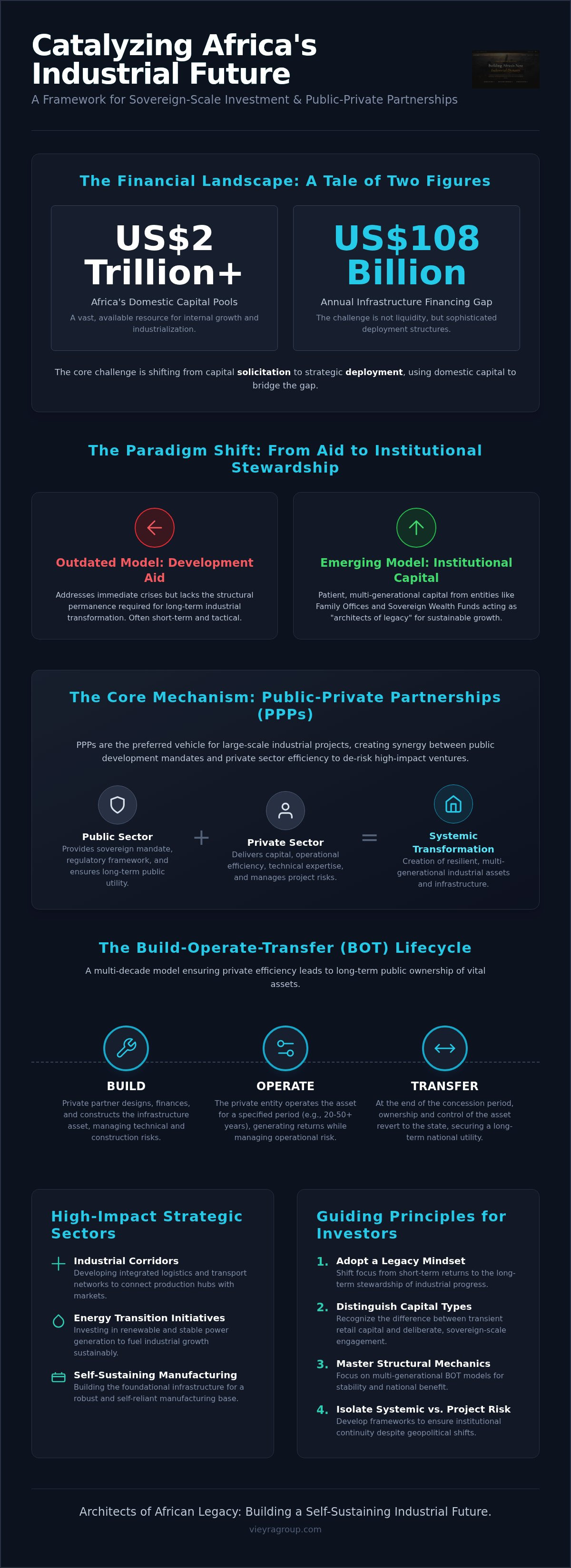
While external flows remain vital, the reality that Africa's domestic capital pools now exceed US$2 trillion suggests that the continent's industrial future depends less on solicitation and more on sophisticated deployment. This shift requires a rigorous re-evaluation of the public-private partnerships Africa utilizes to bridge the annual infrastructure financing gap, which remains as high as US$108 billion. You likely recognize that the primary hurdle isn't a lack of liquidity, but rather the absence of bankable, integrated structures that protect sovereign interests while delivering private returns.
We understand the complexities of navigating diverse regulatory environments and the persistent weight of perceived sovereign risk. This article serves as a definitive institutional reference for leveraging sovereign-scale capital to catalyze systemic industrial transformation. We'll explore the architecture of multi-generational stewardship, identify high-impact industrial sectors, and provide a strategic framework for aligning private investment with long-term public development objectives.
Key Takeaways
- Distinguish between transient retail capital and the deliberate, sovereign-scale engagement required for systemic industrial transformation.
- Master the structural mechanics of the public-private partnerships Africa utilizes, focusing on the lifecycle of Build-Operate-Transfer models designed for multi-generational stability.
- Develop a rigorous framework for isolating systemic geopolitical shifts from project-specific risks to ensure institutional continuity in emerging markets.
- Identify high-impact industrial corridors and energy transition initiatives that serve as the foundational infrastructure for a self-sustaining manufacturing base.
- Adopt the perspective of a visionary architect of legacy, shifting the focus from short-term financial returns to the long-term stewardship of African industrial progress.
Defining the Landscape of African Sovereign Investment
The landscape of capital allocation on the continent is undergoing a profound metamorphosis. It's moving away from the ephemeral nature of retail speculation toward the enduring stability of institutional stewardship. African sovereign investment is the strategic deployment of large-scale capital into systemic growth projects. This evolution reflects a growing recognition that industrialisation isn't just an economic objective; it's the fundamental driver for continental economic sovereignty. By prioritizing long-term industrial assets over short-term liquid gains, institutional actors are laying the foundation for a self-sustaining economic ecosystem. This shift distinguishes the casual investor from the sovereign-level participant who understands that true wealth is built through the physical transformation of nations. Legacy requires time.
The Shift from Aid to Institutional Capital
Institutional frameworks are rapidly replacing the outdated 'development aid' paradigm that once defined external engagement with the continent. While aid often addresses immediate humanitarian crises, it lacks the structural permanence required for industrial transformation. Family offices have emerged as pivotal actors in this new era, providing the patient, multi-generational capital that traditional markets often overlook. These sovereign-scale private entities don't merely seek profit; they act as architects of legacy. Often, they manage this stewardship through the very public-private partnerships Africa needs to secure its industrial future. They complement traditional sovereign wealth funds by offering a layer of strategic agility and private sector rigor. This synergy ensures that capital isn't just allocated but is managed with the foresight of a stately guardian, ensuring that investments outlive their originators.
The Strategic Importance of PPPs in 2026
In the current climate, the Public-Private Partnership (PPP) model has become the preferred vehicle for large-scale industrial projects. This preference stems from the inherent synergy between a public mandate for development and private sector operational efficiency. As of 2026, the African Development Bank identifies an infrastructure financing gap of up to US$108 billion annually. Bridging this chasm requires the sophisticated application of public-private partnerships Africa utilizes to de-risk high-impact ventures. We're seeing a critical shift from capital mobilization to deployment, as Africa's domestic capital pools now exceed US$2 trillion. Current trends show a marked movement toward regional integration and the deepening of domestic capital markets. These developments provide the necessary institutional depth for multi-generational contracts, ensuring that industrial corridors remain viable across decades rather than just fiscal cycles.
The Structural Mechanics of Public-Private Partnerships in Africa
The lifecycle of a sovereign-scale initiative begins long before physical construction. It starts with a multi-decade vision that spans from rigorous feasibility assessments to multi-generational operations, often lasting half a century or more. The public-private partnerships Africa utilizes for such transformative work depend on the integrity of the Build-Operate-Transfer (BOT) model and its sophisticated variants. These structures ensure that while the private partner manages the technical and operational risks, the asset eventually reverts to the state, securing long-term national utility. Strategic capital acts as the foundational layer in this process. It de-risks the early stages of industrial development by providing the intellectual and financial weight required to navigate complex pre-operational phases. By 'crowding in' private capital through highly structured participation, lead investors can significantly compress project timelines and move assets into the operational phase with greater speed. The efficacy of public-private partnerships Africa deploys today will determine the industrial resilience of the continent for the next century.
Capital Allocation and Fee Structures
Managing capital at this scale requires a nuanced understanding of investment management fees and allocation strategies. These structures must balance the immediate need for competitive project returns with the overarching goal of multi-generational wealth preservation. In the context of large-scale industrial projects, fee arrangements reflect the professional rigor and geopolitical expertise required to steward capital across diverse jurisdictions. This isn't merely about transactional profit; it's about the sustainable management of resources, a topic often explored in depth regarding infrastructure investing and its associated fee structures. For institutions seeking to align financial performance with systemic impact, engaging with strategic capital solutions provides a necessary framework for long-term success.
The Architecture of Sovereign-Level Contracts
The permanence of industrial assets necessitates a legal architecture that is as resilient as the structures themselves. Robust legal frameworks are essential for ensuring long-term stability, particularly when projects span multiple political cycles. Sovereign-level contracts rely heavily on international arbitration clauses and bilateral investment treaties to provide a predictable environment for capital deployment. These multi-clause agreements are designed to manage the 'permanence' of the asset, addressing everything from technological obsolescence to shifting regulatory standards. This level of contractual sophistication ensures that the partnership remains a stabilizing force within the regional economy, regardless of external geopolitical shifts. It's this commitment to legal excellence that transforms a simple contract into a multi-generational legacy.
Mitigating Risk and Ensuring Institutional Stability
The mitigation of risk within the context of continental industrialisation requires a departure from traditional, reactive strategies in favor of a model of institutional resilience. Navigating this landscape demands a rigorous stratification of risk that distinguishes between transient geopolitical volatility and project-specific operational hurdles. While project-level risks are often technical in nature, systemic risks require a partner with the institutional gravity to remain steadfast during periods of regional transition. This stability is further reinforced by securing a 'Social Licence to Operate,' a process we facilitate through the strategic initiatives of the Vieyra Foundation to ensure that industrial growth is inextricably linked to social progress. By positioning large-scale projects as pillars of community resilience, we mitigate the risk of local misalignment and foster an environment of shared prosperity. Sovereign-scale risk is a manageable variable through institutional depth. Stability demands foresight.
Regulatory Frameworks and Governance
The year 2026 marks a pivotal moment in the standardisation of legal codes governing public-private partnerships Africa, as more nations adopt harmonised frameworks to attract institutional capital. Working in concert with regional entities like the African Union and the African Development Bank ensures that projects align with broader continental integration goals, such as those outlined in the African Continental Free Trade Area. Such high-level alignment is a prerequisite for navigating the complexities of the African Institutional Investor Frameworks, which provide the necessary governance structures for multi-decade concessions. This collaborative approach ensures that regulatory shifts don't compromise the integrity of long-term industrial assets.
Currency and Macroeconomic Resilience
Macroeconomic resilience is the cornerstone of any multi-generational investment strategy, particularly regarding the management of foreign exchange risk in long-term industrial concessions. Strategies for mitigating FX exposure include the utilisation of sovereign guarantees and sophisticated political risk insurance (PRI) to shield capital from unforeseen currency fluctuations. We employ advanced hedging mechanisms and inflation-linked adjustment clauses to ensure the preservation of capital across generations, maintaining the real value of industrial assets. This methodical approach to financial stewardship ensures that the public-private partnerships Africa implements today can withstand the inevitable cycles of the global economy. It's a commitment to permanence that transcends fiscal cycles.
Strategic Sectors for African Industrialisation and Growth
Industrialisation serves as the definitive metric for continental progress. The transition from raw material extraction to sophisticated value addition requires a thematic focus on four critical pillars. By localising production, high-impact public-private partnerships Africa implements must move beyond standalone infrastructure to create integrated industrial ecosystems that address the continent's estimated US$230 billion annual import bill for essential goods like steel and fertilizer. This systemic approach ensures that capital isn't merely spent but is invested in the structural foundations of economic independence. Legacy requires a shift in perspective from extraction to creation.
The Energy-Industry Nexus
Reliability in energy supply is the non-negotiable bedrock of a manufacturing base. Large-scale renewable and baseload power projects require the deployment of institutional expertise to ensure energy security across borders. These ventures aren't merely utility projects; they're the lifeblood of industrial zones. Successfully Financing Large Scale Industrial Projects in Africa depends on the ability to align long-term power purchase agreements with the needs of heavy industry. By securing consistent power, we enable the multi-generational operation of manufacturing plants, transforming energy from a chronic bottleneck into a sovereign competitive advantage.
Integrated Logistics and Trade
The 'Industrial Corridors' of the future depend on the seamless integration of port and rail developments. These assets act as catalysts for regional trade under the African Continental Free Trade Area (AfCFTA), facilitating the movement of value-added goods with unprecedented efficiency. Private capital accelerates the 'Architecture of African Legacies' by providing the technical depth and financial resilience needed for these expansive trade routes. Physical trade infrastructure represents a multi-generational asset class that remains stable against shifting global market cycles. It's the physical manifestation of continental integration.
Digital infrastructure provides the high-speed backbone for modern sovereign-scale industry, while manufacturing hubs represent the final stage of economic evolution. Moving from commodity exports to value-added industrialisation is the ultimate goal of our institutional stewardship. To explore how your institution can participate in these high-impact sectors through sophisticated public-private partnerships Africa, consider our African Industrialization Capital solutions. We provide the strategic framework for those who build for the next century.
The Vieyra Approach: Institutional Stewardship of African Legacy
Wealth preservation in the African context isn't merely the accumulation of assets; it's the cultivation of industrial permanence. At the Vieyra Family Office, we operate with the deliberation of a sovereign entity, rejecting the volatility of short-term financing in favor of the architectural precision required to build for centuries. This philosophy underpins the public-private partnerships Africa requires to transition from a consumer of global goods to a producer of industrial value. By acting as a stately guardian, we ensure that every allocation of capital contributes to a broader tapestry of continental progress. Legacy is the ultimate dividend of disciplined capital deployment.
The Vieyra Foundation functions as an integral component of this industrialisation strategy, serving as the bridge between large-scale capital deployment and the social resilience of the communities we serve. By aligning social impact with industrial growth, we secure the social licence to operate, ensuring that our projects are viewed not as external interventions but as domestic legacies. This integration transforms a standard investment into a pillar of national stability. We don't just build factories; we cultivate the human and social infrastructure necessary to sustain them across generations.
Sovereign-Scale Capital Solutions
Deploying strategic capital into sovereign-level initiatives requires a synthesis of global investment management expertise and a deep, African-centric core. We manage a diverse portfolio of international assets while maintaining a singular focus on the continent's industrial transformation. This dual perspective allows us to apply world-class financial rigor to the specific challenges of public-private partnerships Africa. Our institutional expertise in industrial finance ensures that project structures are bankable, sustainable, and capable of weathering geopolitical shifts. It's this level of professional rigor that allows us to operate as a visionary architect of legacy in an increasingly complex global market.
Building a Multi-Generational Industrial Legacy
Systemic industrial transformation is a labor of decades, not fiscal quarters. It demands a level of institutional poise that prioritizes quality and depth over the speed of execution. Our approach is characterized by a methodical unfolding of objectives, moving from the broad vision of continental sovereignty to the granular mechanics of industrial corridors. This commitment to permanence is what distinguishes a visionary architect of legacy from a traditional financier. We invite those who seek to align their capital with the long-term trajectory of the continent to Explore our approach to Strategic Capital Allocation for African Industrialisation. Building a legacy is a collective endeavor that requires both foresight and fortitude.
Architecting the Industrial Century through Sovereign Stewardship
The path toward continental economic sovereignty depends on the transition from transient capital flows to the deliberate, multi-generational stewardship of industrial assets. We've explored how the structural mechanics of public-private partnerships Africa utilizes can move beyond standalone projects to create integrated industrial corridors. This transformation requires a rigorous mitigation of risk through institutional depth and the alignment of private returns with the broader public mandate for industrialisation. By prioritising the long-term stability of sovereign-scale capital over immediate liquid gains, visionary architects can build a legacy that transcends political cycles and global market volatility. Our commitment to this vision is rooted in a profound sense of institutional gravity, blending multi-generational stewardship with sovereign-scale capital deployment and institutional expertise in African industrialisation.
We invite you to Discover our institutional approach to African Sovereign Investment as we work toward securing the continent's industrial future. The future of the continent isn't merely found in its potential but in the disciplined execution of its industrial legacy.
Frequently Asked Questions
What defines a sovereign-scale investment in the African context?
Sovereign-scale investment refers to the deployment of capital at a magnitude capable of influencing national industrial trajectories. It's distinguished from retail or middle-market financing by its focus on systemic infrastructure and manufacturing assets that serve as the bedrock of economic sovereignty. These engagements typically involve long-term concessions and institutional-level governance, requiring a partner with the foresight to manage assets that outlive political cycles.
How do public-private partnerships mitigate the infrastructure financing gap?
These frameworks bridge the annual US$108 billion financing gap by combining public mandates with private sector operational efficiency and capital. By utilizing public-private partnerships Africa can de-risk large-scale projects, making them attractive to institutional investors who provide the necessary liquidity for multi-decade developments. This synergy ensures that projects are both bankable and socially impactful, moving assets from conceptual stages to operational reality.
What is the role of a family office in African industrialisation?
Family offices provide the patient, multi-generational capital required for deep industrial transformation. Unlike transient private equity, these offices act as stately guardians, prioritizing long-term stability and legacy over immediate exit strategies. They provide the strategic capital solutions needed to navigate complex regulatory environments, ensuring project continuity through a commitment to the continent's physical and economic transformation.
Can multi-generational wealth be preserved through African industrial projects?
Industrial assets like energy plants and transport corridors offer inflation-linked returns and physical permanence, making them ideal for long-term preservation. These projects provide a hedge against global market volatility while contributing to the continent's structural growth. By investing in the physical transformation of nations, institutions can secure a legacy that grows in value as regional integration and domestic demand increase across the century.
What are the primary risks associated with African sovereign investment in 2026?
Primary risks include currency volatility, shifting regulatory frameworks, and geopolitical transitions. However, these are manageable variables through institutional depth and the use of political risk insurance or sovereign guarantees. Sophisticated investors utilize multi-clause legal agreements and international arbitration to ensure the stability of their capital across diverse jurisdictions, transforming perceived risk into a structured and mitigated component of the investment lifecycle.
How does the Vieyra Family Office structure its capital allocation for PPPs?
We utilize a framework of Strategic Capital Solutions that prioritizes industrial transformation and systemic impact. Our allocation model balances global investment management with a core commitment to African industrialization capital. This ensures that every deployment is supported by professional rigor and a multi-generational horizon, moving beyond the limitations of short-termism to build enduring national assets that serve both investors and the public good.
What sectors are currently most viable for public-private partnerships in Africa?
Energy transition, integrated logistics, and digital infrastructure represent the most viable sectors for public-private partnerships Africa currently hosts. These areas address the fundamental bottlenecks of industrial growth, such as power reliability and trade efficiency. Manufacturing hubs that focus on value-added production also offer significant opportunities for sovereign-scale capital to replace expensive imports and foster domestic economic resilience.
How do institutional philanthropy and industrial investment align?
Alignment is achieved by integrating social progress into the core business model of industrial projects. The Vieyra Foundation exemplifies this by ensuring that large-scale capital deployment fosters community resilience and skill development. This synergy creates a social licence to operate, de-risking investments by making them indispensable to national welfare. It's an approach where industrial success and social advancement are mutually reinforcing goals.


