
Does the preservation of wealth across fragmented international jurisdictions truly constitute an enduring heritage, or is it merely a temporary buffer against the inevitable shifts of global markets? For the principals of the continent’s most significant estates, the realization that capital accumulation alone cannot secure a multi-generational future is becoming increasingly profound. There is a shared understanding that the traditional pursuit of diversified, passive returns often fails to address the fundamental need for continental stability and institutional permanence. This article provides a comprehensive framework for the deployment of sovereign-scale capital, illustrating how legacy investments for African family offices can transcend simple wealth preservation to catalyze systemic industrialization. By aligning family values with large-scale strategic initiatives, we explore the sectors and governance models that transform private resources into pillars of continental progress. We shall examine the transition from fragmented asset management to a unified, institutional-grade strategy that ensures both the security of the family and the advancement of the African economic landscape.
Key Takeaways
- Conceptualize the family office as a sovereign-scale institutional actor to transition beyond the mere preservation of liquid assets.
- Identify industrialization as the primary vehicle for ensuring multi-generational wealth stability and significant continental impact.
- Develop sophisticated asset allocation strategies that balance global liquidity requirements with strategic legacy investments for African family offices.
- Establish institutional-grade governance frameworks and family constitutions to manage the complexities of large-scale capital deployment.
- Align private capital initiatives with systemic industrial development to secure a permanent role in the continent's economic future.
Defining the Modern African Investment Legacy
The conceptualization of legacy within the African context has undergone a profound transformation, moving beyond the mere inheritance of liquid assets toward the establishment of enduring institutional structures. Historically, wealth was often viewed through the lens of private holdings designed for familial security. Today, the most influential families are redefining their role, acting as visionary architects of continental progress. They've recognized that true permanence is achieved through sovereign-scale initiatives that harmonize private interests with the broader economic trajectory of the continent. By adopting this perspective, legacy investments for African family offices become instruments of systemic change rather than just vehicles for personal accumulation.
The Shift from Passive Wealth to Active Stewardship
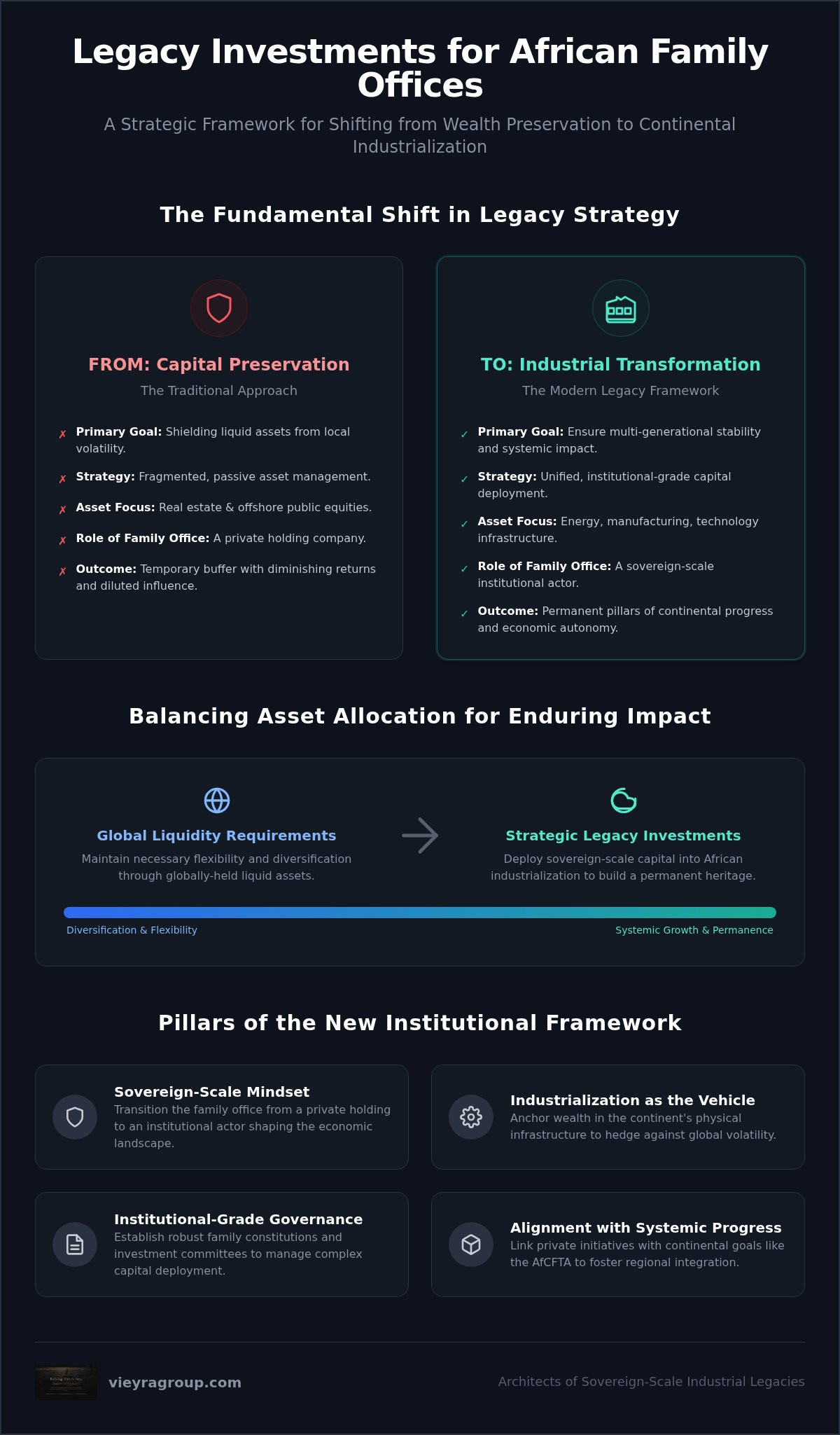
Stewardship requires a deliberate transition from capital preservation to strategic capital deployment. While traditional models focused primarily on shielding assets from local volatility, the modern family office prioritizes the active closure of the African infrastructure gap. This evolution necessitates the institutionalization of the family vision through professional governance. It's no longer sufficient to manage wealth through informal channels; instead, families are building robust investment committees that mirror the rigor of global financial institutions. This professionalization ensures that capital is not merely held but is actively working to build the industrial foundations required for long-term continental stability.
Legacy as a Systemic Contribution
A legacy's true weight is measured by its systemic impact. As we look toward 2026, the metrics of success are increasingly tied to the objectives of the African Continental Free Trade Area (AfCFTA). This strategic alignment reflects the philosophy of Africapitalism, where private capital serves as a primary driver for social and economic transformation. By deploying resources at a sovereign scale, families don't just participate in the market; they shape the environment in which they operate. This creates a virtuous cycle where industrial growth and family heritage become inextricably linked. These legacy investments for African family offices foster regional integration and industrial autonomy, ensuring the family remains a central actor in the continent's future. The family office functions as a stately guardian of progress, blending traditional values with a forward-looking commitment to large-scale development.
The Shift from Capital Preservation to Industrial Transformation
The conventional reliance on real estate and offshore public equities, while providing a degree of liquidity, often fails to generate the systemic impact necessary for true institutional permanence. To secure a multi-generational heritage, the focus must shift toward industrial transformation. This approach anchors wealth within the physical and economic infrastructure of the continent, ensuring that the family's trajectory is inextricably linked to Africa's broader development. Industrialization serves as a hedge against global volatility by creating localized value chains that are resistant to the fluctuations of international capital markets. Traditional asset classes like residential real estate often suffer from diminishing returns and localized market saturation. In contrast, industrial assets provide essential services that maintain demand regardless of broader economic cycles. Fragmented investment strategies across multiple jurisdictions often dilute the family's influence, whereas a concentrated industrial focus consolidates power and heritage. This evolution from a private holding to an institutional actor marks the maturity of the African family office. It's a move toward a sovereign-scale perspective where capital isn't just saved but is deployed to build the very industries that will sustain the family's prominence for centuries. By prioritizing industrial transformation, families transition from being participants in the economy to being its architects.
Strategic Capital for African Industrialization
Strategic capital for African industrialization requires a departure from short-termism. Investment in energy infrastructure, advanced manufacturing, and technology frameworks provides the essential groundwork for sovereign-scale growth. This long-term commitment allows legacy investments for African family offices to evolve from passive holdings into active drivers of continental autonomy. Success in this arena is defined by the ability to finance projects that possess multi-decadal utility, such as regional power grids or specialized manufacturing hubs that reduce reliance on external imports.
Mitigating Risks in Sovereign-Scale Initiatives
Navigating the risk-reward profile of large-scale industrial projects demands a sophisticated institutional approach. By leveraging strategic capital solutions, family offices can access the expertise required to mitigate exposure while maximizing continental impact. Resilience is built through diversified industrial portfolios that span multiple jurisdictions and sectors. This methodical deployment of legacy investments for African family offices transforms a private estate into a cornerstone of the African industrial landscape, moving beyond simple preservation to a legacy of systemic transformation. It's the mark of a stately guardian that operates with the deliberation and foresight of an established institution, certain of its role in Africa's industrial future.
Balancing Global Asset Allocation with Continental Stewardship
The sophistication of a family office is often measured by its ability to reconcile the preservation of global liquidity with the requirement for continental impact. This dual mandate creates a strategic tension that, when managed with institutional rigor, yields a resilient and influential heritage. It's not a matter of choosing between jurisdictions but rather of establishing a symbiotic relationship where international market exposure provides the necessary stability to fuel large-scale industrial projects at home. The modern family office functions as a bridge, utilizing the depth of global markets to reinforce the permanence of its African holdings. This equilibrium ensures that wealth isn't merely parked in offshore havens but is actively managed to support a vision of long-term continental leadership.
As we approach 2026, the management of currency risk and cross-border capital flows has become a central pillar of sovereign-scale operations. Volatility in local markets necessitates a robust global investment management strategy that can buffer against inflationary pressures while maintaining the capacity for local capital deployment. This methodical approach ensures that the family's international standing remains unassailable, providing a secure platform for their most ambitious African initiatives. By maintaining a composed and authoritative presence in global financial centers, African families command the respect and partnership of international institutional actors, further securing the multi-generational stability of their estates.
Global Portfolios as a Foundation for Local Impact
Utilizing global returns to provide strategic capital for African initiatives represents a shift from passive diversification to active stewardship. The synergy between international market exposure and local industrial knowledge allows families to identify unique value propositions that others might overlook. By structuring multi-jurisdictional holdings for maximum tax and regulatory efficiency, families ensure that their legacy investments for African family offices are optimized for both growth and protection. This professionalized structure facilitates the seamless transfer of capital between global portfolios and continental industrialization projects, creating a self-sustaining ecosystem of wealth and influence.
The Mechanics of Cross-Continental Wealth Preservation
Protecting African-centric assets requires the integration of global institutional frameworks that provide an extra layer of security. Sovereign-level capital solutions play a critical role in this diversification, ensuring that the family’s core assets are shielded from localized economic shifts. Access to global capital markets isn't just about diversification; it's about maintaining the institutional gravity required to engage with global actors as peers. This approach to legacy investments for African family offices ensures that the family remains a permanent fixture on the global stage, with the resources and influence to drive progress across generations. It’s the mark of an entity that understands that true security is found in the breadth and interconnectedness of its operations.
Strategic Frameworks for Multi-Generational Institutional Governance
The structural integrity of a multi-generational legacy is fundamentally dependent upon the sophistication of its governance frameworks. A family constitution, when designed with a focus on sovereign-scale impact, transcends the role of a mere legal document to become a visionary blueprint for continental influence. This foundational instrument codifies the family’s commitment to industrial transformation, ensuring that every strategic decision serves the overarching goal of institutional permanence. Within this architecture, the Investment Committee functions as a stately guardian, applying rigorous capital allocation protocols to identify and secure projects that possess systemic significance. By integrating the philanthropic mandates of the Vieyra Foundation into core investment strategies, families harmonize their pursuit of financial returns with a profound commitment to societal advancement.
Institutionalizing the Family Office
Transitioning from a family-led private holding to a professional, institutional-grade entity is a prerequisite for enduring stability. This shift necessitates the implementation of transparency and reporting standards that reflect the highest levels of global professional rigor. Developing the next generation of stewards requires more than simple asset exposure; it demands a structured curriculum of education and involvement in large-scale strategic capital solutions. This methodical preparation ensures that the transition of leadership doesn't compromise the institutional gravity of the office. It's about building a team that operates with the poise of an entity deeply rooted in its identity and certain of its trajectory.
Governance as a Tool for Permanence
Robust governance serves as a critical tool for permanence, providing the structural cohesion required to prevent the fragmentation of capital across successive generations. Without such frameworks, the weight of a family’s influence often dissipates as assets are divided among heirs. Independent advisors play a vital role in this process, offering an objective perspective that reinforces the office’s multi-generational vision. These structures ensure that the family’s trajectory remains certain long after the founder’s tenure has concluded. These protocols are the hallmark of a sovereign-level entity that operates with deliberation and foresight. For those seeking to establish a definitive heritage, implementing these frameworks is essential to the success of legacy investments for African family offices. To begin the process of institutionalizing your family’s vision, consider exploring our strategic capital solutions to ensure your governance matches your ambition. This approach guarantees that the family remains a significant global actor, blending traditional values with a commitment to large-scale progress.
Vieyra Family Office: Architects of Sovereign-Scale Industrial Legacies
Vieyra Family Office operates with the deliberation and foresight of an established institution, positioning itself as a visionary architect of continental progress. Our approach to managing multi-generational wealth is defined by a sovereign-scale perspective, where capital deployment transcends individual gain to facilitate systemic industrialization. We've structured our operations to harmonize global investment management with the specific requirements of African industrialization, ensuring that our international holdings provide the necessary stability for large-scale domestic initiatives. This synthesis allows us to deploy strategic capital into the projects that define Africa’s future, from expansive energy infrastructure to advanced manufacturing hubs. By aligning our investment strategy with the philanthropic principles of the Vieyra Foundation, we ensure that our industrial progress is inextricably linked to the social advancement of the communities we serve. This holistic model demonstrates that the most effective way to preserve wealth is to embed it within the very structures that drive regional prosperity.
Our Commitment to the African Investment Legacy
Our stewardship is rooted in a multi-generational heritage that prioritizes the long-term stability of continental wealth. We manage diversified portfolios that are specifically calibrated to support the complex requirements of legacy investments for African family offices. This commitment involves providing the African industrialization capital necessary for projects of significant scale, ensuring that the foundations of the economy remain robust for generations to come. We recognize that the challenges of the 21st century require a move away from fragmented strategies toward institutional-grade governance. We invite fellow principals to engage with us as peer-level institutional partners, sharing in the responsibility of securing our collective heritage through professionalized management and a shared vision of excellence.
Partnering for Continental Transformation
True systemic impact is achieved through the power of sovereign-level partnerships. We believe that the industrialization of the continent is a shared objective that requires the unified efforts of Africa’s most significant estates. By coordinating our strategic capital solutions, we can address the infrastructure gaps that have historically hindered growth and regional integration. This collaborative effort represents the gold standard for legacy investments for African family offices, transforming private resources into pillars of continental stability. It's our firm conviction that the permanence of African wealth is best secured through its direct contribution to the continent's industrial autonomy. We stand as a stately guardian of this vision, certain of our trajectory and committed to the enduring success of the African economic landscape. As we look toward 2026, our focus remains on the methodical deployment of capital that ensures Africa's position as a significant global actor on the world stage.
Securing the Continental Future through Institutional Permanence
The transition from a private holding to a professional institutional actor represents the definitive evolution of the African estate. By prioritizing systemic industrialization and establishing robust governance frameworks, families ensure their heritage is anchored in the continent's enduring progress. These strategic legacy investments for African family offices catalyze regional integration while providing the structural stability required for multi-generational success. This architecture of wealth demands a partner who understands the intricate balance between global investment management and the specific requirements of African development.
Our sovereign-scale institutional expertise and proven multi-generational investment philosophy provide the necessary foundation for your most ambitious continental objectives. We invite you to Explore the Architecture of Multi-Generational Wealth with Vieyra Family Office and define the future of your institutional heritage. It's a shared journey toward large-scale progress, and the foundations established today will sustain the prominence and influence of your family for generations to come.
Frequently Asked Questions
What defines an African investment legacy in the modern era?
An African investment legacy is defined by the profound transition from the mere preservation of liquid assets toward the establishment of enduring institutional structures. It requires the strategic alignment of private resources with the continent's broader industrial trajectory. This sophisticated approach ensures that legacy investments for African family offices contribute to systemic growth and economic autonomy, moving beyond personal accumulation to become pillars of continental stability.
How do family offices participate in sovereign-scale industrialization?
Participation occurs through the deliberate deployment of strategic capital into large-scale infrastructure and manufacturing projects that possess multi-decadal utility. Family offices act as visionary architects by financing initiatives such as regional energy grids and advanced technology frameworks. These sovereign-scale operations anchor the family's heritage within the physical economic landscape, ensuring their influence remains inextricably linked to the continent's long-term industrial autonomy and progress.
What are the primary risks associated with large-scale industrial projects in Africa?
The primary risks involve complex geopolitical shifts, regulatory variances across multiple jurisdictions, and the inherent volatility of local currency markets. Mitigating these exposures requires the implementation of institutional-grade risk management protocols and the use of global institutional frameworks. By adopting a methodical approach to risk, family offices can buffer their continental holdings against localized economic fluctuations while maintaining a steady and certain multi-generational trajectory.
How can a family office balance global diversification with local impact?
Balancing these objectives requires a dual mandate that utilizes the stability of global liquidity to fuel high-impact domestic industrialization. International market exposure provides a secure platform that allows for the confident deployment of capital into strategic African initiatives. This equilibrium ensures the family office maintains its international standing and international capital access while driving the significant progress required for long-term continental economic stability.
Why is institutional governance critical for multi-generational wealth preservation?
Institutional governance is essential to prevent the fragmentation of capital as it passes through successive generations of the family. Robust frameworks, such as professional family constitutions, provide the structural cohesion necessary to maintain a unified and visionary multi-generational strategy. These protocols ensure that legacy investments for African family offices remain concentrated and effective rather than being diluted or mismanaged among individual heirs over time.
How does the Vieyra Foundation support the broader investment strategy?
The Vieyra Foundation harmonizes philanthropic mandates with core industrial objectives to ensure that wealth creation yields profound societal benefits. This alignment reinforces the institutional gravity of the office by addressing the social foundations required for permanent continental stability. It transforms private success into a pillar of community progress, further securing the family's role as a stately guardian and a visionary leader of the continent's future.
What is the role of strategic capital in African economic development?
Strategic capital serves as the primary driver for closing the continent's significant infrastructure and industrial gaps through patient, long-term commitment. Unlike short-term retail banking or public brokerage services, this form of capital focuses on greenfield projects and industrial transformation. It creates localized value chains that reduce reliance on external imports, fostering the regional autonomy and economic resilience necessary for Africa to act as a significant global player.
How can family offices prepare the next generation for stewardship?
Preparation involves a structured curriculum of education and active involvement in complex sovereign-scale operations from an early stage. Next-generation stewards must be exposed to the professional rigor of global investment management and the intricacies of large-scale industrial finance. This methodical development ensures that the transition of leadership doesn't compromise the institution's long-term stability or its commitment to the family's established continental vision.


