
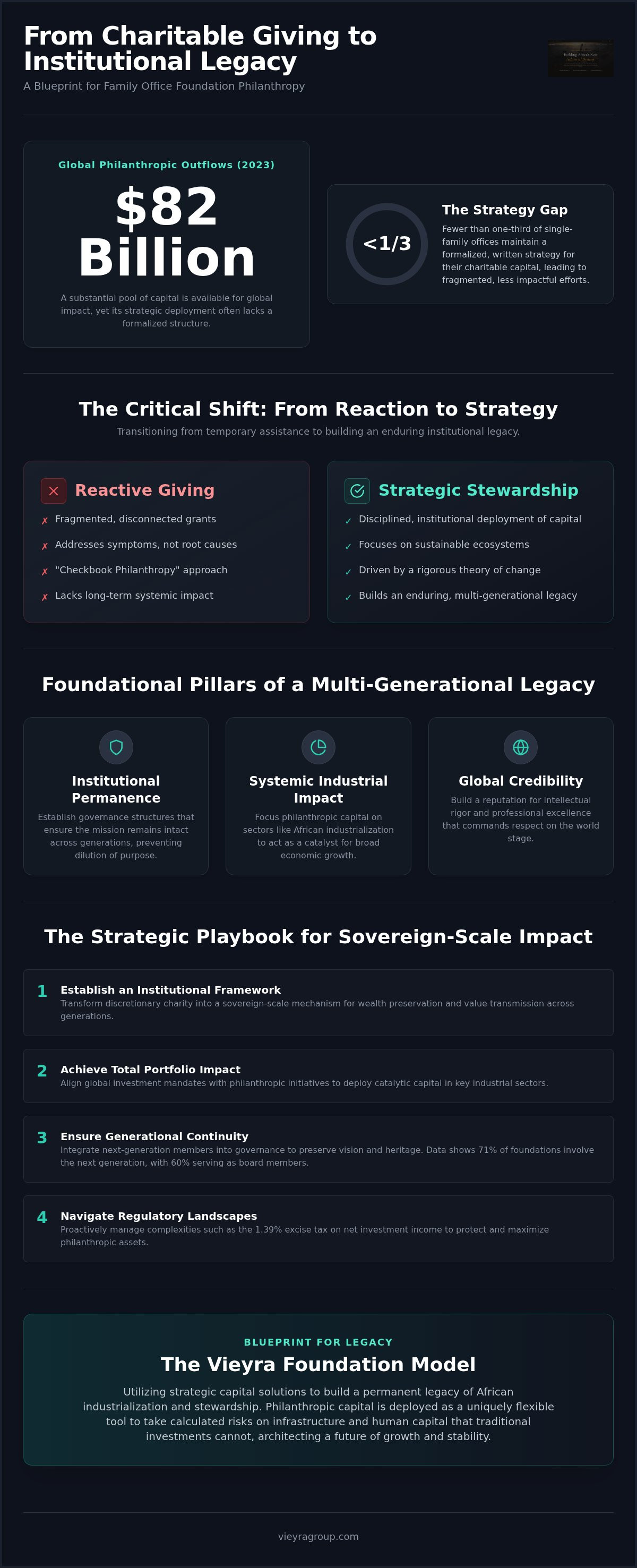
While global philanthropic outflows reached 82 billion USD in 2023, it remains a striking reality that fewer than one-third of single-family offices maintain a formalized, written strategy for their charitable capital. This absence of a strategic architecture often results in fragmented efforts that lack the systemic impact required for large-scale industrial development. For the ultra-high-net-worth family, the transition from reactive giving to a disciplined family office foundation philanthropy represents the vital shift from temporary assistance to the construction of an enduring institutional legacy.
You understand that the preservation of multi-generational values requires more than the simple transfer of wealth; it demands a cohesive alignment between global investment mandates and philanthropic initiatives. This article serves as a strategic blueprint for the integration of sovereign-scale capital with the long-term vision of African industrialization. We shall explore the robust governance frameworks, the navigation of 2026 regulatory landscapes such as the 1.39 percent excise tax on net investment income, and the methodologies for securing institutional permanence across successive generations.
Key Takeaways
- Establish an institutional framework that transforms discretionary charitable acts into a sovereign-scale mechanism for multi-generational wealth preservation and value transmission.
- Navigate the complexities of global jurisdictions and governance models to ensure professional institutional management remains balanced with family involvement.
- Align global investment mandates with family office foundation philanthropy to achieve Total Portfolio Impact through the deployment of catalytic capital in industrial sectors.
- Develop a rigorous theory of change that shifts focus from isolated grant-making toward systemic economic impact and strategic partnerships with global institutions.
- Utilize the Vieyra Foundation blueprint to integrate strategic capital solutions with a permanent legacy of African industrialization and stewardship.
The Institutional Imperative: Defining Family Office Foundation Philanthropy
The establishment of a dedicated philanthropic vehicle within a Family Office framework represents a deliberate move toward institutional permanence. It's a strategic transition where capital is no longer merely distributed as a series of disconnected grants but is instead deployed with the precision of a sovereign entity. This sophisticated approach to family office foundation philanthropy ensures that multi-generational wealth isn't just preserved; it's actively utilized to catalyze systemic changes that reflect the family’s core values. By codifying these values into a formal institutional identity, families create a guardian of their legacy that operates independently of individual lifespans, ensuring that their contribution to global economic development remains a constant force for decades.
The Shift from Charity to Strategic Stewardship
Transactional grant-making often addresses immediate symptoms rather than underlying causes. In contrast, strategic stewardship involves the meticulous alignment of philanthropic missions with long-term capital allocation strategies to foster sustainable ecosystems. It's about moving away from reactive "checkbook philanthropy" toward a model where every dollar serves a broader theory of change. In the context of sovereign-scale family offices, strategic stewardship is defined as the disciplined management of philanthropic assets to achieve measurable, systemic outcomes while reinforcing the family's standing as a significant actor in the global development landscape. This approach requires a rigorous vetting of partners and a commitment to data-driven impact that mirrors the precision of the family’s investment arm.
Foundational Pillars of a Multi-Generational Legacy
A truly enduring legacy requires a vision that transcends the immediate interests of current family members. It necessitates the creation of foundational pillars that provide institutional gravity, attracting high-level global partners and sovereign wealth funds to collaborative initiatives. For the Vieyra Foundation, this vision is inextricably linked to the progress of the African continent. This framework relies on several key components:
- Institutional Permanence: Establishing governance structures that ensure the mission remains intact across generations, preventing the dilution of purpose that often plagues fragmented giving.
- Systemic Industrial Impact: Focusing on sectors like African industrialization where philanthropic capital can act as a catalyst for broader economic growth.
- Global Credibility: Building a reputation for intellectual rigor and professional excellence that commands respect on the world stage.
Philanthropy serves as a uniquely flexible form of capital. It can take risks that traditional investments can't, particularly in supporting the infrastructure and human capital necessary for industrial progress. By positioning the foundation as a visionary architect of development, families ensure their wealth contributes to a narrative of growth and stability that defines their legacy for centuries.
Structural Frameworks for Sovereign-Scale Foundations
Sovereign-scale entities require frameworks that transcend the administrative limits of traditional private foundations. High-level family office foundation philanthropy necessitates a synthesis of institutional rigor and multi-generational vision. This involves the deployment of governance structures that mirror the sophistication of global investment houses, ensuring that the foundation remains a robust vehicle for influence across diverse political and economic cycles. By treating the foundation as a permanent institution rather than a charitable project, families can secure a legacy that operates with the deliberation of a sovereign actor.
Governance and Succession in Large-Scale Foundations
Effective governance for a multi-generational entity requires boards that blend family heritage with professional institutional expertise. It's not merely about oversight; it's about strategic stewardship. Data from 2026 indicates that 71 percent of family foundations now involve next-generation members, with 60 percent serving as board members to ensure continuity. These frameworks must implement robust transparency and accountability standards that withstand the scrutiny of global regulators and AI-driven IRS enforcement. Preparing successors involves more than education; it requires immersion in the systemic complexities of the foundation’s mission to ensure they can manage the institutional gravity of a global legacy.
Jurisdictional Strategy for Global Impact
The choice of jurisdiction dictates the foundation's capacity for capital mobility and international influence. Navigating the 2026 regulatory environment requires precise planning, particularly with the 1.39 percent excise tax on net investment income for U.S.-based private foundations. Global hubs like Switzerland, where donors can deduct up to 20 percent of net income, or the U.K., with its Gift Aid and Inheritance Tax reliefs, offer distinct advantages for multi-national operations. Ensuring tax efficiency across diverse asset classes allows the foundation to maintain its endowment's purchasing power while pursuing systemic change. Families seeking to align their institutional structures with these high standards may benefit from exploring Strategic Capital Solutions that bridge the gap between investment management and philanthropic permanence.
Operating at this magnitude demands the integration of compliance and risk management protocols typically reserved for sovereign wealth funds. Perpetual succession planning is anchored by sophisticated endowment management that balances the 5 percent annual distribution requirement in the U.S. with the need for long-term capital growth. This structural discipline ensures the foundation remains a viable engine for progress, capable of funding large-scale industrialization projects while maintaining its core capital for future generations.
Synergizing Investment Management with Philanthropic Capital
Traditional wealth management often segregates charitable giving from the core investment engine, treating it as a secondary concern primarily for tax mitigation. However, a sophisticated family office foundation philanthropy model adopts the principle of Total Portfolio Impact. This institutional approach mandates that the entirety of a family’s capital, including the endowment and the active investment portfolio, works in concert to advance a unified mission. By integrating these two spheres, the foundation becomes a strategic tool for systemic change, utilizing its unique risk profile to complement global investment management activities. It's a move toward a holistic stewardship where the preservation of capital and the promotion of progress are no longer viewed as competing interests.
Catalytic Capital and African Industrialization
Philanthropic capital possesses a distinct advantage: its capacity to absorb higher levels of risk to unlock stagnant or emerging markets. Within the framework of African industrialization, this "first-loss" or catalytic capital is essential for de-risking large-scale infrastructure and industrial projects that might otherwise struggle to attract traditional commercial financing. The synergy between strategic capital solutions and philanthropic initiatives allows the Vieyra Foundation to provide the necessary patient capital that bridges the gap between feasibility and execution. In this context, the definition of ROI expands beyond immediate fiscal gains to encompass sovereign-level economic transformation and the creation of sustainable industrial ecosystems that support long-term growth.
ESG and Impact Investing as Philanthropic Extensions
Modern stewardship moves beyond traditional grant-making by incorporating mission-related investments (MRIs) and program-related investments (PRIs) directly into the core portfolio. This ensures that the capital preservation goals of the family office don't inadvertently undermine its philanthropic objectives through misaligned holdings. The intersection of sovereign-scale investment and philanthropy is defined as the strategic coordination of all financial resources to foster long-term industrial stability while generating measurable social progress. Measuring performance in this landscape requires the integration of sophisticated social impact metrics with standard financial returns, ensuring that the foundation’s role in systemic development is both transparent and effective. This disciplined alignment ensures the family’s legacy is built on a foundation of genuine, quantifiable progress rather than mere charitable intent.
By harmonizing these functions, families can leverage their wealth to influence global industrial trends and geopolitical stability. The Vieyra Foundation exemplifies this model by focusing on systemic economic development that supports the broader goals of African industrialization capital. This strategic synergy doesn't just fund projects; it builds the institutional capacity required for a continent to thrive, ensuring the family's influence is felt through the actualization of large-scale progress.
Implementation: From Grant-Making to Systemic Industrial Impact
The actualization of a sovereign-scale mission requires a rigorous theory of change that prioritizes industrial and economic progress over traditional charitable disbursement. Within this institutional framework, family office foundation philanthropy operates as a sophisticated instrument for systemic transformation, moving beyond the limitations of isolated grant-making to address the structural requirements of African development. Success in this arena is predicated on the ability to build strategic partnerships with sovereign wealth funds and global institutions, leveraging a collective pool of capital and expertise to tackle challenges that transcend the capacity of any single actor. This level of engagement demands an authoritative stance, where the foundation acts as a guardian of progress and a visionary architect of long-term stability.
Designing a Systemic Impact Strategy
Identifying high-leverage sectors is the first step in constructing a strategy that delivers both industrial progress and social stability. It involves a shift from funding disparate initiatives to supporting integrated regional development frameworks that address the interconnected needs of energy, infrastructure, and human capital. By establishing multi-year commitments, foundations provide the institutional permanence necessary for long-term projects to take root and flourish. This steady, methodical approach ensures that resources are allocated with the foresight required to foster genuine economic sovereignty. It's about building the fundamental structures that allow a society to sustain itself, rather than providing temporary relief for recurring symptoms.
Collaborative Philanthropy at a Sovereign Scale
A family office often serves as a powerful convener, bringing together global capital and specialized expertise to address systemic issues. Collaborative philanthropy involves more than just shared funding; it’s about co-investment and the alignment of strategic objectives with other multi-generational entities. This collective action builds the institutional capacity of recipient organizations, ensuring they possess the professional rigor to manage large-scale capital. For families seeking to participate in this level of impact, our African Industrialization Capital solutions provide the strategic gateway to high-impact development projects across the continent. By pooling resources with like-minded sovereigns, a foundation can amplify its influence and secure a more significant role in shaping global economic trends.
Deeply rooted expertise in local contexts remains an indispensable component of successful implementation. Without an intimate understanding of the geopolitical and cultural landscapes, even the most well-funded initiatives risk failure. Institutional influence should also be leveraged to advocate for systemic policy changes that create a more favorable environment for industrial growth. By blending traditional stewardship with forward-looking advocacy, the foundation secures its position as a visionary architect of a prosperous future, ensuring the family's legacy is defined by its contribution to a stable and thriving global community.
The Vieyra Foundation: A Blueprint for African Legacy
The Vieyra Foundation stands as a definitive extension of multi-generational African stewardship, embodying the transition from private wealth to public institutional progress. As a premier example of family office foundation philanthropy, it operates with the deliberate foresight of an entity deeply rooted in its identity, ensuring that the integration of global investment management with African industrialization goals remains a constant, stabilizing force. The foundation functions as a stately guardian, utilizing strategic capital as a primary tool for economic transformation across the continent. This institutional framework provides the necessary weight and permanence to address systemic challenges that require more than temporary relief.
A Vision for Multi-Generational Impact
The philosophy of permanence dictates every initiative undertaken by the Vieyra Family Office. It's a commitment that transcends individual lifespans, focusing instead on the long-term industrialization of the African continent as a core pillar of legacy. By supporting the fundamental structures of economic growth, the foundation helps define a new era of progress where wealth is utilized to foster sovereign-level stability and industrial capacity. This approach ensures that the impact of the family’s wealth isn't felt through isolated acts of charity, but through the sustainable advancement of entire industrial ecosystems. It represents a shift toward a legacy that is measured by the resilience and prosperity of the regions it serves, rather than by the volume of its disbursements.
Engaging with the Vieyra Family Office
For ultra-high-net-worth families and global institutions exploring the complexities of family office foundation philanthropy, the Vieyra Family Office offers a platform for strategic alignment and sovereign-scale partnership. Our institutional expertise allows us to navigate the complexities of African capital markets with a precision that ensures capital is deployed where it can achieve the greatest systemic effect. We invite like-minded stewards of wealth to inquire about our strategic capital solutions and philanthropic vision to explore how collaborative efforts can amplify our collective influence on global industrial trends.
By joining this institutional network, partners gain access to a disciplined framework that bridges the gap between sophisticated investment management and enduring social progress. This engagement represents an opportunity to participate in a legacy that is both globally significant and deeply rooted in the future of the African continent. We remain committed to the belief that strategic capital, when managed with the poise of an established institution, serves as the most effective catalyst for a stable and thriving global community.
Architecting a Sovereign Legacy
The transition from reactive charity to a disciplined architecture of family office foundation philanthropy marks the beginning of a truly permanent legacy. By instituting robust governance and aligning philanthropic capital with global investment mandates, ultra-high-net-worth families move beyond fragmented giving toward systemic, sovereign-scale impact. We've explored how the integration of catalytic capital can de-risk essential industrial projects while securing multi-generational values through professionalized stewardship.
This strategic alignment isn't merely a financial objective; it's an institutional commitment to the future of global development. The Vieyra Family Office brings multi-generational investment management expertise and a sovereign-scale institutional presence to the pursuit of systemic African industrialization. We invite you to explore the Vieyra Foundation’s commitment to African industrialization as a model for creating enduring progress.
Building a legacy of this magnitude requires foresight and a steadfast commitment to long-term stability. It's a journey that transforms wealth into a permanent force for global good.
Frequently Asked Questions
How does a family office foundation differ from traditional private philanthropy?
A family office foundation functions as a central pillar of an institutional wealth strategy rather than a fragmented charitable effort. It utilizes the family’s existing professional infrastructure to ensure that grant-making aligns with long-term capital preservation and global influence. This model of family office foundation philanthropy prioritizes systemic transformation over transactional giving. It ensures every initiative is managed with the same rigor as a multi-generational investment portfolio.
Can a foundation support large-scale industrialization projects in Africa?
Foundations support large-scale industrialization by providing patient, catalytic capital that de-risks complex infrastructure projects. This capital often acts as a first-loss layer, which attracts sovereign wealth funds and global institutional investors to vital development initiatives. By focusing on industrial ecosystems, a foundation fosters economic sovereignty and long-term stability. It’s an approach that creates sustainable growth in markets traditional investment models might find too nascent to enter alone.
What are the governance requirements for a sovereign-scale family foundation?
Sovereign-scale governance requires a board structure that integrates family heritage with external institutional expertise to ensure objective stewardship. Robust transparency standards are essential to navigate the 2026 regulatory landscape, including the 1.39 percent excise tax on net investment income for U.S. foundations. Effective governance also mandates a codified succession plan. This prepares the next generation to manage the complexities of multi-generational wealth and its broader systemic impact.
How do we align our global investment management with our philanthropic mission?
Alignment is achieved through the principle of Total Portfolio Impact, where investment mandates and philanthropic missions function as a unified strategy. Families utilize mission-related investments to ensure that the core endowment doesn’t contradict the foundation’s objectives. This holistic stewardship ensures that global investment management activities actively reinforce the family’s commitment to progress. It’s about ensuring that every dollar, whether invested or donated, serves a singular, cohesive vision.
Is it possible to measure the systemic impact of institutional philanthropy?
It’s possible to measure systemic impact by integrating qualitative social metrics with quantitative financial performance data. Foundations utilize rigorous theories of change to track long-term progress in industrial capacity and human capital development. By establishing clear benchmarks at the outset, institutional philanthropists demonstrate how their strategic capital catalyzes transformations that transcend individual grants. This data-driven approach ensures that the foundation’s contribution to global development remains both transparent and verifiable.
What role does the next generation play in a family office foundation?
The next generation acts as the future guardians of the family’s institutional legacy and values. Currently, 71 percent of family foundations involve younger members to ensure continuity and introduce fresh perspectives on global economic trends. Their involvement often focuses on modernizing impact strategies and utilizing advanced analytics. This ensures the foundation remains a potent actor in the evolving landscape of family office foundation philanthropy across multiple decades.
How can catalytic capital be used within a foundation structure?
Catalytic capital is deployed to absorb initial risks that might otherwise deter commercial investors from high-impact industrial projects. It functions as a strategic bridge, funding the early-stage infrastructure and feasibility studies necessary for large-scale progress. This flexible capital allows a foundation to act as a visionary architect of new markets. It builds the institutional capacity required for larger capital flows to follow, ultimately accelerating a continent’s economic trajectory.
Why is Africa a priority for sovereign-scale family office philanthropy?
Africa is a priority because it represents a unique intersection of vast industrial potential and a profound culture of generosity. Donors on the continent contribute an average of 1.54 percent of their income, which is the highest rate globally relative to income. Sovereign-scale philanthropy focuses here because strategic capital can achieve disproportionate systemic impact in sectors like energy and manufacturing. It’s a commitment to building a stable, prosperous future for a global actor.


