
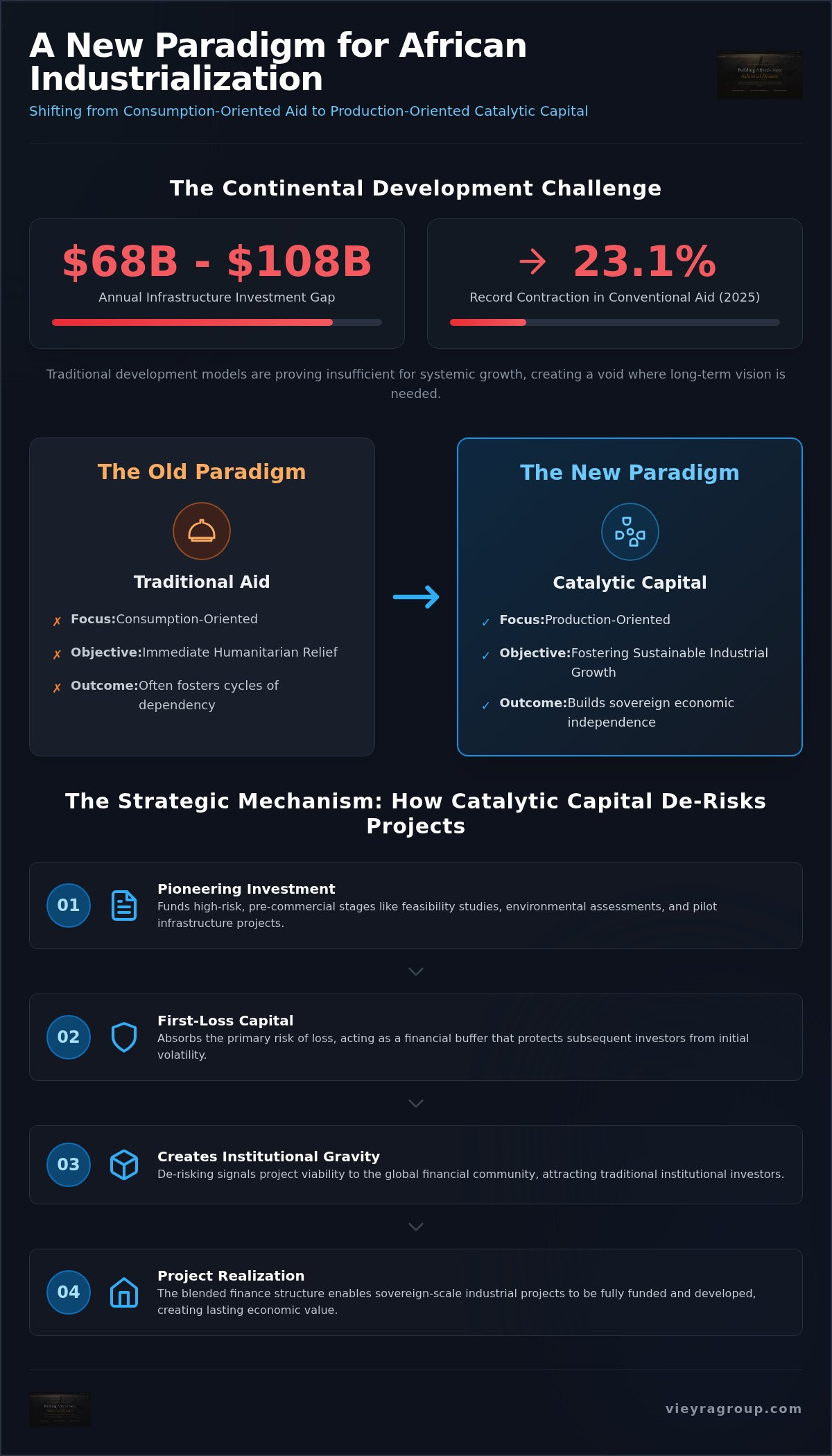
The historical reliance upon conventional official development assistance has proved insufficient for the structural requirements of a continent poised for systemic growth, especially as such aid experienced a record 23.1 percent contraction in 2025. The emergence of sophisticated philanthropic capital for African industrialization represents a pivotal evolution in how global institutions approach the annual infrastructure investment gap, which currently persists between 68 billion and 108 billion dollars. You likely observe that traditional models frequently fail to address the inherent complexities of early-stage industrial projects, leaving a profound void where strategic, long-term vision is most required.
This article provides a comprehensive exploration of how catalytic capital serves as the essential substrate for large-scale economic transformation by absorbing the initial risks that often deter traditional institutional investors. We shall delineate a rigorous framework for the deployment of such resources, illustrating the profound synergy between the multi-generational objectives of the family office and the requirements of sovereign-scale industrial development. By examining specific de-risking mechanisms and the integration of global investment expertise, this discourse illuminates the path toward a future defined by industrial resilience and institutional permanence.
Key Takeaways
- Differentiate between traditional consumption-oriented aid and the strategic deployment of patient, risk-tolerant capital aimed at fostering sustainable industrial growth.
- Explore the operational mechanisms of blended finance wherein philanthropic capital for African industrialization acts as a catalytic substrate to mitigate early-stage project risks.
- Formulate a multi-generational strategy that aligns family office objectives with the broader imperatives of sovereign-scale economic development and industrialization.
- Evaluate the integration of rigorous impact metrics and governance standards into the architecture of large-scale industrial capital allocation.
- Recognize the institutional role of the Vieyra Foundation in bridging the transition from traditional philanthropy to the creation of permanent industrial legacies.
Defining the Paradigm: Philanthropic Capital as a Catalyst for Industrial Transformation
The historical framework of continental engagement has long been characterized by a focus on immediate humanitarian relief. While these efforts address urgent needs, they don't create the structural foundations required for permanent economic transformation. A new paradigm is emerging, one that prioritizes the strategic deployment of philanthropic capital for African industrialization as a means of fostering sovereign-scale development. This approach recognizes that for Industrialisation in Africa to reach its full potential, it requires a specific type of financial substrate that traditional commercial markets are often unable or unwilling to provide.
Catalytic capital is the cornerstone of this evolution. It's defined by its patience and its high tolerance for risk, serving as the essential precursor to commercial investment. Unlike traditional aid, which is often consumption-oriented, catalytic capital is production-oriented. It targets the bankability gap by funding the critical early stages of industrial projects that are perceived as too risky for conventional finance. This non-commercial capital is historically necessary; every major global industrial shift has required a period of pioneering investment that prioritizes systemic impact over immediate returns.
The Shift from Aid to Agency
Traditional philanthropic models in Africa have frequently inadvertently fostered cycles of dependency. The transition toward industrial agency marks a profound shift in objective. It's no longer just about providing resources, but about building the internal capacity for production and innovation. By focusing on industrialization, philanthropic entities support the creation of a self-sustaining economic ecosystem. This deployment of capital isn't merely an act of charity; it's a strategic investment in sovereign-level economic independence. It empowers nations to move up the value chain, transforming raw materials into finished goods and securing a more influential position in the global trade architecture.
Philanthropy as the Substrate of Industry
Philanthropic capital serves as the foundational layer upon which the edifice of industry is built. This involves funding the high-risk activities that precede commercial viability, such as comprehensive feasibility studies, environmental impact assessments, and pilot infrastructure projects. One of the most potent applications of this capital is the first-loss mechanism. By accepting the primary risk of loss, philanthropic funds de-risk the project for secondary, commercial investors. This creates a sense of institutional gravity, signaling to the global financial community that a project is strategically sound and socially aligned. It's this deliberate architecture of risk that allows for the mobilization of the trillions in global institutional assets required for continent-wide transformation.
The Strategic Mechanism: How Catalytic Capital De-risks Sovereign-Scale Projects
Sovereign-scale industrial projects across the continent encounter a unique confluence of risks, ranging from regulatory volatility to the acute "bankability gap" that characterizes early-stage infrastructure. The strategic application of philanthropic capital for African industrialization functions as a sophisticated instrument of financial architecture, designed to insulate these initiatives from the volatility of initial development. By providing a risk-tolerant foundation, this capital enables projects to transcend the barriers that typically deter conventional institutional lenders, thereby transforming speculative ventures into viable investment opportunities.
De-risking Through Blended Finance
Philanthropic capital occupies a critical position within the capital stack, acting as the "first-loss" protection that commercial financiers require before committing their balance sheets. The recent partnership between British International Investment and Africa50, formalized on August 13, 2026, underscores the necessity of mobilizing resources through collaborative frameworks to bridge the infrastructure investment gap. By utilizing grants or concessional loans to fund rigorous feasibility studies and environmental safeguards, philanthropic actors facilitate intentional investment in Africa. This intervention elevates the credit profile of sovereign-scale projects, allowing them to access the favorable lending rates published by the African Development Fund in July 2026. Such strategic stewardship ensures that capital is not merely deployed, but is utilized to catalyze a broader influx of global institutional liquidity.
Building the Human and Technical Infrastructure
Industrialization is not solely a matter of physical assets; it's a complex exercise in institutional and human development. Philanthropic initiatives, exemplified by the Africa Jobs Fund launched on May 27, 2026, demonstrate how targeted capital creates the specialized skillsets required for advanced export manufacturing. This funding supports the research and development necessary to adapt global industrial technologies to regional contexts, ensuring that progress is both sustainable and locally integrated. The long-term return on these investments is found in the resilience of the institutional frameworks they establish, which serve as the permanent scaffolding for economic growth. For family offices seeking to align their multi-generational legacy with these systemic shifts, exploring Strategic Capital Solutions offers a sophisticated pathway to high-impact stewardship. The focus remains on the meticulous cultivation of technical agency, ensuring that African industry possesses the internal capacity to navigate the complexities of the global marketplace.
From Charity to Capability: Shifting Focus Toward Industrial Legacies
The evolution of wealth stewardship requires a fundamental departure from the traditional models of short-term humanitarian relief. While immediate aid addresses the symptoms of economic fragility, it doesn't cultivate the underlying industrial capability necessary for a nation to secure its own future. For High-Net-Worth Individuals and family offices, this transition necessitates a profound psychological pivot from viewing capital as a tool for consumption-based charity to seeing it as a mechanism for production-based agency. The strategic deployment of philanthropic capital for African industrialization represents the highest expression of this shift, focusing on the creation of permanent economic structures rather than temporary solutions.
This sovereign-scale thinking aligns the objectives of private wealth with the broader developmental imperatives of the continent. It moves beyond the limitations of extractive-sector growth, which often leaves little behind for local populations, toward the establishment of an industrial legacy. By architecting sophisticated frameworks for African philanthropy, families can ensure their contributions serve as the bedrock for multi-generational progress. This isn't merely about capital allocation; it's about the deliberate construction of a future where industrial capability is the primary driver of social impact.
Defining Industrial Capability
Industrial capability is distinguished by its focus on manufacturing and value-addition. These sectors provide the most significant multiplier effect on regional employment, creating a diverse range of opportunities from high-tech engineering to floor-level production. Unlike the service sector, which can be volatile and transient, or the extractive sector, which is finite, a robust manufacturing base creates a self-sustaining cycle of innovation and wealth creation. By funding the technical infrastructure and specialized training required for these industries, philanthropic capital builds the internal strength of a nation. It transforms a country from a passive exporter of raw materials into an active participant in the global value chain.
The Role of Multi-Generational Vision
Family offices are uniquely positioned to spearhead this industrial transformation because they operate on a 50-to-100-year horizon. This temporal depth allows for a level of patience that's often absent in public markets or political cycles. When institutional capital is deployed with a vision of permanence, it provides the stability needed for large-scale industrial projects to mature and flourish. This alignment between family legacy and national industrial goals creates a powerful synergy; the family's name becomes synonymous with the nation's progress. Such capital doesn't seek a quick exit. Instead, it seeks to anchor itself in the very fabric of the continent's development, ensuring that the impact of the investment is felt for generations to come.
Architecting the Framework: A Family Office Philanthropic Strategy for the 21st Century
The deployment of philanthropic capital for African industrialization requires more than benevolent intent; it demands a rigorous architectural framework that mirrors the sophistication of global investment management. A multi-generational family office must move beyond ad-hoc contributions toward a codified strategy that prioritizes systemic impact over isolated interventions. This involves the deliberate alignment of private assets with national industrialization goals, ensuring that every dollar serves as a catalyst for broader economic resilience. It's a process that requires the same level of professional rigor applied to a commercial portfolio, blending the traditional values of heritage with a forward-looking commitment to progress.
Pillars of the Strategic Framework
Success in this arena is predicated on a narrow focus on high-multiplier sectors that form the backbone of a modern economy. The framework prioritizes three essential pillars:
- Energy Infrastructure: Establishing the stable baseload power required for heavy manufacturing and industrial processing.
- Value-Added Manufacturing: Facilitating the transition from raw material export to the creation of finished goods within regional borders.
- Regional Logistics: Strengthening the physical and digital corridors that facilitate seamless trade within the African Continental Free Trade Area.
Strategic geographic prioritization is equally essential. By focusing on regional hubs that demonstrate regulatory stability, such as those navigating the 2026 mining code reforms in West Africa, family offices can maximize the efficacy of their catalytic capital. Project selection must be governed by institutional alignment, ensuring that philanthropic initiatives complement sovereign-scale development plans rather than operating in a vacuum. This disciplined approach minimizes duplication of effort and ensures that capital is deployed where it can achieve the greatest structural impact.
Governance and Multi-Generational Stewardship
High-stakes philanthropy requires robust governance structures that protect the family's legacy while ensuring operational excellence. The family council acts as the supreme guardian of this vision, overseeing the integration of sophisticated ESG metrics and impact benchmarks into the capital allocation process. These metrics must go beyond superficial reporting, utilizing quantitative data to measure the long-term industrial capacity created. Transparency isn't merely a compliance requirement; it's a mark of intellectual sophistication that builds trust with sovereign wealth funds and global development finance institutions.
As the industrial landscape matures, the strategy must evolve, shifting focus from initial de-risking to the support of advanced technological ecosystems. To begin architecting your institutional legacy, explore Strategic Capital Solutions that align multi-generational wealth with the continent's industrial future. This disciplined approach ensures that the family office remains a significant global actor, shaping the trajectory of African progress for decades to come. It's about building an institution that survives the individuals who founded it, rooted in the permanence of industrial achievement.
The Vieyra Foundation: Integrating Generational Stewardship with Industrial Progress
The Vieyra Foundation serves as the institutional guardian for this visionary framework, operating at the precise intersection of multi-generational heritage and industrial progress. It represents the formalization of stewardship; here, the preservation of family legacy is inextricably linked to the continent's structural economic trajectory. By deploying philanthropic capital for African industrialization, the Foundation provides the catalytic substrate required to move beyond the limitations of traditional aid. It functions as a sovereign-scale actor, ensuring that private wealth serves the public good through the lens of industrial agency and institutional permanence.
Strategic Initiatives of the Foundation
The Foundation's initiatives are distinguished by their scale and strategic depth. It avoids isolated social programs, prioritizing instead large-scale economic development projects that possess the potential to transform entire regional ecosystems. This involves a collaborative approach with global and regional partners, mirroring the institutional rigor seen in the August 2026 partnership between British International Investment and Africa50. By accepting the primary risks associated with pioneering industrial infrastructure, the Foundation bridges the gap between global institutional capital and African progress. This commitment ensures that resources aren't merely spent; they're invested in the creation of permanent industrial assets that anchor a nation's future.
The Future of African Industrialization
Looking toward the horizon, the strategic deployment of capital aims to mitigate the volatility reflected in the World Bank’s 2026 economic growth projections of 4.1 percent. While median inflation and external debt service present significant challenges to liquidity, a robust industrial base provides the necessary resilience to navigate these macroeconomic pressures. The vision is one of a self-sustaining, industrialized Africa where the bankability gap has been bridged through institutional foresight and strategic de-risking. This excellence in execution ensures that the continent's domestic assets, which currently exceed 4 trillion dollars, can be effectively mobilized for long-term growth.
As the architect of this industrial legacy, the Vieyra Family Office remains committed to the highest standards of professional rigor and intellectual sophistication. It's a journey defined by the belief that industrialization is the highest form of social impact. To understand more about this vision, Explore the Vieyra Family Office global investment strategy. This disciplined approach ensures that the family office remains a significant global actor, shaping the trajectory of African progress for decades to come.
Architecting a Permanent Industrial Legacy
The transition from traditional humanitarian assistance to the strategic deployment of philanthropic capital for African industrialization marks a definitive era in continental development. This catalytic substrate doesn't merely provide temporary relief; it actively de-risks sovereign-scale projects, allowing them to bridge the bankability gap and attract global institutional liquidity. By prioritizing manufacturing and value-addition, family offices move beyond transient charity toward the creation of permanent economic agency. This shift requires a rigorous framework of governance and a multi-generational perspective that aligns private stewardship with national industrialization goals.
The Vieyra Family Office remains dedicated to this vision, leveraging its heritage to architect large-scale transformation. Our focus on sovereign-scale capital deployment ensures that progress is both systemic and sustainable, rooted in the stability of institutional excellence. We invite you to Discover the Institutional Vision of the Vieyra Family Office and explore how strategic capital solutions are shaping the continent's trajectory. The path toward a self-sustaining, industrialized Africa is within reach for those who operate with the foresight of a visionary architect.
Frequently Asked Questions
What is the difference between philanthropic capital and traditional investment?
Philanthropic capital prioritizes systemic transformation and long-term capability building over immediate risk-adjusted financial returns. Unlike traditional investment, which operates within strict commercial parameters, this capital is patient and exceptionally risk-tolerant. It serves to address the bankability gap by funding early-stage project preparation. This foundational support allows industrial initiatives to mature until they meet the rigorous criteria of global institutional lenders and sovereign wealth funds.
How does a family office philanthropic strategy differ from corporate social responsibility?
A family office strategy is characterized by multi-generational stewardship and a vision that spans decades. While corporate social responsibility often focuses on short-term reputational gains or localized social projects, family office philanthropy seeks to architect permanent industrial legacies. It aligns private wealth with sovereign-scale economic goals. This creates a deep integration between the family’s heritage and the nation’s long-term industrial resilience and agency.
Can philanthropic capital be used to fund industrial infrastructure in Africa?
Philanthropic capital is an ideal vehicle for funding the high-risk, early-stage infrastructure that precedes commercial viability. It targets critical gaps in energy, logistics, and manufacturing corridors that traditional financiers often avoid. By providing the initial substrate for these projects, it enables the development of physical assets that anchor regional trade. This strategic use of philanthropic capital for African industrialization facilitates the creation of self-sustaining economic ecosystems.
What is the role of catalytic capital in de-risking sovereign-scale projects?
Catalytic capital functions as a risk-absorber that improves the credit profile of large-scale industrial initiatives. It often takes a first-loss position, protecting secondary commercial investors from the volatility of initial development phases. This intervention is essential for bridging the substantial annual infrastructure gap that persists across the continent. By stabilizing the project’s financial architecture, it signals institutional gravity and attracts larger pools of global institutional liquidity.
How does the Vieyra Foundation measure the success of its industrial initiatives?
The Foundation utilizes sophisticated impact metrics that evaluate the long-term industrial capacity and technical agency created by its deployments. Success isn't measured by disbursement volume, but by the structural resilience of the resulting industrial frameworks. Key indicators include the mobilization of secondary institutional capital and the growth of value-added manufacturing within regional borders. These rigorous benchmarks ensure that every initiative contributes to a permanent, multi-generational economic legacy.
Why is industrialization the focus of the Vieyra Family Office's philanthropic strategy?
Industrialization is recognized as the highest form of social impact due to its immense multiplier effect on regional employment and economic agency. It provides the structural foundation required for sovereign-scale independence and sustainable wealth creation. By focusing on production rather than consumption, the office ensures its contributions build the internal strength of the continent. This focus aligns with a multi-generational commitment to fostering permanent progress across African markets.
How can global institutions partner with African family offices for industrial growth?
Global institutions can leverage the local heritage and strategic depth of African family offices through blended finance frameworks. These partnerships combine the technical expertise of international development finance institutions with the patient, catalytic capital of the family office. Such collaboration is essential for navigating regional regulatory landscapes and identifying high-impact opportunities. Together, they create a robust investment pipeline that supports the continent’s long-term industrial trajectory and development.
What are the primary risks associated with philanthropic capital in African industry?
The primary risks involve regulatory volatility and the potential for capital misallocation in projects lacking institutional rigor. Strategic deployment of philanthropic capital for African industrialization requires meticulous project selection to ensure alignment with sovereign development goals. Without robust governance, there's a risk of creating temporary solutions rather than permanent industrial capability. The Foundation mitigates these risks through disciplined stewardship and a focus on high-multiplier sectors like energy and logistics.


