
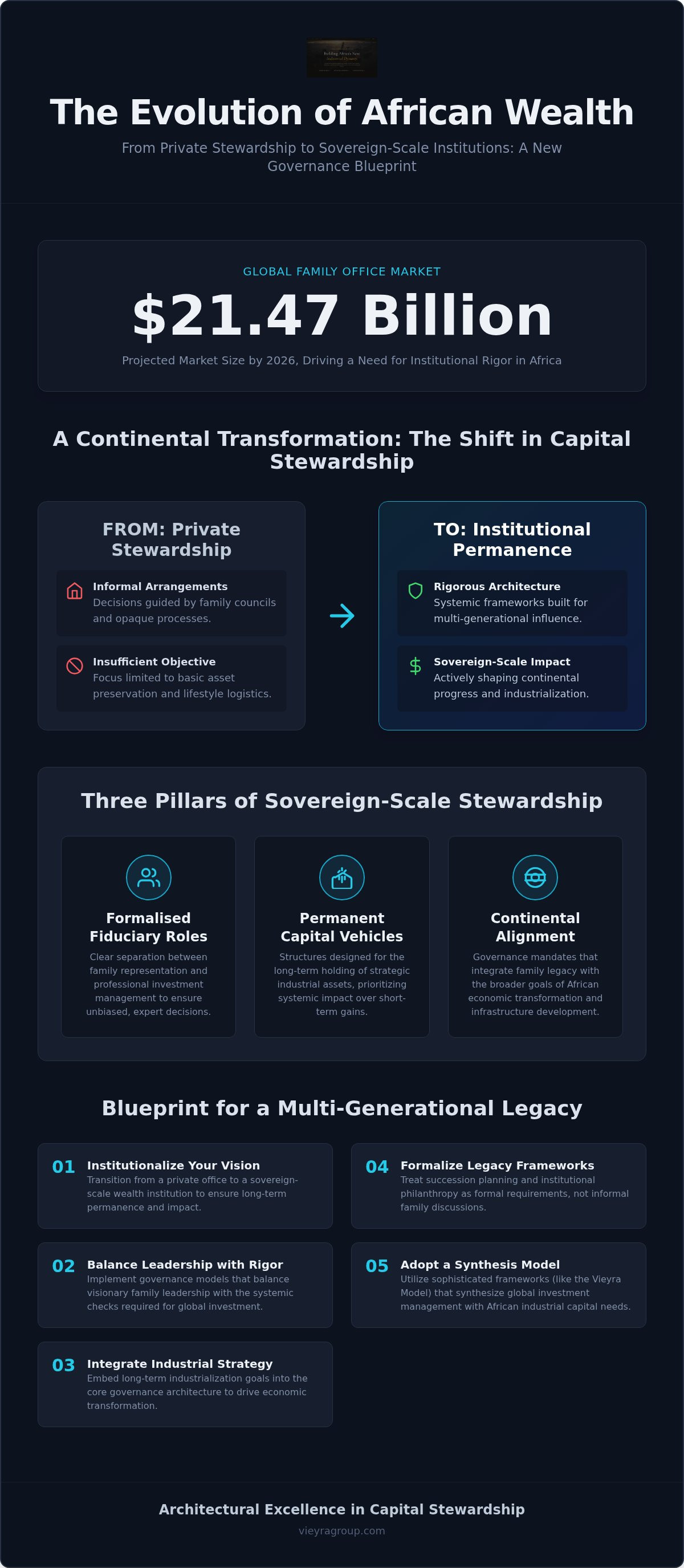
In the current epoch of continental transformation, the mere preservation of wealth has become an insufficient objective for the African industrial elite. While the global family office market is estimated at 21.47 billion USD in 2026, the true measure of success for the continent’s leading dynasties lies in the transition from private stewardship to institutional permanence. You likely recognize that as the African Continental Free Trade Area reaches full implementation this year, the complexity of managing sovereign-scale capital requires a departure from informal arrangements toward rigorous, systemic architectures. This article provides a sophisticated exploration of the family office governance models Africa requires to bridge the gap between traditional family values and global investment rigor. We shall examine the fiduciary frameworks necessary to manage large-scale industrial projects, the implications of the 2026 tax reforms in jurisdictions such as Benin and Nigeria, and the strategic role of the Vieyra Foundation in preserving multi-generational influence. By establishing these robust institutional foundations, families can ensure their legacies act as catalysts for continental progress while maintaining the stability required for centuries of impact.
Key Takeaways
- Define the transition from private stewardship to the status of a sovereign-scale wealth institution to ensure long-term institutional permanence.
- Evaluate the specific family office governance models Africa utilizes to balance visionary leadership with the systemic checks required for global investment rigor.
- Integrate long-term industrialization strategies into the core governance architecture to facilitate large-scale economic transformation and infrastructure development.
- Establish multi-generational legacy frameworks that treat succession and institutional philanthropy as formal requirements rather than informal family discussions.
- Adopt the principles of the Vieyra Model to achieve a sophisticated synthesis between global investment management and the requirements of African industrialisation capital.
Defining Governance Within the African Institutional Context
The emergence of the African wealth institution represents a profound shift in the architecture of continental capital stewardship. It's no longer sufficient for the continent's leading families to operate through informal councils or opaque decision-making processes. Instead, the management of sovereign-scale capital requires a transition toward the status of a strategic investment institution. This distinction is critical. While administrative family offices often focus on lifestyle logistics and basic asset preservation, a strategic institution functions as a visionary architect of industrial progress. African institutional governance is the synthesis of multi-generational stewardship and global investment rigor. By adopting the sophisticated family office governance models Africa requires in 2026, these entities can navigate the complexities of large-scale industrialisation with the poise of an established global actor.
The Evolution of the African Wealth Institution
The transition from founder-led enterprises to multi-generational institutional structures is a hallmark of the current economic era. Founders who built industrial empires across the continent are now codifying their vision into permanent architectures that outlast any single individual. This evolution doesn't just preserve capital; it bridges local heritage with the exacting standards of global markets. As the African Continental Free Trade Area reaches full implementation in 2026, these institutions are redefining sovereign-scale capital deployment. They're moving beyond passive investment into active roles that shape infrastructure and energy sectors. It's a move toward institutional permanence that ensures the family's influence remains a stabilizing force in the regional economy for centuries.
Foundational Pillars of Sovereign-Scale Stewardship
A permanent capital mindset serves as the primary pillar of this new governance framework. It's an approach that prioritizes long-term systemic impact over the ephemeral gains of the fiscal quarter. To achieve this, families must establish formalized structures that separate the emotional dynamics of the household from the fiduciary requirements of the investment office. Fiduciary duty becomes the cornerstone of all operations. This alignment of institutional values with continental economic development creates a resilient framework for wealth preservation. Key components of this stewardship include:
- Formalised Fiduciary Roles: Clear separation between family representation and professional investment management.
- Permanent Capital Vehicles: Structures designed for the long-term holding of strategic industrial assets.
- Continental Alignment: Governance mandates that integrate family legacy with the broader goals of African economic transformation.
By implementing these pillars, the modern African family office operates with the deliberation and foresight of a sovereign entity. This ensures that the deployment of strategic capital solutions remains consistent with the family's multi-generational vision while adhering to the highest levels of professional rigor. It's through these robust family office governance models Africa will secure its position in the global financial hierarchy.
Core Governance Models for African Family Offices
The selection of a governance architecture is a strategic decision that determines the longevity of a family's industrial influence and the security of its sovereign-scale capital. Within the current landscape, the most effective family office governance models Africa utilizes are those that align a family’s unique history with the rigorous requirements of global capital markets. Selection criteria typically hinge upon the complexity of the asset base and the specific nature of the family's industrial focus. For entities managing concentrated positions in critical infrastructure or minerals, the governance must facilitate rapid capital deployment while ensuring multi-generational oversight remains uncompromised.
The Institutionalised Founder Model
This framework is tailored for first-generation wealth creators who seek to preserve their entrepreneurial dynamism while establishing a foundation for institutional permanence. It formalizes the transition from personal influence to systemic authority by introducing professional boards that act as a vital check on individual decision-making. Risk mitigation strategies within this model include the implementation of rigorous due diligence protocols and the use of independent advisors to validate visionary investment theses. By embedding the founder's intent into a formal constitution, the institution ensures that the initial strategic spark remains protected by a layer of professional stewardship that can survive the transition to the second generation.
The Sovereign-Partner and Industrial Framework
As African families increasingly engage in projects of national significance, the Sovereign-Partner Framework has emerged as a vital architecture for co-investment with state actors. This model is specifically designed to support large-scale industrialization projects that require long-term horizons and significant regulatory alignment. It necessitates a high degree of transparency and sophisticated reporting standards to satisfy the requirements of sovereign-level partnerships. A critical component is the establishment of an independent investment committee, which provides the objective analysis needed for multi-sector portfolios spanning energy, logistics, and mining. Families seeking to navigate these complex partnerships often find that strategic capital solutions provide the necessary institutional weight to engage effectively with global stakeholders and sovereign entities.
The Multi-Generational Council serves as an alternative archetype, prioritizing the distribution of decision-making authority across various branches of the family. This model ensures that the institution remains resilient during generational transitions by codifying fiduciary roles and responsibilities within a formal framework. It moves the conversation from the dinner table to the boardroom, ensuring that the preservation of multi-generational influence is managed with the same professional rigor as the underlying industrial assets. Choosing between these family office governance models Africa offers requires a deep understanding of the family’s long-term trajectory and its commitment to continental progress.
Navigating the Complexity of Sovereign-Scale Industrialisation
The deployment of capital at a sovereign scale demands a fundamental recalibration of how industrial strategy is woven into the institutional fabric. In 2026, the complexity of the continental market means that the family office governance models Africa utilizes must transcend traditional oversight. They must become active engines of economic transformation. This requires a governance framework that doesn't just monitor performance but actively manages the intersection of private wealth and public-scale infrastructure. Accountability in this context isn't merely a matter of financial reporting; it's a commitment to the long-term viability of the African industrial landscape. By integrating these strategies into the core governance architecture, families can ensure their influence remains a stabilizing force across multiple industrial sectors.
Strategic Capital Allocation and Oversight
Effective oversight begins with the establishment of rigorous benchmarks that reflect the unique realities of the African industrial sector. It's a delicate balance where global investment management expertise meets the specific requirements of local projects. By fostering institutional expertise in industrial finance, family offices can ensure that their African industrialisation capital is deployed with precision. This oversight mechanism allows for the continuous evaluation of project performance against both financial targets and broader developmental goals. It ensures that every dollar allocated serves the dual purpose of wealth preservation and systemic progress, moving beyond passive asset management toward active industrial stewardship.
Risk Management in Large-Scale African Projects
Large-scale industrial investments often span decades, exposing capital to significant geopolitical and regulatory shifts. With Africa's GDP growth projected between 4.0% and 4.3% in 2026, the opportunities are vast, but the risks remain complex. Robust governance protocols act as a safeguard during these long cycles, providing the stability required to see projects through to completion. In the context of the AfCFTA's full implementation in 2026, the ability to navigate cross-border regulatory environments is paramount. Independent advisory boards play a critical role here, offering the objective risk assessment necessary for sovereign-scale initiatives. They provide a layer of scrutiny that protects the family's multi-generational interests from the inherent risks of multi-sector industrial portfolios.
Strategic capital solutions are the result of this disciplined approach. They provide the flexibility to respond to emerging opportunities while maintaining the steady, methodical pace required for industrial success. By prioritizing risk management within the governance structure, the modern African wealth institution secures its legacy as a visionary architect of the continent's future. It's a poised and deliberate stance that reflects a deep understanding of the scale and responsibility of sovereign-level capital stewardship. Through these refined family office governance models Africa can achieve a level of industrial resilience that was previously the sole domain of state entities.
Implementing a Multi-Generational Legacy Framework
Within the architecture of the African wealth institution, succession planning is no longer a private family dialogue; it's a mandatory institutional requirement. For entities managing assets at a sovereign scale, the transition of leadership must be as methodical as the deployment of capital itself. Data suggests that only 5% to 10% of African families utilize viable legacy plans, a statistic that highlights a significant risk to continental stability. To mitigate this, the family office governance models Africa adopts in 2026 must move beyond simple inheritance toward a framework of institutional permanence. This involves the rigorous education of the next generation, ensuring they possess the intellectual depth to oversee complex industrial portfolios and global investment strategies with the same poise as their predecessors.
Institutional Philanthropy and Social Impact
The Vieyra Foundation serves as a benchmark for how philanthropic missions should be integrated into the core governance architecture. It's not an adjunct activity; it's a strategic pillar that aligns social impact with the long-term investment horizon of the family office. By formalising the governance of philanthropic capital, families ensure that their contributions achieve systemic efficacy rather than fragmented results. This model allows the institution to measure impact with the same precision applied to industrial project performance. It creates a feedback loop where the preservation of legacy is directly linked to the progress of the African communities in which the family operates. Stewardship of this nature requires a deep commitment to transparency and a clear understanding of the institution's role as a global actor.
Succession and the Architecture of Permanence
Formalising leadership transitions is the ultimate test of an institution's gravity. A family constitution acts as the foundational document, codifying the values and decision-making processes that will guide the office through the coming centuries. It's essential to balance multi-generational participation with the rigor of professional management. While family members provide the visionary direction, the day-to-day operations of sovereign-scale projects require specialized expertise. This separation of roles ensures that the institution remains resilient during times of transition. By establishing these structures early, families can avoid the fragility that often accompanies generational shifts. You can explore the Strategic Capital Solutions that support these complex institutional transitions and ensure the continuity of your industrial legacy.
Educating future stewards is a continuous process that begins long before a formal handover. It involves immersion in the realms of high finance, geopolitics, and large-scale industrial development. The goal is to produce leaders who are not merely heirs, but visionary architects capable of navigating the complexities of a globalized economy. When the governance framework treats education as a core institutional function, it secures the multi-generational influence of the family. This disciplined approach to legacy preservation is what distinguishes a mere investment office from a true African wealth institution. It's a commitment to a trajectory that spans generations, rooted in the traditional values of heritage and a forward-looking commitment to progress.
The Vieyra Model: Architectural Excellence in Capital Stewardship
The Vieyra Model represents the pinnacle of institutional evolution within the continent, serving as a definitive archetype for the sophisticated family office governance models Africa requires to manage capital at a sovereign scale. It is an architecture defined by the seamless synthesis of global investment management expertise and a resolute commitment to African industrialisation. By operating with the deliberation of a stately guardian, the office ensures that every strategic initiative contributes to a multi-generational legacy while fostering systemic economic progress. This approach moves beyond the traditional boundaries of private wealth management, positioning the institution as a central actor in the next era of continental transformation. The model functions as a visionary architect, blending the traditional values of heritage with a forward-looking commitment to large-scale progress.
The Architecture of Sovereign-Scale Investment
The framework for capital allocation within the Vieyra model is predicated on a permanent capital mindset that prioritises long-term growth projects over short-term volatility. This institutional oversight is exemplified by the commitment of 480 million USD to the refining and recycling of critical minerals at their source, a move that aligns strategic capital with the broader objectives of African industrialisation. Maintaining institutional composure in a fluctuating global market requires a governance structure that is deeply rooted in professional rigor and intellectual depth. The oversight mechanisms ensure that all initiatives, from infrastructure development to global equity portfolios, are managed with the precision and foresight of a sovereign entity. This commitment to structural excellence provides a stable foundation for economic development across the diverse jurisdictions of the continent.
Engaging with a Global African Institution
Transitioning toward the institutionalisation of a family’s industrial and financial legacy is a process that requires both vision and a disciplined adherence to formal fiduciary roles. Partnering with a global African institution allows for the preservation of multi-generational influence through the implementation of robust governance architectures and strategic capital solutions. The path toward this level of stewardship involves the integration of the Vieyra Foundation as a core component of the governance framework, ensuring that philanthropic impact and investment rigor are mutually reinforcing. As the continent enters a period of accelerated growth, with GDP projections reaching 4.3% in 2026, the need for architectural excellence in wealth preservation has never been more critical. We invite you to Discover the Architecture of Multi-generational Wealth with Vieyra Family Office and establish the foundations for an enduring industrial legacy.
The rhythm of this institutional engagement is measured and methodical, reflecting a deep understanding of the long-term nature of sovereign-scale objectives. It is a partnership designed for families who view their wealth not merely as a private resource, but as a significant global actor capable of driving continental change. By adopting this model, the modern African wealth institution secures its trajectory, ensuring that its influence remains certain and its legacy remains permanent in an ever-evolving geopolitical landscape. This synthesis of heritage and progress is the hallmark of the Vieyra approach to capital stewardship.
Architecting the Future of African Institutional Capital
The maturation of the African industrial landscape necessitates a departure from the informal stewardship of the past toward the rigorous institutional frameworks of the future. As we've explored, the transition to a sovereign-scale entity requires a sophisticated synthesis of global investment rigor and local industrial impact. By adopting the most resilient family office governance models Africa offers, families can secure their legacies against institutional fragility during generational transitions. These architectures ensure that fiduciary roles remain clear and that capital allocation remains aligned with long-term continental transformation.
Vieyra Family Office stands as a stately guardian of this vision, blending a multi-generational African heritage with sovereign-scale institutional expertise. The integration of the Vieyra Foundation ensures that social impact remains a formal pillar of the governance structure. It's through this proven architecture for industrial capital allocation that multi-generational influence is truly preserved. We invite you to Explore the Vieyra Approach to Global Stewardship and Industrialisation to begin the process of institutionalising your family’s influence. Establishing these foundations today ensures that your legacy remains a permanent and visionary force for centuries to come.
Frequently Asked Questions
What distinguishes an African wealth institution from a traditional family office?
An African wealth institution is defined by its operation at a sovereign scale and its focus on industrial transformation rather than mere lifestyle management. While traditional family offices often prioritize administrative convenience, these institutions function as strategic actors in the global financial landscape. They employ the sophisticated family office governance models Africa requires to bridge the gap between multi-generational heritage and the rigorous demands of large-scale industrialization projects across the continent.
How does sovereign-scale governance impact industrialisation projects in Africa?
Sovereign-scale governance provides the institutional stability necessary to manage long-cycle industrial investments. By implementing formal oversight and independent advisory boards, these frameworks mitigate the geopolitical and regulatory risks inherent in large-scale infrastructure and energy projects. This level of professional rigor ensures that capital allocation remains consistent with national development goals while protecting multi-generational interests and maintaining steady progress during periods of regional economic transformation.
What are the primary challenges in African family office governance for 2026?
The primary challenges include navigating increased regulatory scrutiny and the transition from treaty-based planning to evidence-based economic substance. In 2026, families must also manage the complexities of the African Continental Free Trade Area implementation. These shifts require longer lead times for banking onboarding and higher costs for restructuring legacy entities, making the formalization of family office governance models Africa utilizes an immediate institutional priority for sustaining influence.
How can multi-generational families integrate philanthropy into their governance model?
Families can integrate philanthropy by establishing formal entities such as the Vieyra Foundation as strategic pillars within their governance architecture. This approach ensures that social impact is measured with the same precision as industrial investment performance. By codifying philanthropic missions in the family constitution, stewardship becomes a collective responsibility that aligns the family legacy with the broader progress of the African communities in which the institution operates.
What role do independent investment committees play in African institutional governance?
Independent investment committees provide the objective analysis required to manage multi-sector industrial portfolios spanning energy, logistics, and mining. They act as a vital check on visionary leadership, ensuring that every capital allocation decision meets rigorous global investment standards. This separation of family influence from technical fiduciary duty is essential for maintaining institutional composure and securing the long-term viability of capital deployed at a sovereign scale.
How does the Vieyra Family Office approach the management of global assets?
The Vieyra Family Office manages global assets through a synthesis of sophisticated investment management and a permanent capital mindset. The approach involves direct, concentrated investments in strategic assets that support continental industrialization. By operating as a stately guardian, the office ensures that global portfolios provide the liquidity and stability required to fund large-scale projects, thereby maintaining a trajectory of multi-generational growth and global impact.
Is a founder-centric model sustainable for sovereign-scale industrial investment?
A founder-centric model is sustainable only if it evolves into an institutionalised framework. While the initial entrepreneurial spirit is vital, the scale of industrial investment in 2026 requires systemic authority that transcends any single individual. By introducing professional boards and formalised fiduciary roles, the institution preserves the founder's vision while implementing the rigorous oversight necessary to manage sovereign-level partnerships and ensure continuity across multiple generations of stewards.
What are the essential components of a robust African family constitution?
A robust constitution must include clearly defined fiduciary roles, decision-making protocols for industrial capital, and a comprehensive multi-generational legacy framework. It should also incorporate the family's philanthropic mission and educational mandates for future stewards. These components transform the family office into a resilient wealth institution, providing the architectural clarity needed to manage sovereign-scale influence and maintain institutional gravity throughout the coming centuries.


