
True permanence in the theatre of global finance is not found in the mere preservation of liquid assets, but in the deliberate architecture of industrial systems that outlive their creators by centuries. For the stewards of sovereign-scale capital, the primary challenge remains the inherent fragility of wealth when it is divorced from a coherent, long-term purpose. You likely recognize that without a robust institutional framework, the transition of influence across generations often results in the gradual erosion of both financial power and strategic relevance. This article delineates the governance and operational structures required to implement a sophisticated multi-generational global investment strategy that transcends simple market participation.
By integrating global portfolio diversification with high-impact industrial projects across the African continent, institutions can move beyond the limitations of traditional asset management. We will examine how a structured approach to capital deployment allows for the balancing of regional growth with global stability, ensuring that legacy is not merely a memory but a functioning engine of systemic progress. Through this lens, we explore the mechanisms of the Vieyra Model, providing a roadmap for those who seek to transform private success into a sustainable, sovereign-level heritage.
Key Takeaways
- Define the philosophical transition from private wealth management to sovereign-level stewardship necessary for enduring institutional stability.
- Understand the mechanics of balancing liquid global market positions with high-conviction industrial assets to achieve multi-generational resilience.
- Identify the strategic role of African industrialization as a critical frontier for driving systemic growth and securing long-term alpha.
- Implement a governance architecture that facilitates a cohesive multi-generational global investment strategy while successfully navigating the complexities of succession.
- Align institutional objectives with global progress through the integration of strategic capital solutions and the Vieyra Foundation.
The Ethos of Institutional Stewardship in Multi-generational Wealth
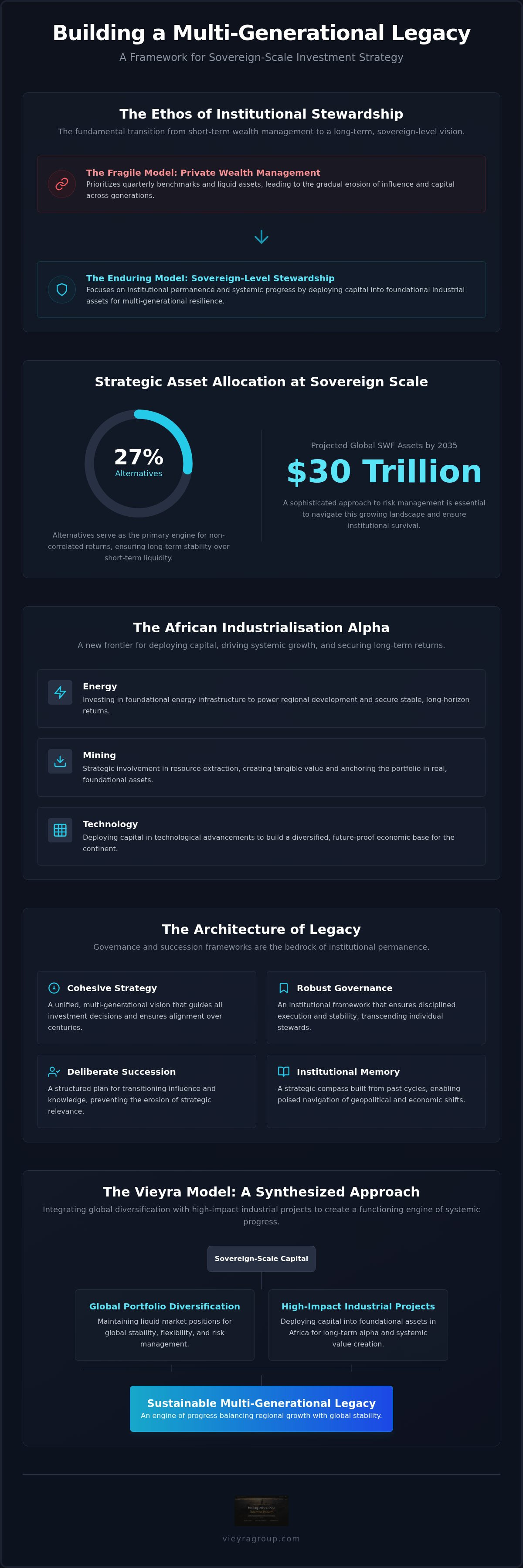
The transition from private wealth management to sovereign-scale stewardship requires a fundamental re-evaluation of the relationship between capital and time. Traditional asset management often fails because it prioritizes quarterly benchmarks over the preservation of systemic influence. For the visionary architect, a multi-generational global investment strategy isn't a mere collection of assets; it's a vehicle for institutional permanence. This shift moves away from passive accumulation toward the deliberate deployment of capital that mirrors the operational depth and strategic foresight of a Sovereign Wealth Fund (SWF).
By adopting this posture, an entity generates a unique form of institutional gravity. This isn't about marketing or hype. It's about the quiet confidence of an actor capable of participating in multi-decade industrial projects. Global partners, from sovereign states to multinational conglomerates, seek out such stability. They recognize that capital committed for a century is fundamentally different from capital seeking an exit in five years. This gravity allows an institution to access opportunities that remain invisible to those operating on shorter horizons.
The Concept of Sovereign-Scale Capital
Sovereign-scale capital operates with a deliberation that transcends the typical family office. It recognizes that a legacy is inextricably linked to the economic health of the regions it inhabits. Rather than maintaining a passive portfolio, this approach requires active strategic involvement in foundational industries like energy, mining, and technology. It's the point where family heritage meets national economic development. This creates a symbiotic relationship that protects wealth through the creation of tangible, systemic value. When capital is viewed as a tool for industrialization, it gains a layer of protection that financial markets alone cannot provide.
Permanence as a Strategic Advantage
In an increasingly fragmented global market, the ability to maintain a composed, long-term outlook provides a distinct stability premium. Multi-generational institutions don't panic during cycles of volatility. They absorb them. This permanence allows for the acquisition of high-value assets and the funding of infrastructure that requires years of gestation before yielding returns. A multi-generational global investment strategy relies on this patience to secure foundational assets that anchor a portfolio. Institutional memory serves as a strategic compass. It allows stewards to navigate geopolitical shifts with the poise of an entity that's seen such cycles before and remains certain of its trajectory. By valuing stability over speed, the institution ensures its influence remains constant across generations.
Strategic Asset Allocation: Navigating Global Markets at Sovereign Scale
The construction of a portfolio at sovereign scale requires a departure from traditional diversification models that focus solely on public equities and fixed income. A robust multi-generational global investment strategy demands an architecture that synthesizes liquid market positions with high-conviction, illiquid industrial assets. This balance ensures that the institution remains resilient against the fiscal pressures and geopolitical uncertainties of the 2026 economic environment. During this period, global sovereign wealth fund assets are projected to continue their ascent toward a $30 trillion valuation by 2035, necessitating a more sophisticated approach to risk management. It's a matter of institutional survival.
Effective Portfolio Management for Institutional Investors necessitates a framework where alternatives, which now represent an average of 27% of sovereign-level portfolios, serve as the primary engine for non-correlated returns. By prioritizing assets that offer long-term stability over short-term liquidity, an institution can absorb the shocks of market volatility without compromising its core mission. Success isn't measured in quarters, but in decades.
Diversified Global Asset Management
Capturing divergent growth cycles involves a methodical allocation across established markets and high-growth emerging economies. In the current landscape, this includes a pivot toward the physical infrastructure underpinning artificial intelligence, such as data centers, semiconductors, and power generation. By utilizing global capital to anchor these regional industrial breakthroughs, the institution creates a self-reinforcing cycle of stability and growth. Infrastructure and real assets don't just provide inflationary hedges; they act as the bedrock of a legacy that remains relevant regardless of shifting market sentiments. This approach ensures the portfolio is positioned to benefit from the shifting centers of global economic gravity.
The Mechanism of Strategic Capital Allocation
Deployment decisions at this scale are governed by a commitment to systemic impact rather than immediate, fleeting yields. The process involves institutional-grade due diligence that evaluates how a private market entry strengthens the overall ecosystem of the portfolio. It's about identifying foundational assets in mining, energy, and technology that offer long-term resilience and align with the institution's values. This rigorous approach to global investment management ensures that every capital commitment is a deliberate step toward long-term prosperity. By focusing on production-led strategies and regional value chains, the institution transforms capital into a tool for enduring industrial influence.
The African Industrialisation Alpha: A New Frontier for Global Capital
While traditional Western markets offer liquidity, the pursuit of enduring industrial influence increasingly points toward the African continent. The shift from extractive models to production-led strategies represents a fundamental realignment of global capital. In 2025, Africa attracted approximately $70 billion in foreign direct investment, yet the deployment of African Industrialization Capital remains concentrated in a few deep, institutionally trusted markets. For the sovereign-scale institution, this concentration creates an opportunity to architect foundational systems that drive systemic growth. A robust multi-generational global investment strategy views this not as a speculative venture, but as the construction of a new industrial frontier.
Mitigating the perceived risks of such large-scale deployments requires more than just capital; it demands an institutional presence rooted in local expertise. By maintaining a physical and strategic presence within these markets, an entity can navigate the complexities of regional integration and geopolitical shifts with the poise of an established actor. This grounded approach allows for the identification of sovereign-level initiatives that are poised for long-term economic transformation, ensuring that capital is deployed where it can have the most profound systemic impact.
Financing Large-Scale Industrial Projects
Strategic capital plays a decisive role in closing the continent's infrastructure gap, specifically through projects that facilitate regional trade and power generation. By partnering with sovereign entities, an institution can support the development of trade corridors and industrial platforms that align with the African Continental Free Trade Area (AfCFTA). These aren't short-term trades. They're multi-decade commitments to physical assets that create tangible value. Examples include the development of local processing facilities and value-addition centers that transform raw materials into finished goods before they leave the continent. This methodical approach to Strategic Capital Solutions ensures that the institution's legacy is built on the bedrock of regional progress.
Economic Transformation as a Wealth Pillar
The link between industrialisation and urbanization is a primary driver of capital appreciation across the continent. As industrial platforms expand, they catalyze the growth of surrounding urban centers, creating a self-reinforcing cycle of economic activity. This systemic transformation serves as a wealth pillar that's largely insulated from the volatility of global financial markets. From the Vieyra perspective, economic stewardship involves the deliberate alignment of capital with these transformative forces. It's about recognizing that the continent's share of global FDI, which reached 6% in 2024, is merely the beginning of a larger trajectory. By focusing on production-led investment, the institution secures a position at the heart of the 21st century's most significant growth story. This isn't merely about returns; it's about the permanence of an industrial legacy that spans generations.
The Architecture of Legacy: Governance and Succession Frameworks
The preservation of institutional influence across a century requires more than financial acumen; it necessitates a governance architecture capable of surviving the transition from the founding visionaries to the third generation and beyond. Most family structures falter not through market failure, but through the dilution of purpose. A robust multi-generational global investment strategy must be anchored by an institutional board that mirrors the complexity of a sovereign entity, blending family heritage with external global expertise. This framework ensures that the institution's trajectory remains certain even as individual leadership roles undergo natural succession. It's a matter of building a structure that outlasts its architects.
Establishing a family council provides a forum for the deliberate education of the next generation. These future stewards must be prepared to manage capital at a sovereign scale, understanding the intricate interplay between geopolitics, industrialization, and long-term stability. By treating succession as an ongoing strategic process rather than a singular event, the institution maintains its institutional memory and strategic depth. This ensures that the core values of the entity aren't lost in the transition of power.
Multi-generational Governance Principles
A formal constitution serves as the bedrock of this architecture, balancing the needs of individual participants with the overarching goals of the institution. The Family Office acts as the guardian of this alignment, ensuring that every deployment of capital adheres to the established ethos of permanence. Succession planning for key leadership roles within a sovereign-scale entity requires a rigorous, meritocratic approach that prioritizes the institution's mission over individual preference.
- Institutional Boards: Integrating non-family directors with deep expertise in high finance and geopolitics to provide objective oversight and strategic breadth.
- Strategic Alignment: Using the Family Office to centralize decision-making and maintain a cohesive vision across a diversified global portfolio.
- Leadership Continuity: Developing clear protocols for succession that prioritize professional rigor and a commitment to the institution's long-term mission.
Philanthropy as a Strategic Extension
The integration of the Vieyra Foundation within the broader institutional framework allows for the alignment of philanthropic initiatives with the mission of African industrialization. This isn't merely a matter of social responsibility; it's a tool for multi-generational cohesion and purpose. By engaging the next generation in the work of the foundation, the institution instills a sense of stewardship that transcends financial returns. Measuring the systemic impact of these initiatives ensures that the foundation's work contributes to the stability and progress of the regions where the institution operates. This synergy between investment and giving reinforces the institution's identity as a visionary architect of legacy. To begin structuring your own institutional framework, explore our Strategic Capital Solutions.
The Vieyra Model: A Case Study in Global Capital Deployment
The Vieyra Model represents the operational realization of a multi-generational global investment strategy. It's not merely a philosophical stance but a methodical framework for the synthesis of global capital and African industrialization. By operating at a sovereign scale, the institution transcends the limitations of traditional wealth management, focusing instead on the long-term orchestration of foundational assets. This model prioritizes the creation of systemic value through concentrated investments in infrastructure, mining, and energy, ensuring that capital is not only preserved but deployed as an engine of progress. It represents the pinnacle of institutional stewardship, where private success is transformed into a sustainable, sovereign-level heritage.
This approach moves beyond the passive participation characteristic of many family offices, opting instead for the role of a visionary architect. By aligning global investment management with strategic capital solutions, the institution creates a self-reinforcing cycle of growth and stability. The Vieyra Model ensures that every capital commitment is a deliberate step toward long-term prosperity, providing the necessary institutional gravity to attract global partnerships. It's the mechanism through which permanence is achieved in an increasingly volatile world.
Strategic Capital Solutions in Practice
Deployment into sovereign-level initiatives requires a sophisticated integration of institutional expertise with deep regional networks. The Vieyra approach emphasizes partnership with state entities and global institutional investors to fund large-scale projects that underpin regional development. In the context of the 2026 economic outlook, this involves a focus on the physical infrastructure of the digital age, including power generation and the development of trade corridors aligned with the African Continental Free Trade Area. These strategic capital solutions are designed to absorb short-term market fluctuations while capturing the massive growth potential of production-led industrialization. The long-term outlook remains focused on the shift from extractive models to value-addition, ensuring that the institution's capital remains at the forefront of global industrial trends.
The Path to Institutional Permanence
Institutional permanence is the natural outcome of a legacy that is architected with deliberation and foresight. It requires a governance framework that survives the transition of leadership and a portfolio that remains relevant across divergent growth cycles. By balancing global diversification with a commitment to regional industrial breakthroughs, an institution secures its identity as a significant global actor. The architecture of permanence is not static; it's a living system that evolves with the shifting centers of economic gravity while remaining rooted in its core values. This synthesis of global investment management and African industrialization capital provides a robust foundation for the next century of growth. To begin this journey and explore the implementation of these frameworks, we invite you to Contact the Vieyra Family Office for Strategic Capital Inquiries.
Architecting the Future of Sovereign-Scale Legacy
The path to institutional permanence is paved with deliberate choices that prioritize systemic influence over fleeting financial yields. True stability in a fragmented global economy requires a transition from passive asset management to the active stewardship of foundational industries. We've examined how the synthesis of global diversification and African industrialization creates a resilient bedrock for the coming century, ensuring that capital remains a tool for meaningful progress rather than a static reserve. A successful multi-generational global investment strategy depends on a governance architecture that treats succession as an ongoing strategic commitment, fostering a culture of excellence that survives the transition of power across decades.
By leveraging a multi-generational African heritage and sovereign-scale institutional capacity, partners can transform private success into a functioning engine of regional and global growth. The future of influence belongs to those who view their wealth as a cornerstone of industrial heritage. We invite you to Discover the Vieyra Family Office Approach to Sovereign-Scale Investment and begin the methodical work of securing your institution's trajectory for generations to come. It's a commitment to the permanence of your vision.
Frequently Asked Questions
What defines a sovereign-scale multi-generational investment strategy?
It's defined by a shift from passive wealth preservation to active institutional stewardship with a century-long horizon. This approach utilizes capital to architect industrial systems that drive systemic growth. It mirrors the deliberation of a state actor, prioritizing long-term stability over short-term yield. By integrating a multi-generational global investment strategy, an institution ensures its influence remains constant across geopolitical shifts and market cycles, securing a legacy of permanence for future generations.
How does the Vieyra Family Office balance global diversification with African industrialisation?
We synthesize liquid global market positions with high-conviction, illiquid industrial assets on the continent. This dual approach provides a hedge against regional volatility while capturing the alpha inherent in production-led growth. By allocating capital across developed markets and foundational African projects, the office maintains global resilience without sacrificing its commitment to regional economic transformation. This balance is the cornerstone of our Global Investment Management model, ensuring stability and growth for the next century.
What role does the Vieyra Foundation play in the overall investment strategy?
The Vieyra Foundation serves as a strategic extension of our institutional mission, aligning philanthropic efforts with long-term industrial goals. It focuses on initiatives that enhance the social and economic ecosystems where our capital is deployed. This integration ensures that our legacy isn't merely financial but systemic. By fostering educational and community progress, the foundation reinforces the stability of the environments necessary for multi-generational prosperity and continued industrial expansion across the African continent.
How can family offices mitigate the risks associated with large-scale industrial projects in Africa?
Mitigation is achieved through a combination of institutional-grade due diligence and a physical presence in key markets. We prioritize production-led strategies and regional value chains rather than speculative market access. Partnering with sovereign entities and leveraging local expertise allows for the absorption of geopolitical shocks. By focusing on foundational assets like infrastructure and energy, family offices can secure tangible Strategic Capital Solutions that remain resilient against the fluctuations of global financial markets and shifting trade policies.
Why is institutional governance critical for multi-generational wealth preservation?
Institutional governance is critical because it prevents the dilution of purpose that often occurs during generational transitions. It establishes a meritocratic framework for leadership and decision-making, ensuring the institution's mission remains paramount. By utilizing family councils and institutional boards with global expertise, an entity can maintain its strategic depth. This structure protects the institutional soul, allowing a multi-generational global investment strategy to survive the third-generation challenge and continue its trajectory as a visionary architect of progress.
What are the primary asset classes included in a sovereign-level global portfolio?
A sovereign-level portfolio prioritizes assets that offer non-correlated returns and long-term stability. This includes foundational sectors like infrastructure, renewable energy, and technology-driven industrial platforms. These holdings are typically balanced with liquid global equities to ensure the institution can meet its operational requirements. It's about creating a diversified structure that absorbs market shocks while anchoring the legacy in physical, productive assets that provide an enduring inflationary hedge across multiple decades and economic cycles.
How does the Vieyra Family Office approach succession planning for its leadership?
Succession is treated as a continuous strategic process rather than a singular event. We emphasize the deliberate education of the next generation, preparing them to act as stewards of sovereign-scale capital. This involves early engagement in governance and investment committees to instill a deep understanding of the institution's values. By prioritizing professional rigor and institutional memory, we ensure that leadership transitions are smooth and the entity's long-term objectives remain unchanged throughout the coming decades.
What is the long-term outlook for African capital markets according to the Vieyra model?
The outlook is defined by a significant shift toward production-led strategies and local value addition. As intra-African trade expands, we anticipate the development of robust industrial corridors that reshape the continent's economic geography. This evolution offers a unique opportunity for African Industrialization Capital to participate in the creation of new, deep markets. It's a trajectory that favors the long-term architect who can navigate regional integration to secure foundational positions in the 21st century's growth story.


