
The enduring wealth of nations is not a product of speculative liquidities but the result of deliberate, sovereign-scale industrial architecture. It is understandable that institutional allocators often hesitate when confronted by perceived geopolitical fragmentation or the absence of transparent infrastructure. However, the deployment of private capital for African growth remains the most significant frontier for those seeking to build a legacy that transcends market cycles. This article serves as a definitive institutional guide to the sophisticated mechanics required to navigate these complexities and identify projects of true sovereign scale.
We provide a robust framework for capital allocation that prioritizes industrial value-chains over transient asset classes. By aligning investment strategies with the continent's industrialization goals, stewards of capital can transform large-scale projects into permanent pillars of prosperity. We shall explore the structural requirements for risk mitigation, the identification of high-impact industrial opportunities, and the methodologies for ensuring multi-generational wealth preservation within a rapidly evolving global landscape. This perspective moves beyond traditional finance to embrace the role of a visionary architect in the global economy.
Key Takeaways
- Define the strategic deployment of private capital for African growth as a fundamental catalyst for systemic industrial transformation and the development of resilient financial architectures.
- Identify the foundational requirements for establishing institutional infrastructure that successfully harmonizes international governance standards with specific local jurisdictional frameworks.
- Recognize why prioritizing industrial value-chains, such as energy transition and advanced manufacturing, provides more sustainable growth than traditional service-oriented private equity.
- Master a sophisticated five-step methodology for sovereign-scale capital allocation that ensures rigorous due diligence and alignment with long-term industrialization objectives.
- Examine the Vieyra Model as a premier institutional approach to orchestrating multi-generational industrial legacies through strategic global investment management.
The Landscape of Private Capital for African Growth in 2026
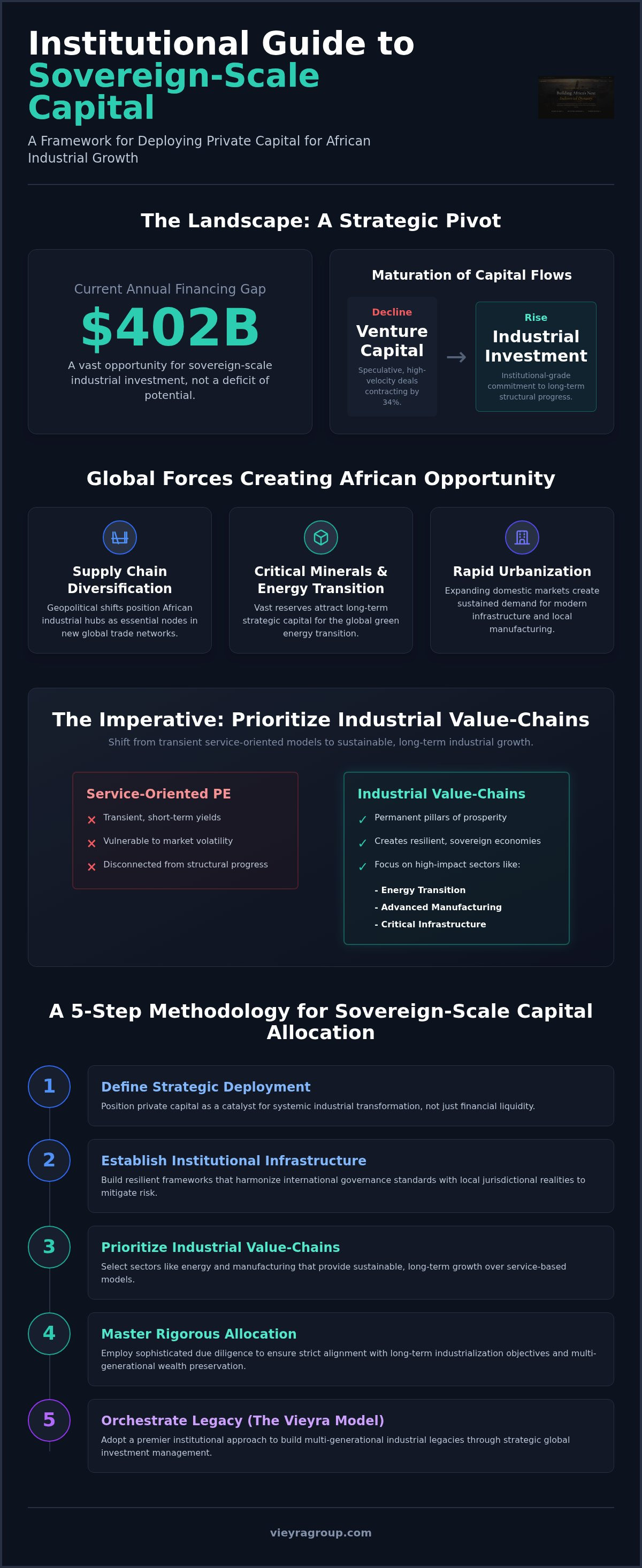
The deployment of private capital for African growth represents a fundamental pivot in the economic trajectory of the continent, moving beyond mere financial liquidity toward a catalyst for systemic industrial transformation. In 2026, the African financial architecture is undergoing a profound evolution, characterized by a transition from a dependence on external development assistance to the cultivation of a robust, internally driven investment ecosystem. This shift is most visible in the maturation of capital flows, where the previous emphasis on speculative, high-velocity venture capital is being superseded by institutional-grade industrial investment. While venture deal counts have contracted, as evidenced by a 34% decline in the first half of 2026, the appetite for large-scale infrastructure and manufacturing indicates a more enduring commitment to structural progress.
The current annual financing gap, estimated at approximately $402 billion, should not be viewed as a deficit of potential but as a strategic opportunity for sovereign-scale actors. This vacuum allows for the entry of sophisticated entities capable of orchestrating the complex synergies required to bridge the distance between raw potential and industrial reality. By positioning private capital as the primary driver of industrialization, the continent is establishing a new paradigm of economic resilience that prioritizes long-term value creation over transient yields.
Geopolitical Fragmentation and the African Opportunity
The ongoing reconfiguration of global supply chains, driven by geopolitical fragmentation, has positioned African industrial hubs as essential nodes in a more diversified international trade network. As global powers seek resilience through friend-shoring, the wealth of critical minerals on the continent, indispensable for the global energy transition, attracts long-term strategic capital that seeks stability over decades rather than quarters. Simultaneously, rapid urbanization continues to expand domestic markets, creating a sustained demand for sophisticated infrastructure and localized manufacturing capabilities that can no longer be ignored by global investment management entities. These factors combine to create an environment where strategic capital can achieve both significant impact and multi-generational preservation.
The Institutional Imperative: Beyond Speculative Flows
True economic sovereignty requires a clear differentiation between short-term capital flight and multi-generational stewardship. The volatility often associated with African markets is frequently a reflection of inadequate institutional infrastructure rather than a lack of inherent value. By establishing resilient frameworks that integrate global governance standards with local jurisdictional realities, institutional investors can effectively mitigate perceived regional risks. Sovereign-scale private investment acts as a stabilizing force, providing the necessary ballast to weather global economic fluctuations while ensuring that wealth preservation is inextricably linked to the broader industrialization goals of the continent. This methodical approach transforms the investment landscape from a series of disconnected transactions into a cohesive narrative of continental progress.
Establishing Institutional Infrastructure for Capital Deployment
The creation of a resilient investment environment requires more than the mere presence of capital; it demands the construction of an invisible, yet impenetrable, institutional architecture. For the effective mobilization of private capital for African growth, the foundational requirements center on the establishment of transparent frameworks that harmonize global governance expectations with the nuanced realities of local African jurisdictions. Family offices, acting as the primary architects of this confidence, provide the steady hand necessary to navigate these complexities, ensuring that capital isn't merely deployed but protected across generations. This structural permanence is what distinguishes sovereign-scale actors from the transient participants of speculative markets.
Governance Frameworks and Transparency
The implementation of rigorous governance standards serves as the essential ballast for sovereign-level capital management. Transparency within this context is a strategic economic lever that substantially reduces the cost of capital in emerging markets by eliminating the opacity that often deters institutional allocators. By integrating multi-layered oversight mechanisms, such as independent investment committees and third-party audit protocols, entities can foster an environment of unwavering trust. This institutional rigor is pivotal in closing Africa's financing gap, as it transforms perceived regional volatility into a manageable set of calculated risks. It's the difference between a high-risk bet and a strategic, long-term allocation.
Operational Infrastructure and Legal Structuring
The selection of appropriate legal and operational structures is a decision of multi-generational consequence. Institutional investors must evaluate the strategic advantages of regional financial hubs, such as Mauritius with its 15% corporate tax rate or South Africa's evolving principles-based regulatory system under FSCA CIS Notice 1 of 2026, against the broader utility of global offshore structures. Key considerations include:
- Regulatory Alignment: Ensuring that cross-border capital flows are supported by robust treaties, especially as jurisdictions like Ghana renegotiate investment authority bills to require explicit arbitration consent.
- Fund Administration: Utilizing institutional-grade administration to maintain the fiduciary rigor required for large-scale industrial projects.
- Sovereign Resilience: Constructing legal vehicles that prioritize the preservation of assets against geopolitical shifts.
Maintaining such high-level global investment management standards ensures that the deployment of capital remains a deliberate act of legacy building rather than a speculative venture. Through these structures, the vision of African industrialization becomes a tangible reality, anchored by the permanence of institutional excellence. It's through this methodical orchestration that true legacy is forged.
Sector Selection: Prioritizing Industrialization and Value-Chains
The pursuit of enduring economic stability necessitates a discerning departure from the high-velocity, service-oriented private equity models that have historically characterized emerging market entries. While the service sector offers agility, it frequently lacks the structural permanence required to anchor a continent's economic sovereignty. The mobilization of private capital for African growth must therefore prioritize industrialization and the fortification of complex value-chains. This strategic approach recognizes that multi-generational wealth is most effectively preserved through the ownership of tangible, productive assets that facilitate systemic transformation rather than mere transactional efficiency. By focusing on industrial value-chains, institutional allocators can mitigate the risks of market volatility through the creation of intrinsic, long-term utility.
The Industrialization Thesis for Private Capital
The industrialization thesis rests upon the conviction that value-addition at the source is the most potent driver of enduring economic dividends and geopolitical resilience. For example, the transition from the exportation of raw minerals to the establishment of sophisticated domestic processing facilities represents a fundamental shift from commodity dependence to industrial leadership. In the first half of 2026, North Africa distinguished itself as a leader in deal value, securing $1.1 billion primarily through large-scale manufacturing and renewable energy initiatives, while West Africa led in transaction volume with 59 deals. Such strategic capital is indispensable for constructing regional manufacturing capacity, ensuring that African nations transition from being passive participants in the global economy to becoming active architects of their own industrial destiny.
Infrastructure as the Bedrock of Growth
Infrastructure development is not an isolated endeavor but the essential bedrock upon which industrial productivity and regional competitiveness are constructed. There exists a profound synergy between the establishment of energy security, particularly through renewable transition projects, and the operational viability of advanced manufacturing hubs. Digital corridors and sophisticated logistics networks further enhance this resilience by ensuring the seamless movement of high-value goods across borders, thereby reducing the friction that historically impeded continental trade. The investment potential within these sectors is substantial, particularly where public-private partnerships allow sovereign-scale actors to participate in projects of continental importance. By establishing value-chain resilience as a primary investment criterion, institutional allocators ensure their portfolios are not merely protected against volatility but are fundamental pillars of the African industrial legacy.
A Methodology for Sovereign-Scale Capital Allocation
The deployment of private capital for African growth necessitates a profound departure from standard transactional frameworks toward a methodology rooted in the deliberation of a sovereign-scale entity. This process isn't merely a financial exercise; it's an architectural undertaking that requires a rigorous five-step protocol. First, one must identify strategic themes aligned with continental industrialization. Second, an exhaustive counterparty deep-dive is performed. Third, we engineer the legal and operational vehicles. Fourth, we execute a disciplined capital drawdown. Finally, we implement active governance to ensure project-level performance. This structured approach ensures that capital serves as a stabilizing force rather than a source of volatility, even when navigating environments like Nigeria, where the Monetary Policy Rate has reached 26.50% as of July 2026.
Due Diligence and Strategic Alignment
Standard financial metrics often fail to capture the nuanced realities of emerging market dynamics. It's essential to assess political risk through a multi-generational lens, recognizing that short-term shifts often mask long-term stability. Diligence must extend to the evaluation of institutional counterparts and local partners, ensuring their values align with the preservation of institutional legacy. This includes verifying regulatory shifts, such as the Ghana Investment Promotion Authority Bill of 2026, which now requires explicit negotiation for international arbitration consent. Furthermore, projects must demonstrate clear alignment with national development goals, as this synergy provides the ultimate protection against regulatory volatility and ensures the project remains a priority for local stakeholders.
Execution and Long-Term Stewardship
The mechanics of capital drawdown and project-level oversight require constant vigilance. Active management isn't a choice; it's a requirement for industrial performance. This includes the integration of philanthropic objectives through foundation-aligned strategies, where the Vieyra Foundation ensures that commercial success translates into broader social resilience and multi-generational wealth preservation. Risk mitigation is further achieved through asset diversification and the adoption of extended time horizons that look beyond the typical five-to-seven-year private equity cycle. Exit planning must be conducted with the same foresight, prioritizing transitions that preserve the systemic value of the industrial asset. For those seeking to master these sophisticated mechanics, our strategic capital solutions provide the necessary institutional framework for enduring success.
The Vieyra Model: Orchestrating African Industrial Legacy
The Vieyra Family Office represents a definitive departure from conventional asset management, serving instead as a stately guardian and visionary architect of African capital. We deploy private capital for African growth through a lens of multi-generational wealth preservation and sovereign-scale industrialization. This methodology, recognized as the Vieyra Model, seamlessly integrates Global Investment Management with a profound commitment to establishing industrial dynasties that transcend the inherent volatility of speculative markets. By operating with the deliberation and foresight of a sovereign-level entity, we ensure that every allocation is a purposeful step toward continental resilience and long-term stability.
Our institutional approach acknowledges that the mobilization of African Industrialization Capital is not merely a financial transaction but a significant global responsibility. We prioritize the development of strategic infrastructure and industrial value-chains, recognizing these as the only true anchors of economic sovereignty. Through the Vieyra Foundation, we further harmonize our commercial objectives with a commitment to large-scale social progress, ensuring that the wealth created today serves as a permanent pillar of prosperity for the generations that follow. This systemic integration of profit and purpose is the hallmark of our institutional identity.
A Multi-Generational Vision for Industrialization
Our commitment to industrialization is rooted in the conviction that enduring economic progress requires the architectural foresight to construct permanent pillars of value. We leverage a unique blend of global reach and deep-rooted African expertise to identify projects that offer both exceptional strategic depth and significant systemic impact. This dual focus ensures that our initiatives don't just generate returns but actively contribute to the reconfiguration of regional manufacturing and energy transition. It's a vision that prioritizes the steady, methodical accumulation of industrial power over the fleeting gains of speculative flows, reflecting a high level of professional rigor and intellectual sophistication.
Engaging with Sovereign-Scale Capital Solutions
Navigating the complex and evolving financial architecture of the continent requires a level of institutional rigor that few can provide. We invite sovereign-scale partners to explore our Strategic Capital Solutions, a collaborative framework designed for those who share our commitment to long-term industrial success. Our expertise in navigating regulatory shifts, such as the 2026 amendments to the Tanzania Foreign Exchange Regulations or the nuanced requirements of the Ghana Investment Promotion Authority Bill, provides our partners with the strategic depth necessary for large-scale execution. Engaging with the Vieyra Family Office means entering a partnership defined by poise, deliberation, and an unwavering focus on the preservation of institutional legacy. We provide the essential pathway for those seeking to transform raw potential into a permanent industrial legacy through the sophisticated deployment of private capital for African growth.
Architecting the Future of African Industrialization
The successful mobilization of private capital for African growth is predicated on a departure from transient financial trends in favor of a deliberate, sovereign-scale industrial strategy. We've explored how the construction of transparent institutional infrastructure and the strategic prioritization of industrial value-chains provide the essential ballast for long-term stability. By adopting a rigorous methodology for capital allocation, institutional stewards can transform the continent's financing gap into a gateway for multi-generational wealth preservation and systemic progress. This transition from speculative flows to industrial-grade investment marks the beginning of a new era of continental economic sovereignty.
The Vieyra Family Office remains a steadfast guardian of this vision, blending a multi-generational institutional heritage with unparalleled sovereign-scale project expertise. Our commitment to global investment stewardship ensures that capital isn't just deployed but orchestrated to create a permanent industrial legacy. We invite those who seek to participate in this transformative journey to Explore Strategic Capital Solutions at Vieyra Family Office. It's through such sophisticated collaboration that we'll build a future defined by industrial resilience and enduring prosperity.
Frequently Asked Questions
What defines private capital for African growth in an institutional context?
Private capital for African growth is defined as the strategic commitment of institutional resources to large-scale industrialization and infrastructure development. Unlike speculative flows, this capital prioritizes the creation of permanent economic pillars. It acts as a stabilizing force by focusing on value-addition at the source. This institutional approach ensures that deployments are not merely transactional but are architected to facilitate systemic transformation across the continent's evolving financial architecture.
How do family offices mitigate geopolitical risk in African industrial projects?
Family offices mitigate geopolitical risk by adopting multi-generational time horizons that look beyond the immediate volatility of political cycles. They establish resilient institutional frameworks that harmonize local jurisdictional requirements with international governance standards. By aligning their investment objectives with national industrialization goals, these entities create a symbiotic relationship with sovereign stakeholders. This strategic depth ensures that assets are protected through periods of fragmentation, maintaining stability where shorter-term investors might see only uncertainty.
What role does institutional infrastructure play in capital deployment?
Institutional infrastructure serves as the essential bedrock for transparent and resilient capital deployment. It encompasses the legal, operational, and governance frameworks that lower the cost of capital by reducing opacity in emerging markets. This architecture includes independent oversight mechanisms and sophisticated fund administration to maintain fiduciary rigor. By establishing these permanent structures, investors ensure that their allocations are protected against regulatory shifts and operational inefficiencies, fostering an environment of unwavering institutional trust.
Why is industrialization prioritized over other asset classes in Africa?
Industrialization is prioritized because it offers a level of structural permanence and economic sovereignty that service-oriented asset classes often lack. Productive industrial assets facilitate value-addition at the source, transforming raw potential into finished goods and high-value exports. This focus on the industrial value-chain creates intrinsic utility that is less susceptible to the whims of speculative market cycles. It builds the foundational infrastructure necessary for enduring economic progress and multi-generational wealth preservation.
How can multi-generational wealth be preserved through African investments?
Multi-generational wealth preservation is achieved through the ownership of tangible, productive assets that are fundamental to the continent's industrial progress. By investing in sectors like energy and manufacturing, stewards of capital align their portfolios with essential economic needs. This approach provides a robust hedge against currency volatility and global market fluctuations. It ensures that wealth is not merely maintained but is actively growing as part of a permanent sovereign-scale industrial legacy.
What are the key sectors for sovereign-scale capital in 2026?
In 2026, sovereign-scale capital is primarily directed toward the energy transition, advanced manufacturing, and logistics corridors. These sectors are critical for closing the infrastructure gap and enhancing regional trade efficiency. For instance, North Africa's leadership in renewable energy deals, which reached $1.1 billion in the first half of the year, demonstrates the high strategic value of these assets. Investing in these areas allows institutional allocators to drive systemic growth while capturing long-term dividends.
How does philanthropy integrate with private capital investment strategies?
Philanthropy integrates with investment strategies by fostering the social resilience required for long-term industrial success. Entities like the Vieyra Foundation ensure that commercial achievements contribute to broader community development and economic stability. This alignment creates a more predictable operating environment, which in turn enhances the performance of industrial assets. By addressing systemic social challenges, philanthropic initiatives provide the necessary ballast for the multi-generational preservation of institutional wealth and the architecting of legacy.
What is the significance of the $402 billion financing gap for private investors?
The $402 billion financing gap represents a significant strategic opening for the deployment of private capital for African growth. This deficit indicates a profound need for sophisticated investment that moves beyond traditional development aid. For sovereign-scale actors, this gap offers the opportunity to lead the continent's industrial transformation. By providing the necessary resources for large-scale projects, private investors can secure dominant positions in the industrial value-chains that will define Africa's economic future.


