
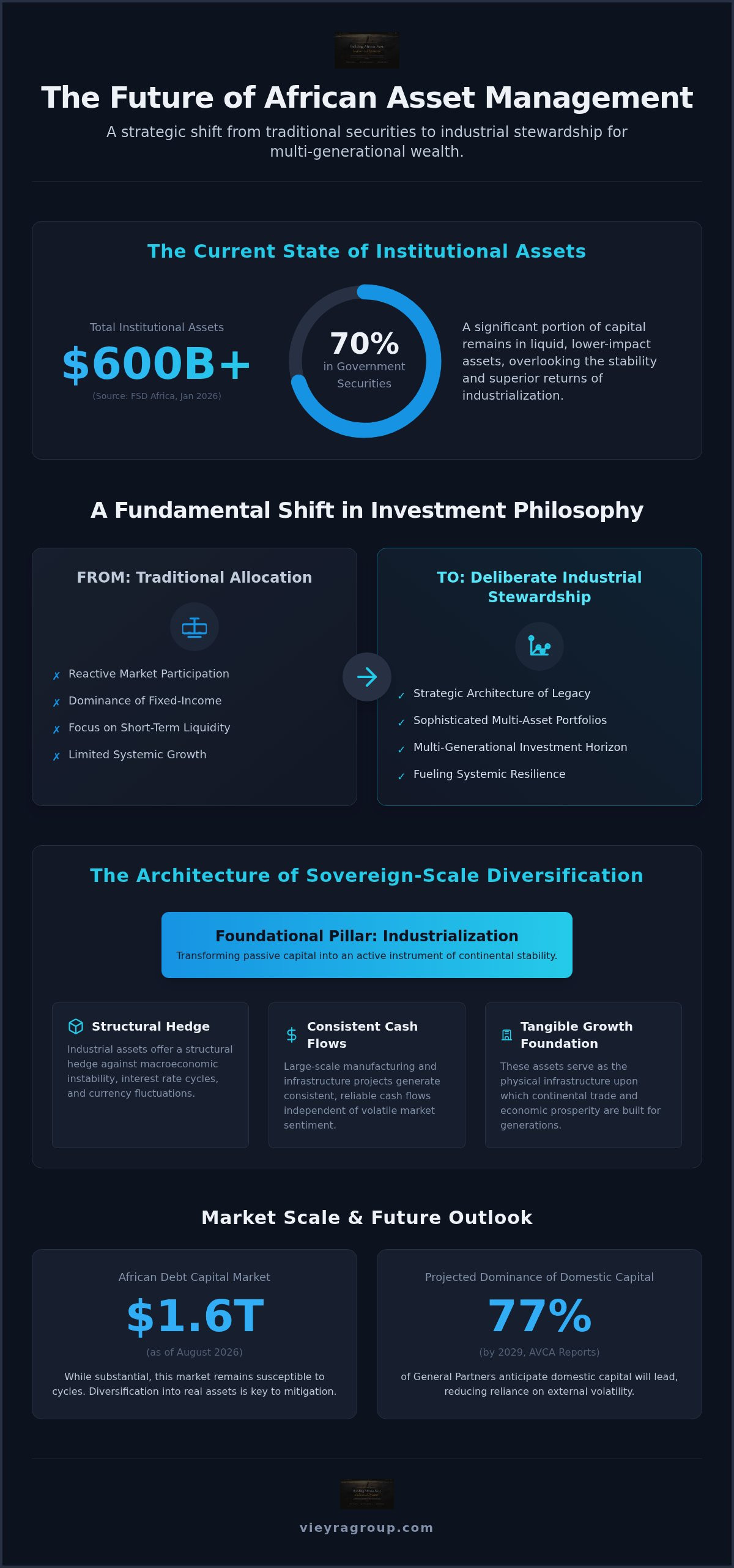
With more than USD 600 billion in assets currently held by African institutional investors, nearly 70% of these portfolios remain anchored in government securities rather than fueling the industrial backbone of the continent. While such positioning suggests a preference for liquidity, it frequently overlooks the profound stability and superior risk-adjusted returns offered by diversified asset management Africa. The current challenge for the global steward is not the availability of capital, but the implementation of a sophisticated framework that bridges the gap between institutional liquidity and the large-scale industrialization necessary for systemic resilience.
You likely recognize that the pursuit of multi-generational wealth preservation requires a shift from reactive market participation to the deliberate architecture of legacy. This article provides an institutional exploration of multi-generational asset allocation and strategic capital deployment within the African landscape. We shall examine the specific mechanisms of sovereign-scale diversification, the rising influence of domestic debt markets, and the methodology for aligning private capital with the enduring principles of industrial stewardship.
Key Takeaways
- Understand the structural transition from traditional fixed-income dominance toward the implementation of sophisticated multi-asset portfolios designed to anchor emerging capital markets.
- Identify the core architectural pillars of sovereign-scale stability by integrating industrialization as a foundational asset class within a framework of diversified asset management Africa.
- Evaluate the comparative advantages of asset-heavy industrial allocations over traditional liquid instruments in securing superior risk-adjusted returns for multi-generational portfolios.
- Discover how systemic risk mitigation strategies and global investment management structures safeguard capital against the inherent geopolitical and macroeconomic volatility of frontier markets.
- Learn how strategic capital solutions facilitate the deployment of resources into industrial projects of sovereign-scale significance to ensure the permanence of institutional legacy.
The Evolution of Diversified Asset Management in Africa
The historical reliance on sovereign debt and fixed-income instruments is yielding to a more nuanced paradigm across the continent. For decades, African institutional capital remained concentrated in government securities, a strategy that provided perceived safety but limited the potential for systemic industrial growth. Today, the landscape is maturing. We're seeing a decisive shift toward diversified asset management Africa, where sophisticated multi-asset portfolios are becoming the standard for sovereign-scale stability. This evolution reflects a growing recognition that true wealth preservation requires exposure to uncorrelated sectors and real-world industrial assets through African Industrialization Capital. By converging global management standards with African-centric opportunities, institutional actors are now stabilizing emerging markets with unprecedented deliberation.
Historical Context and Market Maturation
The trajectory of the African asset management sector is marked by significant scale. According to FSD Africa data from January 2026, the sector has surpassed the USD 600 billion milestone in institutional asset holdings. This growth isn't merely quantitative. Regulatory shifts across various jurisdictions are facilitating broader diversification, allowing capital to flow more freely across regional borders. The African Continental Free Trade Area (AfCFTA) serves as a catalyst here, harmonizing trade rules and encouraging the mobilization of domestic capital toward industrial stability. As local capital influence rises, with 77% of General Partners anticipating its dominance by 2029 according to AVCA reports, the reliance on external volatility is diminishing. This shift necessitates a framework for diversified asset management Africa that prioritizes the identification of industrialization as a stable, high-impact asset class.
The Shift Toward Institutional Stewardship
The transition from short-term yield-seeking to multi-generational investment horizons represents a fundamental change in the African financial architecture. It's no longer enough to chase quarterly returns; managing sovereign-scale assets requires a level of professional rigor that aligns capital with the permanence of the industrial landscape. The Vieyra Family Office embodies this transition, acting as a visionary architect of legacy rather than a mere service provider. Through Strategic Capital Solutions and Global Investment Management, capital is deployed with the poise of an established institution. The Vieyra Foundation serves as a vital extension of this institutional stewardship, ensuring that the impact of capital transcends financial returns to foster systemic progress. Institutional stewardship in the context of African wealth preservation is the disciplined application of multi-generational foresight and rigorous governance to ensure that capital deployment actively constructs the industrial foundations of future prosperity.
The Architecture of Sovereign-Scale Diversification
Diversified asset management Africa requires more than the mere distribution of capital across geographic boundaries; it demands a rigorous, systemic allocation across fundamentally uncorrelated sectors to ensure institutional permanence. By prioritizing assets that maintain intrinsic value regardless of transient market sentiment, sovereign-scale entities can construct portfolios that withstand the cyclical volatility often associated with frontier markets. Industrialization stands as the definitive pillar of this architecture, providing a tangible foundation for growth that transcends the limitations of traditional liquid securities. It's through this deliberate structuring that capital is transformed from a passive resource into an active instrument of continental stability.
Core Asset Classes in the African Context
While the African debt capital market, valued at USD 1.6 trillion as of August 2026, provides a deep pool for liquidity, it remains susceptible to interest rate cycles and currency fluctuations. To mitigate these risks, sophisticated portfolios must balance public equities with private markets and real assets. Industrialization, specifically through large-scale manufacturing and infrastructure, offers a structural hedge against macroeconomic instability. These assets generate consistent cash flows and serve as the physical infrastructure upon which continental trade relies. Integrating Global Investment Management principles into these local strategies allows for a sophisticated approach to risk, where international standards of governance meet the unique opportunities of the African industrial landscape.
Strategic Capital Allocation Frameworks
The methodology behind successful capital deployment involves a deliberate focus on systemic economic impact rather than speculative gain. Sovereign-scale institutions utilize Strategic Capital Solutions to de-risk industrial initiatives, providing the patient capital required for complex, long-term projects to reach maturity. This approach ensures that African Industrialization Capital isn't merely spent, but strategically invested to create a self-sustaining ecosystem of productivity. Multi-generational wealth preservation is the ultimate objective, achieved through asset-backed diversification that prioritizes the longevity of the institution over the immediacy of the transaction. Through this lens, the family office functions as a guardian of progress, ensuring that every allocation contributes to a broader vision of continental stability and institutional legacy. Key considerations for this framework include:
- Uncorrelated Revenue Streams: Prioritizing sectors like agribusiness and energy that respond to domestic demand rather than global commodity cycles.
- Asset-Backed Security: Focusing on tangible industrial assets that provide downside protection during periods of currency volatility.
- Alternative Funding Tools: Utilizing emerging instruments, such as the African sukuk market which surpassed USD 7 billion in 2026, to diversify funding sources.
Comparing Traditional Allocation with Industrial-Centric Strategies
Standard institutional benchmarks often fail to capture the unique requirements of multi-generational wealth preservation within the African context. While conventional models prioritize high liquidity and adherence to market indices, a framework for diversified asset management Africa must look beyond these transient metrics. Conservative liquid portfolios, though easily accessible, remain fundamentally vulnerable to the currency fluctuations and inflationary pressures that characterize frontier markets. In contrast, asset-heavy industrial allocations provide a tangible anchor, transforming capital into productive infrastructure that generates value independently of public market sentiment. This departure from standard benchmarks isn't a rejection of rigor, but an embrace of a more profound institutional stewardship that prioritizers permanence over speed.
Traditional vs. Strategic Capital Models
Traditional capital models in Africa are heavily skewed toward government securities; indeed, FSD Africa reported in January 2026 that 60% to 70% of pension fund portfolios are allocated to government bonds. This concentration creates a high degree of market-index dependency and leaves portfolios exposed to sovereign risk. Strategic capital models, such as those facilitated through Strategic Capital Solutions, prioritize direct industrial participation and sovereign-level partnerships. The difference is primarily one of time horizons. Where traditional managers focus on quarterly reporting and short-term liquidity, strategic stewardship emphasizes multi-generational value creation. This shift ensures that capital deployment aligns with the long-term industrialization needs of the continent, creating a legacy that outlasts market cycles.
The Industrialization Alpha
Industrialization offers a unique "alpha" within the African landscape by generating non-correlated returns that traditional capital market instruments can't match. Large-scale manufacturing and infrastructure projects are driven by domestic demand and regional trade integration under the AfCFTA, rather than the speculative movements of global debt markets. These initiatives provide secondary benefits that strengthen the entire investment ecosystem, including job creation and enhanced regional stability. Industrialization acts as a definitive volatility buffer by anchoring capital in essential physical assets that maintain utility and value regardless of macroeconomic fluctuations. By deploying African Industrialization Capital into these sectors, investors move beyond the limitations of the USD 1.6 trillion debt market to capture the fundamental growth of the African real economy. This approach transforms the investment from a passive holding into a cornerstone of continental progress.
Navigating Systemic Risk in Multi-Generational Portfolios
Protecting capital within frontier markets requires a transition from mere risk mitigation to a comprehensive strategy of systemic resilience. For the sovereign-scale investor, volatility isn't an obstacle to be avoided but a variable to be managed through the application of institutional gravity. A robust framework for diversified asset management Africa integrates multi-generational foresight with the technical precision of global management structures. This ensures that capital remains insulated from localized macroeconomic shocks while maintaining its trajectory toward long-term industrialization. The objective is the creation of a portfolio that doesn't merely react to geopolitical shifts but anticipates them through the deliberate structuring of uncorrelated assets.
Institutional Risk Frameworks
Managing systemic risk necessitates a sophisticated interplay between regional expertise and global jurisdictional architecture. Currency volatility, which remains a persistent challenge in many African markets, is addressed through the deliberate diversification of asset holdings across varied geographic and legal domains. By utilizing Strategic Capital Solutions, investors can enhance the viability of large-scale projects, effectively reducing the risk profile of industrial initiatives through patient capital and rigorous due diligence. The implementation of sophisticated legal frameworks and the selection of stable jurisdictions are critical to protecting multi-generational legacies from regulatory inconsistencies. This methodology transforms strategic capital into a tool for systemic stability, ensuring that projects of sovereign-scale significance reach maturity despite external geopolitical shifts or domestic economic cycles.
Governance and Legacy Preservation
The preservation of multi-generational wealth is as much a science of governance as it's a discipline of finance. It requires a composed, authoritative stance that balances the pursuit of industrial growth with the necessity of capital preservation. Within this framework, the Vieyra Foundation serves as a vital instrument, aligning philanthropic initiatives with the broader goals of institutional risk mitigation. By fostering social stability and local industrial capacity, the foundation reinforces the permanence of the family office. This creates an aura of institutional permanence, where the scale of operations is matched by the depth of the governance structures that protect them. Authoritative governance isn't merely about oversight; it's about the methodical alignment of every capital deployment with the core values of heritage and progress. It's through this methodical approach that the visionary architect of legacy ensures the continuity of impact across centuries, maintaining a steady pace that reflects the long-term nature of its objectives.
Strategic Capital Solutions for African Industrialization
The culmination of a sovereign-scale framework lies in the precise execution of capital deployment into high-impact sectors. Vieyra Family Office operates as a visionary architect of this progress, ensuring that global investment rigor is seamlessly integrated with the unique requirements of the African industrial landscape. This synthesis is vital for transforming liquid capital into enduring physical infrastructure. By focusing on projects of sovereign-scale significance, the institution bridges the gap between traditional asset allocation and the systemic transformation of the continent. The deployment of African Industrialization Capital is not merely a financial transaction; it's a deliberate act of institutional stewardship designed to foster multi-generational stability.
The Vieyra Institutional Model
The institutional model prioritizes the identification of catalysts for regional development through a lens of multi-generational value. Unlike fund-based models that are often constrained by exit timelines, the family office structure allows for the patient stewardship required for large-scale industrial projects to reach full operational maturity. Every capital allocation decision is weighed against the principles of heritage and long-term progress, ensuring that the portfolio remains a reflection of the institution's commitment to permanence. This approach allows for the execution of Global Investment Management strategies that remain deeply rooted in African-centric expertise. By integrating these values, the institution ensures that its trajectory remains aligned with the broader objectives of continental industrialization and wealth preservation.
Partnering for African Progress
Scaling industrial initiatives of this magnitude requires the cultivation of sovereign-level partnerships characterized by mutual foresight and strategic depth. These collaborations go beyond the scope of traditional finance, providing the necessary depth to navigate complex geopolitical and macroeconomic environments with composed authority. Through Strategic Capital Solutions, the Vieyra Family Office provides the architectural support needed to ensure the longevity of African industrialization. We invite institutional actors and sovereign entities to align with this vision of progress, where capital deployment is a tool for systemic impact. The implementation of diversified asset management Africa serves as the foundation for this alignment, ensuring that the pursuit of growth is always anchored in the principles of institutional gravity and multi-generational legacy. Through the Vieyra Foundation, this commitment to progress extends to the development of human capital and the reinforcement of the social structures necessary for sustained industrial success.
Architecting the Future of African Institutional Stability
The transition from passive capital allocation toward active industrial stewardship defines the next era of continental growth. By integrating industrialization as a foundational pillar, institutional actors can transcend the volatility of traditional debt markets and anchor their portfolios in tangible, productive assets. This framework for diversified asset management Africa ensures that wealth preservation isn't merely a matter of risk avoidance, but a proactive architecture of legacy. Achieving this level of permanence requires a departure from short-term benchmarks in favor of a multi-generational vision that aligns capital with the structural evolution of the African real economy. Legacy requires patience.
Vieyra Family Office stands as a stately guardian of this vision, blending sovereign-scale institutional presence with profound multi-generational wealth management expertise. Our focus on large-scale African industrialization provides the strategic depth necessary to navigate frontier markets with quiet confidence. We invite you to Explore Strategic Capital Solutions at Vieyra Family Office to begin architecting a legacy of systemic impact and enduring stability. The path toward continental progress is built on the deliberation and foresight of those who invest for the centuries, not just the seasons.
Frequently Asked Questions
What defines diversified asset management in the African context?
Diversified asset management Africa is defined by the systemic distribution of capital across uncorrelated industrial sectors and geographic regions to mitigate the concentration risk inherent in frontier markets. It's about moving beyond the traditional reliance on sovereign debt to embrace real assets that maintain intrinsic value. This approach prioritizes long term stability over short term liquidity, ensuring that institutional portfolios are resilient enough to withstand localized macroeconomic shifts while capturing the fundamental growth of the continent's real economy.
How does sovereign-scale capital differ from traditional institutional investment?
Sovereign-scale capital is distinguished by its extended time horizon and its focus on institutional permanence rather than immediate market liquidity. While traditional institutional investment often adheres to rigid quarterly benchmarks and index-driven strategies, sovereign-scale entities operate with the deliberation of a visionary architect. It's capital deployed to construct legacies that span generations, prioritizing projects with systemic significance that provide both financial returns and foundational stability for the broader industrial landscape across the continent.
Why is industrialization considered a core asset class for multi-generational wealth?
Industrialization serves as a core asset class because it provides a structural hedge against the currency volatility and inflationary pressures common in emerging markets. Large scale manufacturing and infrastructure projects create tangible utility and consistent cash flows that aren't directly correlated with global equity market sentiment. By anchoring wealth in the physical development of the continent, investors ensure that their capital remains productive and essential, fostering a level of permanence that liquid instruments simply cannot match.
How can global investment management principles be applied to African markets?
Global investment management principles are applied through the implementation of rigorous governance frameworks and sophisticated jurisdictional architectures that protect capital from regulatory inconsistencies. This involves utilizing international standards of due diligence and risk assessment while maintaining a deep, localized understanding of African market dynamics. By bridging these two worlds, investors can de-risk complex industrial initiatives, ensuring that capital deployment is both strategically sound and protected by the same professional rigor found in established global financial centers.
What is the role of a family office in African industrialization?
A family office acts as a stately guardian and a primary architect of legacy within the industrial sector. Unlike traditional fund-based models that are constrained by fixed exit timelines, a family office provides the patient capital necessary for sovereign-scale projects to reach maturity. It's about aligning capital with multi-generational values, ensuring that every investment contributes to a broader vision of progress and stability that outlasts transient market cycles and supports the continent's long term industrialization goals.
How does Vieyra Family Office manage risk across diverse African jurisdictions?
Risk management is achieved through a methodical approach that combines geographic diversification with the use of Strategic Capital Solutions to de-risk specific industrial initiatives. By spreading holdings across varied legal and economic domains, the institution remains insulated from localized shocks. This strategy involves the careful selection of jurisdictions that offer stable regulatory environments, ensuring that every deployment of capital is protected by a robust architecture of governance. We don't merely react to market shifts; we anticipate them.
What is the relationship between strategic capital and multi-generational wealth preservation?
Strategic capital is the essential tool that bridges the gap between institutional liquidity and the long term viability of industrial projects. By providing the patient, de-risking capital required for complex initiatives, it ensures that the physical assets underlying a portfolio remain productive for decades. This approach is fundamental to wealth preservation, as it transforms capital into a cornerstone of the real economy, creating a self-sustaining ecosystem of value that persists across multiple generations of stewardship.
How does the Vieyra Foundation support the institution's investment strategy?
The Vieyra Foundation functions as an extension of institutional stewardship by fostering the social stability and human capital development necessary for industrial success. It reinforces the environment in which the institution operates, ensuring that the impact of capital transcends financial returns to create a lasting legacy of progress. By aligning philanthropic efforts with the broader investment strategy, the foundation mitigates social risk and strengthens the social license to operate, thereby securing the permanence of the institution.


