
The industrial evolution of the African continent is not a task for the speculative or the short-sighted; it is a sovereign-scale imperative that demands the permanence of institutional legacy. You likely recognize that the current landscape is often obscured by fragmented regulatory environments and a perceived scarcity of bankable, large-scale projects, which frequently discourages those accustomed to more traditional markets. The strategic deployment of private capital for African industrialization represents the primary catalyst for overcoming these systemic hurdles and facilitating a definitive transition from resource extraction to sophisticated, value-added manufacturing.
This article provides an institutional framework for evaluating sovereign-scale industrial opportunities, ensuring the alignment of multi-generational wealth with the continent's long-term economic growth. We will examine the methodologies for navigating currency volatility and liquidity concerns, while establishing a vision for industrial transformation that serves as a cornerstone for global stability and heritage. By viewing these challenges through the lens of a visionary architect, the path toward continental prosperity becomes a matter of strategic deliberation rather than speculative chance.
Key Takeaways
- Discern the fundamental transition from raw resource exportation to domestic value-added processing, underpinned by the strategic integration of the African Continental Free Trade Area.
- Evaluate the stabilizing influence of multi-generational patient capital in contrast to the inherent volatility and limitations of short-term, speculative investment cycles.
- Identify the essential components of project bankability, specifically the role of preparation facilities in mitigating regulatory complexities across diverse African jurisdictions.
- Analyze the institutional frameworks required to deploy private capital for African industrialization through the strategic alignment of global investment and sovereign-scale objectives.
- Gain insight into the role of the family office as a stately guardian and visionary architect of the continent’s long-term industrial legacy and economic sovereignty.
The Current Landscape of African Industrialization Investment
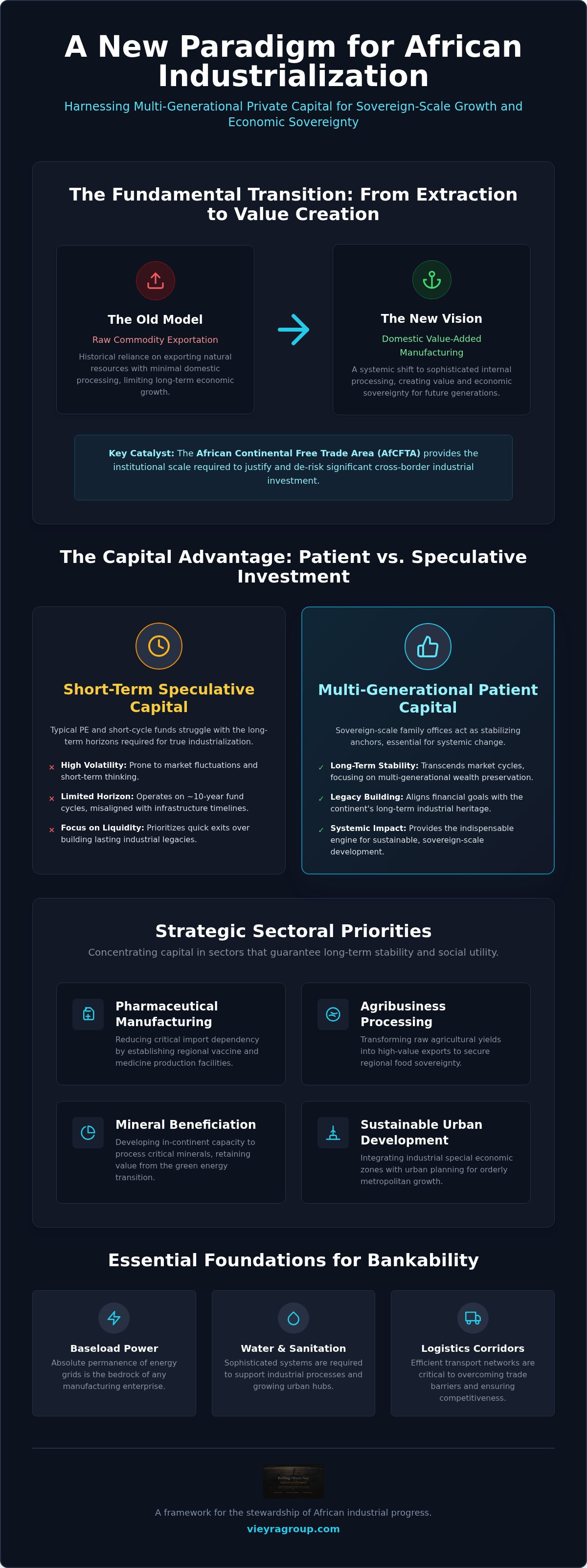
The historical reliance on the exportation of raw commodities has reached its structural limit, giving way to a systemic paradigm shift toward domestic value-added processing. This transition is not merely a policy preference but a fundamental requirement for continental economic sovereignty. The implementation of the African Continental Free Trade Area (AfCFTA) serves as the primary institutional catalyst for this evolution, providing the necessary scale to justify significant industrial investment across cross-border jurisdictions. While traditional development finance has historically anchored infrastructure, the sheer magnitude of the continent's capital requirements means that private capital for African industrialization is now the indispensable engine for sustainable, long-term growth.
The transition toward sovereign-scale private participation reflects a growing recognition that the continent's industrial needs exceed the capacity of public sector balance sheets alone. This shift necessitates a sophisticated understanding of the interconnectedness between policy frameworks and large-scale capital deployment. As African nations harmonize their regulatory environments, the opportunity for institutional investors to participate in the foundational restructuring of regional economies becomes increasingly clear, moving beyond the volatility of speculative trades into the stability of industrial partnership.
The Infrastructure Prerequisite
Industrialization cannot occur in a vacuum; it requires the absolute permanence of baseload power and sophisticated water sanitation systems as the bedrock of any manufacturing enterprise. The logistics gap remains a formidable barrier, as inefficient transport corridors currently inflate the cost of intra-African trade, directly undermining the competitiveness of local manufacturing relative to global imports. The leapfrogging myth falsely suggests that a service-based digital economy can bypass the fundamental necessity of high-energy industrial manufacturing and the physical infrastructure required to sustain it. Authentic progress demands a commitment to the heavy lifting of physical development, ensuring that energy grids and transport networks are capable of supporting multi-generational industrial expansion.
Sectoral Priorities for Strategic Capital
Strategic capital allocation is increasingly concentrated in sectors that guarantee long-term stability and social utility, most notably pharmaceutical manufacturing and agribusiness processing. Mineral beneficiation remains a critical frontier, as the retention of value within the African economic ecosystem ensures that the continent's natural wealth translates into multi-generational prosperity rather than immediate external profit. Several key sectors are currently attracting the attention of visionary architects of capital:
- Pharmaceutical Manufacturing: Reducing critical import dependency through the establishment of regional vaccine and medicine production facilities.
- Agribusiness Processing: Transforming raw agricultural yields into shelf-stable, high-value exports to secure regional food sovereignty.
- Mineral Beneficiation: Developing the internal capacity to process critical minerals, ensuring Africa remains at the center of the global green energy transition.
- Sustainable Urban Development: Integrating industrial special economic zones with urban planning to facilitate the orderly growth of Africa's expanding metropolitan hubs.
The Strategic Advantage of Multi-generational Private Capital
Standard investment vehicles often struggle with the temporal requirements inherent in industrial transformation. While private equity typically operates on a decade-long horizon, true industrialization requires a multi-generational commitment that transcends standard fund cycles. This is where private capital for African industrialization finds its most potent expression, serving as a catalyst for systemic change. By prioritizing long-term stability over immediate liquidity, sovereign-scale family offices act as stabilizing anchors in market environments that might otherwise be perceived as volatile. The alignment of multi-generational wealth preservation with continental industrial legacies creates a synergy that transactional finance simply cannot replicate, as it replaces the anxiety of the quarterly report with the deliberation of the century-long vision.
Institutional Stewardship vs. Transactional Finance
Stewardship involves more than mere management; it's the deliberate preservation of an asset's utility and value across successive generations. Within the African context, this translates to robust governance and ethical oversight that aligns with national development goals and local community interests. Trust with sovereign entities isn't built through transactional efficiency; instead, it's forged through the demonstrated permanence of a partner who views the continent not as a series of trades, but as a legacy. Such institutions act as a bridge, translating public policy objectives into tangible industrial reality through meticulous execution. Organizations seeking this level of strategic alignment often look to established global investment management partners to facilitate these complex, long-term initiatives.
Risk Mitigation through Strategic Depth
The inherent complexities of large-scale industrial projects require a primary actor capable of absorbing and mitigating risk through sheer strategic depth and institutional foresight. Multi-generational capital doesn't face the same pressure for rapid exit as traditional funds, allowing for a more methodical approach to project maturation and operational excellence. This permanence of capital significantly reduces the cost of long-term industrial debt, as lenders recognize the security provided by a committed institutional backer with a proven track record. By utilizing global portfolio diversification, these entities can support localized initiatives even during periods of regional currency volatility or liquidity constraints, ensuring that the industrial mission remains steadfast regardless of short-term macroeconomic shifts.
Addressing Structural Barriers to Project Bankability
The perception that the continent suffers from a shortage of liquidity is often a misdiagnosis; the genuine constraint remains the scarcity of projects that adhere to the rigorous standards of global institutional participation. Addressing this transparency deficit requires a shift toward standardized financial structures and comprehensive institutional reporting, providing the clarity required by sovereign-scale investors. When private capital for African industrialization is deployed with a focus on structural integrity, it converts speculative ventures into stable industrial assets. This transformation necessitates a commitment to foundational infrastructure, as the belief that digital economies can leapfrog the fundamental requirements of baseload power and water sanitation is a myth that undermines long-term industrial viability.
The Project Preparation Mandate
Private capital serves a critical function by funding the early-stage feasibility and technical studies that specialized government agencies often lack the capacity to execute. By financing these preliminary phases, institutional actors create self-sustaining pipelines of commercially viable industrial assets that can withstand the scrutiny of international markets. This proactive engagement bridges the capacity gap, ensuring that projects aren't merely conceptual but are grounded in technical reality. Key areas of focus for this mandate include:
- Technical Engineering Studies: Ensuring that industrial facilities are designed for long-term operational resilience and efficiency.
- Impact Assessments: Conducting comprehensive environmental and social evaluations to align with global governance standards.
- Financial Modeling: Developing sophisticated structures that account for multi-generational growth trajectories and market shifts.
Regulatory Harmonization and Sovereign Risk
The implementation of the African Continental Free Trade Area (AfCFTA) is a transformative development that reduces investment friction across 54 nations, creating a more cohesive environment for cross-border industrial scaling. Strategies for managing currency convertibility and the repatriation of capital are essential for maintaining the confidence of global partners and ensuring the long-term flow of private capital for African industrialization. Within this framework, bankability is defined as the confluence of technical rigor and legal certainty, ensuring that every industrial initiative is protected by a robust regulatory architecture. By navigating these complexities with institutional foresight, investors can move beyond the limitations of fragmented jurisdictions toward a unified continental market.
Frameworks for Sovereign-Scale Capital Deployment
The effective deployment of private capital for African industrialization requires a shift from isolated ventures toward a sophisticated architecture of institutional partnerships. By establishing strategic alliances with sovereign wealth funds and regional development banks, global investors can synchronize their capital allocation with national industrial priorities, ensuring that every initiative is rooted in systemic necessity. Blended finance structures are instrumental in this regard; they allow for the mitigation of perceived risks through the strategic use of concessional funds while maximizing the developmental footprint of institutional-scale investments. Integrating ESG principles into these frameworks isn't merely a matter of compliance, but a fundamental requirement for the longevity and stability of industrial assets.
Monitoring the success of these initiatives demands a transition toward institutional-grade data analytics. It's not enough to track financial returns; instead, we must employ rigorous methodologies to measure systemic impact across entire value chains. This data-driven approach allows for the continuous refinement of investment strategies, ensuring that capital remains a precise instrument for continental progress. For those seeking to lead these sophisticated initiatives, securing specialized African industrialization capital solutions is the essential first step toward meaningful participation.
The Mechanics of Strategic Allocation
Concentrating capital within high-impact industrial clusters creates the economies of scale necessary for global competitiveness. These clusters, often organized around special economic zones, benefit from shared infrastructure and streamlined logistics, which significantly lowers the operational threshold for new manufacturing entities. A balanced approach to capital deployment is required, utilizing both direct equity investments for long-term control and structured credit solutions to provide the necessary liquidity for operational expansion. Co-investment platforms further enhance this capacity, allowing multiple sovereign-scale actors to pool resources and expertise, thereby facilitating industrial projects that would be beyond the scope of any single institution. This collaborative model ensures that the architecture of African growth is both resilient and expansive.
Measuring Multi-generational Impact
Authentic transformation is measured through Key Performance Indicators that extend beyond the balance sheet to include social and economic indicators of progress. These metrics include the depth of local supply chain integration, the sophistication of technical skills transfer, and the overall increase in regional economic complexity. Aligning these investment returns with the broader philanthropic goals of the Vieyra Foundation ensures that the pursuit of prosperity is never decoupled from the advancement of the human condition. Environmental sustainability is a non-negotiable pillar of this vision; large-scale manufacturing projects must be designed with a commitment to resource efficiency and carbon mitigation. This holistic approach guarantees that the industrial legacy we build today will remain a source of strength for the generations that follow.
The Vieyra Vision: Stewardship of African Industrial Progress
The Vieyra Family Office operates as a visionary architect, transcending the limitations of transactional finance to provide a definitive blueprint for continental economic transformation. By harmonizing global investment management with a profound commitment to African industrialization, the institution serves as a stately guardian of progress. This synergy allows for the deployment of private capital for African industrialization with a level of precision and foresight that is rare in the contemporary market. Our mission is centered on the long-term preservation of industrial legacies, ensuring that the wealth generated today becomes the foundation for sovereign-scale stability in the future. This commitment to permanence ensures that our initiatives aren't merely reactive to market trends but are instead proactive drivers of systemic evolution.
We believe that the industrialization of the continent is an institutional mandate that requires the active participation of those who understand the weight of heritage. By aligning our strategic capital solutions with the broader objectives of sovereign partners, we create a unified front capable of addressing the structural challenges identified throughout this analysis. This collaboration is rooted in a shared understanding that the continent's potential is best realized through the steady, methodical application of capital that respects the complexities of the African landscape.
A Legacy of Strategic Depth
The multi-generational journey of the Vieyra institution is characterized by a commitment to depth over speed. Through the Vieyra Foundation, we recognize that the human capital of industry is as vital as the physical infrastructure discussed in previous sections. Supporting technical education and leadership development ensures that the industrial era we're building is managed by a generation capable of maintaining its momentum. This approach represents the future of African institutional wealth, where the family office functions not merely as a repository of assets, but as an active participant in the architectural design of a continent's destiny. It's a vision that blends the traditional values of heritage with a forward-looking commitment to large-scale progress.
The Path Forward
The institutional mandate for African industrialization requires a departure from the tentative and the speculative. It calls for patient, sophisticated capital that understands the rhythm of industrial evolution and is prepared for the deliberation required to achieve systemic impact. We invite sovereign-scale collaboration from entities that share this commitment to permanence and strategic depth. The next industrial era will be defined by those who prioritize legacy over liquidity and institutional stability over immediate returns. We encourage institutional partners to engage with the Vieyra Family Office on strategic capital solutions to facilitate this historic transformation and secure the continent's industrial sovereignty.
Architecting the Continental Industrial Legacy
The industrial transformation of the African continent represents one of the most significant institutional mandates of the current era. It's a task that demands the replacement of speculative, short-term cycles with a commitment to multi-generational stewardship and foundational infrastructure. By addressing structural barriers to bankability and utilizing sophisticated frameworks for capital deployment, we ensure that the continent's natural wealth is finally matched by its industrial capacity. The strategic deployment of private capital for African industrialization serves as the primary catalyst for this evolution, bridging the gap between national policy and physical execution.
The Vieyra Family Office brings sovereign-scale institutional capacity and a multi-generational investment horizon to every initiative we undertake. Our global reach is balanced by deep African expertise, allowing us to act as both a stately guardian and a visionary architect of progress. We invite you to explore our strategic approach to African industrialization and join us in securing a legacy of continental prosperity. The path forward is clear; it requires only the deliberation and foresight of those who recognize that the continent's future is a mission of permanence.
Frequently Asked Questions
What is the role of private capital in African industrialization?
Private capital for African industrialization serves as the primary engine for transitioning from commodity-based economies to value-added manufacturing. It provides the necessary liquidity and strategic foresight to fund large-scale projects that exceed the fiscal capacity of public balance sheets. By prioritizing long-term industrial transformation, this capital facilitates the development of sophisticated regional value chains. It's the essential catalyst for achieving continental economic sovereignty through the establishment of permanent industrial assets.
How does the African Continental Free Trade Area (AfCFTA) affect industrial investment?
The African Continental Free Trade Area serves as a transformative regulatory framework that creates a unified market of over 1.3 billion people. By reducing investment friction and harmonizing trade protocols across 54 nations, it allows industrial projects to achieve the necessary economies of scale. This integration encourages cross-border manufacturing initiatives and facilitates the seamless movement of goods. Investors can now approach the continent as a cohesive economic entity rather than a collection of fragmented jurisdictions.
Why is infrastructure considered the primary bottleneck for African manufacturing?
Foundational infrastructure, specifically baseload power and logistics networks, remains the primary constraint because industrial manufacturing requires absolute energy reliability. Without consistent electricity and efficient transport corridors, the operational costs of local production remain prohibitively high compared to global imports. Addressing these deficits is a prerequisite for any sustainable manufacturing enterprise. Strategic capital deployment must therefore prioritize the physical bedrock of industry to ensure that manufacturing facilities can operate at peak institutional capacity.
What is the difference between sovereign-scale capital and traditional private equity?
Sovereign-scale capital is distinguished by its multi-generational horizon and its focus on institutional stability rather than immediate liquidity. While traditional private equity often operates within rigid ten-year fund cycles, sovereign-scale institutions prioritize the permanence of industrial legacies. This approach allows for the deliberation and strategic depth required to mature complex, large-scale projects. It replaces the pressure for rapid exits with a commitment to long-term stewardship and systemic continental growth.
How can investors mitigate the risks associated with large-scale industrial projects in Africa?
Mitigation of risk in large-scale industrial projects is achieved through the implementation of robust project preparation facilities and rigorous institutional reporting. By funding early-stage feasibility studies and technical engineering, investors can ensure project bankability before committing significant capital. Utilizing blended finance structures and strategic partnerships with regional development banks further de-risks these initiatives. This methodical approach provides the legal certainty and technical rigor necessary to navigate the complexities of cross-border investment environments.
What are the most promising sectors for industrialization in Africa by 2026?
Pharmaceutical manufacturing and agribusiness processing are emerging as the most critical sectors for industrialization by 2026. These industries address fundamental regional needs while reducing dependency on external imports, thereby securing economic resilience. Mineral beneficiation also presents a significant opportunity as African nations seek to retain more value from their natural resources within the domestic ecosystem. These sectors are attracting private capital for African industrialization due to their potential for high-impact, long-term social and economic transformation.
How does a family office approach differ from institutional fund management in Africa?
The family office approach differs through its inherent alignment of wealth preservation with the creation of multi-generational industrial legacies. Unlike standard institutional fund managers who are often constrained by quarterly performance metrics, family offices operate with the poise of an entity rooted in its identity and certain of its trajectory. This allows for a more flexible and patient deployment of capital. It fosters deep, trust-based relationships with sovereign partners that transcend the transactional nature of traditional finance.
What role does the Vieyra Foundation play in African industrial development?
The Vieyra Foundation functions as a strategic pillar for supporting the human capital essential to industrial progress. It focuses on technical skill transfer and leadership development to ensure that the continent's industrial era is managed by a highly capable workforce. By aligning philanthropic initiatives with large-scale economic transformation, the Foundation guarantees that industrial growth translates into meaningful social advancement. This holistic approach ensures that the pursuit of prosperity remains deeply interconnected with the development of the human condition.


