
The prevailing architecture of foreign direct investment has frequently prioritized the velocity of capital over the permanence of industrial foundations, leaving a profound void where sustainable livelihoods should exist. The pursuit of job creation through industrial investment Africa requires more than mere fiscal influx; it demands a sovereign-scale commitment to structural transformation and the deliberate cultivation of industrial ecosystems. You likely recognize that despite the significant volumes of capital entering the continent, the translation of these assets into formal, multi-generational employment remains an elusive objective for many institutional actors navigating fragmented regulatory frameworks.
This analysis provides a rigorous framework for high-impact capital allocation that transcends short-term market fluctuations to establish enduring economic legacies. We shall examine the specific sectors possessing the highest employment multipliers and the critical role of institutional stewardship in de-risking large-scale developmental initiatives. By aligning sovereign-scale investment with the demographic imperative of a population reaching 1.6 billion, we delineate a path toward systemic stability and collective prosperity.
Key Takeaways
- Analyze the demographic imperative where a projected 740 million person increase in the working-age population requires sophisticated capital absorption strategies.
- Identify the precise capital-to-labor ratios within Greenfield projects that optimize job creation through industrial investment Africa.
- Evaluate the role of sovereign-scale institutions in providing the necessary patience and stability to foster multi-generational industrial growth.
- Understand how the African Continental Free Trade Area enables the transition from raw material exportation to high-value regional manufacturing.
- Discover a visionary approach to stewardship that aligns global investment management with the philanthropic objectives of the Vieyra Foundation.
The Demographic Imperative and the Industrial Solution
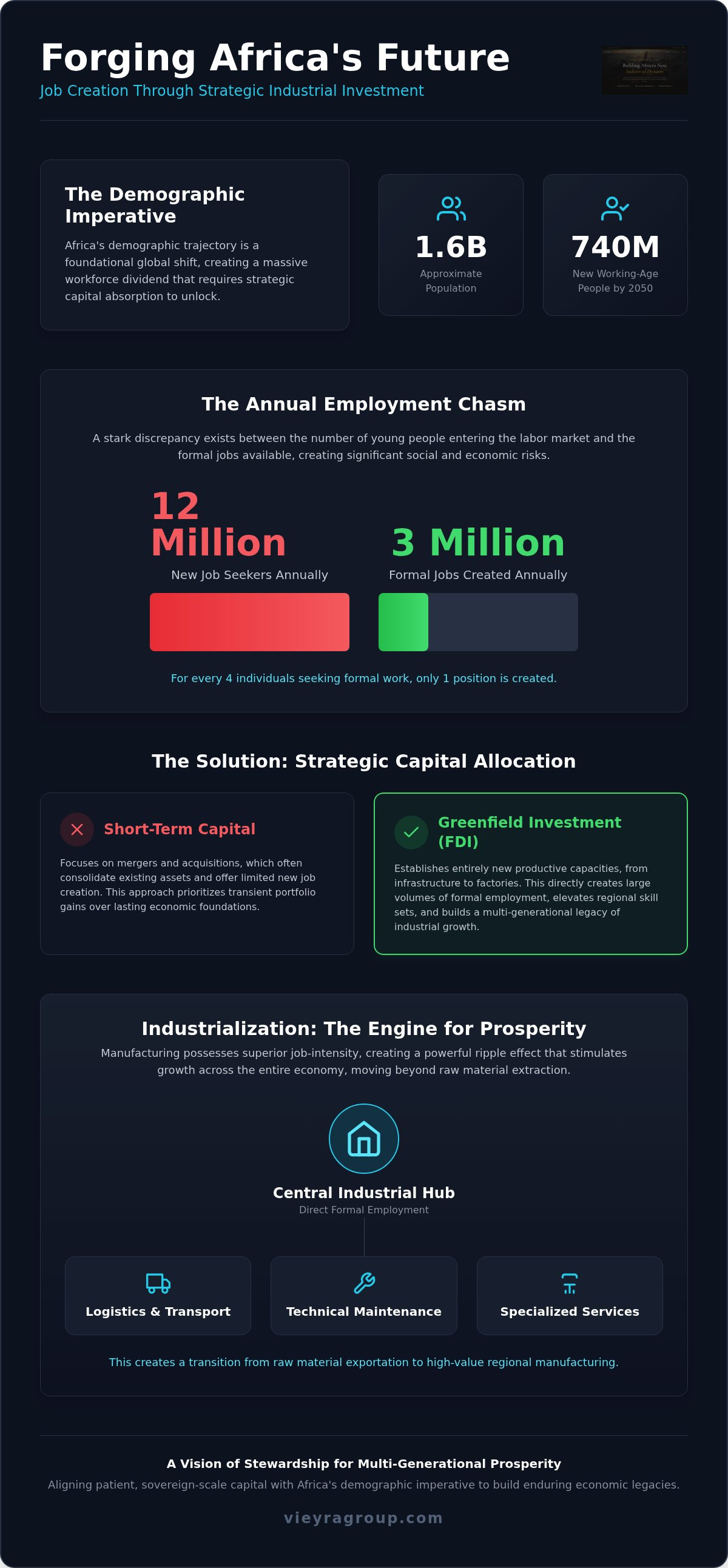
The African continent's demographic trajectory represents a profound inflection point in global economic history, as the population has reached approximately 1.6 billion as of 2026. This expansion is not merely a statistical phenomenon but a foundational shift that demands a recalibrated approach to job creation through industrial investment Africa. The projected increase of 740 million working-age individuals by 2050 creates a "workforce dividend" that remains theoretical until it's met with strategic capital absorption. Traditional service-sector growth, while valuable, often lacks the depth and structural permanence required to anchor a continent-scale economy. Reliance on informal markets or low-productivity services cannot provide the systemic resilience necessary for a global actor of this magnitude.
The Scale of the Employment Deficit
The discrepancy between workforce entry and formal engagement remains stark. Approximately 12 million young Africans enter the labor market annually, yet only 3 million formal wage positions are typically generated. This gap fosters significant social and economic risks, particularly within rapidly expanding urban centers where underemployment can lead to systemic instability. Within the context of African industrial strategy, the demographic surge is defined as a rapid, high-volume expansion of the labor pool that outpaces existing institutional capacity for formal employment. It's a challenge that requires the deliberation of established institutions rather than the frantic pace of retail capital.
Industrialization as a Structural Multiplier
Industrialization serves as the primary engine for converting raw demographic potential into enduring economic power. Unlike primary commodity extraction, which often operates in isolation from the broader domestic economy, manufacturing possesses a superior job-intensity that radiates through multiple layers of society. A study of the history of industrialization in Africa reveals that industrial hubs act as gravity wells for indirect employment, stimulating demand in logistics, technical maintenance, and specialized services. This transition is essential for evolving beyond the mere quantity of roles toward the provision of high-quality, remunerative positions that offer dignity and long-term security. The focus must shift from volatile, short-term capital toward sovereign-scale interventions that recognize industrialization as a multi-generational imperative rather than a transient market opportunity.
The Mechanics of Job-Intensive Capital Allocation
The efficacy of industrial finance is fundamentally determined by the nature of its deployment. While mergers and acquisitions may consolidate market share, it's Greenfield foreign direct investment that serves as the primary catalyst for job creation through industrial investment Africa. These new-build initiatives don't merely transfer existing assets; they establish entirely new productive capacities that require a fresh intake of human capital. This distinction is critical for institutional actors who seek to leave a multi-generational legacy rather than achieving transient portfolio gains. Strategic capital allocation must identify the precise "sweet spot" of capital-to-labor ratios, ensuring that technological sophistication enhances rather than replaces the workforce. This requires the deliberation and foresight of an established institution, moving beyond the reactionary nature of retail capital markets to secure long-term industrial stability.
Greenfield Investment and Formal Employment
Greenfield projects necessitate the construction of physical infrastructure and the recruitment of a workforce from the ground up. This process inherently elevates regional skill sets as employees integrate into global operational standards. To avoid displacing domestic enterprises, sovereign-scale institutions prioritize strategic partnerships that foster local industrial depth. This approach aligns with principles celebrated during UN Africa Industrialization Day. By focusing on asset creation, investors ensure that global capital complements local industrial ambitions. Those investigating Strategic Capital Solutions find that the most resilient models are built on this foundational growth.
Sector-Specific Job Multipliers
Agro-processing bridges the continent's agricultural potential and high-value global markets. Establishing processing hubs within secondary cities allows industrial capital to absorb rural labor surplus while reducing post-harvest losses. Light manufacturing provides a potent entry point for the youth population, offering a transition from informal labor to structured, wage-based employment. The digital-industrial nexus further modernizes this landscape, integrating advanced logistics into traditional manufacturing. By providing structured roles, industrial projects solve the "experience paradox" that hinders young job seekers across the continent. Success in these sectors depends on a visionary approach to capital stewardship that recognizes the interconnectedness of social impact and industrial progress.
Sovereign-Scale Capital as a Stabilizing Force
Global capital markets often exhibit a debilitating short-termism that undermines the very foundations of industrial progress. While traditional foreign direct investment frequently retreats during periods of geopolitical friction, sovereign-scale capital operates with an entirely different temporal horizon. It's this patient, deliberate deployment of resources that provides the necessary institutional gravity to anchor emerging industrial sectors. By prioritizing long-term stability over immediate liquidity, these institutions create the predictable environment required for job creation through industrial investment Africa. This institutional stewardship isn't merely a financial strategy; it's a profound commitment to the permanence of the African industrial landscape that transcends standard market cycles.
The Architecture of Multi-Generational Stewardship
Wealth preservation, when viewed through a sophisticated institutional lens, is intrinsically linked to the successful industrialization of the continent. The Vieyra Family Office serves as a case study in this sovereign-scale investment philosophy, acting as a stately guardian of capital that recognizes the symbiotic relationship between multi-generational wealth and systemic economic transformation. Unlike retail entities, family offices possess the rare capacity to navigate complex multi-jurisdictional regulatory frameworks without compromising their core strategic objectives. They bridge the critical gap between public policy intentions and the rigorous execution required within private industrial sectors. This ensures that capital serves as a lasting foundation for collective prosperity.
Strategic Capital and Risk Mitigation
Large-scale industrial initiatives inherently involve significant early-stage risks that often deter conventional private actors. Sovereign-scale institutions utilize Strategic Capital Solutions to absorb these initial pressures, effectively de-risking the environment to catalyze secondary private investment. This catalytic role is essential for securing industrial corridors that connect regional markets and streamline production. Such efforts directly support the strategic initiatives detailed in Africa's Industrial Development Decade, where the focus has matured from political commitment into tangible, ground-level action. By facilitating these corridors, institutional capital ensures that industrialization remains a continuous, self-sustaining process rather than a series of disconnected projects. This approach builds the resilience necessary to withstand global economic shifts while maintaining a steady trajectory toward industrial maturity.
AfCFTA and the Value Chain Opportunity
The operationalization of the African Continental Free Trade Area (AfCFTA) represents a fundamental departure from the historical reliance on raw material exports. As of the decisive implementation phase in early 2026, the shift from fragmented national policies to a unified continental industrial strategy has become the primary driver of systemic growth. This transition is essential for job creation through industrial investment Africa, as it facilitates the emergence of economic corridors that anchor large-scale infrastructure to localized employment hubs. By moving beyond the limitations of individual domestic markets, the continent can finally establish the industrial depth required for multi-generational stability.
Regional Value Chain Integration
High-potential trade corridors serve as the primary conduits for sovereign-scale industrial capital, allowing for the sophisticated distribution of manufacturing processes across multiple jurisdictions. Strategic capital deployment is the necessary mechanism for overcoming intra-African trade barriers, particularly as the continent rolls out a $3.1 billion unified customs system to digitize cross-border procedures. These integrated logistics networks don't merely facilitate the movement of goods; they generate a dense texture of formal employment in technical maintenance, data management, and specialized transport services. This structural interconnectedness ensures that industrial growth in one region catalyzes productivity in another, creating a resilient web of economic activity.
Industrial Specialization and Market Scale
The AfCFTA provides the requisite market depth to foster continental-scale industrial champions capable of global competitiveness. Moving from small-scale domestic production to high-volume manufacturing is the only viable path to absorbing the burgeoning labor pool. Intra-African trade is projected to reach $230 billion in 2026, a milestone that correlates directly with the expansion of formal manufacturing roles across the continent. This scale allows for industrial specialization, where specific regions develop expertise in key sectors such as automotive assembly or textile production. To participate in this historic consolidation of economic power, institutional actors require African Industrialization Capital that is as enduring as the legacies it seeks to build.
The Vieyra Vision: Stewardship for Multi-Generational Prosperity
The culmination of industrial strategy lies in the synthesis of capital endurance and human flourishing. At the heart of this endeavor is a commitment that transcends traditional profit-seeking, positioning job creation through industrial investment Africa as both a moral and institutional imperative. The Vieyra Family Office operates with the deliberation of a stately guardian, recognizing that true economic transformation requires more than just fiscal deployment. It demands a visionary architecture of legacy where every industrial asset serves as a pillar for societal stability. By aligning Global Investment Management with the specific needs of the continent, we ensure that progress is both permanent and profound.
The Vieyra Foundation and Social Impact
Inclusive growth cannot be achieved through industrialization alone; it requires a parallel commitment to the development of the human spirit and intellect. The Vieyra Foundation acts as a complementary force within our industrial ecosystems, ensuring that philanthropic initiatives are strategically aligned with long-term developmental goals. We recognize that skill development and education are the essential prerequisites for the absorption of high-value industrial roles. By establishing technical training centers and educational frameworks alongside our industrial hubs, we measure our success not merely by capital returns but by the systemic elevation of African communities. This integrated approach ensures that the dividends of industrialization reach every layer of the workforce, fostering a sense of dignity and shared prosperity.
Securing the African Investment Legacy
Maintaining the poise of a global actor requires a deep, unwavering root in the soil of African growth. Our approach is characterized by a methodical pace, reflecting the multi-generational nature of our objectives and the permanence of our presence on the continent. We don't rush to capitalize on transient trends; instead, we build the foundations of a sovereign-scale future. This deliberate stewardship allows us to navigate the complexities of global geopolitics while remaining focused on the structural transformation of African economies. For those who share this vision of patient, impactful capital, the path forward is one of institutional partnership and collective legacy. We invite you to contact the Vieyra Family Office to discuss how strategic capital allocation can secure both wealth preservation and the industrial future of the continent.
Architecting a Continental Legacy
The transition from commodity-dependent economies to sophisticated industrial hubs is no longer a matter of policy preference but a requirement for regional stability. By leveraging the framework of the AfCFTA and focusing on high-multiplier sectors like agro-processing and light manufacturing, the continent can finally realize its demographic potential. Achieving meaningful job creation through industrial investment Africa requires the deliberate stewardship of sovereign-scale institutions that prioritize multi-generational prosperity over transient market gains. This institutional gravity ensures that capital serves as a permanent foundation for growth rather than a volatile visitor. It's through this methodical approach that we bridge the gap between public policy and private execution.
As a sovereign-scale institution with global influence, the Vieyra Family Office remains committed to this profound economic transformation. Our deep expertise in strategic capital allocation allows us to navigate the complexities of multi-jurisdictional frameworks while maintaining a steadfast focus on wealth preservation and industrial legacy. We invite you to explore our commitment to African industrialization and multi-generational stewardship. Together, we can anchor a future defined by systemic resilience and collective advancement. It's a journey toward a more stable and prosperous tomorrow for all.
Frequently Asked Questions
How does industrial investment directly influence job creation in Africa?
Industrial investment acts as a foundational catalyst by establishing physical production facilities that require structured labor. Unlike commodity extraction, which often remains isolated, manufacturing necessitates a broad range of technical and administrative roles. This process accelerates job creation through industrial investment Africa by integrating domestic workers into global value chains. It converts the demographic surge into a productive workforce, fostering economic stability through the provision of formal employment that supports multi-generational livelihoods.
What is the significance of Greenfield FDI for the African workforce?
Greenfield foreign direct investment is essential because it involves the creation of entirely new industrial assets rather than the mere acquisition of existing ones. This development requires the recruitment and training of a fresh workforce, directly addressing the employment deficit. By building factories and logistics hubs from the ground up, investors establish permanent infrastructure that anchors regional economies. Such projects elevate local skill sets to meet international standards, ensuring the workforce stays competitive in a digitized market.
How does the African Continental Free Trade Area (AfCFTA) impact industrial jobs?
The AfCFTA creates a unified market of 1.6 billion people, allowing industrial enterprises to achieve the scale necessary for global competitiveness. This expanded market depth encourages specialization and the formation of regional value chains, which in turn stimulates diverse employment opportunities. As intra-African trade is projected to reach $230 billion in 2026, the demand for manufacturing and technical services will rise. This shift from domestic to continental strategy ensures that industrial hubs can sustain a larger workforce.
Why is manufacturing considered the most job-intensive sector for African development?
Manufacturing is uniquely job-intensive due to its extensive backward and forward linkages within the broader economy. For every direct role created in a factory, multiple indirect positions emerge in raw material supply, transport, and professional services. This sector provides a structured path for youth to transition from informal labor to formal wage employment. By processing resources domestically, manufacturing retains the value that would otherwise be exported, maximizing the employment potential of the continent's abundant natural wealth.
What role do family offices play in African industrialization?
Family offices provide the patient, sovereign-scale capital required to navigate the long-term horizons of industrial development. Unlike volatile retail investors, these institutions operate with a multi-generational vision that prioritizes stability and wealth preservation through systemic growth. They act as stately guardians of capital, bridging the gap between public policy objectives and private sector execution. Their presence offers the institutional gravity needed to anchor large-scale projects, ensuring that industrialization remains a steady and deliberate process for the continent.
How can sovereign-scale capital mitigate the risks of industrial investment in Africa?
Sovereign-scale capital mitigates risk by absorbing early-stage pressures that often deter conventional private equity. Through Strategic Capital Solutions, these institutions provide the fiscal resilience necessary to withstand geopolitical shifts and market cycles. Their deep expertise in navigating multi-jurisdictional regulatory frameworks allows for more secure capital allocation. By de-risking the environment, they catalyze secondary private investment, ensuring that essential industrial corridors receive the sustained funding required for completion and long-term operational success across various African regions.
What is the projected employment impact of African agro-industry by 2050?
The agro-industry is projected to be a primary driver of labor absorption for the 740 million additional working-age individuals expected by 2050. By establishing processing facilities in secondary cities, this sector bridges the gap between rural production and urban consumption. It reduces post-harvest losses and creates high-value roles in food technology and logistics. This strategic deployment of capital ensures that the workforce dividend is captured across diverse geographies, preventing the over-saturation of primary metropolitan centers.
How does the Vieyra Foundation support the broader industrial investment strategy?
The Vieyra Foundation serves as a complementary force by aligning philanthropic initiatives with the needs of industrial ecosystems. It focuses on skill development and education, ensuring that local populations possess the technical proficiency required for modern industrial roles. This integrated approach ensures that job creation through industrial investment Africa results in inclusive growth. By measuring the systemic impact on communities, the Foundation reinforces the institutional commitment to multi-generational prosperity and the creation of an enduring economic legacy.


