
True multi-generational stewardship requires more than the mere preservation of liquid assets; it demands the architectural foresight and systemic deliberation typically reserved for nation-states. Traditional wealth management models often fail to account for the gradual erosion of capital caused by shifting geopolitical landscapes and the historical disconnect between private assets and regional industrial growth. To transcend these systemic vulnerabilities, the adoption of a sovereign scale family office investment strategy is essential for those who intend to transform substantial wealth into a permanent instrument of global influence. This institutional approach ensures that the scale of operations is matched by the depth of strategic intent, positioning the family as a visionary architect of industrial legacy.
You recognize that the ultimate security of a dynasty is inextricably linked to the prosperity of the economies it helps to build. This article provides an authoritative exploration of how sovereign-scale entities orchestrate complex capital allocation to drive systemic industrialization. We shall examine a blueprint for institutional-grade governance that aligns global portfolios with large-scale development projects, creating a resilient framework for multi-generational stewardship. This analysis offers the clarity required to navigate current geopolitical volatility, ensuring that your capital serves as a stately guardian of progress and a cornerstone of regional stability.
Key Takeaways
- Establish institutional-grade governance by constructing a sophisticated Investment Policy Statement that facilitates the deployment of capital across multiple generations.
- Adopt a sovereign scale family office investment strategy to transition from passive wealth preservation to the active orchestration of systemic industrial influence.
- Leverage industrialization as a strategic pillar to provide a superior hedge against global market volatility and secure long-term asset appreciation.
- Build a resilient sovereign system that mitigates geopolitical risk by ensuring your portfolio operates independently of localized economic disruptions.
- Utilize strategic capital solutions to align global investment portfolios with regional industrialization, ensuring the permanence of your family's multi-generational legacy.
The Mandate of Sovereign-Scale Capital: Beyond Traditional Wealth Management
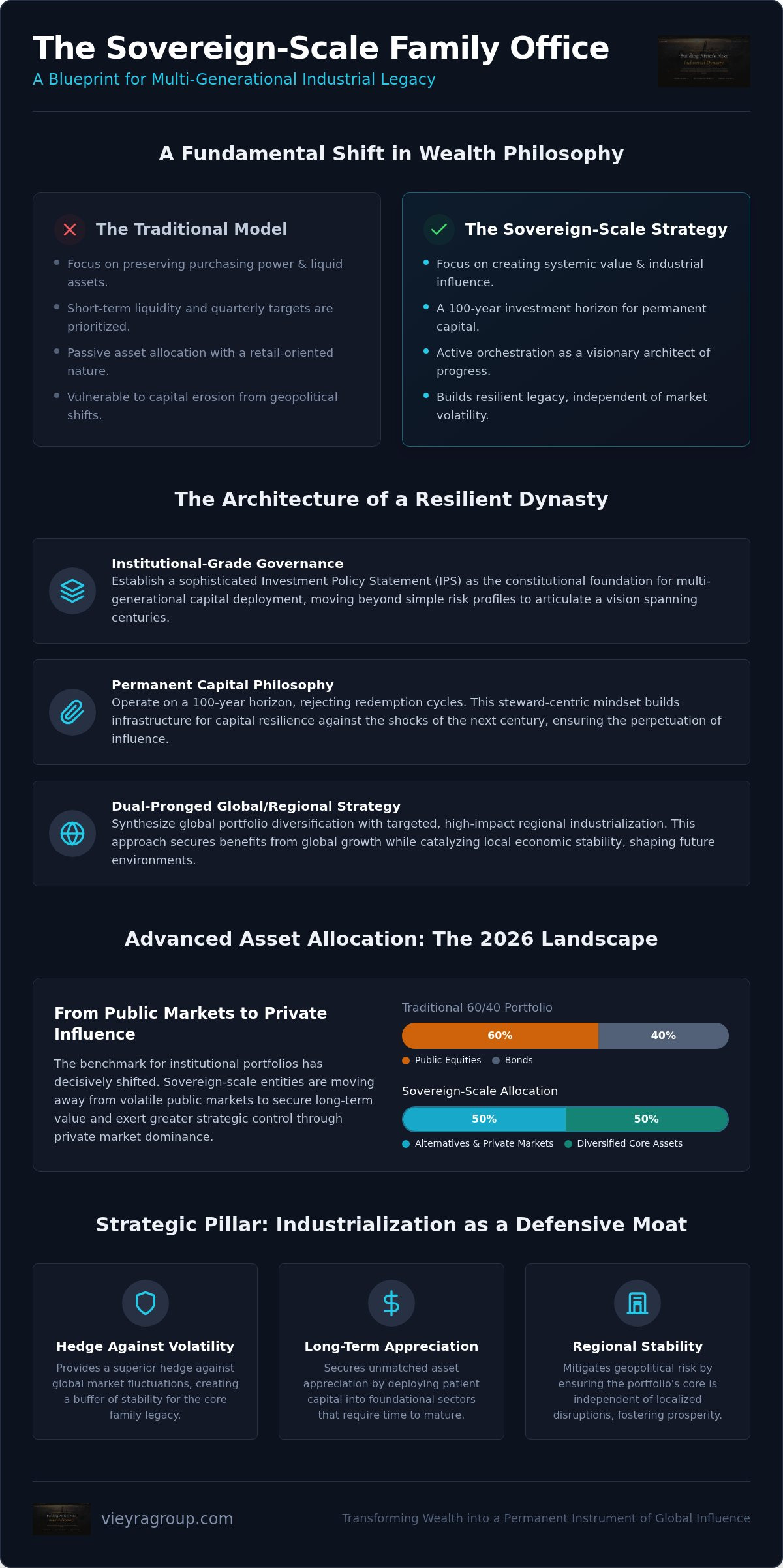
The transition of a Family office from an administrative vehicle into a sovereign-scale entity represents a fundamental shift in the philosophy of private wealth. While traditional management models emphasize the preservation of purchasing power through liquid benchmarks, a sovereign scale family office investment strategy prioritizes the creation of systemic value across decades. This approach isn't defined by assets under management alone. It's defined by the institutional gravity with which a dynasty engages with global markets. It rejects the fragmented, retail-oriented nature of conventional private banking, which often prioritizes short-term liquidity and fee-driven turnover. Instead, sovereign-scale capital operates with the deliberation of a state actor, seeking to influence the very industrial landscapes it inhabits.
Institutional Gravity and the Permanence of Capital
The concept of permanent capital serves as the bedrock of this framework. Unlike institutional funds governed by redemption cycles, a sovereign-scale office manages a 100-year investment horizon where the objective is the perpetuation of influence rather than the hitting of quarterly targets. This requires a profound psychological transition from the role of an owner to that of a steward. Stewards don't merely extract value; they build the infrastructure that ensures capital remains resilient against the inevitable shocks of the next century. By prioritizing systemic impact, these entities create a buffer of stability that protects the family legacy from the volatility inherent in speculative markets. This composure allows for the patient deployment of capital into sectors that require time to mature but offer unmatched defensive qualities.
Synthesizing Global Markets with Regional Interests
Operating as a non-state sovereign actor provides a unique strategic advantage. It allows for the seamless integration of global portfolio diversification with targeted, high-impact African industrialization projects. This duality ensures that while the family benefits from global growth, it also acts as a primary catalyst for regional economic stability. Sovereign-scale investment is a mechanism for shaping future economic environments. By directing strategic capital solutions toward foundational industries, the family office moves beyond the limitations of passive asset allocation. It becomes a visionary architect, ensuring that the legacy is defined by the enduring industrial progress it facilitates rather than the simple accumulation of wealth. This alignment of capital with regional industrial growth creates a symbiotic relationship that secures both the family's future and the economic health of the territories it serves.
The Architecture of a Sovereign-Scale Investment Strategy
The construction of a robust Investment Policy Statement (IPS) serves as the constitutional foundation for multi-generational deployment. This document transcends simple risk-return profiles, articulating a vision that spans centuries. In a sovereign scale family office investment strategy, capital is organized into tiered structures to ensure both permanence and progress. The core preservation bucket ensures the absolute stability of the family’s base assets, utilizing low-volatility instruments to guard against erosion. Conversely, the strategic growth bucket focuses on large-scale industrialization and systemic advancement. Managing the delicate balance between immediate liquidity requirements and long-term capital commitments requires a sophisticated internal treasury function that mirrors the methodical operations of a central bank.
Advanced Asset Allocation in the 2026 Landscape
As we navigate the economic environment of 2026, the benchmark for institutional-grade portfolios has shifted significantly toward private markets. Sovereign-scale entities now frequently allocate between 45% and 50% of their total assets to alternatives, a marked departure from traditional 60/40 models. This transition reflects a calculated move away from public market volatility toward the predictable cash flows of private debt and large-scale infrastructure projects. These assets provide essential inflation-hedged returns while anchoring the portfolio in tangible industrial progress. Impact mandates aren't merely peripheral considerations; they're integrated into the core financial architecture. This ensures that every deployment of capital contributes to a sustainable global order while securing the family’s position as a primary actor in regional development.
Governance Protocols and the Investment Committee
Resilience is underpinned by a governance structure that emulates the oversight and accountability of a sovereign wealth fund. Establishing an investment committee composed of seasoned professionals and independent directors is a vital step in professionalizing the office. These external voices provide the necessary distance to mitigate familial emotional bias, ensuring that every decision is filtered through a lens of professional rigor and strategic alignment. Institutional discipline is mandatory. Formalizing these protocols allows for the seamless orchestration of large-scale capital deployment across diverse jurisdictions and complex asset classes. For families seeking to refine these structures, engaging with specialists in global investment management provides the institutional depth required to execute such a complex vision. This formalization transforms the office into a deliberative body capable of making profound, long-range strategic commitments that define a legacy.
Industrialization as a Strategic Pillar for Wealth Preservation
The implementation of a sovereign scale family office investment strategy necessitates a departure from the ephemeral trends of public equities toward the tangible permanence of industrial assets. Industrialization constitutes the physical manifestation of permanent capital. It offers a defensive posture that liquid benchmarks simply cannot replicate. By anchoring wealth in the productive capacity of a region, a family ensures its legacy is tied to the fundamental survival and expansion of the economy. These assets serve as a superior hedge against global market volatility because their value is derived from essential utility rather than speculative sentiment. It's a method of wealth preservation that transforms capital into a foundational component of the global supply chain.
Direct participation in large-scale industrial projects provides a level of transparency and control that fund structures often obscure. Sovereign-scale entities possess the requisite capital depth to engage directly with state actors, facilitating the formation of public-private partnerships (PPPs) that remain inaccessible to standard private investors. These collaborations allow the office to secure favorable regulatory positioning while contributing to national development goals. This synergy between infrastructure investment and multi-generational asset growth creates a self-reinforcing cycle of stability and influence. It doesn't just preserve wealth; it builds the very economic environments where that wealth can thrive.
The African Industrialization Opportunity
The continent presents a unique landscape for the deployment of African Industrialization Capital, particularly within the energy, manufacturing, and logistics sectors. Identifying high-growth infrastructure projects requires an institutional lens that prioritizes systemic impact over immediate yield. The family office acts as a primary catalyst for regional economic transformation, providing the patient capital necessary to modernize supply chains and power grids. The Vieyra approach to industrial finance is characterized by a sophisticated synthesis of multi-generational heritage and forward-looking institutional rigor. This perspective ensures that every industrial commitment is measured by its ability to foster long-term regional prosperity.
Risk Mitigation in Sovereign-Level Industrial Projects
Navigating jurisdictional complexity in emerging markets demands a high degree of professional rigor and a deep understanding of local regulatory frameworks. Strategic capital solutions are essential for de-risking these large-scale projects, often serving as the primary anchor that attracts secondary institutional investors. By providing the initial layer of strategic capital, the sovereign-scale office establishes the governance standards and operational benchmarks required for project success. This leadership role is vital for ensuring that complex industrial initiatives remain resilient against localized economic shocks.
The Vieyra Foundation plays a critical role in this framework by aligning social impact mandates with industrial growth. This alignment ensures that industrialization isn't merely a financial exercise but a holistic contribution to societal stability. Integrating philanthropic oversight into the core investment strategy reinforces the family's position as a stately guardian of progress. It secures the social license to operate, which is as foundational to long-term wealth preservation as the financial returns themselves.
Navigating Geopolitical Risk and Institutional Resilience
Risk management in the contemporary era has evolved beyond the calculation of standard deviation or portfolio volatility. A sovereign scale family office investment strategy recognizes that capital is never truly safe if it remains tethered to a single jurisdiction or economic cycle. By constructing a 'Sovereign System', an office creates an institutional buffer that operates independently of localized economic shocks. This system relies on profound jurisdictional diversification that goes beyond simple offshore accounts. While hubs like Singapore and Hong Kong now host approximately 15% of the world's family offices, the objective for a sovereign-level entity is not just presence. It's the ability to move capital with the deliberation of a non-state actor. This independence ensures that the family's core assets remain untouched by regional instability, providing a foundation of permanence that survives the rise and fall of local regimes.
Geopolitical Stewardship in an Interconnected World
The impact of global trade shifts on African industrial assets demands a proactive stance. Hedging against currency fluctuations in emerging markets isn't just a technical requirement. It's a strategic necessity for maintaining the real value of long-term infrastructure commitments. The family office functions as a diplomatic actor within international investment circles, utilizing its scale to negotiate terms that protect its interests across borders. This level of engagement ensures that the dynasty remains a participant in global policy discussions rather than a passive observer of them. It's about securing a seat at the table where the rules of global commerce are written, ensuring that regional developments are aligned with the family's broader strategic objectives.
The Architecture of Resilience: Talent and Technology
Resilience is built upon the quality of the institution's human and technological capital. Attracting institutional-grade talent from sovereign wealth funds and global banks is essential for maintaining the professional rigor required at this scale. These professionals bring a level of expertise that transcends traditional wealth management. They allow the office to leverage advanced analytics for real-time risk assessment across diverse asset classes, identifying vulnerabilities before they manifest as crises. Succession planning is equally vital. By institutionalizing the office, a family ensures that its vision survives leadership transitions. It creates a structure where the mission is more significant than any single individual, maintaining a steady trajectory across generations.
To achieve this level of institutional permanence, families must employ Strategic Capital Solutions that integrate risk mitigation into the very fabric of their global operations. This commitment to resilience transforms the family office into a stately guardian, capable of navigating the complexities of the 21st century with the poise of an established institution. It ensures that the legacy isn't merely preserved but is actively fortified against the unpredictable currents of global geopolitics.
The Vieyra Framework: Orchestrating Global and Regional Impact
The integration of institutional rigor with multi-generational heritage defines the essence of the Vieyra Framework. It's a philosophy that views capital not merely as a resource for accumulation, but as a primary instrument for systemic change. By embedding the family’s core values into the investment DNA, the office ensures that every deployment of capital reflects a commitment to permanence and prestige. A sovereign scale family office investment strategy within this framework requires a profound alignment between private objectives and public progress. It's the deliberate orchestration of global influence to facilitate sovereign-level economic development, ensuring that the dynasty remains a relevant and constructive actor on the world stage for centuries to come.
The Vieyra Approach to Strategic Capital Allocation
Effective allocation requires a sophisticated synthesis of global market intelligence and deep regional expertise. The Vieyra Approach to Global Stewardship prioritizes the deployment of capital into high-impact African industrial hubs, where the need for foundational infrastructure remains acute. This strategy focuses on the creation of integrated logistics networks and energy systems that serve as the backbone of regional commerce. By providing Strategic Capital Solutions, the office de-risks these essential projects, allowing for the participation of secondary institutional partners. This approach transforms the family office into a visionary architect of industrial landscapes, where the success of the investment is measured by the enduring stability it brings to the broader economic ecosystem.
Securing the Legacy: Philanthropy and Industrial Progress
A resilient legacy transcends the boundaries of financial returns to include a commitment to systemic progress. The Vieyra Foundation serves as a vital complement to the core investment mandate, ensuring that the family’s philanthropic efforts are strategically aligned with its industrial initiatives. This alignment creates a holistic model of stewardship where social impact and economic growth are mutually reinforcing. It's a method of building a legacy that is deeply rooted in the success of the communities it serves. Families seeking to elevate their institutional presence must move beyond the limitations of traditional wealth management to embrace a more expansive role as guardians of regional prosperity.
The path forward requires a transition toward institutional-grade governance and the adoption of a truly sovereign perspective. Engaging with the Vieyra Family Office for sovereign-scale collaboration provides the strategic depth and operational expertise necessary to execute this vision. By professionalizing the office and aligning capital with large-scale industrialization, a dynasty secures its position as a permanent fixture in the global economic order. This is the ultimate objective of the framework. It's the preservation of heritage through the active creation of a better, more stable future.
Architecting the Permanent Institution
The transition toward a sovereign scale family office investment strategy represents a definitive shift from the management of private wealth to the stewardship of a global institution. This framework demands the construction of a resilient architecture where capital is deployed with the deliberation of a state actor, prioritizing systemic industrialization over transient market trends. By professionalizing governance and embracing jurisdictional diversification, a dynasty secures its assets against the erosion of time and the volatility of contemporary geopolitics. This evolution ensures that the family office functions as a visionary architect, capable of shaping the economic landscapes of the future while maintaining the stability of its multi-generational heritage.
The synthesis of deep African heritage with sophisticated global investment management provides the institutional depth required to navigate this complex trajectory. We invite you to Explore the Vieyra Family Office Institutional Framework to align your legacy with the principles of sovereign-scale capital allocation and industrial finance. Establishing such a framework is an enduring commitment to progress, positioning your family as a stately guardian of regional prosperity and a permanent actor within the global economic order. Your trajectory toward systemic influence and multi-generational permanence begins with the professionalization of your strategic vision.
Frequently Asked Questions
What defines a sovereign-scale investment strategy for a family office?
A sovereign-scale strategy is defined by the intentional deployment of capital to shape industrial landscapes, mirroring the deliberation and foresight of a state actor. It represents a shift from passive wealth preservation to active systemic influence. A sovereign scale family office investment strategy prioritizes institutional gravity and a 100-year investment horizon. This approach focuses on permanent capital and systemic impact. It requires the family to act as a stately guardian of progress rather than a mere participant in financial markets.
How do family offices manage the risks associated with African industrialization?
Managing the complexities of African industrialization requires a synthesis of jurisdictional diversification and the application of strategic capital solutions. Sovereign-scale entities utilize their institutional weight to form public-private partnerships, securing favorable regulatory positioning. By acting as primary anchor investors, they establish the governance standards required to de-risk projects for secondary institutional partners. This leadership role ensures that infrastructure initiatives remain resilient against localized shocks, aligning private capital with the fundamental economic survival and expansion of the region.
What is the typical asset allocation for a sovereign-scale family office in 2026?
In the 2026 economic landscape, sovereign-scale portfolios have transitioned toward a 45% to 50% allocation in alternative assets. This strategic shift reflects a move away from the volatility of public equities toward private debt and large-scale infrastructure. These assets provide predictable cash flows and essential inflation-hedged returns. The remaining capital is typically organized into tiered structures, ensuring the institution remains resilient against global trade shifts while maintaining the necessary liquidity for multi-generational stewardship and long-term capital commitments.
Why is an Investment Policy Statement (IPS) critical for multi-generational wealth?
An Investment Policy Statement serves as the constitutional foundation that governs capital deployment across multiple generations. It articulates a vision that transcends individual leadership, ensuring that the office’s strategic mission remains constant. A robust IPS formalizes decision-making protocols and mitigates familial emotional bias. By defining the parameters for a sovereign scale family office investment strategy, it provides the institutional discipline required to maintain a steady trajectory. This document is essential for protecting the dynasty’s legacy from the unpredictability of market sentiments.
How can a family office transition from passive investing to sovereign-level capital deployment?
Transitioning begins with professionalizing governance and attracting institutional-grade talent from global banks or sovereign wealth funds. The office must move beyond retail-oriented private banking models toward an internal treasury function that manages long-term capital commitments. This process involves establishing an independent investment committee and formalizing oversight protocols. By adopting a proactive stance on industrialization and regional stewardship, the office evolves into a significant global actor. It becomes a visionary architect capable of orchestrating complex capital allocation to drive systemic industrialization.
What role does philanthropy play in a sovereign-scale investment framework?
Philanthropy functions as a strategic complement to the core investment mandate, ensuring that capital deployment generates holistic societal value. Within the Vieyra framework, the Vieyra Foundation aligns social impact with industrial growth. This alignment secures the social license to operate in emerging markets and reinforces the family’s position as a stately guardian of progress. It transforms wealth into an instrument for systemic progress, ensuring the legacy includes a commitment to the fundamental health and stability of the regions it inhabits.
How does the Vieyra Family Office balance global investments with African regional growth?
Balancing these interests requires the seamless integration of a diversified global portfolio with targeted African industrialization capital. The office maintains global liquidity to guard against localized shocks while directing strategic capital toward foundational industries like energy and logistics. This duality ensures the family benefits from global growth while acting as a primary catalyst for regional economic transformation. It's a methodical approach that synthesizes multi-generational heritage with the forward-looking rigor of a sovereign-level institution, securing both the family’s future and regional stability.


