
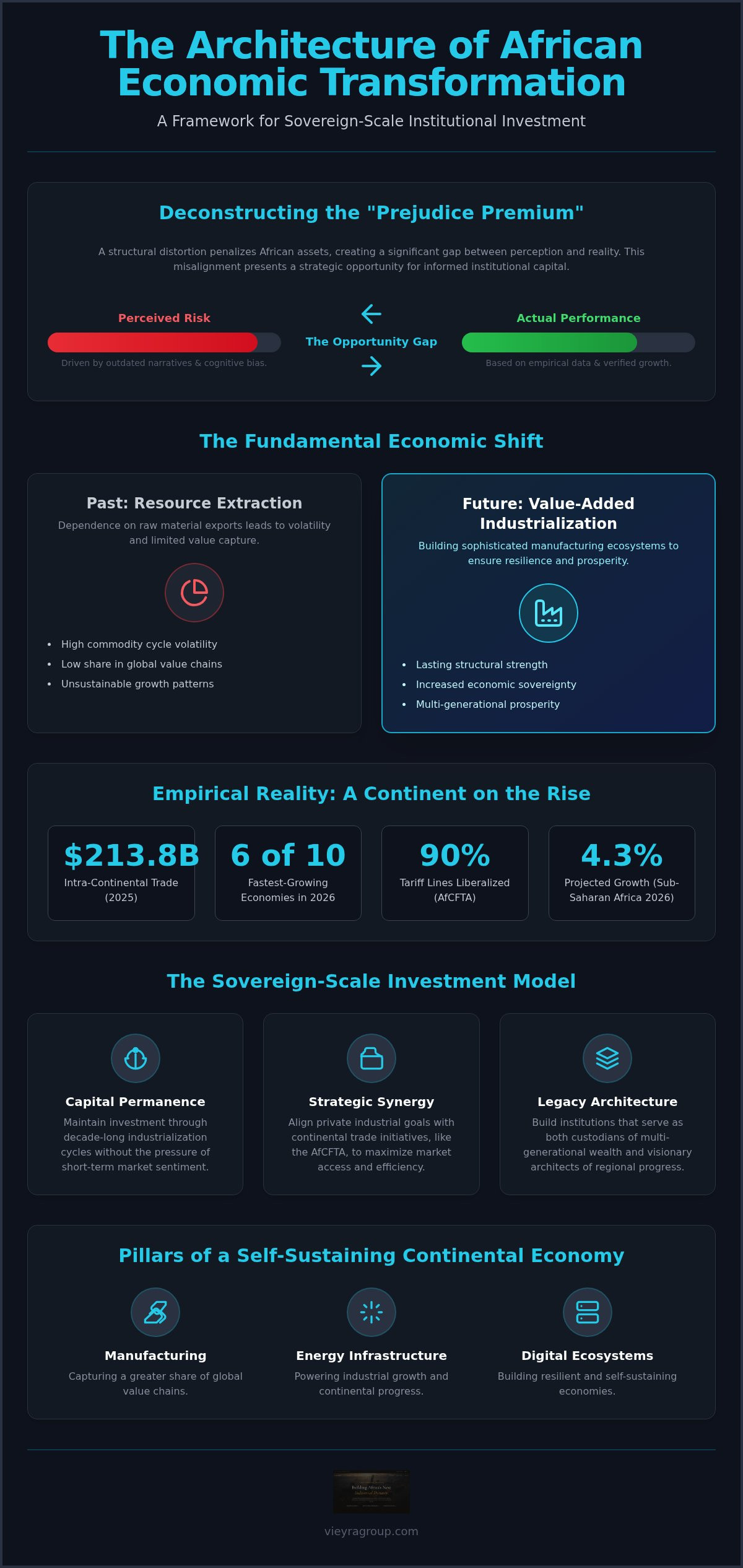
The systemic mispricing of African assets, driven by an enduring "Prejudice Premium," represents perhaps the most significant intellectual failure in contemporary global finance, where cognitive bias often outweighs empirical growth. While international discourse remains tethered to outdated narratives of instability, the strategic reality is that African economic transformation investment now commands a landscape where intra-continental trade reached an unprecedented $213.8 billion in 2025. It's evident that the ephemeral nature of short-term capital is fundamentally ill-suited for the rigorous demands of large-scale industrialization and the structural economic shifts required for true continental sovereignty.
This exploration serves as a definitive guide for the deployment of sovereign-scale institutional capital, offering a sophisticated framework designed to catalyze permanent industrial growth across the continent. We'll articulate a vision for long-term capital allocation that aligns with the operational phase of the AfCFTA, focusing on the strategic depth required to transform foundational sectors like energy and infrastructure through enduring partnerships with established African family offices. By moving beyond the reactionary cycles of traditional markets, we provide the architectural blueprint for a legacy of institutional stability and multi-generational prosperity.
Key Takeaways
- Understand the fundamental transition from resource extraction to value-added industrialization as the primary mechanism for achieving enduring structural economic shifts.
- Analyze the systemic causes of the "Prejudice Premium" and the institutional methodologies required to correct the misalignment between perceived risk and actual market performance.
- Examine a sovereign-scale model for African economic transformation investment that leverages permanent capital to anchor long-term industrialization cycles.
- Evaluate the strategic role of manufacturing, energy infrastructure, and digital ecosystems in building a resilient and self-sustaining continental economy.
- Learn how the integration of multi-generational stewardship and industrial capital serves to preserve African legacies while driving systemic global progress.
The Architecture of African Economic Transformation
Realizing sustainable growth requires moving beyond the volatility of commodity cycles toward a framework of institutional gravity. This gravity anchors developmental cycles, ensuring that capital remains committed through the inevitable fluctuations of global markets. Sovereign-scale African economic transformation investment transcends traditional emerging market strategies by prioritizing the creation of foundational assets over speculative yield. It necessitates a rigorous alignment with the African Continental Free Trade Area (AfCFTA) frameworks, which have already seen 90% of tariff lines liberalized to foster a unified, competitive market across the continent. By anchoring capital in industrial logic rather than short-term arbitrage, institutions can catalyze a shift that is both permanent and systemic.
Beyond GDP: The Depth of Economic Shift
The metrics of success must evolve from aggregate growth figures to the qualitative depth of economic resilience. Diversification and productivity stand as the twin pillars of this transition. By pivoting from the exportation of raw materials toward the establishment of sophisticated manufacturing ecosystems, the continent captures a greater share of global value chains. Industrialisation in Africa is no longer an aspirational goal but a strategic imperative for institutional actors seeking to mitigate the risks of resource dependency. Economic transformation is a systemic realignment of productive forces designed to transition labor and capital from low-productivity activities into high-value industrial sectors. This shift ensures that the projected 4.3% growth for Sub-Saharan Africa in 2026 translates into lasting structural strength rather than transient wealth accumulation.
The Institutional Mandate for Change
Family offices are uniquely positioned to act as the vanguard of this shift, providing the patient capital that traditional public markets often lack. Their multi-generational horizon allows for the absorption of initial complexities in exchange for the stability of long-term industrial assets. This institutional approach creates a synergy between global investment standards and deep-seated local expertise. It's this fusion that enables the deployment of capital into sectors that require long lead times but offer profound systemic impact.
Key advantages of this sovereign-scale approach include:
- Capital Permanence: The ability to maintain investment through decade-long industrialization cycles without the pressure of quarterly redemptions or short-term market sentiment.
- Strategic Synergy: Aligning private industrial goals with continental trade initiatives, such as the AfCFTA, to maximize cross-border market access and logistics efficiency.
- Legacy Architecture: Building institutions that serve as both custodians of multi-generational wealth and visionary architects of regional progress.
Establishing a multi-generational vision isn't just a preference; it's a prerequisite for the scale of impact required to transform continental economies. When capital is deployed with the deliberation of a sovereign entity, it ceases to be a mere financial instrument and becomes a tool for architectural change.
Deconstructing the Prejudice Premium and Risk Misalignment
The "Prejudice Premium" isn't merely a financial anomaly; it's a structural distortion that penalizes African jurisdictions through inflated borrowing costs that often bear little relation to underlying fiscal realities. Global credit agencies frequently operate within cognitive bottlenecks, where historical biases overshadow present-day industrial data and verified growth projections. Sophisticated African economic transformation investment requires an institutional capacity to look past these distortions and engage with the empirical reality of a market where six of the ten fastest-growing economies in 2026 are projected to be in Africa. By utilizing deep-sector expertise and a permanent presence, sovereign-scale actors identify where perceived risk diverges from actual performance, allowing for the deployment of capital into high-growth corridors that traditional markets overlook due to systemic myopia.
The Cognitive Justice Framework
Challenging the standard risk-reward models applied to African industrial projects is essential for any institution seeking to architect a lasting legacy. Standard models often fail to account for the unique socio-economic dynamics and the rapid liberalization of trade across the continent. We advocate for a "Cognitive Justice" approach, which prioritizes cultural fluency in institutional decision-making. This transition from basic risk-aversion to risk-sophistication allows for the identification of new pathways to job creation through service-led and digital industrialization. It's not about ignoring risk, but about understanding it with the precision that only a permanent, locally-rooted institution can provide. This ensures that investment decisions are based on structural potential rather than superficial sentiment.
Blended Finance and Capital Stack Optimization
Strategic capital serves as a stabilizer for local financial ecosystems by providing the institutional gravity necessary to weather global volatility. By optimizing the capital stack, investors can de-risk large-scale infrastructure and industrial assets through the use of blended finance instruments. This involves leveraging diverse capital sources to bridge the gap between short-term liquidity needs and the long-term developmental horizons of the continent. When institutional gravity is applied to these projects, it reduces the volatility that often plagues traditional emerging market portfolios. This methodology ensures that capital isn't just deployed but is anchored in a way that preserves wealth across generations through deliberate African economic transformation investment. For those seeking to align their portfolios with these systemic shifts, exploring Strategic Capital Solutions offers a sophisticated entry point into the continent's industrial future.
Strategic Capital Deployment into Industrialization
The transition from passive portfolio management to active industrial stewardship marks the definitive boundary between traditional finance and sovereign-scale African economic transformation investment. While the previous discourse addressed the intellectual correction of risk perceptions, the practical deployment of capital requires a rigorous focus on manufacturing, energy infrastructure, and digital ecosystems. These sectors aren't merely investment categories; they're the foundational pillars upon which continental sovereignty is constructed. By prioritizing African Industrialization Capital, institutions ensure that their wealth preservation strategies are anchored in tangible assets that produce recurring value across multiple decades. This approach demands a sophisticated understanding of regulatory complexities, where the objective is to harmonize private profit with the broader developmental trajectories of host nations.
The Industrialization Imperative
Large-scale industrial projects serve as the bedrock of multi-generational wealth because they're inherently resilient to the volatility of global liquid markets. In sectors like energy and logistics, the creation of robust value chains allows for the integration of local SMEs into global markets, fostering a broader base of economic stability. This integration is increasingly informed by sustainable practices, as evidenced by the adoption of circular economy roadmaps across various jurisdictions. These roadmaps provide a structured approach to waste reduction and resource efficiency, ensuring that industrial growth doesn't come at the expense of ecological longevity. It's a strategic alignment where ESG metrics are no longer peripheral considerations but are central to the investment's core thesis, ensuring that the legacy built is both profitable and ethically sound.
Sovereign-Scale Partnerships
Navigating the geopolitics of large-scale capital deployment requires a level of deliberation that transcends typical private equity models. Joint ventures between established family offices and sovereign wealth funds create a formidable alliance, blending private sector agility with the long-term mandate of the state. These partnerships are essential for securing the necessary regulatory support and ensuring that capital allocation remains aligned with national developmental goals. It's a delicate balance of interests that requires constant stewardship and a deep commitment to the region's future. By operating with the poise of a significant global actor, the Vieyra Family Office facilitates these complex arrangements, ensuring that every deployment of Strategic Capital Solutions contributes to a cohesive architecture of continental progress. This methodical approach to partnership ensures that institutional gravity remains a stabilizing force throughout the investment lifecycle.
The Multi-Generational Horizon and Wealth Preservation
The advantage of the permanent capital vehicle lies in its immunity to the redemption pressures that often dictate the behavior of traditional fund structures. This stability acts as a catalyst for African economic transformation investment, allowing for the patient cultivation of industrial assets that require extended horizons to reach full operational maturity. By institutionalizing these investment frameworks, the Vieyra Family Office ensures that the preservation of African legacies isn't left to the caprice of market sentiment but is instead secured through the ownership of essential infrastructure. Navigating the inherent volatility of emerging markets requires a multi-generational patience that views cyclical downturns not as crises, but as periods of consolidation within a much larger trajectory of continental growth. It's this deliberation that transforms capital from a transient resource into a permanent pillar of stability.
The Science of Legacy Architecture
Structuring a portfolio to withstand global fluctuations necessitates a shift toward industrial backing, where revenue streams are derived from the fundamental needs of a growing population. The Vieyra Foundation plays a critical role here, aligning philanthropic initiatives with systemic progress to ensure that the social license to operate remains robust across decades. The allocation of a significant portion of the $2.1 trillion in assets held by African institutional investors into productive industrial capacity creates a direct correlation between the expansion of regional manufacturing and the long-term solvency of the estates that fund them. This architectural approach to wealth ensures that capital remains a tool for progress rather than a victim of inflation or currency devaluation. Industrial assets provide the tangible security required to anchor an estate through centuries of change.
Stewardship in a Global Context
Maintaining a position as a global actor requires a sophisticated balance between African-centric industrial commitments and a diversified global portfolio. The institutionalization of the family office model allows for a level of poise and deliberation that is often absent in the frenetic pace of modern finance. It's this composure that enables a sovereign-scale entity to navigate complex geopolitical shifts without compromising its core mission of continental transformation. By acting as both a stately guardian of heritage and a visionary architect of the future, the institution provides a template for how private capital can drive large-scale progress while maintaining global influence. Capital becomes a tool for architectural change. To align your institutional objectives with this multi-generational vision, we invite you to explore our Global Investment Management framework.
The Vieyra Framework for Continental Transformation
The Vieyra Family Office operates with a mandate that transcends conventional financial management, functioning instead as a sovereign-scale architect of regional stability. This framework integrates three critical dimensions: the deployment of African Industrialization Capital, the exercise of global stewardship, and the systemic alignment of the Vieyra Foundation. By unifying these elements, the institution ensures that every allocation of capital serves a dual purpose: the preservation of multi-generational wealth and the structural advancement of the continent. This approach recognizes that true African economic transformation investment isn't a series of isolated transactions but a cohesive narrative of industrial growth. The institution serves as a stately guardian, ensuring that the trajectory of progress remains steady despite the inevitable shifts in the global geopolitical climate. It's a mandate for permanence.
Strategic Capital Solutions
Tailored allocation strategies are essential when navigating the complexities of large-scale industrial projects that define the African century. Our methodology prioritizes the synergy between institutional expertise and regional development, ensuring that capital is directed toward foundational assets like energy grids and manufacturing hubs. By positioning the institution as a visionary architect, we provide the Strategic Capital Solutions required to bridge the gap between continental potential and realized industrial capacity. This isn't merely about funding projects. It's about designing the economic infrastructure that will support the next century of growth. We focus on sectors where institutional gravity can provide the most significant stabilizing effect, ensuring that regional ecosystems are integrated into the global value chain with precision and deliberation.
A Call for Institutional Alignment
The scale of the challenges and opportunities across the continent requires more than individual effort; it demands a collective alignment among sovereign-scale entities and institutional investors. By fostering strategic partnerships, we amplify the impact of our stewardship, creating a unified front against the market distortions discussed in previous chapters. Finalizing this vision requires a shared commitment to deliberate stewardship and a rejection of the short-termism that has historically hampered continental progress. We invite those who share this multi-generational perspective to join us in constructing a legacy that is both enduring and transformative. The future of the continent depends on the foresight of its most significant actors. We encourage you to engage with the Vieyra Family Office vision for African industrialization and participate in the architectural work of building a resilient, industrialized Africa.
Architecting a Legacy of Continental Industrialization
The pursuit of structural economic shifts requires a departure from the ephemeral strategies of traditional capital markets toward a framework of institutional permanence. By prioritizing the transition from raw material dependency to value-added manufacturing, we establish the groundwork for a resilient and self-sustaining economy. Correcting the systemic distortions of the Prejudice Premium isn't merely a financial necessity but a strategic imperative that ensures capital is allocated based on empirical growth rather than outdated narratives. This sovereign-scale approach to African economic transformation investment ensures that wealth is not only preserved across generations but is actively deployed to anchor the continent's industrial future.
Our multi-generational institutional heritage and commitment to large-scale operations provide the stability required to navigate global shifts with deliberation. We invite you to explore the Vieyra Family Office approach to sovereign-scale African investment and join a visionary architect dedicated to the strategic deployment of industrial capital. Together, we can realize the profound potential of the African century through steadfast stewardship and a commitment to enduring progress.
Frequently Asked Questions
What defines economic transformation in the African investment context?
Economic transformation is defined as the qualitative transition of an economy from its reliance on raw commodity exports toward a sophisticated, value-added industrial base. This systemic realignment involves the migration of labor and capital into high-productivity sectors, such as manufacturing and advanced services. It represents a fundamental shift in the productive forces of a nation, ensuring that growth is rooted in structural depth rather than the transient volatility of global resource cycles.
How does the "Prejudice Premium" affect institutional capital allocation in Africa?
The "Prejudice Premium" results in systemically inflated borrowing costs for African jurisdictions, often disconnected from their actual fiscal performance or verified growth metrics. This phenomenon stems from cognitive bottlenecks within global credit agencies that prioritize historical narratives over empirical data. Consequently, institutional capital allocation is often distorted, leading to a higher cost of capital that penalizes viable industrial projects and necessitates sophisticated institutional frameworks to correct these pervasive market misalignments.
Why is multi-generational capital essential for African industrialization?
Multi-generational capital is essential because the industrialization process requires a degree of patience and stability that traditional short-term capital markets cannot provide. Large-scale infrastructure and manufacturing projects often possess lead times that exceed standard investment cycles. By utilizing permanent capital vehicles, investors can anchor developmental cycles through periods of global volatility. This long-term horizon is a prerequisite for executing the complex African economic transformation investment strategies necessary for continental sovereignty.
What role do family offices play in sovereign-scale African investments?
Family offices serve as visionary architects and stately guardians of regional progress by bridging the gap between private sector agility and sovereign-level developmental mandates. They provide the institutional gravity required to stabilize local financial ecosystems while offering deep cultural fluency and regional expertise. Unlike retail banking or brokerage entities, these offices operate with a multi-generational vision, ensuring that strategic capital is deployed with the deliberation and foresight required for large-scale industrial impact.
How can investors mitigate perceived risks in African industrial projects?
Investors mitigate perceived risks by adopting a "Cognitive Justice" framework that prioritizes cultural fluency and empirical data over superficial market sentiment. Strategic risk-sophistication involves the use of blended finance and capital stack optimization to de-risk industrial assets. By forming sovereign-scale partnerships with established family offices, institutional investors can align their portfolios with national developmental goals, thereby reducing the volatility associated with traditional emerging market strategies through deliberate and informed stewardship.
What is the relationship between industrialization and multi-generational wealth preservation?
Industrialization provides the foundational security required for wealth longevity by creating tangible assets that produce recurring value across multiple decades. These industrial assets are inherently more resilient to the fluctuations of liquid markets, offering a stable anchor for the preservation of African legacies. The correlation between the expansion of regional manufacturing and the long-term solvency of an estate is profound, as it transforms capital into a permanent pillar of stability and progress.
How does the Vieyra Family Office approach African economic transformation?
The Vieyra Family Office approaches African economic transformation investment through a unified framework that integrates industrialization, global stewardship, and philanthropic impact. By deploying Strategic Capital Solutions, the institution acts as a stately guardian of regional stability, focusing on foundational sectors that drive systemic change. This architectural approach ensures that capital isn't merely a financial instrument but a tool for building enduring legacies that align with both private wealth and continental growth.
What sectors are most critical for African economic transformation in 2026?
In 2026, the most critical sectors include manufacturing, energy infrastructure, and digital ecosystems, as these are the primary engines of structural economic shifts. These sectors facilitate the integration of local value chains into global markets while fostering the self-sufficiency required for continental sovereignty. Prioritizing these areas allows for the creation of sophisticated industrial ecosystems that can absorb labor and drive productivity, ensuring that growth is both sustainable and qualitatively superior to resource-based expansion.


