
The prevailing narrative that characterizes African industrialization as a realm of insurmountable volatility often obscures the profound opportunity for institutional permanence available to those with a multi-generational horizon. For the sophisticated investor, the intricacies of cross-border regulatory environments and the perceived instability of emerging markets represent significant intellectual and operational hurdles. This analysis provides a rigorous institutional framework designed to transform these challenges into pillars of stability through advanced risk management in African industrial projects. We shall examine the methodologies required to align immediate project execution with the overarching objective of long-term capital preservation and systemic impact.
By establishing a sovereign-scale perspective on strategic capital allocation, it becomes possible to neutralize macro-industrial risks while securing a legacy of industrial progress. The subsequent sections delineate the architecture of this framework, offering a definitive guide to achieving multi-generational wealth preservation within the continent's most ambitious industrial initiatives. This approach ensures that capital is not merely deployed but is instead woven into the very fabric of regional economic development, providing a foundation for enduring global influence and structural stability.
Key Takeaways
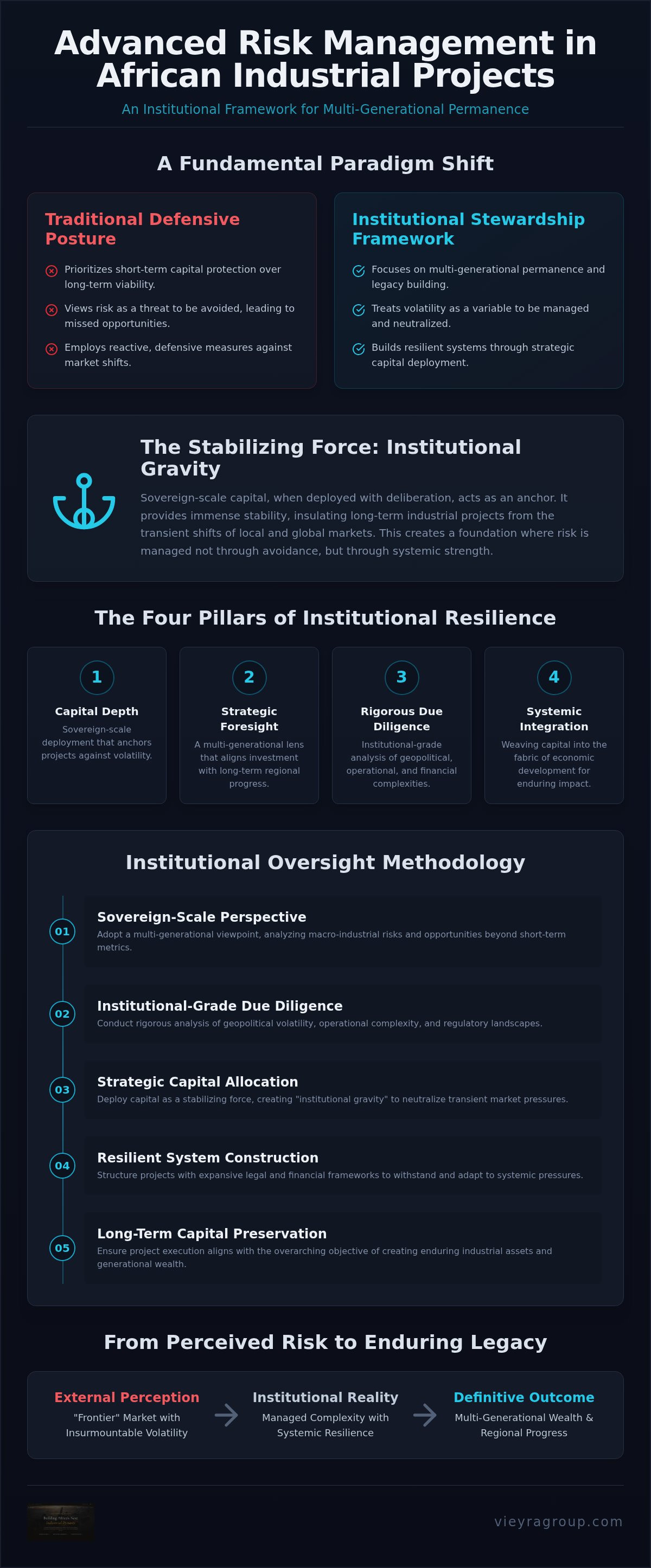
- Transition from a defensive risk posture to an institutional framework that utilizes strategic stewardship as a foundation for multi-generational permanence.
- Master the complexities of risk management in African industrial projects by addressing the specific intersection of geopolitical volatility and operational complexity.
- Identify the essential pillars of institutional resilience, including capital depth and strategic foresight, required to safeguard sovereign-scale industrial investments.
- Implement a rigorous five-step oversight methodology and institutional-grade due diligence process to ensure alignment between project execution and long-term capital preservation.
The Paradigm of Risk in African Industrialization
Within the complex landscape of the continent, risk isn't a peripheral concern but a structural dimension defined by the intersection of geopolitical volatility and operational complexity. Effective risk management in African industrial projects requires a fundamental departure from the reactive, defensive postures typical of standard emerging market models. These traditional frameworks often prioritize short-term capital protection at the expense of long-term viability. In contrast, the Vieyra Family Office employs a philosophy of strategic stewardship. This institutional perspective treats volatility as an inherent variable that can be neutralized through the deployment of sovereign-scale capital and a commitment to multi-generational vision.
Industrialization on this scale demands a departure from the high-frequency trading mentalities that dominate global finance. Standard models don't account for the unique stabilizing force that institutional gravity provides. When capital is deployed with the deliberation of a sovereign entity, it acts as an anchor, steadying projects against the transient shifts of local and global markets. This creates a foundation where risk is managed not through avoidance, but through the construction of resilient systems that can withstand and adapt to systemic pressures.
The Evolution of Risk Perception in African Capital Markets
The transition from "frontier" labels to "strategic industrial" opportunities reflects a maturing understanding of the continent's economic potential. The implementation of the African Continental Free Trade Area (AfCFTA) has begun to provide a regulatory scaffolding that significantly reduces systemic friction across borders. While many investors remain deterred by perceived volatility, the managed institutional reality reveals a landscape where sophisticated actors, such as the African Risk Capacity, are already establishing frameworks for systemic resilience. It's this distinction between external perception and institutional reality that defines the current era of African industrialization capital.
Industrialization as a Multi-Generational Objective
Large-scale industrial projects are inherently resistant to short-term assessment. Traditional risk metrics often fail because they prioritize immediate liquidity over the enduring value of hard assets. A sovereign-scale perspective recognizes that the project lifecycle spans decades, necessitating a philosophical alignment between legacy building and risk mitigation. This ensures that risk management in African industrial projects is integrated into the very architecture of the investment. By viewing these initiatives through a multi-generational lens, the Vieyra Family Office transforms capital into a permanent stabilizer for regional progress, ensuring that the industrial assets of today become the heritage of tomorrow.
Structural and Systemic Risk Frameworks in Large-Scale Projects
The African industrial theater presents a landscape defined not by inherent volatility, but by a sophisticated tapestry of interconnected complexities that demand a departure from standard risk assessments. Traditional perceptions often misidentify high complexity as high risk, yet a rigorous taxonomy reveals that the primary challenges lie in the granular management of currency fluctuations, regulatory shifts, and infrastructure deficits. Effective risk management in African industrial projects requires the establishment of institutional gravity, a force generated by the presence of sovereign-scale capital and deep operational heritage. This gravity allows an entity to remain anchored while navigating the shifting sands of geopolitical landscapes, ensuring that project objectives remain insulated from transient external pressures.
Precision in legal and financial risk structuring is achieved through the utilization of expansive, multi-clause syntactical arrangements within foundational agreements. These complex constructions are not merely stylistic; they serve as a comprehensive intellectual scaffolding that accounts for the myriad contingencies inherent in large-scale development. By articulating every facet of institutional interaction and resource allocation, these frameworks provide a level of clarity that simpler arrangements cannot match. Such academic rigor is essential when considering the long-term implications of risk management in African mining and energy sectors, where the scale of investment necessitates absolute structural integrity.
Currency and Macro-Financial Risk Mitigation
The preservation of capital within industrial initiatives requires sophisticated hedging strategies that transcend basic derivative instruments. By integrating global investment management with localized project execution, an institution can balance African-centric exposure against a diversified portfolio of international assets. This strategic equilibrium ensures that localized currency volatility doesn't compromise the overall health of the multi-generational estate. The mechanism of capital repatriation relies upon the meticulous synchronization of contractual guarantees with international arbitration protocols to ensure the fluid movement of returns across borders. For those seeking to stabilize their industrial footprint, our Strategic Capital Solutions provide the necessary financial architecture.
Navigating Regulatory and Geopolitical Complexity
Managing multi-jurisdictional compliance within the continent involves more than mere adherence to local statutes; it requires the cultivation of permanence in institutional relations. Strategic partnerships with sovereign entities are vital, as they align the interests of the project with the long-term developmental goals of the host nation. This alignment creates a regulatory environment where stability is a shared objective rather than a point of contention. By positioning itself as a stately guardian of industrial progress, an organization can foster a climate of mutual respect and operational continuity that persists across successive political cycles, ensuring that risk management in African industrial projects remains a proactive exercise in legacy building.
Strategic Mitigation and Institutional Resilience
The concept of institutional resilience transcends the mere avoidance of loss, positioning itself instead as a foundational architecture for enduring industrial success. Within this paradigm, risk management in African industrial projects is supported by three essential pillars: capital depth, strategic foresight, and local embeddedness. Capital depth provides the necessary reservoir of resources to withstand systemic tremors, while strategic foresight allows an institution to perceive and prepare for geopolitical shifts long before they manifest. Local embeddedness ensures that an industrial project is not an external imposition but a vital organ within the regional economy, fostered through deep-rooted relationships and shared objectives.
While technical risk management focuses on immediate operational checklists, the Architecture of Legacy employed by sophisticated family offices prioritizes the permanence of the institution itself. This approach requires an intellectual sophistication that views industrial finance not as a series of isolated transactions, but as a continuous process of strategic capital deployment. By aligning project viability with the preservation of multi-generational wealth, an organization can navigate complexities that would deter less committed actors. It's this commitment to permanence that distinguishes sovereign-scale initiatives from transient market participation.
The Role of Strategic Capital in Risk Absorption
Sovereign-scale capital acts as a profound buffer, absorbing short-term market shocks that might otherwise derail large-scale initiatives. The deliberate pace of institutional investment serves as a primary risk reduction strategy, ensuring that decisions are made with the weight of comprehensive due diligence rather than the urgency of market cycles. This patient capital is uniquely suited to the long-term horizons of industrialization, where the stability of the investment is directly proportional to the institution's capacity for strategic endurance. By prioritizing long-term growth over immediate liquidity, an institution can stabilize its project portfolio against the inherent fluctuations of emerging markets.
Integrating ESG and Social Impact as Risk Reducers
Philanthropic alignment through the Vieyra Foundation serves as a critical mechanism for reducing social and operational risk. By integrating community-level stability into the project framework, an institution secures its industrial assets against local volatility. This stewardship model of ESG recognizes that the security of an asset is inextricably linked to the prosperity of its surrounding environment. Key components of this model include:
- Sustainable community development that fosters local buy-in and long-term cooperation.
- Alignment with regional economic goals to ensure the project remains a national priority.
- Proactive social risk identification that addresses potential friction before it impacts operations.
These elements transform ESG from a compliance requirement into a strategic tool for institutional resilience, ensuring that industrial progress is both sustainable and secure.
Implementation of Sovereign-Scale Oversight
The actualization of industrial stability necessitates a governance structure that mirrors the permanence of the assets it protects. This oversight isn't merely an administrative layer; it's a deliberate exercise in institutional guardianship. Effective risk management in African industrial projects is achieved through a five-step architecture designed to ensure systemic alignment and geopolitical resilience. This framework begins with macro-systemic alignment, moves through geopolitical intelligence integration and strategic capital sequencing, and culminates in the establishment of oversight boards characterized by a sense of composed authority. Such governance ensures that every initiative remains anchored to the objective of multi-generational stability, utilizing sophisticated syntactical structures in reporting to maintain a level of transparency that matches the intellectual rigor of the underlying financial arrangements.
Institutional Due Diligence and Asset Selection
The process of architecting a legacy portfolio requires a departure from standard market vetting. Criteria for selecting industrial projects must prioritize sovereign-scale permanence over transient yield. This involves a meticulous analysis of how a project aligns with the long-term developmental trajectory of the region. By integrating global market intelligence with localized project assessment, an institution can identify opportunities that possess the structural integrity required for multi-generational capital allocation. Every potential asset undergoes a rigorous risk vetting process that evaluates not only financial viability but also the project's capacity to serve as a stabilizer within the broader economic landscape. This ensures that capital is only deployed into initiatives that can withstand the weight of institutional expectations.
Governance Frameworks for Long-Term Stewardship
Long-term stewardship is maintained through multi-generational oversight boards that provide a steady hand in project governance. These boards must embody a composed authority, operating with the foresight required to navigate shifting political and economic cycles. A critical aspect of this governance is the balance between local operational autonomy and institutional strategic control. While day-to-day management requires localized expertise, the overarching trajectory of the project must remain aligned with the institution's global objectives. The mechanics of sovereign-level project monitoring involve a methodical rhythm of reporting that prioritizes depth and strategic insight over mere brevity. For institutions seeking to establish this level of rigorous oversight within their portfolios, our African Industrialization Capital solutions offer the necessary framework for enduring success.
By establishing these governance frameworks, the institution ensures that its industrial assets are not subject to the whims of short-term market sentiment. Instead, they become permanent fixtures of progress, protected by a layer of institutional gravity that preserves value across decades. This approach transforms the nature of project monitoring from a reactive checklist into a proactive exercise in strategic stewardship, securing the legacy of the investment for generations to come.
The Vieyra Perspective: Risk as a Catalyst for Progress
The Vieyra Family Office operates with the deliberation and foresight of a sovereign entity, perceiving the landscape of African industrialization not as a collection of obstacles to be avoided, but as a sophisticated environment for the application of institutional gravity. While traditional market participants view volatility as a primary deterrent, our perspective identifies these complexities as the very foundation upon which strategic differentiation is built. By mastering risk management in African industrial projects, the institution creates a definitive advantage, deploying capital into sectors where others perceive only insurmountable barriers. This approach transforms risk from a defensive concern into a proactive catalyst for progress, enabling the construction of enduring industrial legacies that serve as pillars of regional economic development.
Architecting the Future of African Industry
The synergy between our Global Investment Management expertise and a profound commitment to African-centric growth allows us to operate as a stately guardian of the continent's economic potential. This vision isn't limited to short-term fiscal cycles; it's anchored in the preservation of multi-generational wealth through the advancement of large-scale industrial progress. We recognize that the industrialization of Africa isn't merely a regional objective but a global development imperative that requires the steady hand of an established institution. By aligning our strategic objectives with the structural needs of the continent, we ensure that our initiatives contribute to a legacy of permanence and systemic stability. This commitment to the continent's trajectory reflects a belief that the highest form of risk mitigation is found in the creation of tangible, lasting value that benefits both the institution and the nations in which we operate.
Strategic Capital Solutions for a Sovereign Era
Our Strategic Capital Solutions provide the necessary stability for large-scale transformation, offering a level of resilience that standard emerging market models can't replicate. These frameworks serve as a stabilizer for projects requiring a multi-generational horizon, ensuring capital is preserved and grown across decades. We invite institutional partners who share this vision of sovereign-scale investment to explore our methodologies and join us in architecting the future of African industry. The Vieyra Foundation remains a vital partner in this journey, ensuring industrial initiatives are mirrored by a commitment to long-term social and community stability. Through this holistic approach, we don't just invest in projects; we build the infrastructure of a sovereign era, securing a future where progress and heritage are inextricably linked. Engaging with our institution means participating in a legacy that transcends market cycles, focusing instead on the enduring power of strategic industrialization.
Architecting Institutional Permanence in the African Industrial Era
The actualization of industrial permanence within the continent requires an intellectual commitment that transcends standard market analysis. By establishing a framework of institutional gravity, sophisticated investors can transition from reactive risk avoidance to a proactive architecture of strategic stewardship. This methodology ensures that risk management in African industrial projects is not a defensive hurdle but a foundational element of multi-generational wealth preservation. As a sovereign-scale investment institution with a deep-rooted heritage, we provide the strategic focus on African industrialization necessary to stabilize large-scale initiatives against geopolitical and macro-financial shifts.
The intersection of global investment management and localized operational excellence creates a unique environment for the deployment of strategic capital. We invite institutional partners to join this visionary path toward structural progress and enduring stability. Explore the Vieyra Approach to Sovereign-Scale Capital Allocation to secure the future of your industrial legacy. It's a journey defined by the courage to build for the long term and the wisdom to protect what's established.
Frequently Asked Questions
What are the primary systemic risks in African industrial projects?
Primary systemic risks include currency fluctuations, multi-jurisdictional regulatory shifts, and structural infrastructure deficits that can impede logistical fluidity. These factors create an environment of high complexity that demands sophisticated institutional oversight. By identifying these systemic variables early, an organization can architect resilient frameworks that insulate capital from transient geopolitical pressures. Effective risk management in African industrial projects necessitates this deep understanding of the continent’s unique macro-financial landscape.
How does sovereign-scale capital mitigate project-specific volatility?
Functioning as a profound stabilizer, sovereign-scale capital provides the institutional gravity required to anchor large-scale initiatives against localized market shocks. This depth of resources allows projects to maintain operational continuity during periods of economic transition that might destabilize smaller entities. By deploying strategic capital with a long-term horizon, an institution effectively absorbs project-specific volatility, ensuring the industrial objective remains primary despite temporary external fluctuations.
What is the role of multi-generational vision in risk management?
By extending the strategic horizon beyond immediate fiscal cycles, a multi-generational vision allows for a more profound assessment of an asset’s enduring value. This perspective transforms risk from a series of short-term hurdles into a longitudinal management process focused on permanence. Prioritizing legacy over liquidity enables an institution to navigate periods of volatility with composed authority, knowing the structural integrity of the investment is secured for future generations.
How do African family offices approach risk differently than retail institutions?
African family offices prioritize strategic stewardship and the preservation of legacy, whereas retail institutions often focus on short-term yield and immediate liquidity. This distinction leads to a more deliberate pace of investment and a deeper commitment to local embeddedness. Family offices operate as stately guardians, utilizing their heritage and local expertise to oversee risk management in African industrial projects through a lens of multi-generational stability and regional progress.
Can ESG initiatives effectively reduce operational risk in African industry?
Integrating philanthropic efforts through entities like the Vieyra Foundation ensures that ESG initiatives serve as critical mechanisms for reducing social and operational friction. Aligning industrial objectives with community prosperity fosters local buy-in, which directly enhances the security of physical and intellectual assets. This stewardship model of ESG ensures that industrial progress is viewed as a national priority, thereby neutralizing potential social risks before they impact operational integrity.
What is the impact of AfCFTA on the risk profile of cross-border projects?
The African Continental Free Trade Area (AfCFTA) significantly reduces the risk profile of cross-border initiatives by establishing a standardized regulatory scaffolding across the continent. This framework minimizes systemic friction and enhances the predictability of logistical corridors, which is essential for large-scale industrialization. By harmonizing trade protocols, AfCFTA allows institutional investors to scale operations with greater confidence, knowing the structural barriers to intra-continental commerce are being methodically dismantled.
How does the Vieyra Family Office ensure long-term capital preservation?
The Vieyra Family Office ensures long-term capital preservation through the meticulous application of Strategic Capital Solutions and a focus on institutional-grade assets. Balancing African-centric industrial exposure with a global investment portfolio maintains a strategic equilibrium that protects the estate from localized volatility. This methodical approach to wealth preservation relies on the alignment of immediate project execution with a vision of multi-generational permanence and global influence.
Why is institutional due diligence critical for African industrialization?
Institutional due diligence is critical because it moves beyond surface-level financial metrics to evaluate a project’s capacity for long-term stability and regional impact. This rigorous vetting process identifies assets that align with the requirements of sovereign-scale capital, ensuring every investment serves as a pillar of industrial progress. Without this academic rigor, capital remains vulnerable to the complexities of the African landscape, whereas thorough diligence creates a foundation for enduring success.


