
The prevailing characterization of African industrialization as a landscape defined by ephemeral risk and fragmented ventures misconstrues the profound emergence of a sovereign-scale institutional architecture. While traditional capital markets often succumb to the constraints of short-termism, the actual stability inherent in large-scale regional development requires a departure from conventional, reactionary investment behaviors. You likely recognize that the current disconnect between global asset management and local production remains a primary barrier to transformative growth. This article provides an authoritative analysis of the sophisticated institutional frameworks and multi-generational capital strategies essential for this transition. By examining advanced capital deployment models for African industry, we establish a formal foundation for aligning global liquidity with the enduring requirements of continental progress.
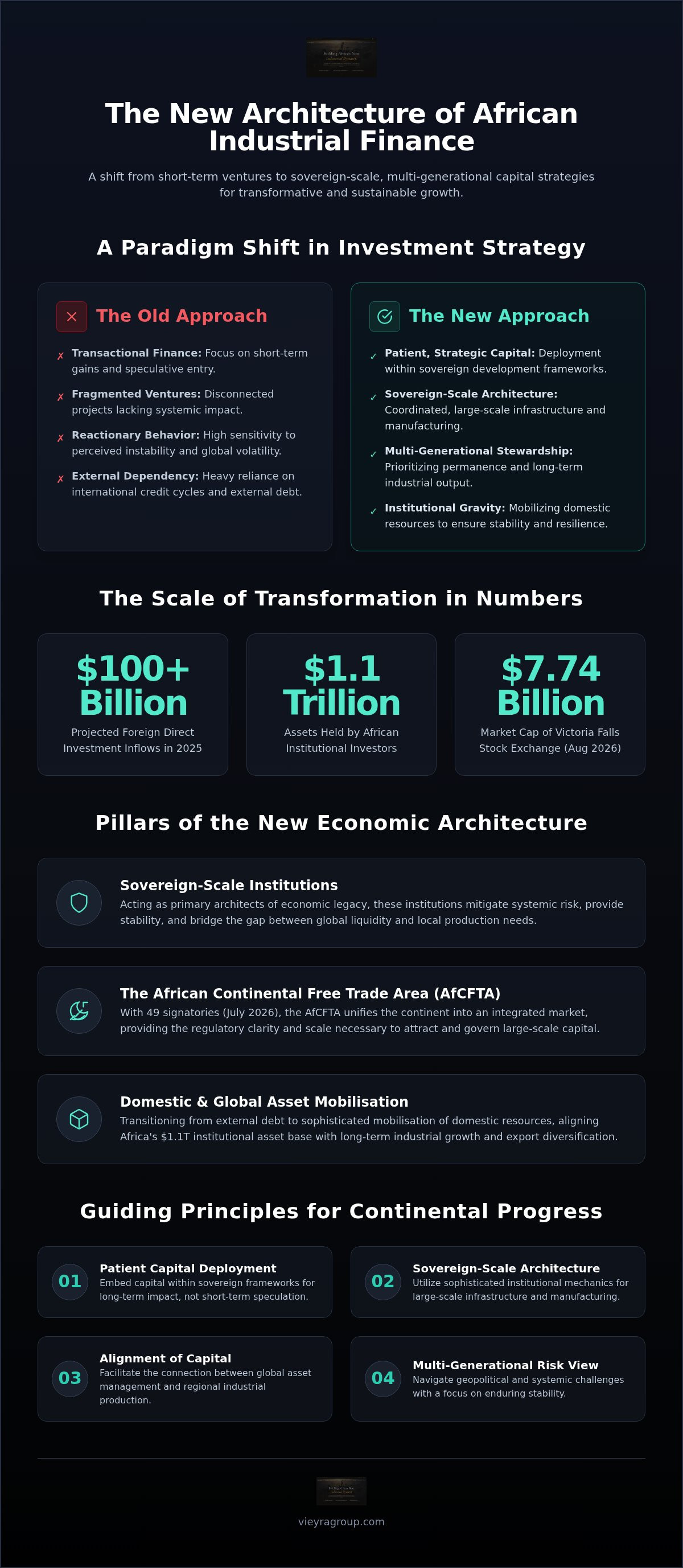
We shall explore how sovereign-scale institutions act as the primary architects of this economic legacy, mitigating systemic risk through strategic capital solutions that prioritize permanence. With foreign direct investment inflows exceeding 100 billion dollars in 2025, the imperative for structured, long-term stewardship is critical. The following discourse details the mechanisms through which institutional gravity can bridge the gap between perceived instability and actual industrial potential. Through this lens, the focus shifts from speculative entry to the cultivation of a stable, industrial future for the continent.
Key Takeaways
- Discern the imperative for transitioning from transactional finance to the deployment of patient, strategic capital embedded within sovereign development frameworks.
- Examine the sophisticated architecture of sovereign-scale capital allocation and the institutional mechanics governing large-scale infrastructure and manufacturing.
- Analyze the efficacy of various capital deployment models for African industry in facilitating the alignment of global asset management with regional industrial production.
- Adopt a multi-generational perspective on risk mitigation to navigate the complexities of geopolitical tensions and systemic institutional challenges.
The Imperative of Structural Transformation through African Industrialisation Finance
African industrialisation finance represents the deliberate orchestration of strategic, patient capital into the continent's productive sectors. It's a fundamental shift from the fragmented "billions" of the previous decade to the "trillions" required for systemic change. These capital deployment models for African industry aren't merely financial instruments; they're the essential bedrock of national development frameworks. In 2026, industrialisation stands as the most credible pathway for economic resilience. It provides a buffer against global volatility while fostering local value addition. Sovereign-scale institutions play a pivotal role here. They bridge the historical gap between global liquidity and the granular needs of local production, ensuring that investment aligns with long-term industrial output.
The 2026 Landscape of Continental Finance
The current fiscal year reflects a significant geopolitical realignment. Capital flows are increasingly directed toward regions demonstrating regulatory clarity and integrated market access. The African Continental Free Trade Area (AfCFTA) serves as the primary engine for this unification. With 49 signatories having deposited instruments of ratification by July 2026, the continent's no longer a collection of disparate markets. The provision of African Industrialization Capital is now governed by frameworks that define structural transformation in 2026 as the systematic reallocation of economic resources toward high-value production, a process evidenced by the record US$7.74 billion market capitalization reached by the Victoria Falls Stock Exchange in August 2026. This progress is underscored by a deep understanding of the history of industrialisation in Africa and the lessons learned from previous policy cycles.
Institutional Gravity and Market Stability
Sovereign-scale actors provide a necessary stabilizing force within volatile global markets. They manage the inherent tension between perceived risk and actual sovereign-scale stability. We're witnessing a critical transition from a heavy reliance on external debt to the sophisticated mobilization of domestic resources. African institutional investors now hold approximately $1.1 trillion in assets. This capital is increasingly utilized for long-term industrial growth. By leveraging capital deployment models for African industry that prioritize multi-generational stewardship, these institutions provide Strategic Capital Solutions that ensure export diversification becomes a reality rather than a policy aspiration. This approach transforms strategic capital into a tool for permanent economic sovereignty, shielding the continent from the fluctuations of international credit cycles.
The Architecture of Sovereign-Scale Capital Allocation
The deployment of large-scale capital into infrastructure and manufacturing requires a framework that transcends simple liquidity provision. It involves the synthesis of global investment management expertise with the specificities of regional industrial production. Central to this is the architecture of development finance, which serves as the primary blueprint for coordinating diverse capital flows toward sovereign-scale objectives. Within this structure, the mechanics of capital allocation fees are not merely administrative costs but reflect the institutional gravity and professional rigor required to manage multi-billion-dollar initiatives across varied jurisdictions. These fees represent the value of strategic oversight and the mitigation of systemic risks that are often invisible to less established actors.
Navigating complex regulatory environments demands a level of institutional expertise that few entities can truly claim. As African institutional investors continue to mobilize their $1.1 trillion in assets, the requirement for sophisticated capital deployment models for African industry becomes increasingly paramount. These models must balance the rigorous fiduciary standards of global asset management with a nuanced, African-centric approach to industrial deployment. This ensures that capital isn't just placed within a market but is strategically embedded to foster sustainable, productive capacity. It's about creating a harmonious relationship between international capital standards and local industrial realities.
Strategic Capital Solutions for Industrial Projects
Structuring finance for large-scale projects involves a meticulous blend of mezzanine debt and equity financing to ensure long-term project viability. This combination allows for the absorption of initial volatility while securing the project's broader industrial transformation goals. By prioritizing Strategic Capital Solutions, institutions can navigate the early-stage capital requirements of manufacturing plants and infrastructure hubs. This layered approach provides the necessary buffer for projects that require years of gestation before reaching full operational capacity. For those seeking to implement these robust frameworks, understanding Strategic Capital Deployment for Institutions is essential for aligning resources with continental progress.
Allocating for Multi-Generational Impact
The Vieyra Family Office distinguishes itself from traditional private equity through its steadfast commitment to multi-generational wealth preservation. This isn't a speculative endeavor; it's a deliberate science of legacy building. By utilizing sophisticated syntactical arrangements and precise legal frameworks in investment contracts, the office ensures permanence and structural clarity in its industrial growth initiatives. This method prioritizes the long-term health of the industrial ecosystem over the short-term exit strategies common in the broader market. It positions the institution as a stately guardian of African industrial legacy, ensuring that capital remains a productive force for decades rather than just a fiscal quarter. This perspective allows for the patient cultivation of industrial assets that serve as the backbone of regional economic stability.
Mobilising Domestic and Global Assets for Industrial Resilience
The deliberate orchestration of domestic reserves alongside international liquidity defines the current epoch of continental resilience. It's a shift from dependency to partnership. The strategic alignment of global investment management with African production represents a fundamental evolution in how value is created and preserved across the continent. By leveraging public resources, sovereign entities can successfully attract high-scale private institutional investment, creating a robust shield against the volatility of international markets. This integrated approach addresses the structural weaknesses exposed by recent global supply chain disruptions. It ensures that local industrial capacity remains insulated from external shocks. When these capital deployment models for African industry are implemented with institutional rigor, they transform idle capital into a catalyst for permanent economic sovereignty.
The evolution of African capital markets provides the necessary foundation for this industrial growth. With African institutional investors now stewarding approximately $1.1 trillion in assets, the capacity for domestic resource mobilization has reached a historic zenith. This pool of capital is no longer a passive observer of economic trends. Instead, it's becoming an active participant in the industrialization process. By coordinating these domestic assets with global financial expertise, the continent can build a financial architecture that's both resilient and forward-looking. This synergy is essential for maintaining stability in a world defined by geopolitical realignment and shifting trade patterns.
The Synergy of Global and African-Centric Assets
Industrial stability is predicated on the prerequisite of diversified asset management. When global portfolios are strategically aligned with regional production, they serve to de-risk African industrial investments by providing a broader base of fiscal support. This synergy allows for the absorption of localized economic fluctuations while maintaining the momentum of large-scale manufacturing initiatives. It's a methodical approach to wealth preservation. Understanding the nuances of Diversified Asset Management in Global Markets is essential for institutions looking to bridge the gap between international standards and regional industrial needs. This alignment ensures that capital remains productive across multi-generational cycles.
Strengthening Africa’s Financial Architecture
By 2026, the African Financing Stability Mechanism has emerged as a cornerstone of the continent's financial architecture, providing a framework for coordinated capital deployment. This mechanism facilitates the acceleration of regional value chains. It allows for a more cohesive approach to industrial growth across borders. Central to this effort is the investment in integrated and sustainable energy systems, which serve as the indispensable power source for modern industry. These capital deployment models for African industry prioritize the long-term viability of the energy-industrial nexus. This ensures that progress is both stable and permanent, reflecting the deliberation and foresight of a sovereign-level entity.
Navigating Institutional Risk in Large-Scale Industrial Infrastructure
The management of sovereign-scale risk necessitates a departure from the reactive postures typical of conventional finance. It requires a multi-generational stewardship that views industrial infrastructure not as a series of isolated assets but as a systemic foundation for national permanence. Sophisticated capital deployment models for African industry must account for the inherent tensions between long-term development and the cyclical nature of global capital. By prioritizing institutional gravity, actors ensure that large-scale projects remain insulated from the caprice of short-term market sentiment. This methodical approach fosters a climate of fiscal coherence, aligning fragmented policy areas into a unified strategy for industrial resilience. It's a process that demands a commitment to stability over speculative gain.
Sovereign-Level Risk Mitigation Strategies
Institutional gravity serves as a protective bulwark, shielding capital from the disruptive influence of short-term political cycles and shifting administrative priorities. Intellectual sophistication in risk assessment involves more than just quantitative analysis; it requires a deep understanding of the geopolitical undercurrents that shape continental trade. Evidence suggests that a sustained increase in Manufacturing Value Added (MVA) directly correlates with the long-term stabilization of sovereign credit ratings by diversifying the revenue base away from volatile raw material exports. This perspective allows for the cultivation of strategic institutional partnerships that mitigate tensions through shared economic objectives. Such partnerships don't merely share risk; they create a collective shield against systemic shocks.
The Role of Strategic Philanthropy
Addressing the social dimensions of industrial risk is as critical as managing fiscal volatility. The Vieyra Foundation exemplifies how institutional philanthropy can be strategically aligned with large-scale economic development to dismantle systemic barriers to progress. By focusing on foundational social infrastructure, such initiatives ensure that industrial growth is inclusive and structurally sound. Understanding The Role of Institutional Philanthropy is essential for any actor seeking to harmonize commercial objectives with social legacy. This alignment transforms philanthropic activity from a peripheral concern into a central pillar of industrial stability. It ensures that the human capital required to sustain industrialization is as resilient as the financial frameworks that support it.
For institutions seeking to secure their legacy through robust and permanent frameworks, the path forward lies in Strategic Capital Solutions.
Multi-Generational Stewardship as a Catalyst for Continental Progress
The ultimate efficacy of continental industrialisation is found not in the mere accumulation of assets but in the transition toward a philosophy of multi-generational stewardship. This approach ensures that the progress achieved today remains a permanent fixture of the regional economic landscape. By positioning the Vieyra Family Office as a visionary architect of African legacy, we emphasize a commitment to stability that transcends the volatility of standard market cycles. Institutional capital, when managed with this level of deliberation, becomes the primary driver of the African century. It's the force that transforms temporary gains into an enduring sovereign-scale reality, providing the foundation for a future defined by industrial autonomy and structural strength.
The Architecture of Legacy
True institutional gravity is evidenced by the creation of structures that outlast individual investment cycles. The preservation of multi-generational wealth is intrinsically linked to the prosperity of the continent; one can't exist in isolation from the other. We invite institutional actors to embrace their role as global stewards, recognizing that their decisions today shape the industrial heritage of tomorrow. This requires a shift in focus from short-term liquidity to the long-term health of the productive ecosystem. It's a call for a more profound engagement with the principles of permanence and strategic depth, where wealth is viewed as a tool for systemic transformation rather than just a balance sheet metric.
The Vieyra Approach to Strategic Capital
The deployment of sovereign-scale capital into manufacturing and infrastructure represents the highest expression of this stewardship. By utilizing refined capital deployment models for African industry, institutions can secure the future of regional value chains while maintaining the integrity of their global portfolios. The Vieyra approach prioritizes long-term growth projects that offer both economic development and systemic stability. This methodical strategy ensures that every allocation serves as a building block for a more resilient and self-sufficient continent. It's about building a legacy that reflects the sophistication of global investment management while remaining deeply rooted in African progress. For those ready to contribute to this vision of enduring progress, we invite you to Engage with the Vieyra Family Office on Strategic Capital Solutions.
Securing the Industrial Legacy of the African Century
The transition toward a sovereign-scale financial architecture represents a definitive departure from the ephemeral strategies of the past, establishing a permanent foundation for industrial growth. We have examined the synthesis of global investment management and regional production as the primary mechanism for absorbing systemic shocks and ensuring fiscal coherence. By implementing sophisticated capital deployment models for African industry, institutional actors can ensure that wealth preservation remains inextricably linked to continental prosperity.
It's through this lens of multi-generational stewardship that the true potential of the continent's manufacturing and infrastructure sectors is realized. Our methodology is rooted in a multi-generational African heritage, combining global strategic capital deployment with sovereign-scale investment management. We invite you to Explore our Institutional Frameworks for African Industrialisation to align your objectives with the enduring progress of the continent. The trajectory of structural transformation is deliberate, and the opportunity to architect a lasting legacy is now within reach.
Frequently Asked Questions
What is the primary challenge in African industrialisation finance in 2026?
The fundamental challenge resides in the misalignment between the short term requirements of traditional capital markets and the long term horizon of industrial transformation. While foreign direct investment reached 100 billion dollars in 2025, much of this liquidity remains speculative. Overcoming this requires institutional frameworks that prioritize multi-generational stewardship over immediate fiscal exits. Ensuring that capital remains embedded in productive sectors is essential for achieving permanent structural resilience across the continent.
How do sovereign-scale institutions mitigate risk in African industrial projects?
These entities employ institutional gravity to insulate large scale projects from the volatility of short term political and economic cycles. By utilizing sophisticated capital deployment models for African industry, they provide a stabilizing force through strategic capital solutions. This involves a profound understanding of geopolitical undercurrents and the implementation of rigorous risk assessment frameworks. Such deliberate oversight transforms systemic risk into managed stability, ensuring that manufacturing initiatives remain viable across decades.
What role does the AfCFTA play in financing regional industrial value chains?
The agreement serves as a primary catalyst for attracting high scale private institutional investment by reducing regulatory fragmentation across the continent. As of July 2026, 49 signatories have ratified the agreement, providing a harmonized framework for regional growth. This integration allows for the efficient allocation of resources across borders, fostering robust value chains. It ensures that industrialization is supported by a unified market, facilitating the movement of capital into large scale infrastructure projects.
How can multi-generational family offices contribute to African structural transformation?
They act as visionary architects of legacy by deploying patient capital that aligns with national development objectives. Unlike traditional investors, these offices prioritize wealth preservation and the permanence of industrial progress. Their multi-generational vision ensures that capital remains committed to projects with long gestation periods, such as energy systems and manufacturing hubs. This approach provides the necessary stability for structural transformation, bridging the gap between global asset management and local production needs.
What is the difference between traditional private equity and sovereign-scale industrial finance?
Traditional private equity often focuses on short term exit strategies and speculative gains, whereas sovereign-scale finance emphasizes long term institutional stability. The latter utilizes capital deployment models for African industry designed for multi-generational impact and regional sovereignty. While private equity might prioritize quarterly returns, sovereign-scale initiatives focus on building a permanent industrial legacy. This distinction is vital for projects that serve as the backbone of regional economic stability and long term export diversification.
Why is domestic resource mobilization critical for African industrial growth?
It reduces reliance on external debt and aligns local capital with regional development priorities. African institutional investors currently hold approximately 1.1 trillion dollars in assets, representing a significant pool of liquidity for industrial transformation. Mobilizing these domestic resources ensures that the continent's growth is self-sustaining and less vulnerable to global credit fluctuations. It fosters a financial architecture where local assets are actively deployed into productive sectors, strengthening national economic resilience and autonomy.
How does the Vieyra Family Office align global investments with African industrialisation?
The office leverages its global investment management expertise to channel strategic capital into high impact industrial sectors. By blending traditional values of heritage with forward-looking commitment, it ensures that global portfolios support the continent's structural progress. This alignment is achieved through sophisticated syntactical arrangements in investment contracts and a focus on sovereign-scale operations. It positions the office as a stately guardian of progress, ensuring that capital deployment serves both wealth preservation and industrial growth.
What are the key priorities for strengthening Africa’s financial architecture?
Priorities include the implementation of the African Financing Stability Mechanism and the expansion of the Pan-African Payment and Settlement System. By July 2026, the PAPSS network connected 28 countries, facilitating intra-African trade and reducing currency dependency. Strengthening this architecture requires the coordination of domestic and global assets to support sustainable energy and industrial value chains. Ensuring fiscal coherence across fragmented policy areas is essential for creating a resilient and autonomous financial ecosystem for the future century.


