

The viability of a multi-generational infrastructure project is frequently determined not by the physical durability of its assets, but by the underlying sophistication of its financial architecture. Many institutional actors recognize that the complexity of fee structures for large-scale African projects often creates a significant cost squeeze, where rising expenses outpace the projected margins of vital industrial initiatives.
You understand that in an environment defined by multi-jurisdictional capital allocation, transparency is not merely a preference but a prerequisite for systemic stability. This exploration serves as an institutional guide to the strategic management of investment fees, offering a rigorous framework to evaluate their impact on project viability. We will examine how sovereign capital can be deployed with greater foresight, ensuring that fee arrangements align with the preservation of wealth and the advancement of global industrialization.
By understanding these fiscal levers, partners can mitigate the risks associated with opaque pricing and foster partnerships that reflect the permanence and gravity required for continental transformation. This analysis moves from broad institutional overviews to specific strategies for aligning capital with the long-term objectives of sovereign-scale development.
Key Takeaways
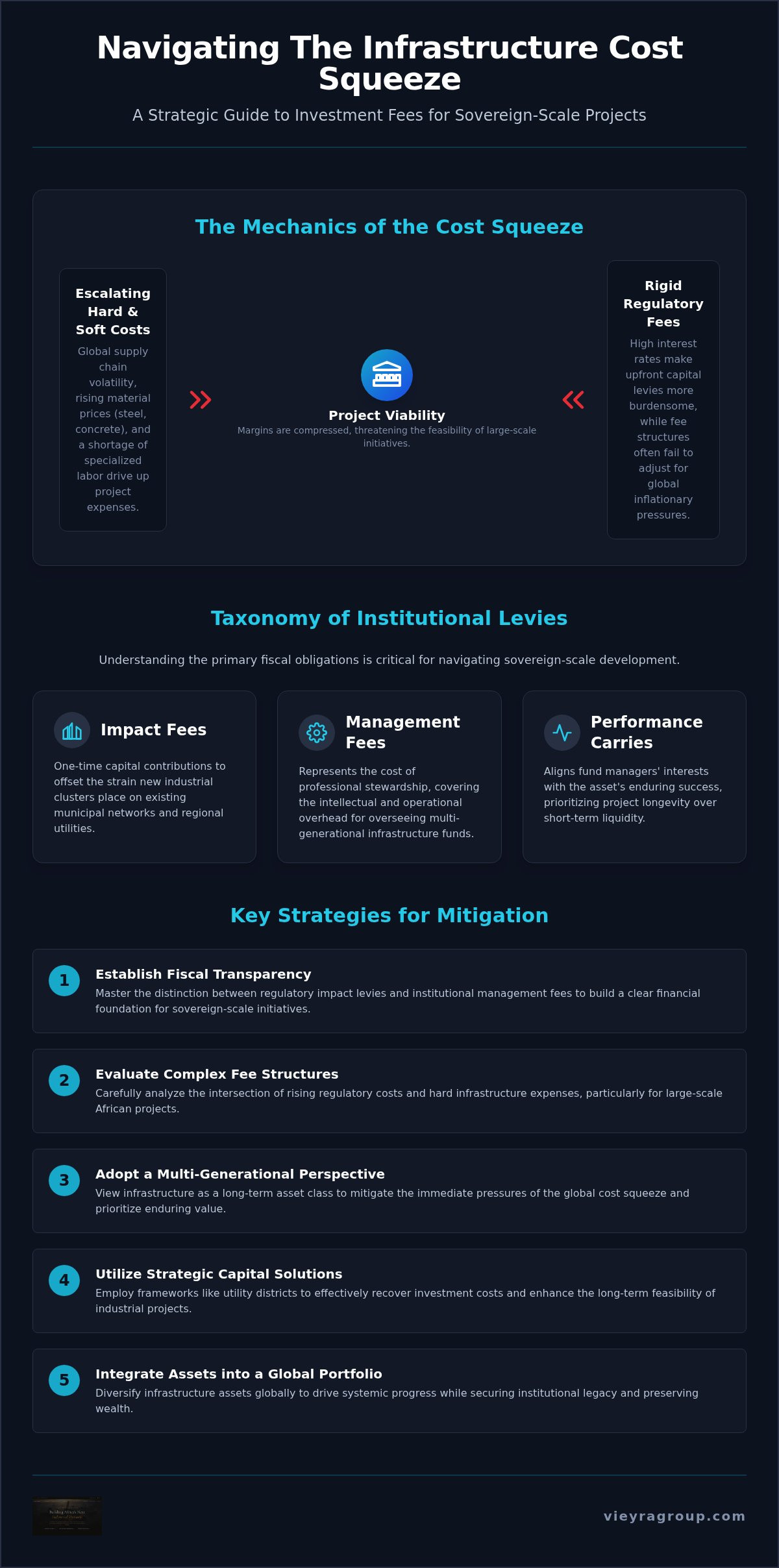
- Master the distinction between regulatory impact levies and institutional management fees to establish a transparent fiscal foundation for sovereign-scale initiatives.
- Navigate the intricate fee structures for large-scale African projects by evaluating the intersection of rising regulatory costs and hard infrastructure expenses.
- Adopt a multi-generational perspective on infrastructure as an asset class to mitigate the immediate pressures of the global cost squeeze.
- Utilize strategic capital solutions and utility district frameworks to recover investment costs and enhance the long-term feasibility of industrial projects.
- Integrate infrastructure assets into a diversified global portfolio to drive systemic progress while securing institutional legacy and wealth preservation.
Defining the Infrastructure Investment Fee in a Sovereign Context
The infrastructure investment fee represents a multi-dimensional levy that integrates regulatory impact charges with institutional management requirements, serving as a fundamental pillar for the systemic expansion of industrial utilities. As of 2026, the infrastructure investment fee is defined as a strategic capital requirement essential for ensuring the long-term feasibility and operational integrity of industrial assets within a global portfolio. These levies are not merely administrative costs. They are the financial mechanisms that facilitate the integration of private capital into the broader socio-economic fabric of a nation. Navigating the complex fee structures for large-scale African projects necessitates a clear distinction between the upfront capital obligations borne by developers and the ongoing stewardship costs managed by institutional investors.
The Taxonomy of Institutional Levies
A rigorous classification of these charges is necessary to navigate the complexities of sovereign-scale development. The following categories define the primary fiscal obligations within the sector:
- Impact fees: These function as one-time capital contributions intended to offset the strain that new industrial clusters place on existing municipal networks, ensuring that the integration of a project does not compromise the stability of regional utilities.
- Management fees: These represent the cost of professional stewardship, covering the intellectual and operational overhead required to oversee infrastructure funds with a multi-generational horizon.
- Performance-based carries: To ensure that the interests of fund managers remain tethered to the enduring success of the asset, these carries create an alignment that prioritizes project longevity over short-term liquidity.
The Economic Rationale for Infrastructure Charges
The transition toward developer-funded infrastructure reflects a broader shift in the 21st-century economic landscape. The burden of capital provision has moved from the public balance sheet to private and sovereign actors. By internalizing the externalities associated with large-scale industrialization, these fees ensure that the true cost of development is accounted for within the project’s initial financial model. This approach is critical for maintaining the sustainability of a Public-Private Partnership (PPP), as it provides the upfront capital necessary to de-risk the initiative for all participating stakeholders. Within the context of fee structures for large-scale African projects, this fiscal discipline allows for the creation of bankable projects that can withstand the volatility of emerging markets while contributing to the continent's industrial maturity. Such frameworks ensure that the expansion of utilities is both self-sustaining and capable of supporting future growth.
The Mechanics of the Infrastructure Cost Squeeze
The convergence of escalating hard costs and rigid regulatory fees creates a pincer movement that threatens the viability of sovereign-scale industrialization. In 2026, the global economy faces a uniquely challenging environment where high interest rates significantly increase the cost of capital, making upfront infrastructure levies more burdensome for institutional actors. When fee structures for large-scale African projects aren't adjusted for these global inflationary pressures, projects face a heightened risk of stalling before they reach the execution phase. This structural friction requires a sophisticated understanding of how physical costs and fiscal mandates interact to compress project margins.
Escalating Hard Costs and Material Inflation
Global supply chain volatility has profoundly impacted the procurement of essential infrastructure components. The 2026 cost index for industrial-grade steel and concrete remains elevated, reflecting systemic shifts in production and logistics that have persisted beyond the initial post-pandemic recovery. These rising material costs don't exist in a vacuum; they're compounded by a shortage of specialized industrial engineering labor. This scarcity drives up the soft costs of development, as the technical expertise required for multi-generational projects commands an increasing premium. Institutional investors must account for these variables during the initial capital allocation phase to prevent mid-cycle budget overruns that can derail industrial progress.
Regulatory Inflation and Design Stipulations
Beyond physical materials, there's a growing trend toward "oversizing" municipal infrastructure requirements. These gold-plated design stipulations often exceed the immediate needs of the project, placing an undue fiscal load on the developer to fund future public capacity. Environmental and social governance (ESG) mandates, while essential for ensuring long-term institutional stability, introduce additional layers of complexity to existing fee structures. Hidden costs, such as recurring inspection fees and long-term hook-up charges, can quietly erode the financial foundation of an initiative. As highlighted in the AUDA-NEPAD report on Unlocking Sustainable Infrastructure Financing, addressing these structural barriers is critical for mobilizing private capital at scale and closing the continent's infrastructure gap.
Navigating these pressures requires more than mere accounting; it demands a strategic approach to project financing that anticipates the interconnectedness of global markets. Early-stage development for large-scale infrastructure, including feasibility studies and financial structuring, can account for 5-12% of total project costs, a figure that is increasingly sensitive to interest rate fluctuations. Organizations seeking to preserve multi-generational wealth while driving progress often benefit from strategic capital solutions that provide the necessary poise to weather these economic cycles. By aligning fee structures with realistic cost projections, partners ensure that projects remain bankable even in volatile environments.
Global Perspectives: Infrastructure Fees in Emerging vs. Developed Markets
The global landscape of infrastructure levies is characterized by a profound bifurcation between the mature, codified frameworks of developed economies and the dynamic, evolving structures of industrializing nations. While the US and EU rely on decades of legal precedent to govern fiscal obligations, the African continent presents a landscape where the relationship between sovereign entities and private capital is being redefined. Navigating the fee structures for large-scale African projects requires an understanding that these costs aren't merely administrative hurdles. They're strategic instruments used to bridge a continent-wide financing gap estimated at 400 billion dollars annually. In this context, capital deployment serves as both a private investment and a public catalyst.
Fee Archetypes in Developed Economies
In Western Europe and North America, infrastructure fees are defined by a high degree of transparency and institutional predictability. Many jurisdictions utilize a "Value Capture" model, where public investment in transportation or utility networks is recouped through precisely calculated developer levies. In the US, the "nexus" requirement serves as a critical legal safeguard, ensuring that any impact fee remains proportional to the specific burden a project places on public systems. This creates a rigid but stable environment for long-term capital allocation. It allows institutional investors to model their outlays with a high degree of certainty, as the rules of engagement are rarely subject to abrupt shifts in political or economic priority.
The African Industrialization Landscape
The approach to fee structures for large-scale African projects often reflects the urgent need for primary utility expansion. Infrastructure fees in Africa often involve a higher degree of direct capital deployment into primary utilities. Rather than simple cash transfers to municipal treasuries, developers frequently engage in "In-Kind" provision, where they assume the responsibility for constructing the foundational roads, water treatment facilities, or power substations required for their industrial clusters. This direct involvement ensures that the infrastructure is built to the precise technical standards required for modern industrial operations, bypassing the delays often associated with public procurement.
Sovereign wealth funds and regional development banks play a pivotal role in this ecosystem, acting as the visionary architects of special economic regions. These entities often use fee structures as a lever for industrial policy. Strategic capital can negotiate significant fee waivers or fiscal incentives when a project demonstrates a commitment to multi-generational job creation and systemic progress. By aligning capital deployment with the continent's industrial ambition, investors can transform what would be a static expense in a developed market into a strategic advantage. This creates a bankable environment where the scale of the investment is matched by the depth of its long-term impact on regional stability and wealth preservation.
Strategies for Mitigating Fee Burdens in Large-Scale Projects
The successful mitigation of infrastructure fee burdens necessitates a transition from reactive accounting to proactive institutional stewardship. Within the sophisticated frameworks of global investment management, infrastructure is positioned not as an immediate expense but as a multi-generational asset class that demands a composed and visionary approach. This shift in perspective is particularly critical when navigating the fee structures for large-scale African projects, where the complexity of capital allocation across diverse jurisdictions can otherwise lead to significant cost inflation. By adopting a long-term horizon, institutional actors can implement strategic capital solutions that prioritize the structural integrity of the project’s financial foundation while ensuring the preservation of wealth across generations. Strategic foresight is mandatory. Legacy requires fiscal discipline.
Institutional Planning and Capital Recovery
The establishment of Special Assessment Districts represents a methodical approach to the financing of foundational infrastructure. These districts allow for the distribution of capital obligations over an extended duration, typically spanning 10 to 20 years, thereby ensuring that the project remains viable during its most sensitive early phases. Utility reimbursement agreements complement this strategy by providing a mechanism for the recovery of upfront expenditures as industrial clusters expand and the demand for utility services grows. Methodical forecasting prevents project stalling. The deployment of institutional expertise to forecast fee escalations is a prerequisite for maintaining stability in an environment where regulatory shifts can occur without warning. This allows for the inclusion of potential inflationary pressures within the initial project model, preventing the erosion of margins due to unforeseen fiscal demands.
Negotiating Sovereign-Scale Incentives
Engagement with sovereign entities and local municipalities must be characterized by a spirit of collaborative foresight. The provision of community-scale utilities often enables the negotiation of impact fee credits, effectively reducing the net fiscal burden on the project while contributing to the regional industrialization agenda. Public-Private Partnerships (PPPs) serve as the architectural blueprint for this cooperation, allowing for a shared responsibility in the development of primary infrastructure. Additionally, the integration of advanced cost-segregation studies allows for the optimization of tax treatments related to these fees, transforming a mandatory levy into a strategic component of the overall capital structure. Aligning these initiatives with the broader goals of institutional philanthropy ensures that the project is viewed as a pillar of progress rather than a mere commercial venture. Poise in negotiation yields long-term dividends.
To secure the professional rigor and strategic depth necessary for navigating these complex fiscal environments, institutional actors are invited to explore Strategic Capital Solutions for sovereign-scale industrialization.
Institutional Stewardship: The Vieyra Approach to Strategic Capital
The management of sovereign-scale assets requires a transition from the transactional nature of traditional finance toward a philosophy of institutional stewardship. At the Vieyra Family Office, infrastructure investment is viewed as a primary pillar of a diversified global portfolio, designed to secure multi-generational wealth through the acquisition and development of essential industrial utilities. This perspective acknowledges that the complexities inherent in the fee structures for large-scale African projects are not merely obstacles to be cleared but are essential components of a project's financial architecture. By integrating these costs into a visionary framework, it's possible to transform regulatory requirements into permanent value that transcends the immediate returns of a single project cycle. True progress is measured in decades, not quarters.
The Architecture of Multi-generational Wealth
Preserving capital in an era of global fragmentation demands a commitment to assets that possess inherent permanence and systemic utility. Investments in essential industrial infrastructure provide the stability required to weather economic volatility while ensuring that wealth remains productive across generations. The deliberate pace of institutional capital allows for a level of foresight that's often absent in more speculative markets. This composure is necessary when navigating the long-term nature of infrastructure, where the initial deployment of strategic capital serves as the foundation for decades of industrial growth. For a more comprehensive understanding of these underlying tenets, one should examine our Principles of Global Investment Management for deeper insight into our institutional philosophy.
Strategic Capital Solutions for Africa
The commitment to African industrialization is driven by the recognition that the continent represents the most significant opportunity for industrial and economic transformation in the 21st century. Deploying capital where it can catalyze systemic growth requires more than just financial resources; it demands a deep alignment with the industrial ambitions of sovereign entities. By partnering with regional leadership, it's possible to redefine the investment legacy of the continent, moving away from extractive models toward the creation of self-sustaining industrial zones. Understanding the nuances of fee structures for large-scale African projects is critical in this endeavor, as it allows for the creation of bankable initiatives that attract further global interest. We invite you to explore our Sovereign-Scale Capital Solutions for African Industrialization to see how strategic capital is being utilized to bridge the infrastructure gap and foster a new era of continental prosperity. This synergy between global investment management and local industrial impact ensures that every project contributes to a broader narrative of progress and stability.
Architecting the Industrial Future
The successful implementation of sovereign-scale projects depends on the ability to transform fiscal obligations into long-term industrial pillars. We've explored how a rigorous understanding of the fee structures for large-scale African projects allows institutional actors to navigate inflationary pressures and regulatory complexity with poise. By adopting a multi-generational horizon, strategic partners ensure that upfront capital outlays contribute to the systemic growth and stability of the continent.
The Vieyra Family Office remains dedicated to this vision, managing global investments with the deliberation and foresight of an established institution. Our institutional expertise in large-scale strategic capital deployment is deeply rooted in a commitment to African industrialization and multi-generational stewardship. We invite you to Explore our Sovereign-Scale Capital Solutions for African Industrialization to align your initiatives with a trajectory of permanent progress.
The path toward continental maturity is paved with the precision of well-structured capital. Together, we can build a legacy of industrial excellence that endures for generations.
Frequently Asked Questions
What is the primary difference between an impact fee and an infrastructure investment fee?
Impact fees are one-time regulatory levies paid by developers to municipalities to offset the strain on public service integration. In contrast, an infrastructure investment fee encompasses the broader institutional costs of capital stewardship and long-term asset management within a sovereign portfolio. While the former is a statutory obligation, the latter is a strategic requirement for maintaining the financial architecture of the project. This distinction ensures that both immediate public needs and multi-generational investor interests are addressed.
How are infrastructure investment fees typically structured in sovereign-scale projects?
Fee structures for large-scale African projects typically integrate base management fees with performance-based carries to ensure alignment between institutional managers and sovereign partners. These arrangements often include provisions for early-stage development costs, which can account for 5 to 12 percent of total project expenditures. By structuring fees methodically, investors can accommodate the long-term horizons required for industrial transformation. Such frameworks prioritize stability and the preservation of capital over the course of the asset’s lifecycle.
Can infrastructure investment fees be recovered or mitigated through strategic planning?
Mitigation is achieved through the utilization of Special Assessment Districts and utility reimbursement agreements that allow for the gradual recovery of upfront capital outlays. Institutional actors often negotiate impact fee credits by providing community-scale infrastructure that serves a broader public utility. These strategic maneuvers transform mandatory expenses into recoverable assets, enhancing the overall bankability of the industrial initiative. Proper cost-segregation studies further optimize the fiscal treatment of these levies within a global investment portfolio.
What role do sovereign wealth funds play in determining infrastructure fee frameworks in Africa?
Sovereign wealth funds act as the primary architects of regional fiscal policy, often setting the standards for fee transparency and institutional participation. These entities leverage their scale to negotiate standardized fee structures for large-scale African projects, reducing the friction associated with multi-jurisdictional capital allocation. By providing a stable regulatory anchor, they attract private capital and foster an environment where industrial job creation is balanced with the need for sustainable infrastructure levies and long-term economic stability.
How does the "infrastructure cost squeeze" affect long-term industrialization in 2026?
The convergence of high interest rates and escalating material costs creates a pincer movement that can stall vital industrial initiatives if not managed with institutional poise. In 2026, the global cost index for industrial components remains a significant barrier to project feasibility. This squeeze necessitates a more sophisticated approach to capital allocation, where fee structures are adjusted to account for inflationary pressures. Failure to address these mechanics risks eroding the margins necessary for systemic growth and continental progress.
Are infrastructure investment fees tax-deductible for institutional investors?
The tax treatment of these fees depends on their classification as either capitalized costs or ordinary business expenses within a specific jurisdiction. Institutional investors frequently utilize advanced cost-segregation studies to identify components of the fee structure that may qualify for accelerated depreciation or immediate deduction. While some regulatory levies are viewed as mandatory capital contributions, others related to management and stewardship may offer fiscal advantages. Professional consultation remains essential for navigating these complex international tax landscapes.
What is the typical range for management fees in infrastructure-focused private equity?
Management fees in this sector traditionally align with the standards of high finance, though they're increasingly structured to reflect the long-term stewardship required for industrial assets. These fees support the intellectual overhead and operational rigor necessary to oversee multi-jurisdictional projects. While specific percentages vary based on the scale of the commitment, the emphasis remains on ensuring that the management team possesses the strategic depth to navigate geopolitical and economic volatility over several decades of project life.
How does the Vieyra Family Office evaluate infrastructure fees in its capital allocation strategy?
The Vieyra Family Office approaches these fees as foundational elements of a project’s financial durability rather than isolated expenses. Evaluation is conducted through the lens of multi-generational wealth preservation, ensuring that every levy contributes to the systemic industrialization of the region. This methodical assessment prioritizes projects where fee structures align with the permanence of the asset and the broader goals of institutional legacy. We focus on creating permanent value through the deployment of strategic capital solutions.


