
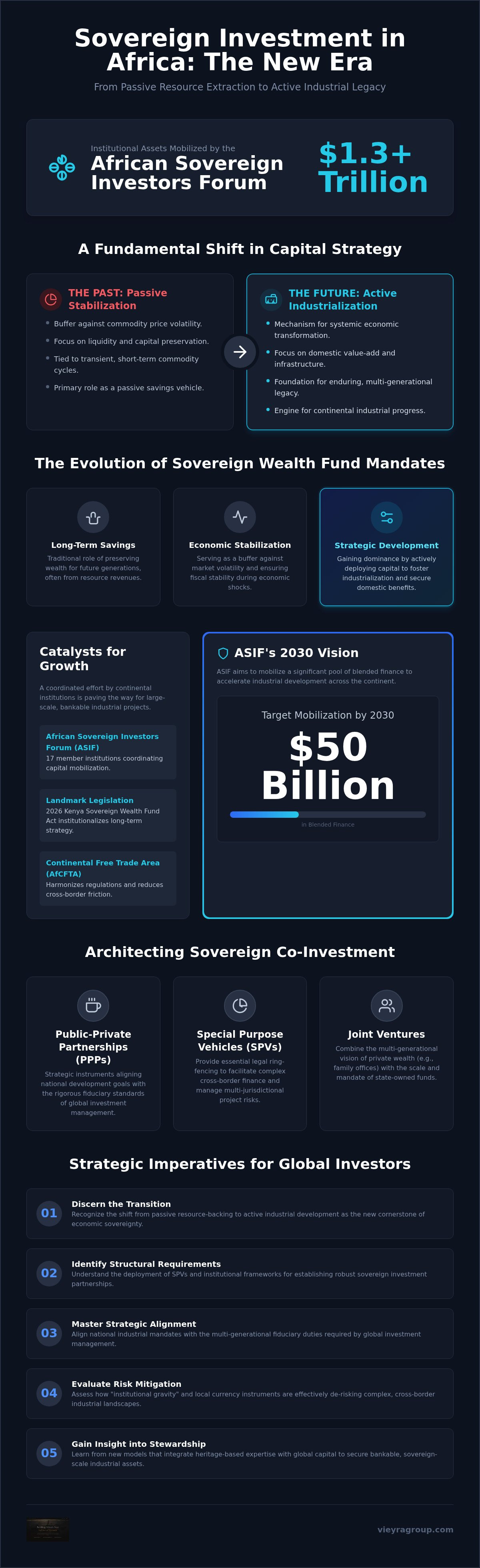
The era of passive resource extraction has reached its institutional conclusion, replaced by a sophisticated architecture of sovereign investment partnerships in Africa that prioritize the permanence of industrial legacy over the transience of commodity cycles. As the African Sovereign Investors Forum now oversees the mobilization of institutional assets estimated at over 1.3 trillion dollars, the shift toward active, state-aligned industrialization represents the most significant realignment of global capital in the current decade. This transition demands a departure from speculative ventures in favor of robust, sovereign-scale frameworks that can withstand the fluctuations of global markets.
It is understood that the primary challenge for the global institutional actor remains the perceived systemic risk and the historical lack of alignment between fleeting political mandates and the enduring needs of large-scale infrastructure. This analysis provides an authoritative framework for navigating these complexities, offering the strategic depth necessary to align sovereign-scale capital with the industrialization requirements of the next century. We shall examine the structural evolution of these partnerships, the de-risking mechanisms inherent in the 2026 Kenya Sovereign Wealth Fund Act, and the methodologies for identifying bankable industrial projects that serve as the foundation for enduring, multi-generational global influence.
Key Takeaways
- Discern the transition from passive resource-backing to active industrial development, which serves as the cornerstone for permanent economic sovereignty across the continent.
- Identify the structural requirements for establishing sovereign investment partnerships in Africa through the deployment of sophisticated Special Purpose Vehicles and institutional frameworks.
- Master the strategic alignment between national industrial mandates and the multi-generational fiduciary duties of global investment management.
- Evaluate the efficacy of institutional gravity in mitigating perceived systemic risks within complex, cross-border industrial landscapes.
- Gain insights into the stewardship models that integrate heritage-based expertise with global capital to secure bankable, sovereign-scale industrial assets.
The Evolution of Sovereign Investment Partnerships in Africa
The historical trajectory of African state-owned capital is undergoing a fundamental metamorphosis. For decades, the traditional sovereign wealth fund served primarily as a buffer against the volatility of global commodity prices. These stabilization vehicles were designed for liquidity and preservation rather than active participation in industrial progress. The current landscape has shifted. We now see the maturation of sovereign investment partnerships Africa as a mechanism for systemic economic transformation. This evolution is punctuated by the rise of the African Sovereign Investors Forum (ASIF). This forum currently coordinates 17 member institutions in a collective effort to mobilize 50 billion dollars in blended finance by 2030. The year 2026 represents a definitive juncture. It's marked by the enactment of the Kenya Sovereign Wealth Fund Act and Guinea's billion-dollar launch. These milestones signal a continental pivot toward capital self-sufficiency and the institutionalization of long-term development strategies.
From Resource Stabilization to Strategic Growth
The transition from commodity-backed savings to active industrial capital reflects a broader movement toward domestic value-addition. African nations are no longer content with the export of raw materials. They're deploying capital to build the infrastructure of beneficiation. This shift has necessitated the emergence of sovereign-scale private institutions. These entities act as critical co-investors, bridging the gap between state mandates and private-sector agility. By aligning through sovereign investment partnerships Africa, states can ensure that their industrial goals aren't just visionary but bankable and enduring across generations. This alignment transforms passive wealth into an engine for continental industrialization.
The Institutional Landscape of African SWFs
The current institutional landscape is defined by three primary mandates: long-term savings, economic stabilization, and strategic development. While stabilization remains a priority for resource-dependent economies, the strategic development mandate is gaining dominance. This shift reflects a move toward industrial nationalism where governments assert control over natural resources to ensure domestic benefits. A critical component of this de-risking strategy involves the utilization of local currency instruments, which mitigate the exchange rate risks that have historically hampered large-scale infrastructure projects. Sovereign-scale capital is defined as the deployment of high-volume, long-horizon liquidity through institutional frameworks that harmonize national economic sovereignty with the rigorous fiduciary standards of global investment management.
Structural Frameworks for Sovereign-Institutional Co-Investment
The mobilization of institutional capital into the African industrial landscape necessitates an architectural precision that transcends conventional private equity models. At the sovereign level, Public-Private Partnerships (PPPs) function not merely as procurement methods but as instruments of strategic alignment between national development goals and global fiduciary standards. These structures often utilize Special Purpose Vehicles (SPVs) to facilitate cross-border finance. These vehicles provide the legal ring-fencing required to manage the complexities of multi-jurisdictional industrial projects. The declaration of intent signed on June 26, 2026, between the African Sovereign Investors Forum and the African Development Bank Group underscores the commitment to deepening these capital-mobilizing partnerships for large-scale infrastructure.
Joint venture models between global family offices and state-owned investment funds represent a burgeoning frontier for sovereign investment partnerships Africa. These models combine the multi-generational vision of private wealth with the scale and mandate of the state. Regulatory harmonization, accelerated by the African Continental Free Trade Area (AfCFTA), provides the necessary scaffolding for these ventures by standardizing investment protocols and reducing the friction of cross-border industrial operations. For institutional actors, aligning with strategic capital solutions ensures that these structural frameworks are not merely theoretical but operational pathways to industrial growth.
Designing Bankable Sovereign-Scale Projects
To achieve institutional-grade status, industrial projects must demonstrate more than just commercial viability. They must align with the long-term industrialization mandates of the host nation while satisfying the rigorous risk-adjusted return requirements of global institutions. Blended finance plays a pivotal role here. It utilizes concessional capital to mitigate early-stage development risks, thereby creating a pathway for sovereign-scale private capital to enter. Ensuring governance alignment between private stewards and state entities is paramount. It requires a shared commitment to transparency and the preservation of industrial legacy.
Legal and Fiduciary Considerations
The longevity of these partnerships rests upon a foundation of legal clarity and fiduciary rigor. Navigating sovereign immunity and establishing robust dispute resolution mechanisms are essential for de-risking long-horizon investments. Agreements must be structured with multi-clause provisions that account for shifting geopolitical landscapes and macroeconomic cycles. The adoption of international auditing standards and transparency protocols ensures that these sovereign investment partnerships Africa remain insulated from the short-term political cycles that often disrupt capital flows. This creates a stable environment where multi-generational capital can flourish with the poise of an established institution.
Strategic Alignment: Industrialization vs. Wealth Preservation
The strategic imperative for the deployment of sovereign-scale capital across the African landscape has undergone a fundamental transition, moving beyond the mere accumulation of liquid reserves toward the active cultivation of integrated industrial ecosystems. While stabilization funds served a necessary purpose in previous decades, the current mandate focuses on the systemic integration of value chains. By shifting from the export of raw commodities to the development of domestic manufacturing and energy transformation, sovereign investment partnerships Africa establish a foundation for returns that are intrinsically linked to the continent's fundamental growth. This approach recognizes that true wealth preservation isn't found in the avoidance of industrial risk, but in the institutional mastery of it. Leveraging the potential of sovereign investors is critical in this regard, as these entities possess the unique capacity to bridge the gap between high-level policy and the rigorous demands of global investment management.
The Multi-Generational Investment Horizon
A fifty-year investment horizon fundamentally recalibrates the definition of risk, as short-term volatility becomes secondary to the pursuit of structural permanence. There's a profound synergy between the multi-generational vision of established family offices and the long-term mandates of sovereign funds, both of which prioritize the creation of enduring legacy over quarterly fluctuations. The industrialization-preservation paradox is the perceived tension between the immediate requirements of national economic development and the fiduciary obligation of long-term capital security, a conflict resolved through the development of tangible industrial assets that generate compounding value across successive generations. This long-term perspective allows for the allocation of capital into projects that might appear capital-intensive in the short term but serve as the bedrock for stable, inflation-hedged returns over decades.
Sectors of Systemic Impact
Identifying sectors that offer systemic impact is essential for ensuring that capital deployment results in both economic sovereignty and robust returns. Energy security, digital infrastructure, and agro-processing represent the primary conduits for this progress, serving as the connective tissue for regional industrial hubs. Within the framework of sovereign investment partnerships Africa, the role of capital extends beyond simple financing; it acts as a catalyst for creating integrated economic zones that reduce reliance on external supply chains. Evaluating the social impact of these industrial initiatives isn't merely a secondary consideration but a core metric of success, as the stability of the industrial landscape is directly tied to the prosperity of the communities it serves. This creates a virtuous cycle where industrial growth and wealth preservation are mutually reinforcing goals.
Mitigating Systemic Risk through Institutional Gravity
The distinction between perceived systemic risk and the structural reality of the African industrial landscape is often a matter of institutional perspective. While external observers may focus on surface-level volatility, the sophisticated actor recognizes that institutional gravity provides a necessary counterweight to macroeconomic shifts. By utilizing the prestige and deliberate pace of an established entity, it's possible to navigate geopolitical complexities that would otherwise deter speculative capital. The cultivation of sovereign investment partnerships Africa relies on this sense of permanence. It transforms the investment from a transactional venture into a foundational pillar of regional stability. Success in this environment doesn't come from avoiding risk, but from structuring partnerships that possess the weight and longevity to absorb and mitigate it over several decades.
Navigating Geopolitical and Economic Volatility
Deciphering regional political nuances requires more than data; it demands the presence of local partnerships that understand the historical context of state mandates. These alliances serve as an essential sensory network, allowing institutional investors to distinguish between fleeting political cycles and enduring national objectives. Currency volatility remains a primary concern for long-term industrial projects, yet it can be managed through sophisticated hedging strategies and the utilization of local currency instruments mentioned in previous frameworks. Building resilience also necessitates a multi-asset class global diversification strategy. By balancing African industrialization capital with a global portfolio, an institution ensures that its commitment to the continent remains steady even during periods of global economic realignment.
Stewardship and the Social License to Operate
The longevity of any sovereign-scale investment is inextricably linked to its social license to operate. This is where the Vieyra Foundation plays a critical role. By aligning philanthropic initiatives with industrial goals, we ensure that the progress of the project is mirrored by the progress of the community. This alignment creates a protective layer of social license that strengthens investment stability against short-term market noise. As an institutional guardian, the family office protects the legacy of the partnership by acting as a stabilizing force for regional economic development. It's this commitment to stewardship that ensures the industrial landscape isn't merely exploited but cultivated for future generations. For those seeking to anchor their capital in such enduring frameworks, our Global Investment Management services provide the institutional depth required for multi-generational success.
Strategic capital, when deployed with the foresight of a sovereign actor, does more than generate returns. It builds the very infrastructure of sovereignty. By focusing on diversification within African markets, from manufacturing hubs to energy corridors, we reduce the systemic vulnerability of the portfolio. This methodical approach ensures that each initiative contributes to a larger, interconnected web of industrial growth. The result is a portfolio that doesn't just exist within a market but helps define the market's trajectory, ensuring that the legacy of the partnership remains secure through the inevitable cycles of the global economy.
The Vieyra Model: Architects of Sovereign-Scale Stewardship
The Vieyra Model represents a synthesis of institutional gravity and private sector agility, positioning the family office as a permanent architect of African industrial progress. By integrating Global Investment Management with deep-rooted industrial expertise, we facilitate sovereign investment partnerships Africa that are designed for multi-generational longevity. This approach recognizes that the continent’s economic transformation requires more than just capital; it demands a commitment to stewardship that mirrors the deliberation of a sovereign entity. We don't merely participate in markets. We assist in their foundational construction, ensuring that every initiative contributes to a legacy of stability and influence. This methodology ensures that strategic capital is deployed with the poise of an entity that is certain of its trajectory.
A Legacy of Strategic Capital Allocation
The foundation of our strategy rests upon the alignment of multi-generational African heritage with the rigorous standards of global finance. This unique perspective allows us to decipher opportunities that remain opaque to traditional institutional actors. Our methodology for Strategic Capital Solutions involves a methodical evaluation of industrial projects, ensuring they possess the structural depth required for sovereign-scale deployment. By bridging the gap between global institutional liquidity and the specific requirements of African industrialization, we create a pathway for capital that is both impactful and enduring. It's this sense of permanence that defines our role as a significant global actor, blending traditional values with a forward-looking commitment to progress.
Engagement and Future Outlook
The trajectory for the coming decade is defined by a commitment to large-scale industrialization corridors and regional energy security. As more nations adopt frameworks similar to the 2026 Kenya Sovereign Wealth Fund Act, the opportunities for institutional alignment will only expand. We envision a future where sovereign investment partnerships Africa serve as the primary engine for continental self-sufficiency. The roadmap ahead requires a composed and authoritative stance, prioritizing the quality of the legacy over the speed of the transaction. This steady, deliberate pace mirrors the long-term nature of our objectives and the scale of the industrial transformation we seek to lead. For those prepared to engage at this level of institutional rigor, we invite you to inquire regarding institutional partnerships and strategic capital deployment.
Ultimately, the Vieyra Model is a testament to the power of institutional prestige when applied to the challenges of emerging markets. It's a framework that transcends the short-term political cycles and focuses on the multi-generational needs of a growing continent. By deploying African Industrialization Capital into bankable, sovereign-scale projects, we secure not just returns, but a place in the history of the continent’s rise. This is the essence of stewardship: the deliberation of a guardian combined with the vision of an architect, all dedicated to the permanence of African growth.
Architects of a Continental Industrial Legacy
The transition from passive resource stabilization to active industrial stewardship represents the definitive economic realignment of our era. By harmonizing state mandates with institutional rigor, we've established a framework where capital doesn't merely seek transient returns but constructs the enduring foundations of economic sovereignty. The institutionalization of sovereign investment partnerships Africa ensures that the systemic risks historically associated with emerging markets are neutralized through structural permanence and the composed authority of an established guardian. This approach prioritizes the cultivation of bankable, sovereign-scale assets that function as the bedrock for multi-generational wealth preservation.
As we approach a future defined by continental self-sufficiency, the requirement for sophisticated capital allocation remains paramount. Our institution is dedicated to the architectural development of this industrial landscape. We invite global actors who share our commitment to long-term stability and legacy preservation to join this vision. Connect with the Vieyra Family Office to discuss sovereign-scale investment strategy and leverage our strategic focus on African industrialization. The path to permanent progress is secured through the deliberation of those who build for the centuries.
Frequently Asked Questions
What defines a sovereign-scale investment partnership in the African context?
It's the formal alignment of institutional capital with national industrial mandates to facilitate large-scale, long-horizon infrastructure and manufacturing projects. These partnerships transcend traditional private equity by integrating state-backed security with private sector efficiency. They're characterized by their capacity to absorb systemic volatility while prioritizing domestic value-addition. This structural depth ensures that sovereign investment partnerships Africa remain insulated from short-term economic fluctuations and geopolitical shifts.
How do African sovereign wealth funds compare to global peers in asset management?
African sovereign wealth funds are increasingly transitioning from passive stabilization vehicles to active strategic development funds, mirroring the sophistication of global peers. While total assets under management for African funds reached approximately 164 billion dollars in 2026, their focus is uniquely domestic and regional. Unlike many global funds that prioritize international diversification, African institutions are strategically deploying capital into local industrialization corridors to secure multi-generational economic sovereignty.
What are the primary risks associated with large-scale industrial projects in Africa?
The primary risks include currency volatility, shifting regulatory landscapes, and the misalignment of political cycles with long-term capital needs. These challenges are often perceived as systemic, yet they're mitigated through institutional gravity and the use of local currency instruments. By establishing robust governance frameworks and utilizing Special Purpose Vehicles, investors can ring-fence assets against macroeconomic shocks. Transparency and international auditing standards remain essential for maintaining fiduciary integrity in these complex jurisdictions.
How can global family offices effectively co-invest with African state institutions?
Global family offices achieve efficacy by aligning their multi-generational vision with the strategic industrial mandates of state-owned entities. This synergy is best facilitated through joint venture models that respect national sovereignty while demanding global investment standards. Effective co-investment requires a deep understanding of regional political nuances and a commitment to stewardship. Such sovereign investment partnerships Africa provide family offices with access to bankable, large-scale projects that offer inflation-hedged, long-term returns.
What role does the AfCFTA play in sovereign investment partnerships?
The African Continental Free Trade Area serves as the regulatory scaffolding that standardizes investment protocols across 54 nations. It reduces the friction of cross-border industrial operations, making regional infrastructure projects more attractive to sovereign-scale capital. By harmonizing trade rules and intellectual property rights, the AfCFTA allows for the creation of integrated regional industrial hubs. This continental alignment provides the scale necessary for sovereign investors to finance complex, multi-jurisdictional value chains effectively.
How is multi-generational wealth preservation balanced with industrial development goals?
This balance is achieved by recognizing that industrial development serves as the primary engine for stable, long-term asset appreciation. Industrialization creates tangible, productive assets that are less susceptible to the volatility of liquid markets. By investing in energy security and manufacturing, sovereign actors secure compounding value that benefits future generations. This strategic alignment ensures that the pursuit of national economic growth directly supports the fiduciary obligation of permanent wealth preservation.
What sectors are currently attracting the most sovereign-scale capital in Africa?
Strategic capital is predominantly flowing into energy transformation, digital infrastructure, and agro-processing hubs. The global energy transition has accelerated investment into critical minerals and green hydrogen projects, particularly in nations like Guinea and Kenya. Digital infrastructure remains a priority as it provides the connective tissue for modern industrial economies. These sectors offer high systemic impact, ensuring that capital deployment results in both economic sovereignty and robust, multi-generational institutional returns.
Why is institutional gravity essential for navigating African investment landscapes?
Institutional gravity provides the necessary poise and permanence to withstand short-term market noise and geopolitical shifts. It acts as a stabilizing force, signaling to both state actors and global markets that the investment is rooted in a long-term vision. This composed stance allows for the deliberate negotiation of complex agreements and the cultivation of deep-rooted social license. Without this sense of institutional weight, capital remains speculative and vulnerable to the very volatility it seeks to navigate.


