
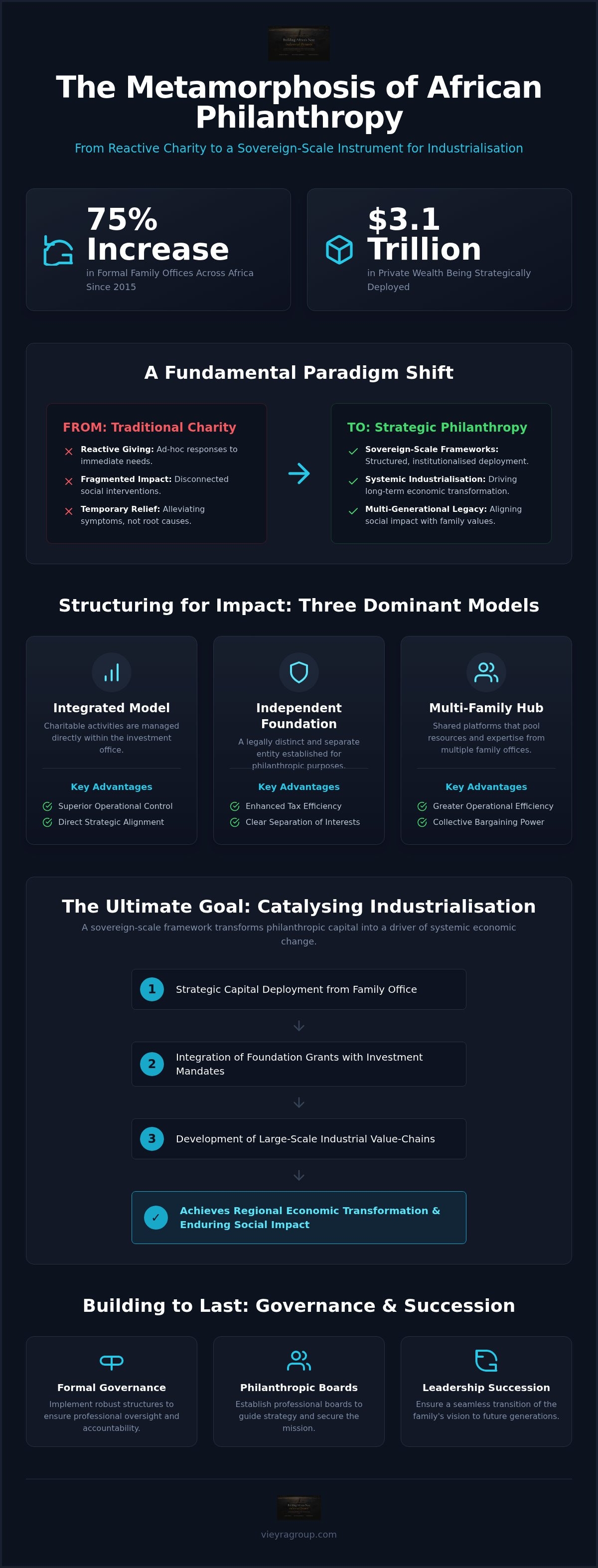
The traditional paradigm of African charity, once defined by reactive giving and fragmented social interventions, is undergoing a definitive metamorphosis into a structured instrument of continental sovereignty. With the number of formal family offices across the continent increasing by 75% since 2015, the emergence of sophisticated family office philanthropy models Africa now employs signals a shift toward the strategic deployment of the region’s USD 3.1 trillion in private wealth. Many principals recognize the inherent tension in maintaining a multi-generational legacy when philanthropic efforts remain disconnected from the broader industrial objectives of the family’s investment portfolio.
This discourse provides a comprehensive analysis of the transition from traditional grant-making to sovereign-scale frameworks designed to drive systemic industrialisation. You will discover the methodologies required to professionalise the family’s charitable arm and align social impact with regional economic transformation. We shall examine the structural evolution from fragmented impact to a permanent institutional legacy, ensuring that the family’s vision operates with the deliberation and foresight of a significant global actor. This evolution represents more than a change in tactics; it is the architectural foundation for an enduring African heritage.
Key Takeaways
- Grasp the transition from reactive, ad-hoc giving to an institutionalised framework that ensures the preservation of multi-generational wealth and social influence.
- Analyze the structural nuances of the family office philanthropy models Africa employs, focusing on the strategic alignment between independent foundations and global investment mandates.
- Identify methods to catalyze regional industrialisation by integrating foundation grants with large-scale industrial value-chain development.
- Implement formal governance structures and philanthropic boards to secure a permanent institutional legacy and facilitate seamless leadership succession.
- Review the Vieyra Foundation model as a benchmark for synchronizing sovereign-scale social impact with the broader strategic capital solutions of the family office.
The Paradigm Shift: Defining Strategic Philanthropy in Africa
The conceptualization of philanthropy within the context of African wealth preservation has transitioned from discretionary benevolence to a core component of institutional stability. Historically, philanthropic engagement often mirrored the informal nature of early wealth accumulation, characterized by ad-hoc responses to immediate communal needs. Today, the maturation of the continent's financial architecture necessitates a more rigorous approach. By defining the family office as a vehicle for multi-generational continuity, principals are increasingly adopting the formal family office philanthropy models Africa requires to ensure that capital deployment serves as a strategic extension of the family’s legacy. This shift reflects a move toward institutionalised strategic impact where the foundation isn't merely a charitable arm, but a guardian of the family’s enduring values and regional influence.
Sovereign-scale philanthropy is the deliberate deployment of strategic capital to address systemic structural deficiencies rather than merely alleviating symptomatic social pressures. It's a philosophy that prioritizes root-cause resolution over temporary relief. African family offices are uniquely positioned to lead this regional economic transformation because their capital is inherently patient, their horizons are multi-generational, and their success is tied to the industrialization of the continent. Unlike foreign aid or institutional donors, these offices possess the local nuance and agility required to navigate complex geopolitical landscapes while remaining committed to long-term progress.
The Cultural and Economic Imperative
The persona of the guardian is central to the African wealth management tradition. It reflects a profound commitment to heritage that transcends simple asset accumulation. While Western models often emphasize tax optimization or public relations, indigenous institutional growth in Africa is intrinsically linked to the stability of the surrounding ecosystem. A family’s reputation isn't merely a social asset; it's a foundational requirement for long-term operational success in emerging markets. By fostering systemic social stability, families protect the very environments where their industrial interests reside, creating a symbiotic relationship between private prosperity and public health. This cultural imperative ensures that the family remains a welcomed partner in national development across generations.
Philanthropy as a Pillar of Sovereign-Scale Institutions
The integration of a social mission into the core investment philosophy is no longer a secondary consideration. It's a strategic imperative for any entity aiming for sovereign-level influence. Sovereign-scale institutions prioritize the creation of permanent philanthropic structures that operate with the same professional rigor as their commercial counterparts. This permanence ensures that impact isn't subject to the whims of economic cycles or shifting family interests. Within the volatile contexts of emerging markets, a robust philanthropic arm serves as a vital risk-mitigation tool. It builds social capital and local resilience, creating a buffer against geopolitical shifts as principals refine the family office philanthropy models Africa needs to secure its future.
Comparative Models: Structuring the Philanthropic Arm
The selection of a structural framework is a foundational decision that dictates the efficacy of long-term social mandates. When evaluating family office philanthropy models Africa currently utilizes, the choice often lies between the direct integration of charitable activities within the investment office or the establishment of a legally distinct foundation. A fundamental trade-off exists here: an integrated approach offers superior operational control and strategic alignment, while an independent foundation typically provides enhanced tax efficiency and a clearer separation of the family's public and private interests. The maturation of the African wealth landscape has also seen the rise of multi-family office philanthropic hubs. These shared platforms allow smaller offices to pool resources, achieving a level of operational efficiency and collective bargaining power that would be unattainable for a single entity acting in isolation.
We're seeing a significant rise in "Impact-First" investment vehicles that blur the traditional boundaries between philanthropy and private equity. These structures prioritize systemic change, treating social outcomes as a primary metric of success alongside financial preservation. By adopting these sophisticated models, families can ensure their capital doesn't merely alleviate symptoms but actively reshapes the economic environment. It's a method of professionalizing the family’s charitable arm to match the rigor of their sovereign-level operations.
Model A: The Integrated Foundation
This model leverages the resident expertise of the family office to execute charitable initiatives. By utilizing shared administrative and financial oversight, the family ensures that philanthropic spending adheres to the same rigorous standards as their global investment management. This structure facilitates a unified governance framework, yet it presents the challenge of balancing commercial imperatives with altruistic objectives. It's often the preferred route for families who view their social mission as inseparable from their industrial identity and want to maintain a direct hand in every initiative.
Model B: The Sovereign-Scale Strategic Fund
A more expansive approach involves the creation of a strategic fund that deploys capital into large-scale infrastructure and industrial projects with specific social mandates. These vehicles often act as development catalysts by partnering with sovereign wealth funds and regional development banks. Through the mechanics of blended finance, family offices can mitigate risk profiles while driving systemic change. This represents a sophisticated evolution in the African landscape, allowing principals to address structural barriers through strategic capital solutions that generate both social stability and long-term economic value across the continent.
Catalysing African Industrialisation through Strategic Capital
The deployment of capital into the industrial sector represents the ultimate philanthropic act within the African context. While traditional interventions often prioritize immediate relief, the sophisticated family office philanthropy models Africa is now pioneering focus on the structural transformation of entire regions. By aligning foundation grants with industrial value-chain development, families can move beyond the provision of subsistence support. Instead, they facilitate the creation of robust economic ecosystems that offer dignified employment and long-term stability. This approach recognizes that true social impact isn't measured by the volume of aid distributed, but by the degree of economic participation fostered within local communities.
Strategic capital serves as the catalyst for this transformation. Unlike fragmented grant-making, aligning foundation resources with industrial value-chain development creates a self-sustaining cycle of prosperity. It's a method of ensuring that every dollar spent contributes to the industrial sovereignty of the continent. By focusing on technical education and industrial skills training, family offices ensure that the human capital of the region is capable of sustaining the very industries they seek to build.
Industrialisation as Social Impact
The transition from subsistence-level support to systemic economic empowerment requires a shift in how impact is quantified. Family offices are increasingly financing regional industrial hubs that serve as anchors for local development. These hubs don't just provide jobs; they create a multiplier effect that stimulates ancillary businesses and infrastructure. Measuring the success of such initiatives involves looking at economic participation metrics rather than simple donation totals. It's about establishing a legacy of self-reliance. This focus on industrial skills ensures that the local workforce is prepared for the high-value roles created by African Industrialization Capital.
Strategic Capital Allocation for Development
Identifying sovereign-level gaps in the industrial landscape is the first step toward meaningful intervention. Philanthropic capital is uniquely suited to de-risk large-scale development projects that might otherwise struggle to attract purely commercial investment. By providing the initial layer of patient capital or funding essential feasibility studies, family offices act as architects of progress. This collaboration between private family wealth and public industrial policy creates a powerful synergy. It allows for the deployment of Strategic Capital Solutions that address foundational barriers like energy access or transport logistics. When private capital takes the lead in these areas, it signals confidence to global markets and secures the family’s position as a stately guardian of regional prosperity.
Governance, Legacy, and the Next Generation
The endurance of any institutional legacy depends upon the structural integrity of its governance. As principals refine the family office philanthropy models Africa increasingly requires for stability, the focus must shift from the individual to the institution. Establishing a formal Philanthropic Board ensures that the family’s social mandates are executed with the same professional rigor as their global investment management. This body serves as a bridge, maintaining the delicate balance between the family’s heritage and the evolving needs of the continental industrial landscape. Without such a framework, even the most well-capitalized initiatives risk succumbing to the fragmented impact of reactive giving or intergenerational misalignment.
The Legacy Charter serves as a foundational document for institutional permanence, codifying the family's philosophical commitment to the continent while defining the operational boundaries for future successors. It's a testament to the family's role as a stately guardian of regional progress.
Architecting the Governance Framework
A robust governance framework requires precise decision-making procedures for both grantmaking and impact investing. It's essential to define the reporting relationships between the investment and philanthropic arms to ensure that social missions don't conflict with fiduciary duties. By institutionalising these processes, families protect their "stately guardian" vision from the volatility of individual preferences. This structural clarity allows for the seamless transition of leadership, ensuring that the family’s commitment to African industrialisation remains a permanent fixture of their institutional identity. Clear governance guidelines transform a charitable impulse into a multi-generational engine for systemic change.
Educational Empowerment for Successors
Empowering the next generation requires more than a mere transfer of wealth; it necessitates a comprehensive immersion in the family’s strategic philosophy. Through structured mentorship programs within the Vieyra Foundation framework, younger family members learn to navigate the complex intersection of high finance and systemic social impact. This education fosters a global perspective that remains deeply rooted in a commitment to African development. Successors are encouraged to take on leadership roles within the philanthropic arm, providing them with a platform to develop the skills required for broader institutional stewardship. This methodical approach ensures that the next generation isn't just an heir to wealth, but a visionary architect of the family's ongoing legacy. To explore how these frameworks integrate with broader strategic capital solutions, review our approach to Global Investment Management.
The Vieyra Foundation: A Blueprint for Sovereign-Scale Impact
The Vieyra Foundation serves as the institutional embodiment of the principles discussed throughout this discourse, representing a definitive shift toward the maturation of private wealth on the continent. It functions not merely as a vehicle for distribution but as a sophisticated architect of continental progress. By establishing a permanent institutional legacy, the Foundation ensures that the family’s commitment to African economic development remains insulated from the volatility of market cycles. This model demonstrates how the family office philanthropy models Africa currently utilizes can evolve into sovereign-scale frameworks that command respect on the global stage. It's a commitment to a vision that prioritizes the long-term industrial sovereignty of the region over the ephemeral visibility of traditional charity.
Integration between the philanthropic arm and the office's global investment strategy allows for a level of synergistic impact that fragmented models cannot achieve. When social mandates are synchronized with the family’s broader industrial objectives, the foundation acts as a strategic vanguard. It identifies and addresses the structural barriers that commercial capital might avoid, effectively de-risking the environment for future industrial expansion. Principals are encouraged to adopt these sovereign-scale frameworks to ensure their family’s influence transcends individual lifetimes and becomes a permanent pillar of the African economic landscape.
Mission-Aligned Social Impact
Industrialisation sits at the heart of the Foundation’s mission, serving as the primary mechanism for systemic economic growth. The Foundation acts as a catalyst for long-term projects, providing the patient capital required to build robust industrial ecosystems. We focus on initiatives that foster self-reliance and technical proficiency within local populations, ensuring that economic participation is both broad and durable. This philosophy is deeply ingrained in The Vieyra Approach to Global Stewardship, where we detail the intersection of private heritage and public progress. By prioritizing the development of industrial value chains, the Foundation creates a multiplier effect that elevates entire communities through dignified, high-value employment.
Collaborative Stewardship
Stewardship in the African context requires an openness to sovereign-level partnerships that can amplify the reach of private initiatives. The Foundation actively seeks collaboration with regional development banks and national governments to align philanthropic efforts with broader industrial policies. This methodology relies on a measured, methodical deployment of capital, ensuring that every intervention is both strategic and sustainable. We invite you to explore the mission of the Vieyra Foundation and see how our commitment to African industrialisation is architecting a legacy of stability and prestige for the generations to come. Through these collaborative efforts, we secure the continent’s future as a significant global actor.
Architecting a Permanent Continental Legacy
The maturation of private wealth across the continent necessitates a definitive transition from discretionary benevolence toward the institutionalised family office philanthropy models Africa now employs to secure its industrial future. By synchronizing social mandates with sovereign-scale institutional depth, principals ensure that their family’s influence isn't merely a record of past success but an active engine for systemic regional transformation. This framework prioritizes long-term industrialization over symptomatic relief, fostering a self-sustaining ecosystem of prosperity that honors a multi-generational African heritage.
Establishing a permanent institutional legacy requires the same strategic focus on industrial transformation that defines the family’s commercial interests. Through rigorous governance and a commitment to architectural permanence, the vision of the stately guardian becomes a lasting pillar of continental progress. We invite you to explore how these sophisticated frameworks can preserve your family’s values while driving meaningful economic growth. Discover the Institutional Vision of the Vieyra Family Office and join us in shaping the future of the continent with the deliberation and foresight that your legacy deserves.
Frequently Asked Questions
What are the most common philanthropy models used by African family offices?
Leading families utilize the Integrated Foundation model for superior operational control or the Sovereign-Scale Strategic Fund for collaborative regional development. These structures represent a maturation of family office philanthropy models Africa employs to transcend the limitations of fragmented, reactive giving. By institutionalising their charitable efforts, families ensure that their social mandates are executed with the same professional rigor as their global investment management, facilitating a permanent legacy of continental influence.
How does impact investing differ from traditional philanthropy in Africa?
Traditional philanthropy typically involves non-reciprocal grant-making for immediate relief, whereas impact investing prioritizes systemic change with an expectation of financial preservation or return. In the African context, impact investing often functions as a Strategic Capital Solution that targets industrial value chains. This approach allows families to deploy patient capital into sectors like energy or logistics, creating self-sustaining economic ecosystems that generate both social stability and long-term value.
Can a family office philanthropy model support large-scale industrialisation?
A sophisticated family office philanthropy model supports large-scale industrialisation by providing the initial layer of de-risking capital for infrastructure projects. By funding feasibility studies and technical education, philanthropic arms prepare the human and physical landscape for industrial expansion. This strategic alignment ensures that every charitable dollar acts as a catalyst for broader economic transformation, moving beyond subsistence support to establish robust regional industrial hubs that drive systemic growth.
What is the role of the next generation in African philanthropic governance?
The next generation serves as the future architects of the family’s institutional legacy, often taking leadership roles within the Philanthropic Board. Through structured mentorship, they learn to navigate the intersection of high finance and systemic social impact. Their involvement ensures that the family’s stately guardian persona evolves to meet modern challenges while maintaining a deep-rooted commitment to the continent’s long-term industrial sovereignty and economic prosperity across successive generations.
How do sovereign-scale institutions measure the success of their philanthropy?
Sovereign-scale institutions prioritize economic participation metrics and industrial value-chain maturity over simple donation totals. Success is defined by the degree to which an intervention resolves systemic structural deficiencies and fosters local self-reliance. Measurement frameworks often include job creation figures in high-value industrial sectors and the successful de-risking of large-scale development projects, ensuring that the family’s impact is both measurable and enduring within the broader regional economic landscape.
What legal structures are best for setting up a family foundation in Africa?
The optimal legal structure often involves a trade-off between direct operational control and tax efficiency, such as the 20% donation tax rate in South Africa for values under ZAR 30 million as of 2026. Families may choose between a non-profit company or a charitable trust depending on the specific regulatory environment of their primary jurisdiction. Professionalizing these structures is essential to navigate evolving tax laws and ensure the foundation’s long-term institutional permanence.
How can family offices align their investment portfolios with their social mission?
Alignment is achieved by integrating the social mission into the core investment philosophy of the family office. This involves prioritizing African Industrialization Capital and ensuring that global investment management strategies don't conflict with the foundation’s developmental goals. By viewing the philanthropic arm as a strategic partner, families can identify sovereign-level gaps in the industrial landscape where private capital can act as a visionary architect of progress and stability.


