
The preservation of sovereign-scale wealth is no longer a matter of passive stewardship; it's a rigorous exercise in institutional architecture. For entities managing billions across disparate jurisdictions, the traditional boundaries of diversification have dissolved. This necessitates a more profound approach to family office strategic capital allocation. You likely recognize that the sheer complexity of global regulatory shifts, such as the 2025 transition to the UK residence-based tax system or the evolving guidance for family foundations in the UAE, demands a level of sophistication that transcends conventional wealth management.
It's evident that the primary challenge for the modern principal lies in the alignment of a multi-generational legacy with the high-impact requirements of regional economic transformation. This article serves as an authoritative exploration into the sophisticated mechanisms of strategic capital deployment, offering a robust framework for institutional-grade asset allocation. We'll examine the integration of industrialization as a core asset class and the strategic alignment of global wealth with systemic progress. This inquiry provides the necessary clarity to transform private capital into a permanent instrument of global influence.
Key Takeaways
- Define the transition from passive wealth management to a deliberate institutional mandate for family office strategic capital allocation.
- Design a multi-asset framework that balances immediate liquidity with the extended horizons required for sovereign-scale industrial deployment.
- Recognize African industrialization as a core strategic asset class capable of driving systemic value and regional economic transformation.
- Implement rigorous governance structures, including independent investment committees, to ensure the permanence of multi-generational stewardship.
- Align global investment management with visionary legacy objectives to catalyze large-scale progress across generations.
The Paradigm Shift: From Wealth Management to Strategic Capital Allocation
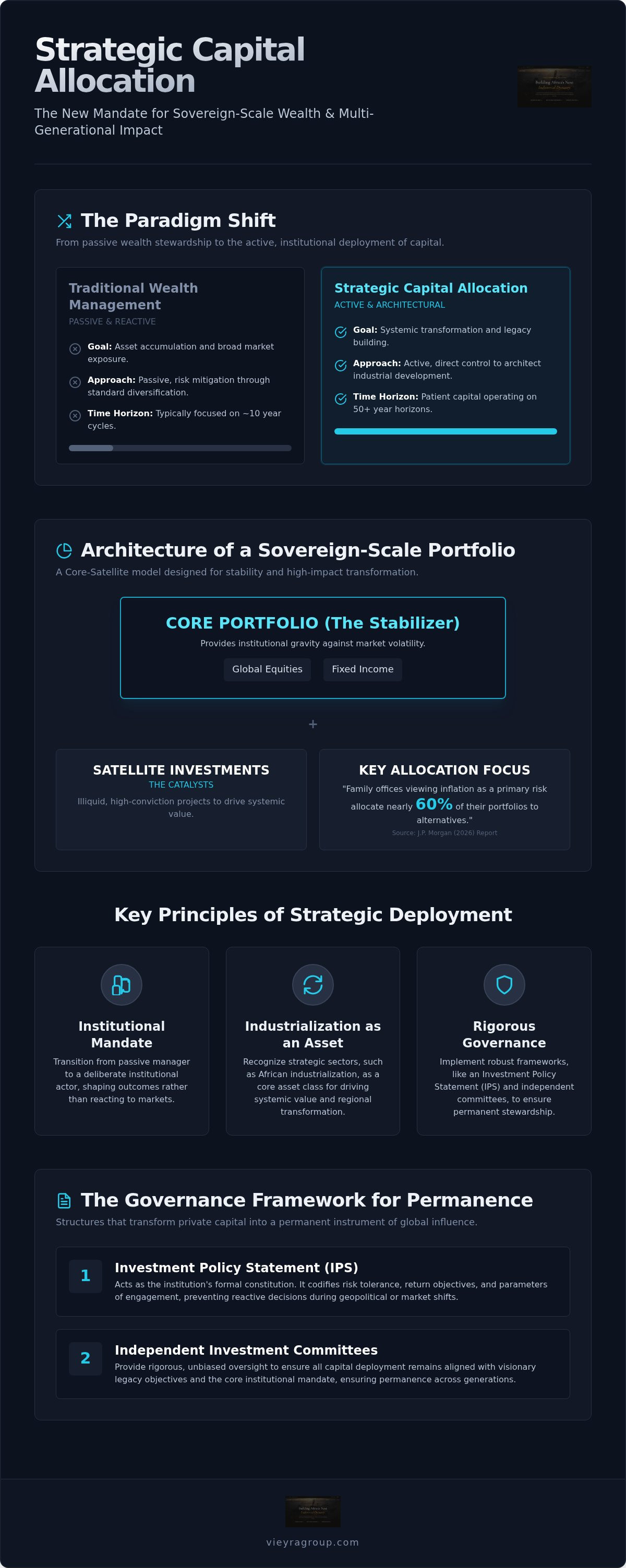
The landscape of private wealth is currently undergoing a fundamental transformation, where the era of passive wealth management has yielded to a rigorous institutional mandate. For the world's most significant principals, this shift toward family office strategic capital allocation represents a departure from mere asset accumulation toward the deliberate deployment of resources as a sovereign-level actor. Traditional diversification models, while functional for standard portfolios, often fail to account for the systemic impact required by institutions of this magnitude. These models typically lack the depth to facilitate regional economic transformation or to manage the complexities of global industrialization projects.
Institutional gravity serves as a primary stabilizer against the currents of global market volatility. When markets experience turbulence, sovereign-scale offices don't react with the frantic urgency of short-term participants. They maintain a composed, multi-generational vision that allows for the absorption of temporary fluctuations in favor of long-term systemic gains. This approach prioritizes the permanence of the institution over the transience of the market cycle, ensuring that capital remains a tool for progress rather than a victim of speculation.
The Evolution of the Sovereign-Scale Family Office
Historically, these entities functioned as administrative hubs for private affairs, yet they've evolved into sophisticated global institutional actors. To understand this progression, it's useful to consider the foundational definition of what is a family office. Unlike standard multi-family offices that often prioritize standardized returns and retail-adjacent services, sovereign-scale entities operate with the deliberation and foresight of a state-level institution. Their mandate is the preservation of heritage through large-scale progress. This requires a transition from being a passive recipient of market trends to becoming an active architect of industrial development.
Strategic Capital vs. Traditional Investment
The fundamental distinction between these two approaches lies in their underlying intent. Traditional investment seeks to mitigate risk through broad market exposure and liquidity. Strategic capital, by contrast, seeks systemic transformation. It's characterized by an extraordinary level of patience, often operating on 50-year horizons that exceed typical ten-year private equity cycles. In the current macroeconomic environment, where J.P. Morgan (2026) reports that family offices viewing inflation as a primary risk allocate nearly 60% of their portfolios to alternatives, the focus has shifted toward direct, active control. This isn't merely about wealth preservation. It's about the deployment of family office strategic capital allocation to build infrastructure and power industries that secure a legacy for generations to come.
The Architecture of Sovereign-Scale Asset Allocation
Constructing a portfolio at this magnitude requires a deliberate synthesis of immediate stability and long-horizon ambition. It's no longer sufficient to rely on traditional modern portfolio theory; instead, the institution must adopt a framework where family office strategic capital allocation functions as a structural foundation for multi-generational endurance. This architecture typically employs a sophisticated core-satellite model. The core consists of highly liquid global equities and fixed income instruments that serve as stabilizers, while the satellites comprise illiquid, high-conviction industrialization projects designed to catalyze regional transformation.
The governing authority of this entire structure is the Investment Policy Statement (IPS). Within a sovereign-scale context, the IPS acts as a formal constitution. It dictates the parameters of engagement and ensures that the office remains resolute during cycles of geopolitical realignment. By codifying the institution's risk tolerance and return objectives, the IPS prevents the erosion of capital that often follows reactive decision-making. Insights into current family office investment trends suggest a pronounced shift toward this level of professionalization as offices seek to mitigate the complexities of the current macroeconomic environment.
Tiered Liquidity and Risk Parameters
Risk management for the visionary architect is a function of institutional permanence. This involves establishing tiered liquidity buckets that align with specific generational requirements:
- Operating Liquidity: Capital reserved for immediate institutional requirements and administrative costs, typically maintained in low-volatility instruments.
- Strategic Reserve: Mid-term capital deployed to capitalize on market dislocations or to fund incremental phases of ongoing industrial projects.
- Endowment Capital: The permanent bucket, dedicated to long-horizon illiquidity and systemic economic development.
In 2026, stress-testing these tiers against a US Federal Funds rate of 3.75% and shifting tax regimes in the UK and UAE is vital. It's through this methodical approach that an office maintains its composure while others succumb to the transience of market volatility.
The Role of Global Alternative Assets
The institutional mix has evolved beyond passive limited partner positions in hedge funds. Today's sovereign-scale offices prioritize direct investment and co-investment frameworks that allow for greater transparency and control. This shift is reflected in the fact that offices viewing inflation as a primary risk now allocate nearly 60% of their portfolios to alternatives, according to 2026 J.P. Morgan data. By engaging directly with infrastructure and private debt, the institution can bypass traditional intermediaries and align its capital more closely with its long-term vision. Those seeking to refine their deployment strategies may find that Strategic Capital Solutions provide the necessary institutional depth to navigate these complex private markets.
Industrialization as a Strategic Asset Class: Beyond Alternatives
While traditional alternative investments often focus on multiple expansion and exit-driven returns, the sovereign-scale institution recognizes industrialization as a foundational pillar of institutional permanence. Within the framework of family office strategic capital allocation, industrial assets aren't merely yield-generating satellites; they're the engines of a multi-generational legacy. This shift in perspective moves capital from the transience of liquid volatility into the tangible stability of regional infrastructure. In the first half of 2026, PwC reported a 34% decline in private equity deal volume, yet the average deal size increased significantly. This data suggests a flight toward quality and scale, mirroring a broader institutional preference for large-scale, high-conviction industrial plays over fragmented opportunistic investments.
Financing the African Industrial Renaissance
The mechanics of deploying capital into the African industrial landscape require a sophisticated understanding of the synergy between private resources and state-level initiatives. Energy, manufacturing, and logistics serve as the primary conduits for this transformation. By positioning capital within these sectors, an office creates a natural hedge against the correlations of global public markets. It's a move toward tangible assets that possess intrinsic value and serve as the backbone of regional stability. Strategic deployment of African Industrialization Capital allows the institution to secure long-term yield while participating directly in the creation of essential economic infrastructure. This approach prioritizes the role of the family office as an active architect of progress rather than a passive observer of market trends.
Measuring Systemic and Economic Impact
Evaluating these investments requires a departure from the narrow confines of Internal Rate of Return (RR). While financial performance remains a non-negotiable benchmark, the visionary architect must also account for qualitative metrics of regional development. This is where the integration of the Vieyra Foundation becomes essential, as it ensures that the philanthropic strategy and the industrial deployment work in concert to foster a resilient economic ecosystem. Industrial capital serves as the primary mechanism for transforming latent economic potential into a resilient, self-sustaining industrial ecosystem. By aligning family office strategic capital allocation with these broader objectives, the institution secures a position of global influence that is rooted in genuine economic contribution. The result is a portfolio that is not only robust in its financial structure but also profound in its systemic impact.
Establishing the Governance Framework for Multi-Generational Stewardship
The stability of a sovereign-scale institution depends entirely upon the strength of its governance framework. It's the silent scaffolding that supports every decision regarding family office strategic capital allocation. Without a formal institutional structure, even the most substantial portfolios risk fragmentation across generations. This framework must include an Investment Committee (IC) comprised of independent global experts who provide the necessary distance and professional rigor to challenge internal assumptions. According to 2024 Deloitte projections, family office assets are expected to reach US$5.4 trillion by 2030. This scale necessitates the same level of oversight as a sovereign wealth fund or a global pension scheme.
Formalizing the architecture of permanence involves the implementation of sophisticated trust structures and family constitutions. These documents aren't merely legal requirements; they're the codified values of the institution. They ensure that the multi-generational legacy remains aligned with high-impact industrialization projects, even as individual family members' interests evolve. Transparency and reporting are the lifeblood of this system, providing the clarity required for informed stewardship and the preservation of institutional gravity.
The Investment Committee and Institutional Rigor
An effective IC brings a diverse array of global perspectives, ensuring that strategic rebalancing reviews are conducted with methodical depth. These reviews shouldn't be infrequent events. They're continuous processes that evaluate the portfolio's resilience against shifting geopolitical realities. In 2026, this includes integrating ethical mandates and ESG principles into the very core of the governance framework. This ensures that capital isn't just preserved but is deployed in a manner that honors the institution's commitment to systemic progress. Data from UBS (2026) indicates that 60% of sophisticated family offices now utilize formal investment committees to maintain this level of professional oversight.
Education and Preparation of Next-Generation Stewards
The transition of power is perhaps the most critical moment in the life of a multi-generational institution. It requires a deliberate effort to bridge the gap between historical heritage and modern financial sophistication. The family office serves as a mentor, preparing the next generation to manage the complexities of family office strategic capital allocation with the same poise and deliberation as their predecessors. This ensures the continuity of the institutional vision across centuries. Principals seeking to formalize this level of institutional rigor can explore Strategic Capital Solutions to secure their family's trajectory and ensure the permanence of their global influence.
The Vieyra Approach: Deploying Capital for Trans-Generational Impact
The Vieyra Family Office operates with a philosophy that transcends standard financial benchmarks, viewing the deployment of capital as a sacred trust. Our framework for family office strategic capital allocation is built upon the conviction that sovereign-scale wealth must serve as a catalyst for systemic stability. By integrating global investment management with an intimate understanding of regional dynamics, we bridge the gap between international capital and African industrialization. This isn't merely a service; it's a commitment to the architecture of legacy that values the permanence of institutions over the transience of the present moment. This methodology ensures that every dollar deployed is an investment in the long-term stability of the global economic order.
A Legacy of African Industrialization
Rooted in a multi-generational African heritage, our institution recognizes that true wealth preservation is inseparable from regional progress. We view family office strategic capital allocation as the primary mechanism for funding the essential sectors of energy, manufacturing, and logistics. These industries form the backbone of a modern economy and provide a structural hedge against the correlations of public markets. This industrial focus offers a level of permanence that traditional alternatives often fail to provide. The Vieyra Foundation further solidifies this capital ecosystem, ensuring that philanthropic strategy and industrial deployment work in concert to foster a resilient, self-sustaining environment of growth across the continent.
Engaging with Sovereign-Scale Excellence
As we navigate the complexities of 2026, including the 3.75% US Federal Funds rate and the refined tax guidance for family foundations in the UAE, the need for institutional gravity has never been more pronounced. Our approach remains methodical and deliberate, prioritizing long-term stability over the frantic pace of market cycles. We don't chase the transience of trends; instead, we build the foundations of future centuries. This poise is the hallmark of an entity that is deeply rooted in its identity and certain of its trajectory. We invite principals who share this visionary commitment to large-scale progress to join us in shaping a future defined by resilience and systemic impact. The path forward requires more than just capital; it demands a partnership with a stately guardian and a visionary architect of legacy.
Discover the Architecture of Global Stewardship at Vieyra Family Office
Architecting a Permanent Global Legacy
The transition from passive wealth management to a rigorous institutional mandate marks a definitive era for global principals. By integrating industrialization as a core asset class and formalizing governance through independent oversight, an office ensures its longevity across centuries. The refinement of family office strategic capital allocation represents the ultimate maturation of private wealth into a sovereign-level force capable of systemic impact. It's through this methodical rigor that the visionary architect secures a multi-generational legacy that transcends market volatility.
Vieyra Family Office stands as a stately guardian, blending multi-generational global investment management with a commitment to an African industrial legacy. Our sovereign-scale institutional expertise provides the depth required to navigate the complexities of regional economic transformation. We invite you to Explore Strategic Capital Solutions at Vieyra Family Office as you define your institution's trajectory. The future of global stewardship is built upon the deliberation and foresight exercised today, ensuring that your capital remains a permanent instrument of progress.
Frequently Asked Questions
What is the primary difference between wealth management and strategic capital allocation?
Strategic capital allocation differs from traditional wealth management by prioritizing a deliberate institutional mandate over passive growth. While wealth management often focuses on standardized returns and liquidity, family office strategic capital allocation emphasizes the long-horizon deployment of resources for systemic impact. This approach ensures that capital functions as a tool for regional transformation and institutional permanence rather than merely a vehicle for individual accumulation.
How much capital should a sovereign-scale family office allocate to alternative assets?
Data from J.P. Morgan in 2026 indicates that sophisticated family offices allocate nearly 60% of their portfolios to alternative assets when inflation is viewed as a primary risk. For sovereign-scale institutions, this allocation is typically directed toward private equity, infrastructure, and private debt. These illiquid assets provide a necessary buffer against the volatility of public markets while supporting the office's multi-generational objectives through direct control and co-investment.
Why is industrialization considered a strategic asset class for African family offices?
Industrialization is a strategic asset class because it provides tangible stability and serves as a primary driver of regional economic transformation. For African family offices, investing in sectors like energy, manufacturing, and logistics creates a natural hedge against global market correlation. This focus transforms latent economic potential into a resilient industrial ecosystem, securing both financial yield and a permanent institutional legacy that remains rooted in the continent's progress.
What role does an Investment Policy Statement (IPS) play in multi-generational wealth?
The Investment Policy Statement serves as the governing constitution for multi-generational wealth by codifying the institution's risk parameters and strategic objectives. It provides a formal framework that prevents reactive decision-making during periods of geopolitical or market instability. By establishing clear mandates for asset allocation and rebalancing, the IPS ensures that the office's vision remains resolute and consistent across successive generations.
How can family offices mitigate the risks associated with large-scale industrial projects?
Mitigation of risk in large-scale industrial projects is achieved through direct investment frameworks and the alignment of private capital with sovereign-level initiatives. By maintaining active control over project development, family offices can bypass the opacity and fees associated with traditional fund structures. This approach allows for greater transparency and the implementation of rigorous operational oversight to secure the long-term viability of the project.
What is the importance of independent governance in a family office structure?
Independent governance is essential for maintaining institutional rigor and ensuring that investment decisions are free from discretionary or reactive influences. An investment committee comprised of global experts provides the diverse perspectives necessary to challenge internal assumptions and maintain a composed stance. This professional oversight is a hallmark of a sovereign-scale entity, reinforcing the stability and permanence of the family's global influence.
How does philanthropy integrate with a family office’s strategic capital allocation?
Philanthropy integrates with family office strategic capital allocation by aligning social impact objectives with large-scale industrial deployment. Through the Vieyra Foundation, our institution ensures that philanthropic initiatives support the broader economic ecosystem. This synergy fosters regional resilience and ensures that capital deployment contributes to systemic progress while preserving the family's multi-generational heritage and commitment to social responsibility.
What are the key considerations for multi-generational succession in investment management?
Multi-generational succession requires a deliberate effort to bridge the gap between historical legacy and modern financial sophistication. It's vital to educate next-generation stewards on the complexities of institutional-grade asset allocation and the governance structures that support it. This preparation ensures that the institutional vision remains cohesive and that the office continues to operate with the same deliberation and foresight as its visionary architects.


