

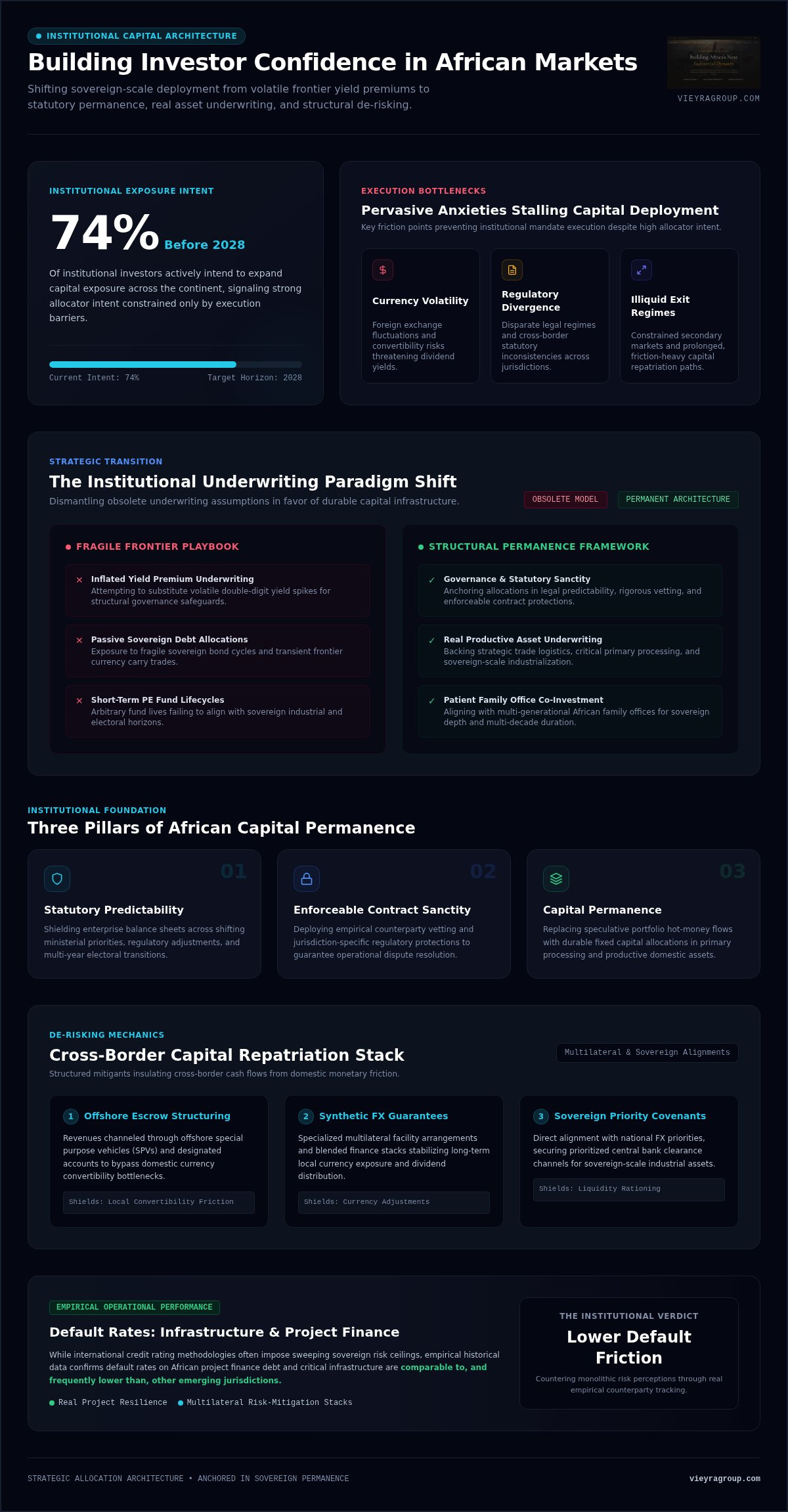
Compensating for sovereign risk with inflated yield premiums is an obsolete approach to African capital deployment. While seventy-four percent of institutional investors intend to increase their exposure across the continent before 2028, pervasive anxieties surrounding currency volatility, regulatory divergence across disparate jurisdictions, and illiquid exit regimes continue to stall execution. Genuine progress in building investor confidence in African markets cannot rely on short-term speculative appetites; it demands moving past fragile private equity models toward institutional permanence and deep structural de-risking.
Global allocators and institutional fiduciaries rightly recognize that sovereign-scale opportunity requires rigorous governance architectures rather than mere risk tolerance. In this analysis, you will discover the structural frameworks, risk-mitigation architectures, and institutional partnerships essential for building investor confidence in African markets with unwavering conviction. We examine how empirical due diligence protocols, multilateral blended finance structures, and enduring local co-investment conduits collectively establish a permanent foundation for sovereign industrialization and multi-generational capital preservation.
Key Takeaways
- Institutional stability relies on replacing speculative yield premiums with robust governance architectures anchored in statutory predictability and capital permanence.
- Dismantling monolithic risk perceptions requires evaluating empirical counterparty performance alongside jurisdiction-specific regulatory protections and regional economic frameworks.
- Deploying blended finance stacks and multilateral risk-mitigation guarantees provides the structural security necessary for building investor confidence in African markets.
- Sovereign-scale due diligence mandates exhaustive legal counterparty vetting paired with comprehensive stress-testing against currency adjustments and liquidity friction.
- Partnering with multi-generational African family offices affords global institutional allocators sovereign alignment and patient capital duration that transcends short-term fund life cycles.
Defining Investor Confidence in Contemporary African Capital Markets
Institutional investor confidence is fundamentally defined by statutory predictability, enforceable contract sanctity, and capital permanence rather than ephemeral yield spikes. For global allocators assessing the broader Economy of Africa, building investor confidence in African markets requires transcending the volatile cycles of foreign portfolio flows. Hot money pursues transient currency carry trades, only to reverse abruptly at the onset of global monetary tightening. By contrast, genuine institutional maturity hinges on long-horizon fixed capital formation across productive domestic sectors. Such structural permanence acts as an operational anchor; it safeguards enterprise balance sheets and preserves asset integrity across multi-year electoral cycles, shifting ministerial priorities, and evolving regulatory architectures.
The Paradigm Shift Beyond Speculative Frontier Yields
Historical underwriting models that relied on double-digit yield premiums to compensate for systemic risk failed to attract sovereign pension allocators and legacy institutions. Fiduciary institutions cannot substitute elevated headline yields for structural governance stability. Consequently, sophisticated global capital is moving decisively away from passive sovereign debt toward real asset underwriting, strategic trade logistics, and primary processing assets. This institutional evolution directly underpins the mandate for private capital in African industrialization, demonstrating that building investor confidence in African markets relies on backing tangible economic capacity rather than volatile frontier debt.
Structural Liquidity and Cross-Border Capital Repatriation
Capital repatriation anxieties and periodic liquidity rationing within emerging central bank regimes represent historical deterrents to sovereign-scale allocation. De-risking these environments requires modern transactional mechanisms designed to insulate cross-border cash flows:
- Offshore Clearing and Escrow Architectures: Structuring revenues through offshore special purpose vehicles and designated accounts to mitigate domestic currency convertibility bottlenecks.
- Synthetic FX Hedging and Convertibility Guarantees: Utilizing specialized multilateral facility arrangements to manage local currency exposure and stabilize multi-year dividend distributions.
- Sovereign Co-Investment Covenants: Aligning project milestones with national foreign exchange priorities, ensuring that critical industrial enterprises maintain prioritized central bank clearance channels.
Multi-generational family offices and sovereign capital stewards deploy these institutional mitigants to ensure unencumbered liquidity across multi-decade holding periods, decoupling long-term industrial operations from domestic monetary friction.
Evaluating Institutional Risk: Perceived Vulnerabilities Versus Empirical Realities
A persistent impediment to global capital allocation across the continent is the institutionalized risk premium, which routinely conflates subjective market perception with empirical operational performance. While international credit rating methodologies often impose sweeping risk ceilings, historical data reveals that default rates on project finance debt and critical infrastructure across key African markets remain comparable to, and frequently lower than, other emerging jurisdictions. Crucially, the substantial expansion of private capital mobilisation in Africa demonstrates that sophisticated fiduciaries are actively recalculating this disparity. Institutional allocators achieve genuine security by implementing rigorous frameworks for sovereign investment risk management in Africa, which protect long-term equity allocations against localized political and macro-fiscal shifts.
Sovereign Legal Enforceability and Arbitration Architecture
Legal fragmentation is mitigated through robust transnational legal harmonization systems and institutional treaty networks:
- Harmonized Corporate Law: The Organization for the Harmonization of Business Law in Africa (OHADA) provides seventeen member states with a unified, predictable commercial legal code that governs contracts, corporate formations, and secured transactions.
- Bilateral Investment Treaties (BITs): Strategic cross-border investments leverage bilateral pacts guaranteeing non-discriminatory treatment, protection against direct or indirect expropriation, and clear compensation standards.
- Neutral Dispute Venues: Multi-jurisdictional structuring roots contract covenants in established arbitral forums, such as the London Court of International Arbitration (LCIA) or the International Chamber of Commerce (ICC) in Paris, guaranteeing neutral, binding enforcement.
These legal safeguards are pivotal for building investor confidence in African markets, converting abstract regulatory environments into concrete, enforceable statutory rights.
Macroeconomic Differentiation Across Regional Economic Blocs
Treating fifty-four distinct jurisdictions as a monolithic asset class obscures critical macroeconomic variations. The East African Community (EAC), characterized by integrated transport corridors and regional trade, presents vastly different balance-sheet dynamics than the resource-endowed Southern African Development Community (SADC) or the Economic Community of West African States (ECOWAS). Furthermore, sovereign wealth funds holding over $164 billion in continental assets increasingly anchor major industrial transactions. By co-investing alongside state balance sheets, global allocators build systemic alignment with host governments. For institutional fiduciaries seeking to navigate these intricate jurisdictions, partnering with an established multi-generational office through Strategic Capital Solutions provides the jurisdictional lineage necessary to de-risk sovereign deployment and ensure multi-generational capital preservation.
Structural Frameworks That De-Risk Large-Scale African Deployment
Deploying sovereign-scale capital into emerging industrial corridors requires sophisticated contractual engineering that systematically buffers institutional balance sheets. Rather than relying on unhedged exposures, global allocators utilize multi-layered capital structures to insulate primary investments against political, regulatory, and currency shocks. The rapid maturation of private capital markets in Africa reflects this structural shift, proving that institutional capital preservation depends on deliberate risk-partitioning architectures rather than passive diversification.
Blended Finance and Multilateral Risk-Mitigation Instruments
Blended capital stacks combine concessional finance with commercial debt to reconfigure project risk-return profiles:
- First-Loss Capital Tranches: Development finance institutions absorb initial project impairments, protecting senior private tranches and enabling commercial banks to participate.
- Multilateral Political Risk Underwriting: The Multilateral Investment Guarantee Agency (MIGA) issues guarantees covering sovereign contract breaches, expropriation, and transfer restrictions, effectively elevating project credit ratings.
- Synthetic Currency Swaps: Specialized offshore hedging facilities convert domestic revenue streams into hard-currency equivalents, neutralizing local exchange volatility.
These tiered structures are indispensable for building investor confidence in African markets, enabling global institutional fiduciaries to participate in sovereign-scale infrastructure with investment-grade protections.
The African Continental Free Trade Area as an Institutional Catalyst
The operationalization of the African Continental Free Trade Area (AfCFTA) dismantles historical market fragmentation by harmonizing customs protocols, tariffs, and cross-border trade regimes across member states. This consolidated market structure enables industrial operators to achieve critical mass across logistics hubs and value-added manufacturing corridors. Complementing this framework, the Pan-African Payment and Settlement System (PAPSS) allows intra-African trade transactions to clear in local currencies. By circumventing intermediate currency conversions and reducing systemic reliance on third-party reserves, PAPSS lowers cross-border transaction friction while reinforcing the broader objective of building investor confidence in African markets.
Cross-Border Special Purpose Vehicle Domiciliation and Governance
Legal resilience requires intermediate holding vehicles domiciled in established, transparent jurisdictions such as Mauritius, Abu Dhabi, or London. These jurisdictions provide robust double taxation avoidance agreements, clear statutory protections, and stable corporate registries. Structuring through these conduits guarantees predictable repatriation pathways and subjects operations to independent fiduciary governance. Independent board directorships, rigorous audit covenants, and international compliance architectures ensure complete structural transparency, directly aligning sovereign industrial initiatives with global fiduciary standards.
Institutional Due Diligence: A Strategic Roadmap for Sovereign-Scale Allocation
Deploying capital at an institutional threshold requires moving past off-the-shelf questionnaires designed for public equities. Sovereign-scale underwriting demands a forensic methodology engineered to verify whether legal rights hold under operational stress. True efficacy in building investor confidence in African markets emerges when global allocators execute a five-stage due diligence sequence tailored to regional administrative realities:
- Forensic Counterparty Screening: Conduct deep background verification on beneficial ownership networks, political exposure registries, and cross-border regulatory compliance histories.
- Macro-Financial Stress Testing: Model operational cash flows against acute currency devaluations, local inflation spikes, and foreign exchange rationing cycles.
- Governance and Operational Audit: Verify statutory accounting standards, local content compliance frameworks, and long-term community integration protocols.
- Jurisdictional Recourse Validation: Confirm clear choice-of-law clauses tied to neutral, globally recognized arbitral forums with proven enforcement track records.
- Bilateral Institutional Structuring: Anchor deployments alongside permanent domestic partners capable of buffering administrative friction through generational operational stature.
Assessing Counterparty Integrity and Domestic Institutional Stature
Surface-level compliance checks conducted by international advisory firms cannot substitute for boots-on-the-ground operational verification. Institutional allocators must analyze an operating partner's balance sheet through multi-year commodity and currency cycles to verify debt sustainability. Equally vital is evaluating beneficial ownership structures to insulate allocations from sudden shifts in political administrations. Partnering with domestic institutions that possess decades of operational lineage ensures uncompromised regulatory standing, strategic continuity, and operational stability throughout extended holding periods.
Structuring Capital Preservation and Repatriation Covenants
Robust contract architecture protects cross-border investments against balance-of-payments volatility before capital deployment occurs. Fiduciaries must implement strict cash waterfall mechanisms, priority offshore reserve escrows, and pre-agreed operational exit triggers. Incorporating dynamic currency adjustment formulas insulates core returns from localized monetary depreciation. Institutional stewards should consult the principles of global investment management to balance systemic wealth preservation across international portfolios while expanding into high-conviction African real assets.
Executing an empirical due diligence program transforms theoretical frontier potential into predictable, bankable deployment. Sovereign allocators seeking to structure de-risked institutional co-investments can collaborate with Global Investment Management to secure resilient assets anchored by established multi-generational governance.
The Sovereign-Scale Family Office as the Anchor of Long-Term Confidence
Closed-end private equity funds struggle to accommodate the multi-decade horizon required for foundational industrialization. When finite fund lifecycles dictate premature exits, operational momentum stalls. In contrast, sovereign-scale multi-generational family offices deploy permanent balance-sheet capital unrestricted by arbitrary liquidity mandates. This patient structure provides an enduring institutional foundation for building investor confidence in African markets. By committing substantial principal equity alongside institutional co-investors, sovereign family offices eradicate traditional general-partner agency conflicts, binding their long-term outcomes to asset solvency, operational excellence, and lasting economic value.
Patient Capital Versus Cyclical Market Vulnerability
Permanent capital vehicles insulate foundational enterprises from external cyclical shocks:
- Decoupling from Fund Expiration: Eliminating fixed five- to seven-year divestment mandates shields productive assets from forced liquidations during broader market contractions.
- Compounding Real Economic Value: Multi-generational horizons allow major industrial, logistics, and processing assets to reach full operational scale and cash-flow maturity.
- Balance-Sheet Autonomy: Family office governance provides the patient capital reserves necessary to absorb commodity downturns and currency realignments without diluting enterprise equity.
Patience changes everything. Where short-horizon fund managers see liquidity risk, permanent capital stewards establish generational operating resilience across shifting economic cycles.
The Architecture of Strategic Co-Investment with the Vieyra Family Office
The Vieyra Family Office functions as an institutional bridge between international institutional allocators and sovereign-scale industrial transformations. Deploying African Industrialization Capital across vital manufacturing, infrastructure, and supply chain sectors, the institution couples global fiduciary governance with deep domestic lineage. This generational presence provides peerless navigation of regional regulatory systems and insulates co-investors from administrative friction. Simultaneously, foundational commitments stewarded through the Vieyra Foundation guarantee that industrial development directly supports broader human capital growth, securing an enduring social license to operate. By structuring transparent, de-risked co-investment syndicates, the institution establishes the governance predictability that is indispensable for building investor confidence in African markets across multi-generational horizons.
Anchoring the Next Era of Sovereign Institutional Capital
Establishing enduring capital formation across the continent requires transcending speculative yield chases in favor of structural rigor. By deploying blended capital stacks, anchoring contracts in enforceable transnational arbitration frameworks, and adopting permanent balance-sheet horizons, global allocators systematically eliminate sovereign execution friction. The true catalyst for building investor confidence in African markets is not arbitrary risk tolerance; it's the implementation of governance structures that ensure statutory certainty, operational resilience, and multi-generational capital preservation.
As foundational industrialization accelerates across vital corridors, global fiduciaries require partners possessing uncompromised domestic roots alongside international fiduciary discipline. Backed by multi-generational sovereign-scale heritage, our institution couples systemic risk-mitigation frameworks and multilateral guarantees with generational vision to steward productive economic transformation. The continent's industrial expansion offers unprecedented scope for allocators prepared to lead with structural permanence. Explore Strategic Capital Partnerships with the Vieyra Family Office to deploy de-risked institutional capital alongside proven generational stewards.
Frequently Asked Questions
What primary factors determine institutional investor confidence in African capital markets?
Institutional investor confidence is fundamentally anchored in statutory predictability, uncompromised contract enforcement, and clear capital repatriation rights. Institutional allocators prioritize transparent legal frameworks and sovereign policy stability over headline yield spreads. Building investor confidence in African markets requires transparent regulatory oversight alongside credible dispute resolution mechanisms, ensuring multi-decade commitments remain insulated from unexpected administrative interventions or sudden foreign exchange restrictions.
How do institutional allocators effectively mitigate foreign exchange and currency convertibility risks?
Allocators mitigate currency volatility by structuring offshore collection accounts, utilizing synthetic cross-currency swap mechanisms, and negotiating sovereign foreign exchange prioritization covenants. Large projects frequently peg revenue tariffs to international trade baskets or hard currencies. Intermediate holding entities established in robust financial centers further insulate dividend flows, enabling global fiduciaries to manage foreign exchange convertibility risks while preserving enterprise balance sheets.
What role does the African Continental Free Trade Area play in de-risking investments?
The AfCFTA reduces cross-border operational risk by standardizing customs tariffs, unifying regulatory protocols, and dismantling non-tariff barriers across participating member nations. By creating an integrated continental market, it eliminates historical fragmentation and allows industrial enterprises to scale regionally. The integration of local-currency settlement channels through PAPSS further shields trade logistics from third-party foreign exchange reserve dependency, reinforcing stability.
How do multilateral organizations like MIGA provide political risk insurance for large-scale projects?
The Multilateral Investment Guarantee Agency (MIGA) issues comprehensive investment guarantees that cover expropriation, breach of sovereign contracts, currency inconvertibility, and civil disturbances. By inserting international treaty backing into project capital stacks, MIGA enhances credit profiles and insulates senior debt tranches. This multilateral presence acts as a powerful deterrent against arbitrary regulatory renegotiation, reassuring global institutional co-investors.
Why is multi-generational family office capital better suited for African industrialization than private equity?
Multi-generational family offices deploy permanent balance-sheet capital that is entirely free from the rigid five- to seven-year divestment cycles typical of traditional private equity funds. Developing foundational infrastructure and industrial assets demands sustained patience and decades-long alignment. Sovereign-scale family offices absorb cyclical macroeconomic fluctuations without forcing untimely asset sales, creating an enduring operational foundation for building investor confidence in African markets.
What legal jurisdictions and dispute resolution venues are preferred for pan-African cross-border contracts?
Cross-border investments favor intermediate special purpose vehicles domiciled in established corporate domiciles such as Mauritius, Abu Dhabi, or the United Kingdom, which offer reliable double-taxation networks. For binding dispute resolution, sovereign agreements routinely stipulate international arbitration covenants seated at the London Court of International Arbitration, the International Chamber of Commerce in Paris, or under OHADA uniform commercial statutes.
How do sovereign wealth funds and sovereign-scale family offices co-invest to anchor foundational infrastructure?
Sovereign wealth funds and established family offices structure joint equity consortia to finance primary infrastructure, processing hubs, and national logistics corridors. Domestic sovereign backing guarantees deep regulatory alignment, while the family office contributes private capital discipline, governance oversight, and operational longevity. This bilateral alignment demonstrates host-country commitment, significantly de-risking initiatives for international institutional partners.


