
What if a development proposal with compelling returns is still not ready for durable capital? The commercial viability of development projects depends on more than an attractive forecast: projections must rest on credible market evidence, development outcomes must be assessed alongside financial returns, and infrastructure, regulatory and execution risks must have clear owners. For investors considering long-horizon opportunities, confidence comes from how these elements reinforce one another, not from any single headline metric.
It is reasonable to expect a project to demonstrate both a sound commercial case and meaningful development value. Yet these objectives can be difficult to assess together, particularly when assumptions remain untested or delivery responsibilities are diffuse. A disciplined review can distinguish a viable proposal from one that requires redesign, stronger partnerships or further evidence before capital is committed.
This investor checklist offers a repeatable way to examine demand, financial resilience, governance, delivery capacity and risk allocation. It also considers how development outcomes and local conditions, including those relevant to African industrialisation, should inform the assessment without treating markets as interchangeable. By the end, investors can identify the conditions and safeguards that may strengthen a project’s case for long-term capital.
Key Takeaways
- Assess whether the commercial viability of development projects rests on verifiable demand, credible revenue assumptions and a realistic route to sustainable delivery.
- Separate evidence of development need from evidence that a project can perform financially under its stated assumptions.
- Examine sponsor capability, governance and technical readiness, then assign relevant delivery risks to accountable parties.
- Use clear decision gates to record required evidence, reviewer responsibility and unresolved questions before committing capital.
- Consider how capital structure, partner roles and sequencing may strengthen long-term resilience, while weighing the limitations of each approach.
What Commercial Viability Means for a Development Project
Commercial viability is the credible prospect that a development project can be delivered sustainably and generate the financial performance its sponsors expect, given evidenced demand, projected cash flows and the conditions required for execution. The assessment tests whether the case holds under stated assumptions, rather than treating an attractive forecast or strategic ambition as proof of success.
A clear development need can establish why a project matters, but it cannot establish that customers will use its output, that revenues will cover costs, or that delivery arrangements are sufficient. A feasibility study can help structure this examination by considering economic and operational dimensions; the Feasibility study overview provides a foundational account of the method. For capital providers, the central question is whether the project can sustain its obligations and intended financial performance under realistic operating and execution conditions.
How commercial viability differs from development impact
Commercial returns and development outcomes are related, but they require separate evidence. A project may support industrial capacity, employment or access to essential infrastructure, while its revenue model remains uncertain. Conversely, a project may show a credible commercial case without delivering every wider public or strategic objective its sponsors seek.
Public value may support a case for public participation or other forms of support, where appropriate. It does not, by itself, demonstrate project cash flows or establish that the proposed structure is financially sustainable. Investors should therefore assess commercial performance and development contribution as distinct dimensions, then consider how they interact.
African industrialisation provides important context for long-horizon investment, but market conditions, infrastructure, institutions and demand differ across countries and sectors. Project-level evidence matters. An assessment should reflect the specific operating environment rather than assume that conclusions drawn in one market apply elsewhere.
Which projects need a viability assessment
Industrial facilities, infrastructure and other long-horizon projects all require scrutiny before substantial commitments are made, although the evidence and decision criteria should fit each project’s purpose, revenue model and delivery structure. A shared framework can establish common questions without imposing a single template.
Sponsors can use the assessment to identify gaps before seeking commitments; capital providers can test whether the evidence supports durable allocation; and public partners can examine whether proposed participation aligns with demonstrated public value and clear responsibilities. For readers considering the relationship between investment and industrial development, the article on private capital for African industrialisation offers a related perspective.
Test the Market, Revenue Model and Financial Assumptions
Market analysis should establish who will buy or use a project’s output, under what conditions, and whether that demand can support the proposed scale. Define the market boundary by geography, customer group and competing alternatives; a broad estimate of total market size is not a substitute for evidence relevant to the project’s actual customers. Forecast revenues are only as credible as the evidence, agreements and operating capacity that support them.
What demand evidence makes a project case credible?
Distinguish documented demand from expressions of interest and unsupported market estimates. Executed offtake arrangements may provide stronger evidence than preliminary discussions, but investors should still examine counterparties’ credibility, contract conditions and the extent to which projected volumes depend on a single buyer. The same scrutiny applies to reliance on one supplier or an assumed policy outcome.
Assess whether competition, customer affordability and the project’s planned capacity align with the demand case. Country-specific market, currency, regulatory and sector assumptions require current, primary-source verification. The Scottish Government’s Development viability factsheet offers a public-sector perspective on whether value generated can cover costs, including profit; project investors must also assess whether expected revenues are supported by the market evidence.
How should investors test cash-flow assumptions?
Trace projected income to verifiable demand, pricing assumptions, contractual terms and realistic operating capacity. Then examine whether capital expenditure, operating costs, ramp-up, maintenance and working capital reflect the project’s delivery and operating plan. Sensitivity analysis should focus on exposures relevant to the project, such as construction delays, lower utilisation, foreign-exchange movements or changing input costs, rather than applying generic benchmarks.
A simple scenario comparison can expose which assumptions carry the greatest weight:
| Case | Assumptions to examine | Evidence to seek |
|---|---|---|
| Downside | Slower ramp-up, weaker demand or higher costs | Cost estimates, demand records and delay analysis |
| Base | Expected demand, pricing and operating capacity | Market research, contracts and operating plan |
| Upside | Stronger utilisation or improved commercial terms | Documented customer interest and credible capacity |
Label each assumption and record its evidence; do not present an upside case as the expected outcome. This discipline is central to evaluating the commercial viability of development projects and helps reveal whether the financial case remains resilient when conditions change. For a related perspective, see the discussion of financing large-scale industrial projects in Africa. Investors considering long-horizon opportunities may also explore Vieyra Family Office's African industrialisation capital.
Assess Delivery Capacity, Governance and Risk Allocation
A sound financial case depends on an organisation capable of delivering the project and a governance structure that can respond when conditions change. Assess the sponsor’s relevant experience, technical readiness, procurement plan and operating expertise. Distinguish capabilities already in place from those that depend on future financing, recruitment or partners; an unconfirmed capability should be recorded as a dependency, not treated as an established strength.
Risks without accountable owners can undermine otherwise sound projections. For each material exposure, identify who can influence it, who bears its consequences and what evidence supports the proposed mitigation. This is central to judging the commercial viability of development projects, because risk allocation affects whether plans can be carried through as expected.
Can the sponsor and delivery structure execute the plan?
Review decision rights, project-management capacity, key counterparties and governance arrangements. Then test whether implementation milestones have clear owners, verifiable completion evidence and approval gates. For example, if a project depends on a specialist operator, establish whether that expertise is secured, still being negotiated or absent from the current delivery structure. The USDA Rural Development feasibility study guide offers a structured reference for examining project readiness and the evidence behind a feasibility assessment.
A practical risk register can make responsibilities visible:
- Risk: What could prevent delivery or disrupt operations?
- Control: Which party can reduce the likelihood or impact?
- Accountability: Who owns the response and bears residual consequences?
- Evidence: What agreement, technical assessment or milestone confirms mitigation?
How should institutional and country risks be evaluated?
Separate project-controlled exposures, such as procurement sequencing or contractor performance, from external conditions the sponsor cannot directly control. Depending on the project, these may include infrastructure availability, permitting, political developments, currency movements or cross-border arrangements. State the assumptions clearly and verify policy, legal and regulatory details against current, jurisdiction-specific primary sources; conditions should not be presumed to apply uniformly across African markets.
Where a risk cannot be eliminated, assess whether its consequences are understood and allocated through credible arrangements, or whether additional evidence, partners or safeguards are needed before proceeding. Readers can also consult the related article on sovereign investment risk management in Africa for a broader perspective on external exposures. For further context on the firm’s focus, explore Vieyra Group’s strategic capital solutions.
Use a Viability Checklist to Compare Projects and Set Decision Gates
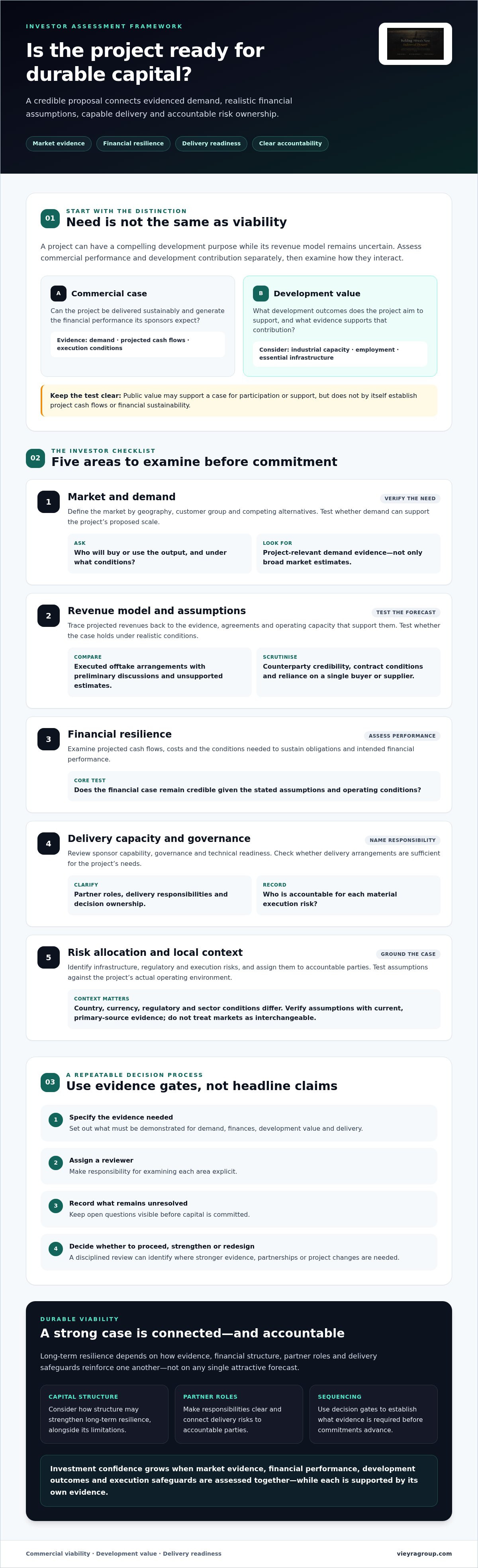
A consistent screening framework makes proposals easier to compare without imposing identical assumptions on projects with different purposes, markets or delivery structures. For each criterion, record the evidence reviewed, the accountable reviewer and the question that remains unresolved. This turns the assessment of the commercial viability of development projects into a documented decision process rather than a single judgment based on headline projections.
- 1. Strategic fit: Record how the project aligns with the investor’s objectives and intended development contribution. The reviewer should identify any strategic assumptions that still need support.
- 2. Demand: Examine market evidence, customer commitments and competitive alternatives. The market reviewer should clarify whether demand is demonstrated, conditional or still uncertain.
- 3. Economics: Test revenue, costs, cash flows and sensitivity assumptions. The finance reviewer should identify which assumptions most affect expected performance.
- 4. Delivery: Assess sponsor capability, technical readiness, procurement and operations. The delivery reviewer should confirm milestone owners and outstanding dependencies.
- 5. Risk allocation: Map material exposures to accountable parties and documented mitigations. The risk reviewer should flag risks without a credible owner or response.
- 6. Development contribution: Assess intended public or strategic outcomes separately from commercial returns. The relevant reviewer should specify the evidence supporting each claimed outcome.
What evidence should each decision gate require?
Use staged gates so the depth of review grows with the decision. Initial screening can establish strategic relevance and identify fatal gaps; detailed diligence should validate material market, financial, delivery and risk assumptions; final capital approval should rely on traceable sources, documented assumptions and resolved conditions. Where evidence warrants it, commission independent technical, legal, environmental or market review. Record who reviewed each item and what remains open.
Comparison should be consistent in method, not necessarily identical in evidence or risk tolerance. A project’s sector, jurisdiction, structure and objectives may require different diligence, while the decision record should still make the basis of comparison clear.
When should a promising project be redesigned or deferred?
Choose proceed when material evidence supports the case; proceed subject to conditions when specific, monitorable requirements remain; and redesign when a solvable constraint weakens the economics or delivery plan. Defer when critical demand, governance or risk evidence remains unverified. These are decision categories, not universal numerical thresholds. For a related perspective, see the discussion of strategic capital deployment.
For context on the institution’s approach to strategic capital, explore Vieyra Group’s strategic capital solutions.
Make Viability Durable Through Capital Structure and Long-Term Stewardship
A project’s financing structure should reflect its development period, operating life, cash-flow profile and allocation of responsibilities. Capital that must be repaid before operations can reasonably support those obligations may weaken resilience; a structure aligned with the project’s timing can provide a more coherent basis for delivery. This is not a formula for approval. The appropriate mix depends on the project’s evidence, risks and objectives.
How can capital structure support commercial viability?
Private capital may bring commercial discipline, investment capacity and an emphasis on financial performance, but its participation depends on a credible risk-adjusted case and clear accountability. Public participation may be relevant where a project serves public objectives or requires coordination beyond the sponsor’s control; it also makes transparent roles, obligations and oversight essential. Blended finance may combine public and private participation where their mandates and risk responsibilities are compatible, but added complexity can create coordination demands. No structure removes risk or guarantees bankability.
Assess whether financing tenor and obligations fit the project’s construction, ramp-up and operating phases. Review how responsibilities are divided among sponsors, capital providers, public partners and operators, including who is accountable if costs, timing or performance depart from plan. Sequencing matters as well: commitments should align with evidence and readiness at each stage, rather than assume that later capital or partners will be available on unverified terms.
Keep the commercial case distinct from strategic or philanthropic objectives. A project may have development significance that warrants separate consideration, but that purpose should not be presented as proof of commercial cash flows. Where different mandates contribute to a project, disclose their roles and decision criteria clearly. The Vieyra Foundation pursues philanthropic initiatives aligned with Vieyra Family Office’s investment strategy; it should not be characterized as a commercial investment product.
What makes a development project viable over the long term?
Long-term viability requires more than initial approval. The final review should consider operational continuity, capable governance, maintenance responsibilities and a means of monitoring outcomes against stated objectives. It should also establish how performance will be reviewed, who can respond to emerging issues and whether the project’s operating model remains credible as conditions evolve. These considerations are especially important for long-horizon projects supporting African industrialisation, where country and sector circumstances must be assessed individually.
For durable capital allocation, treat stewardship as ongoing oversight, not a one-time decision. Revisit material assumptions, monitor delivery against agreed responsibilities and distinguish financial performance from strategic or development outcomes. This integrated discipline helps determine whether the commercial viability of development projects can endure beyond construction and initial operations.
To explore whether a project’s long-term objectives align with Vieyra Family Office’s stated focus on strategic capital and African industrialisation, Explore Vieyra Family Office.
Build a Stronger Foundation for Durable Capital
The commercial viability of development projects rests on the strength of the whole investment case: evidenced demand and credible cash-flow assumptions, a capable delivery structure, and clear responsibility for material risks. A disciplined checklist helps investors distinguish proposals ready to advance from those that need further evidence, redesign or defined conditions before capital is committed.
Viability also extends beyond initial approval. Financing should fit the project’s timeline, partner roles should be explicit, and ongoing governance should sustain operations and track intended outcomes. Commercial returns and development contributions may reinforce one another, but each requires its own evidence and transparent assessment.
Vieyra Family Office is a multi-generational African family office operating at sovereign scale, with global investment management and a stated focus on African industrialisation and long-term development. For those considering how strategic capital may align with durable development objectives, Explore Vieyra Family Office strategic capital solutions.
With careful scrutiny and long-term stewardship, investors can help advance projects grounded in sound evidence and lasting purpose.
Frequently Asked Questions
What does commercial viability mean for a development project?
Commercial viability means a project has a credible prospect of sustainable delivery and financial performance under its stated assumptions. Investors assess whether demonstrated demand can support projected revenues and cash flows, and whether the sponsor, operating plan and execution conditions can deliver the intended results. Development need or strategic importance may strengthen a project’s wider case, but neither alone proves it can meet its financial obligations.
How do you assess the commercial viability of a development project?
Assess the commercial viability of development projects by testing market demand, the revenue model, financial assumptions, delivery capacity and risk allocation. Trace forecasts to evidence such as customer commitments, credible market research, cost estimates and operating plans. Compare downside, base and upside scenarios, documenting assumptions and unresolved questions. Assign reviewers to each area, then decide whether the project should proceed, proceed subject to conditions, be redesigned or be deferred.
Is a project commercially viable if it delivers strong development impact but limited returns?
Not necessarily. Strong development impact can establish public or strategic value, but commercial viability concerns whether a project can be delivered and sustain its financial performance. Assess the two dimensions separately, using evidence for each. If the commercial case is weak, public participation or another appropriate support structure may merit examination, but its rationale, responsibilities and funding basis should be explicit rather than treated as proof of reliable project cash flows.
Can a development project become viable through blended finance or public-private partnerships?
Blended finance or a public-private partnership may improve a project’s prospects when partner roles, financing obligations and risks are appropriately structured for its context. Public participation may support objectives or responsibilities that private capital alone may not address, while private participation can bring a focus on commercial performance. Neither structure automatically makes a project viable. Investors should test the underlying demand, cash flows, governance and delivery capacity, and assess whether the arrangement is sustainable.
What financial assumptions should a development project feasibility assessment include?
A feasibility assessment should document expected revenues and their evidence, capital expenditure, operating costs, maintenance, working capital, ramp-up timing and operating capacity. It should compare downside, base and upside cases, explaining the assumptions behind each rather than relying on generic benchmarks. Where relevant, test the effect of delays, lower utilisation, changing input costs or foreign-exchange exposure. The analysis should show which assumptions materially affect cash flows and who has verified them.
What happens if a project is strategically important but commercially unviable?
A strategically important project should not be treated as commercially viable solely because of its purpose. Identify whether a specific constraint can be addressed through redesign, a different delivery structure, additional evidence or appropriate public participation. If critical assumptions remain unsupported, defer the capital decision. Keep any strategic or public rationale distinct from the commercial case, and make clear which parties would fund, govern and bear the consequences of proposed support.
How do investors account for country and execution risks in development projects?
Investors should identify project-controlled risks separately from external exposures, then assign each material risk an accountable owner, a mitigation measure and evidence supporting that response. Review sponsor capability, counterparties, procurement, technical readiness and milestone approvals. For country-specific legal, policy, currency or permitting assumptions, consult current primary sources relevant to the jurisdiction. Record residual risks and their allocation; an exposure without a credible owner or response can weaken an otherwise persuasive investment case.


