

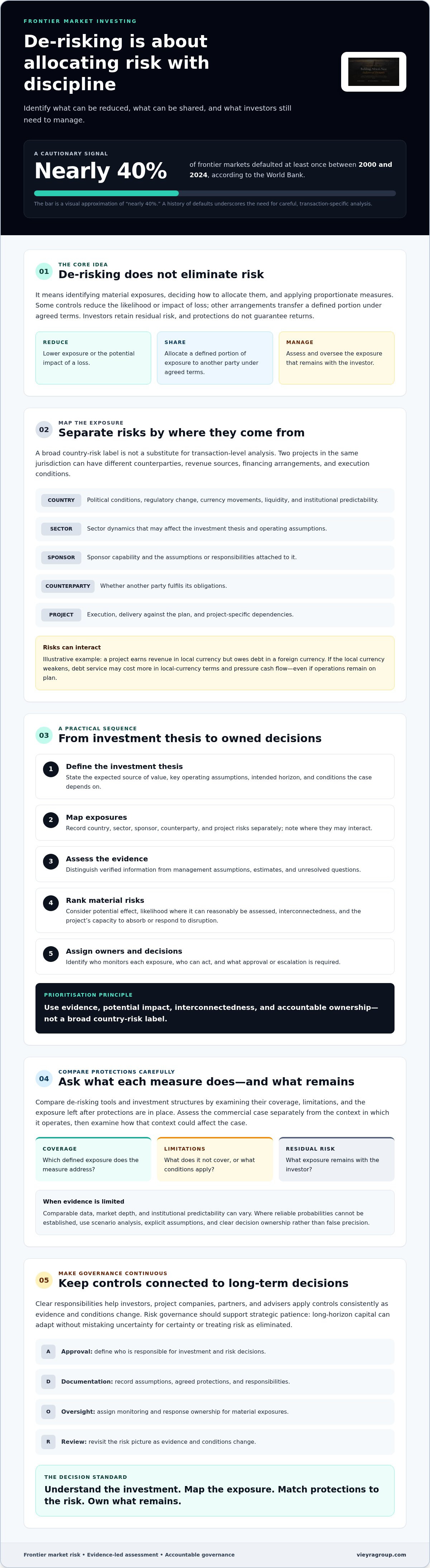
Nearly 40% of frontier markets defaulted at least once between 2000 and 2024, according to the World Bank. That history underscores why de-risking investments in frontier markets takes more than a promising project thesis. Investors need to identify which risks can be reduced, which can be shared and which they will need to manage themselves.
Political uncertainty, currency movements, regulatory change and execution challenges can converge, but they have different causes and require different responses. Investors can reduce exposure without giving up viable long-term opportunities. The essential principle is that de-risking allocates risk with discipline; it does not eliminate it.
This guide offers a practical process for identifying and prioritising material risks, comparing mitigation tools and investment structures, and assessing the exposure that remains after protections are in place. It also explains how project fundamentals, institutional conditions and governance inform decisions over a long investment horizon, including in African industrialisation, where strategic capital depends on careful preparation and patient stewardship.
Key Takeaways
- Build a risk map that separates country conditions from sector, sponsor, counterparty and project-specific exposures.
- Prioritise risks using evidence, potential impact and accountable ownership, not a broad country-risk label.
- Compare de-risking investments in frontier markets by examining what each instrument covers, its limitations and the exposure that remains.
- Set clear approval, documentation, oversight and review responsibilities across investors, project companies, partners and advisers.
- Connect risk governance with strategic patience so long-horizon capital can adapt as evidence and conditions change.
What Does De-Risking Investments in Frontier Markets Actually Mean?
Frontier markets can offer substantial opportunities alongside uneven information, market depth and institutional conditions. These characteristics vary by country, sector and transaction. The label itself is not a verdict on an investment: definitions vary among index providers and institutions, and the distinction between frontier and emerging markets may depend on the classification framework. The overview of Frontier Markets offers useful background, but investors should verify how a particular index or institution defines its categories.
De-risking investments in frontier markets means identifying material exposures, deciding how to allocate them and applying proportionate measures to mitigate them. It does not remove uncertainty, transfer every exposure or guarantee returns. Some controls reduce the likelihood or impact of a loss; others transfer a defined portion of exposure to another party under agreed terms. Investors retain residual risk and should assess it directly.
A country or sector label cannot replace transaction-specific analysis. Two projects in the same jurisdiction may have different counterparties, revenue sources, financing arrangements and execution conditions. Assess the investment’s commercial case separately from the context in which it operates, then examine how that context could affect the case.
Which risks should investors distinguish first?
Start by separating political, regulatory, currency, liquidity, counterparty and execution exposures. Political risk concerns changes in the operating environment; regulatory risk relates to rules and how they are applied. Currency exposure can affect the value of cash flows, while liquidity risk concerns the ability to exit or access capital. Counterparty risk concerns whether another party fulfils its obligations, and execution risk concerns delivery against the project plan.
Illustrative example: A project earns revenue in local currency but owes debt in a foreign currency. If the local currency weakens, servicing that debt may cost more in local-currency terms, putting pressure on cash flow even if operations remain on plan. This is one possible interaction, not a universal pattern across markets or sectors.
Why can frontier-market risk be difficult to assess?
Comparable data may be limited, local markets may have less depth, and institutional predictability may vary. These conditions affect how confidently investors can estimate outcomes, but should not be generalised across countries. A measurable risk can be assessed using available evidence and assumptions; uncertainty is harder to quantify when reliable probabilities cannot be established. In that situation, scenario analysis, explicit assumptions and clear decision ownership are more useful than false precision.
For a broader regional perspective, consider the related discussion of sovereign investment risk management in Africa. It complements transaction-level analysis by showing how country context can inform, but should not determine, investment decisions.
How to Identify and Prioritise Frontier-Market Investment Risks
A useful assessment begins with the investment, not a generalised view of a country. For disciplined de-risking investments in frontier markets, separate national conditions from sector dynamics, sponsor capability, counterparty performance and project-specific dependencies. This helps identify where exposure originates, how it could affect the investment thesis and who has authority to respond.
- Define the investment thesis. State the expected source of value, key operating assumptions, intended horizon and conditions on which the case depends.
- Map exposures. Record country, sector, sponsor, counterparty and project risks separately, then note where they may interact.
- Assess the evidence. Distinguish verified information from management assumptions, estimates and unresolved questions.
- Rank material risks. Consider potential effect, likelihood where it can reasonably be assessed, interconnectedness and the project’s capacity to absorb or respond to disruption.
- Assign owners and decisions. Identify who monitors each exposure, who can act and what approval or escalation is required.
Risk materiality depends on the investor’s exposure, how a risk could affect the investment and the capacity to respond. A risk map should guide structure, sequencing and governance, not just catalogue concerns. Diligence may support proceeding as proposed, staging capital against milestones, adjusting governance or financing arrangements, postponing commitment until evidence improves, or declining the investment.
How should investors build a risk map?
For each exposure, record its potential effect, supporting evidence, data gaps and accountable decision-maker. Map dependencies among permits, infrastructure, suppliers, financing and operating assumptions. A delay in one element, for example, can undermine the conditions supporting another. Flag uncertainty explicitly instead of presenting an assumption as established fact. Where multiple parties or sources of capital depend on one another, the World Economic Forum’s discussion of collaborative finance for climate resilience offers context for considering coordination.
How can scenario analysis inform the decision?
Test plausible adverse conditions against cash flows, delivery timelines and operational continuity. Sensitivity analysis can show which assumptions have the greatest effect on viability; scenarios can reveal combinations of pressure that a single-variable test may miss. Neither method predicts political or market events with precision. Use the findings to set review triggers, such as a material change in a key assumption, that prompt escalation, restructuring or a pause in further commitment.
For institutions deploying capital over long horizons, this process connects diligence with continuing stewardship. Readers seeking context on Vieyra Family Office’s approach to long-horizon capital allocation can consider how disciplined governance supports strategic investment decisions.
Comparing Tools for De-Risking Investments in Frontier Markets
Effective de-risking investments in frontier markets starts by matching a tool to a defined exposure, rather than choosing a familiar instrument and assuming it improves the investment as a whole. A protection may transfer or share a specific risk, but it cannot repair weak project economics, inadequate execution capacity or an unsuitable commercial structure. Verify availability, eligibility, exclusions and terms for each transaction.
| Approach | Risk addressed and mechanism | Limitations and residual exposure | Decision owner |
|---|---|---|---|
| Political risk insurance | May cover specified political events under a policy’s terms. | Coverage is limited by defined events, exclusions and claims conditions; commercial and uncovered risks remain. | Investor, with relevant legal and risk advisers. |
| Guarantees | May support a defined obligation if a specified party does not perform. | Scope depends on the guarantee’s terms; it does not ensure project viability or remove obligations outside its coverage. | Investor and project-finance decision-makers. |
| Blended finance | Combines capital with different risk-return roles to address a project’s financing constraints. | Requires a sound rationale and aligned terms; it is not suitable for every project and does not resolve operating weaknesses. | Participating capital providers. |
| Partnerships | Can add relevant local knowledge, capabilities or governance oversight. | Partner incentives, capacity and accountability require scrutiny; shared involvement does not remove execution risk. | Investor and project company leadership. |
| Diversification | Spreads capital across investments to reduce reliance on a single exposure. | Does not protect an individual project, and correlated risks may affect multiple investments. | Portfolio decision-makers. |
When might risk-sharing instruments be relevant?
Political risk insurance or a guarantee may be relevant when diligence identifies a specific political event or obligation that materially affects the investment case. First establish exactly what event or obligation is covered, who benefits and under what conditions a claim may be made. Review exclusions, claims procedures, duration and uncovered exposures in context. Confirm current provider terms and eligibility before relying on either instrument.
How do blended finance and partnerships change exposure?
Capital providers may accept different risk-return roles, while a capable partner may contribute local knowledge, operating expertise or oversight. Assess each contribution against a documented project need, and clarify who bears losses, makes decisions and monitors performance. Blended finance is not an automatic route to viability. For the related capital-structure discussion, see the article on private capital for African industrialisation.
Compare each tool by the risk it addresses, the party responsible for it and the exposure that remains. This distinction matters for long-horizon projects, where protection and sound governance should reinforce, not replace, robust commercial fundamentals.
How to Put Frontier-Market Risk Controls into Investment Practice
Risk controls work when they are built into investment approval, documented responsibilities and continuing oversight. For de-risking investments in frontier markets, governance should make clear not only which exposures have been identified, but who can act when assumptions change. The investor, project company, partners and advisers may hold different information and authority, so define decision rights before committing capital.
What should an investment risk-control plan contain?
Use a concise approval and monitoring checklist tailored to the investment and mandate. Name accountable owners and keep an auditable record of decisions:
- Document priority exposures, supporting evidence, information gaps and the mitigations adopted.
- Assign each risk to an owner, and specify who can approve changes, exceptions or corrective action.
- Set reporting cadence and escalation thresholds that reflect the project’s operating and financial profile.
- Record residual risks accepted at approval, including the rationale and the party accountable for ongoing oversight.
- Set review dates and identify events that require an earlier reassessment.
Local expertise and information quality belong in this control framework, not only in initial diligence. Establish how project information will be validated, how conflicting reports will be resolved and whether monitoring leads have sufficient access and relevant knowledge. A control is only as reliable as the information and authority behind it.
How should investors monitor changing conditions?
Track a focused set of indicators tied directly to the project’s exposure. Depending on the investment, these may include operating milestones, cash-flow performance, delivery timelines, counterparty obligations or relevant jurisdictional developments. Avoid collecting data without connecting it to a decision: each indicator should have a defined owner, reporting route and response if a threshold is crossed.
When a material event changes project assumptions or expected cash flows, revisit the original analysis rather than treating prior approval as permanent. Predetermined responses might include escalation to an investment committee, additional review, changes to the project’s structure or a pause in further commitment, where permitted by the governing arrangements. Record the evidence considered, decisions made, exceptions granted and corrective actions taken. This creates institutional memory and helps distinguish considered adaptation from unmanaged drift.
For long-horizon capital, disciplined controls support strategic patience by keeping oversight active as conditions evolve. Explore Vieyra Family Office’s perspective on global investment management and the institutional considerations that inform sustained capital allocation.
From Risk Controls to Long-Term Capital Deployment in Africa
Disciplined deployment follows a continuing sequence: assess the investment, allocate exposures, apply appropriate mitigations, monitor performance and changing conditions, then reassess. The objective is not to find a risk-free market. It is to decide whether the investment’s remaining risks are understood, appropriately governed and consistent with the investor’s mandate.
This distinction matters for long-horizon capital. Strategic patience can allow time for complex projects to mature, but it is not a reason to tolerate unmanaged or unpriced exposure. Clear mandates, accountable oversight and regular review help institutions remain committed to a sound thesis while responding when evidence changes. Country and project conditions differ materially, so assess African industrialisation opportunities on their individual merits rather than treating them as a uniform investment profile.
How does institutional stewardship support durable investment?
Institutional stewardship connects project-level decisions to responsibilities that continue beyond initial approval. Defined decision rights clarify who can accept residual exposure, require corrective action or reconsider the investment thesis. Ongoing oversight helps distinguish temporary setbacks from changes that undermine the original rationale. For a related perspective, see the discussion of family office governance for wealth preservation.
Vieyra Family Office describes itself as a multi-generational African family office operating at sovereign scale, with global investment management and a stated focus on African industrialisation and strategic capital for long-term growth. This context reflects a long-horizon orientation; it does not mean every project is suitable or that risk protections ensure a particular outcome.
What should investors do before committing capital?
Before approval, confirm that the investment thesis is supported by evidence and that its limitations are explicit. Verify that priority risks have named owners, decision authority is clear and proposed mitigations match the project’s needs and the investor’s mandate. Record which exposures remain and who is accountable for monitoring them. If key assumptions cannot be substantiated or decision rights are unclear, address those gaps before proceeding.
For institutions considering long-term capital allocation, this discipline can support patient investment without confusing patience with passivity. Explore Vieyra Family Office’s institutional perspective on long-horizon investment and consider how its stated focus on African industrialisation informs strategic capital deployment.
Carry Risk Discipline Into Long-Term Investment Decisions
Durable frontier-market investment depends on treating risk as an ongoing governance responsibility, not a barrier that can be removed before capital is deployed. A clear thesis, transaction-specific assessment and careful comparison of mitigation tools help investors understand which exposures can be reduced or shared, and which remain theirs to manage. Effective de-risking investments in frontier markets also requires monitoring those exposures as conditions and project assumptions evolve.
This discipline supports patient capital without confusing strategic patience with acceptance of unmanaged risk. It is particularly relevant to African industrialisation, where opportunities and operating conditions differ across countries, sectors and projects. Vieyra Family Office is a multi-generational African family office operating at sovereign scale, with a stated investment focus on African industrialisation and strategic capital.
For an institutional perspective on long-horizon capital allocation, explore Vieyra Family Office’s institutional perspective. Careful preparation and accountable oversight can help investors approach complex opportunities with greater clarity and purpose.
Frequently Asked Questions
What does de-risking an investment in a frontier market mean?
De-risking means identifying material exposures, deciding who bears them and applying measures to reduce or share their potential effects. It does not eliminate uncertainty or guarantee returns. Assess country conditions alongside sector, sponsor, counterparty and project-specific factors. For example, a project’s currency exposure may depend on the relationship between its revenue currency and financing obligations, not simply the country where it operates.
Can political risk insurance eliminate frontier-market investment risk?
No. Political risk insurance may cover specified events under defined policy terms, but it cannot eliminate all political, commercial, currency or execution exposures. Confirm the covered event, exclusions, eligibility, claims process, duration and remaining obligations before relying on a policy. Coverage terms vary by provider and transaction, so verify current details directly. The project’s commercial fundamentals and governance still require independent assessment.
How do investors assess political risk in frontier markets?
Assess political risk by examining how plausible changes in the operating environment could affect the investment’s cash flows, assets, counterparties or ability to operate. Use current, jurisdiction-specific evidence, distinguish verified facts from assumptions and test scenarios rather than relying on a country label alone. Assign an owner to monitor relevant developments and define what would prompt escalation or review. Consider political risk alongside regulatory, sector and project exposures.
What is the difference between risk mitigation and risk transfer?
Risk mitigation reduces the likelihood or impact of an exposure through measures such as stronger controls, careful project sequencing or improved oversight. Risk transfer shifts a defined portion of potential loss to another party through an agreed arrangement, subject to its terms. Neither approach removes every exposure. Before proceeding, identify what the measure addresses, who remains responsible and which residual risks the investor is accepting.
Does blended finance make frontier-market investments safer?
Not automatically. Blended finance combines capital providers with different risk-return roles and may help address a project’s financing constraints when the structure fits its needs. It cannot by itself correct weak project economics, limited execution capacity or inadequate governance. Examine the purpose of each capital contribution, the allocation of losses and decision rights, and the exposures that remain. Suitability depends on transaction-specific terms and project fundamentals.
How can investors manage currency risk in frontier markets?
Start by mapping the currencies of project revenues, operating costs, financing and distributions, then test how exchange-rate movements could affect cash flows and debt obligations. Where feasible, assess whether local-currency financing, contractual arrangements or hedging instruments fit the project and mandate. These options have their own costs, constraints and availability, which require verification. Establish monitoring indicators and review assumptions when currency conditions materially change.
What should a frontier-market investment risk checklist include?
A practical checklist should record the investment thesis, material exposures, supporting evidence, data gaps, proposed mitigations and accountable owners. Separate country, sector, sponsor, counterparty and project-specific risks, and note important dependencies. Set reporting expectations, review dates, escalation triggers and decision authority across the investor and project parties. Before approval, document which residual risks remain, why they are acceptable under the mandate and who is responsible for monitoring them.


