

A project can be financially sound long before its returns are fully visible. That is the central challenge in assessing patient capital returns in African infrastructure: construction, currency, policy and demand risks unfold over time, while near-term measures may capture only part of an asset’s performance.
Investors and other stakeholders need a credible way to judge long-term commitments. Infrastructure timelines complicate comparisons, and development impact, however important, is not a substitute for financial evidence. Confidence depends on distinguishing the two and explaining how each is assessed.
This guide sets out how to build an evidence-led case for patient capital across the investment lifecycle. It covers return drivers, risks and time horizons, and offers a consistent framework for comparing opportunities without obscuring uncertainty or overstating potential outcomes.
From project preparation and construction through operations and review, the discussion considers measurable milestones, disciplined performance assessment and the distinct roles of financial returns and development objectives. For stakeholders taking a long view, including those guided by multi-generational stewardship, this approach can make patient capital more transparent, comparable and accountable.
Key Takeaways
- Assess patient capital returns in African infrastructure across the asset lifecycle, rather than relying on early-stage measures that may not capture long-term performance.
- Keep financial returns, capital preservation, resilience and development outcomes distinct, and define how each will be evaluated.
- Compare opportunities using consistent criteria, including project stage, revenue model, currency exposure, risk and investment horizon.
- Strengthen an investment case with a traceable baseline, evidence sources, explicit assumptions and scenario ranges that make uncertainty visible.
- Use disciplined milestones and review processes to support stakeholder confidence without presenting long horizons or development objectives as guarantees of financial performance.
Why patient capital returns in African infrastructure need a lifecycle view
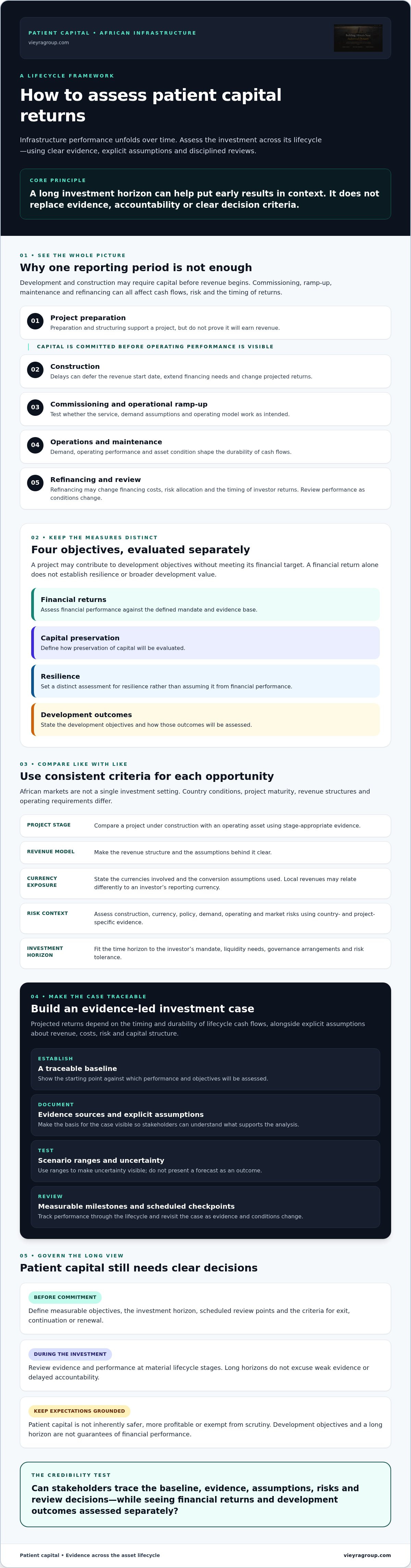
Infrastructure performance cannot be judged reliably from a single reporting period. Development and construction may consume capital before an asset earns revenue. Commissioning and operational ramp-up then test whether the service, demand assumptions and operating model work as intended. Maintenance affects the asset’s condition and cash flows, while refinancing may change financing costs, risk allocation and the timing of investor returns.
Lifecycle return assessment is the evaluation of an investment’s financial performance, risks and objectives at each material stage of an asset’s life, against a defined mandate and evidence base. This framing explains why patient capital returns in African infrastructure require more than a comparison of short-term results. Early cash flows may not represent later operating performance, but a long horizon does not excuse weak evidence or delayed accountability.
What does patient capital mean in infrastructure investing?
Patient capital generally describes capital prepared to accept a longer investment horizon than short-term performance comparisons allow. In infrastructure, that horizon must still fit the investor’s mandate, liquidity needs, governance arrangements and tolerance for construction, operating and market risks. It is neither an indefinite commitment nor an assurance of superior returns.
Before committing capital, investors should define measurable objectives, scheduled review points and criteria for exit, continuation or renewal. Assess financial return, capital preservation, resilience and development outcomes separately. A project may contribute to development objectives without meeting its financial target; a financial return, in turn, does not establish resilience or broader development value.
Why do African infrastructure returns require contextual analysis?
African markets are not a single investment setting. Countries differ in currency conditions, institutions and demand; sectors and projects also vary in revenue structures, maturity and operational requirements. Assess each market claim against country- and project-specific evidence rather than relying on a continent-wide assumption.
Project maturity shapes when returns may emerge. A project under construction has a different evidence base from an operating asset with a record of demand and maintenance requirements. After commissioning, ramp-up may take time as usage develops or operations stabilise. Currency exposure can also affect the relationship between local revenues and an investor’s reporting currency, so comparisons should state the currencies and conversion assumptions used.
Patient capital is not inherently safer, more profitable or exempt from scrutiny. Its credibility rests on disciplined evaluation across the asset lifecycle, with risks and performance reviewed as conditions change. Multi-generational stewardship can support a longer perspective, but sound governance still requires transparent evidence and clear decision criteria.
How infrastructure projects generate returns over the full investment lifecycle
Returns emerge through a sequence of project stages, each with different cash-flow drivers. Development spending supports preparation and structuring, but does not establish that a project will earn revenue. Construction draws on capital before operations begin; delays can defer the revenue start date, extend financing needs and change projected returns. As the continent's infrastructure spending needs continue to command attention, rigorous analysis must distinguish a project’s financing requirement from its capacity to generate cash.
Projected returns depend on the timing and durability of lifecycle cash flows, together with explicit assumptions about revenue, costs, risk and capital structure. This gives stakeholders a basis for testing the investment case instead of treating a forecast as an outcome.
Which cash-flow drivers matter at each project stage?
At commissioning, investors assess whether the completed asset can begin delivering its intended service. During operations, the focus shifts to cash generation: contracted revenues provide a defined payment basis, subject to contract terms, while user-demand revenues depend on actual utilization and collection. Operating efficiency, service reliability and maintenance requirements influence the net cash available after operating costs.
- Development and construction: Test preparation assumptions and delivery schedules. Assess how delays could affect financing needs and the start of revenue.
- Commissioning and ramp-up: Examine readiness to operate, expected utilization, tariff assumptions where relevant, and the time required for demand to develop.
- Operations and maintenance: Track revenue collection, service reliability, operating costs and maintenance against the asset’s plan.
- Refinancing or transfer: Model these as possible scenarios, testing their assumptions and conditions rather than counting them as guaranteed sources of return.
Keep asset value changes distinct from operating cash flow. A projected increase in value is not equivalent to cash received; it depends on valuation assumptions and the circumstances under which a sale or transfer might occur. To assess patient capital returns in African infrastructure credibly, disclose and test utilization, tariffs, collections, costs and maintenance inputs individually.
How should investors distinguish forecast returns from realized performance?
In stakeholder materials, label cash flows as modelled, contracted or realized. A modelled forecast reflects assumptions; a contracted payment is subject to its terms and performance conditions; realized cash flow records what has actually been received or paid. Do not blend these categories into a single return figure.
At each review point, compare actual milestones and results with the original investment case, document revised assumptions and explain material variances. Identify the sources and verification status of benchmarks, forecast inputs and performance claims. This record supports informed decisions about continued investment, revised expectations or an eventual exit without presenting any outcome as assured.
For readers considering how long-term capital allocation is framed, explore Vieyra Family Office’s strategic capital perspective.
How to compare patient capital opportunities and test African infrastructure returns
Comparisons are useful for decisions only when each opportunity is assessed on a consistent basis. A shared framework makes differences visible without implying that projects with different markets, stages or financing structures are directly interchangeable. Use the table below as a starting point, and support each entry with project-specific evidence.
| Comparison factor | What to record |
|---|---|
| Sector and country | Asset type, jurisdiction and evidence relevant to the specific market. |
| Project stage | Development, construction, commissioning or established operations. |
| Revenue model | Contracted payments, user demand, or a combination, with key conditions stated. |
| Currency | Revenue, operating cost and financing currencies, plus exposure and conversion assumptions. |
| Risk and horizon | Material delivery and operating risks, proposed mitigants, residual exposure and expected investment horizon. |
Data quality matters as much as the framework. Mark inputs as verified, estimated or uncertain, and document material differences in assumptions. Test base, downside and upside scenarios. Explain the events or conditions behind each case rather than assigning probabilities without a defensible basis. Sensitivity analysis can show how results respond to changes in demand, tariffs, costs, delays or currency assumptions.
Which financial and operational measures should stakeholders examine?
Choose measures that fit the investment structure, then state the calculation convention, timing and currency used. Depending on the structure, analysis may include projected cash-flow timing, capital requirements, operating performance and relevant debt obligations. Compare benchmarks only when geography, sector, project stage, currency and measurement period are sufficiently aligned. Otherwise, identify the differences and limit the conclusion.
Keep financial performance distinct from service access, employment, industrial capacity or other development measures. These outcomes may form part of the mandate, but they do not replace financial evidence or prove a financial return. Report each against its own baseline and stated objective.
How should currency, policy and delivery risks enter the comparison?
Model financing and revenue currencies explicitly, using country-specific data with a checkable source and date. Assess permitting, procurement, political, construction and offtake risks at the project level. For each risk, record the proposed mitigant, the party responsible and the exposure that remains; do not present mitigation as eliminating risk.
For broader context on sovereign exposures and governance, consult the related discussion of sovereign investment risk management in Africa. A disciplined comparison makes patient capital returns in African infrastructure more credible by showing both the assumptions supporting the case and the conditions that could weaken it.
How to convince stakeholders on long-term ROI with a disciplined investment case
A credible investment case starts with the decision stakeholders must make, not a headline return figure. State the mandate, the capital commitment under consideration, the intended investment horizon and what acceptable performance means in that context. These definitions establish the basis for evaluating patient capital returns in African infrastructure and help keep financial objectives separate from development ambitions.
A projected return is an evidence-based estimate under stated assumptions, not a promised or guaranteed outcome. Its credibility depends on making assumptions, uncertainties and decision points visible to those accountable for the capital.
What should an investor include in a long-term ROI presentation?
Present the project rationale alongside its capital structure, cash-flow drivers, material risks and return measurement methodology. Establish a traceable baseline, identify the sources supporting key inputs, and show base, downside and upside scenarios. For each case, explain the conditions that could produce it and how sensitive results are to relevant assumptions. This prevents a single forecast from implying certainty.
Make accountability explicit. Identify which assumptions stakeholders can verify, who is responsible for monitoring them, and when each review will occur. Connect forecasts to milestones such as construction progress, commissioning readiness or operating performance. Define corrective decision points in case evidence departs materially from the investment case.
How can reporting sustain confidence after capital deployment?
After deployment, report actual results against the original baseline using consistent definitions and a regular, pre-agreed cadence. Disclose delays, adverse events, forecast revisions and remedial actions, including how each change affects the outlook. Preserve the original case when revising a forecast, and explain what has changed and why.
Measure development outcomes separately, using indicators suited to the stated objectives. Explain their relationship to the financial mandate without treating one as proof of the other. This distinction matters when considering private capital for African industrialisation: strategic objectives may inform capital allocation, while financial performance still requires its own evidence and review.
For a considered perspective on strategic capital and long-term investment priorities, explore Vieyra Family Office’s investment perspective.
Where Vieyra Family Office’s patient-capital perspective fits
Vieyra Family Office is a multi-generational African family office operating at sovereign scale, with a focus on African industrialisation and long-term growth. Its institutional context offers a perspective on patient capital as a discipline of mandate, governance and evaluation, not as a claim that long investment horizons guarantee performance. The credibility of patient capital returns in African infrastructure still depends on project evidence, clearly stated assumptions and accountable review.
How does a multi-generational mandate inform return evaluation?
A multi-generational perspective can allow stakeholders to assess an asset over a longer period than short-term comparisons permit, while retaining interim scrutiny of delivery, operations and financial performance. A longer horizon does not remove the need for liquidity planning, measurable objectives or decision points. Nor does one family office’s approach establish a universal risk appetite, liquidity profile or investment method for others.
Vieyra Family Office’s relevant institutional context includes its African identity, multi-generational orientation, sovereign-scale operations and industrialisation focus. These facts do not establish specific infrastructure holdings or realized returns. They underscore why an investment case should make its mandate explicit, distinguish financial analysis from development objectives, and explain how both will be reviewed over time.
What is a practical next step for interested stakeholders?
Before assessing potential alignment, stakeholders can clarify decision authority, the investment mandate, acceptable risks, available project evidence and governance expectations. They can then consider whether the project’s stage, financial assumptions and development objectives are consistent with that mandate. This connects strategic intent to due diligence and accountability instead of treating alignment as evidence of a likely outcome.
For broader portfolio context, readers may also consider global investment management principles alongside the organisation’s stated focus on African industrialisation and strategic capital. The investment horizon and evaluation criteria should remain grounded in the mandate under consideration; long-term stewardship does not imply that every opportunity is suitable.
To review Vieyra Family Office’s stated strategic capital and African industrialisation perspective, explore Vieyra Family Office.
Build Confidence Through Evidence and Stewardship
Credible patient capital returns in African infrastructure are assessed across the full investment lifecycle, not inferred from a single forecast or reporting period. Stakeholders strengthen their case by separating financial performance from development outcomes, comparing opportunities on consistent terms, and making assumptions, uncertainties and review points transparent.
Long horizons can provide room to evaluate infrastructure performance as assets progress from development into operation, but patience must come with accountability. Clear mandates, measurable milestones and disciplined reassessment help stakeholders judge whether results remain aligned with the investment case and what decisions may be needed as conditions change.
Vieyra Family Office is a multi-generational African family office operating at sovereign scale, with a focus on global investment management and African industrialisation. Its institutional perspective places long-term stewardship alongside disciplined capital allocation, without implying guaranteed performance or predetermined outcomes.
Transparent evidence and sustained accountability help stakeholders approach long-term infrastructure investment with greater clarity and confidence.
Frequently Asked Questions
Can patient capital generate financial returns in African infrastructure?
Yes, patient capital can generate financial returns in African infrastructure, but neither a long horizon nor a project’s development purpose guarantees a particular result. Returns depend on project-specific factors such as revenue arrangements, demand, construction delivery, operating costs, maintenance and currency exposure. Investors should distinguish forecasts from contracted and realized cash flows, test assumptions under different scenarios, and assess whether expected performance remains consistent with the mandate as evidence develops.
How do investors measure long-term infrastructure returns?
Investors measure long-term infrastructure returns by assessing cash flows, capital requirements and relevant financing obligations over the investment lifecycle, using methods suited to the investment structure. State the measurement period, currency and calculation conventions, then compare actual performance with the original baseline. Reporting should distinguish modelled forecasts, contracted amounts and realized cash flows, document changes to assumptions, and explain material differences between projected and observed results.
What risks can affect infrastructure returns in Africa?
Infrastructure returns may be affected by construction delays, cost changes, weaker-than-expected demand, operating challenges, maintenance needs, currency movements, policy changes and difficulties collecting revenue. Their relevance differs by country, sector, project stage and revenue model, so a continent-wide risk assumption is rarely sufficient. Investors should identify the evidence behind each assessment, assign responsibility for monitoring it, and describe mitigants alongside the residual exposure that remains.
How can stakeholders compare infrastructure projects with different timelines?
Stakeholders can compare projects by recording common criteria, including sector, country, project stage, revenue model, currency, risk and investment horizon. Use consistent definitions for cash flows and return measures, while disclosing material differences in assumptions and data quality. Base, downside and upside scenarios can clarify how results may change. Benchmarks are useful only when their geography, sector, stage, currency and measurement period are sufficiently comparable.
Does a longer investment horizon mean lower risk?
No. A longer investment horizon does not inherently reduce risk or ensure higher returns. It may allow investors to assess performance over more stages of an asset’s life, but it can also leave capital exposed to construction, demand, operating, currency or policy risks for an extended period. Investors should set interim review points and examine whether material assumptions remain valid, even when the original mandate anticipates a long-term commitment.
How should development impact be included in an infrastructure ROI case?
Report development impact alongside, but separately from, financial performance. Define the intended outcomes, such as improved service access or expanded industrial capacity, and select measures suited to those objectives. Establish a baseline and explain how progress will be assessed; do not treat an impact result as proof of financial return. The investment case should describe how development objectives relate to the mandate while maintaining distinct evidence and accountability for each.
To explore Vieyra Family Office’s global investment management and strategic capital perspective on African industrialisation, visit Vieyra Family Office.


